It was 6:30 in the morning, and the night-shift supervisor stopped me before I even got my coffee. To be honest, my heart sank — this was warehouse tote and pallet washing hygiene failing in the most visible way possible. A food customer was coming for an audit that day, and the totes returned yesterday were still stacked by receiving — a film of grease on the bottoms, crumbs from the last load in a few of them. The crew had washed a batch overnight, but drying had fallen behind, and the totes were stacked damp. If the customer saw that, we would lose points before anyone opened a single document.
Warehouse tote and pallet washing hygiene gets treated like a side job in too many warehouses: hand a couple of people a hose and call it done. Then an audit finding lands, or a foreign-object complaint comes back with a shipment, and suddenly everyone realizes this was never a side job. The tote touches the product. A dirty tote means dirty product. Food customers know that, and they read your totes the way they read your management.
Warehouse Tote and Pallet Washing Hygiene Loop: From Return to Reissue
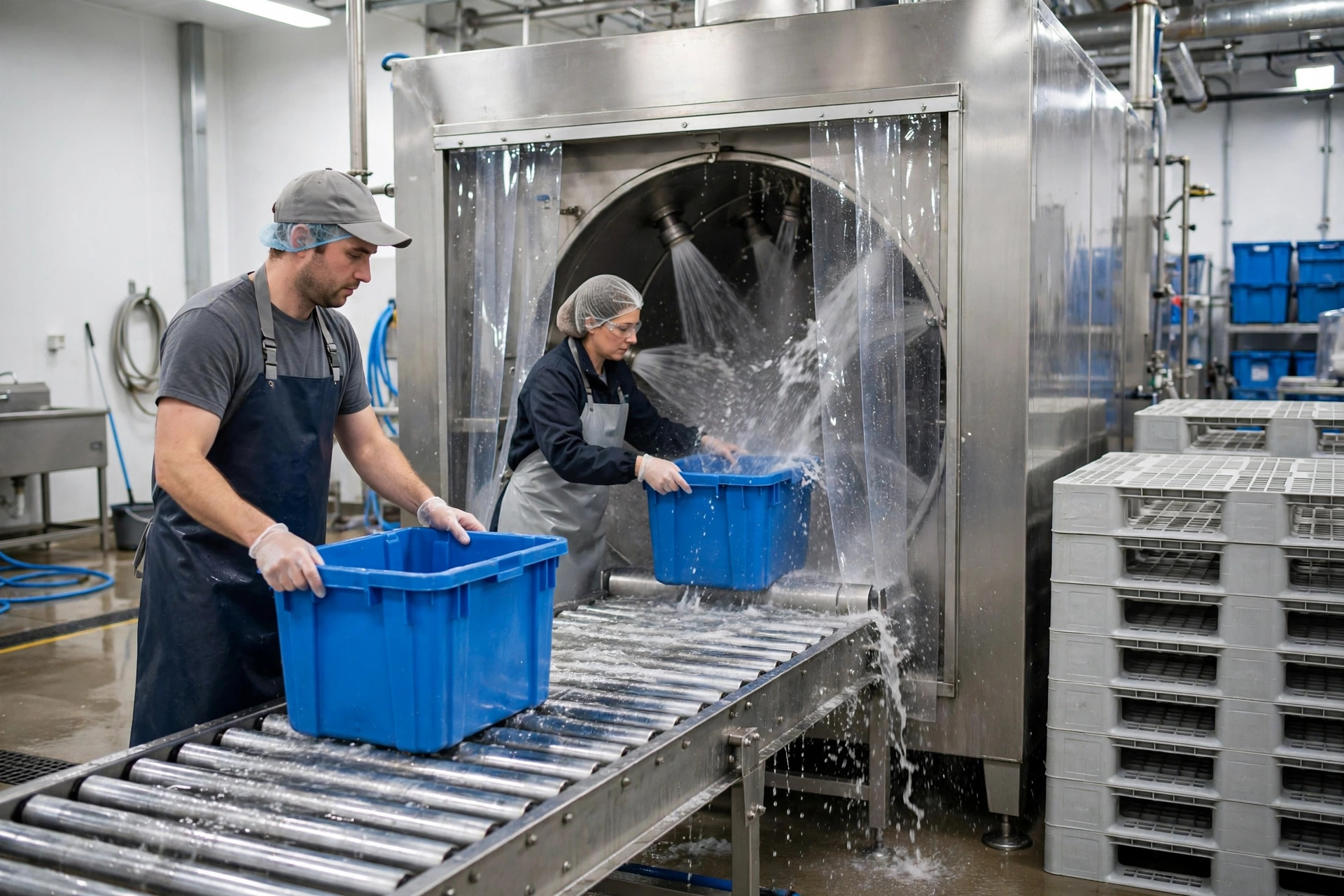
The loop we run now has six steps, and none of them is optional: return, sort, wash, dry, inspect, reissue. Returned totes get sorted first. Cracked ones, ones with broken lids or clasps that will not catch, come out before they ever reach the wash line. Sorting is the step people are most tempted to skip, and it is the step that saves the most money: a broken tote that goes through washing and drying only to be rejected at the end has wasted every minute spent on it.
Washing itself depends on how dirty the tote is. Lightly soiled totes go straight through the wash line. Heavy grease gets a soak first. Pallets split two ways: plastic pallets can go through the line, wooden pallets cannot be soaked — they get brushed and air-dried, because soaked wood grows mold and splinters, which is worse than before. Drying is the step that gets rushed under pressure. In peak season, when outbound orders are waiting, damp totes get stacked, sit overnight, and smell in the morning. That is a wasted wash. Our rule is plain: a tote that is not dry does not ship, even if it costs us half a day.
Warehouse Tote and Pallet Washing Hygiene Audits: Where the Points Actually Come Off
Inspection is where we learned our lesson the hard way. We used to let the washer eyeball the tote and call it good. Then a food customer's auditor ran a white glove along the inside corner of a tote and found residue, and it went down as a finding on the spot. After that we changed the rule: inspection has fixed checkpoints, a written standard, and a record. Corners, the ribs on the tote floor, the slots on the lid — those are the dead spots, and they get checked every time. A tote that passes gets a same-day inspection tag, so a problem can be traced back to a batch and a person.
One more thing most warehouses overlook: the detergent and the water. The detergent has to be food-contact safe, mixed to the label concentration — more is not better, because residue is its own problem. The wash water has to be changed on schedule; water that washed a morning's worth of grime will not clean the afternoon's totes. Auditors ask what detergent you use, what concentration, and how often the water changes. If your team cannot answer, that costs points too. These details feel fussy on an ordinary Tuesday. On audit day, every one of them is a point.
Washing Cost Versus Buying New: The Loop Math
Let me be straight about the money, because otherwise washing always looks like pure cost. Our math is simple: the purchase price of a new tote, against the full cost of one wash — labor, water, power, detergent, equipment wear, and drying energy — multiplied by how many cycles a tote makes in a year. Run it, and as long as a tote cycles ten or more times a year, washing beats buying new by a wide margin, before you even count procurement lead time and the stock you would have to hold.
But here is the counterintuitive part: cheaper washing is not better washing. We once outsourced to the lowest bidder, and to save water they ran the detergent weak. The totes looked clean and failed inspection, and the rework cost more than the savings. There is a second trap: totes do not last forever. Plastic ages with repeated washing — it chalks, goes brittle, loses its shape. Past its life, a tote should not carry food, no matter how much you want to save the replacement cost. Our rule is simple: a cracked body, a failed clasp, or a smell that survives washing — any one of the three, and the tote is scrapped, no second thoughts.
People are part of this too. Wash-line jobs turn over fast, and a new hire left alone on day one will wash to whatever standard they imagine. Our rule is that new hires shadow an experienced worker for the first two weeks and never work a shift alone until then. The inspection standard is not explained in words alone; we keep sample totes on hand showing what passes and what fails, so the standard is something you can see, not something you have to guess. Crews do not cut corners out of laziness most of the time. They cut corners because nobody showed them where the corner is.
Separation matters just as much. Clean totes stacked next to dirty ones will not stay clean — a forklift passes, dust and splash settle, and you are rewashing work you already paid for. We painted a yellow line down the middle of the wash area: dirty side, clean side, a clear aisle between them, and no forklift traffic through the clean side. One painted line cut our rewash rate sharply. Good management is often that unglamorous: not new equipment, but a line, a label, and a rule someone finally bothers to enforce.
Peak season needs its own plan. A line that handles three hundred totes a day in a normal week will drown when returns double, and dirty totes start piling up at receiving until someone ships unwashed stock just to keep orders moving. We staff up two weeks before peak and size the wash capacity ahead of the surge, not after the pile reaches the door. When washing cannot keep pace with outbound volume, the problem always surfaces at the customer — never in your own building first.
A word of warning to anyone running the same kind of warehouse: do not leave tote washing to the night before an audit. Fix the six-step loop, put the inspection standard on the wall, and keep the wash records daily. When the customer walks in, what you are really showing them is not a stack of clean totes. It is a system you can explain, and trace. Clean totes are the result. The system is what the customer is actually buying.
By Chen Feng, Warehouse Operations Manager