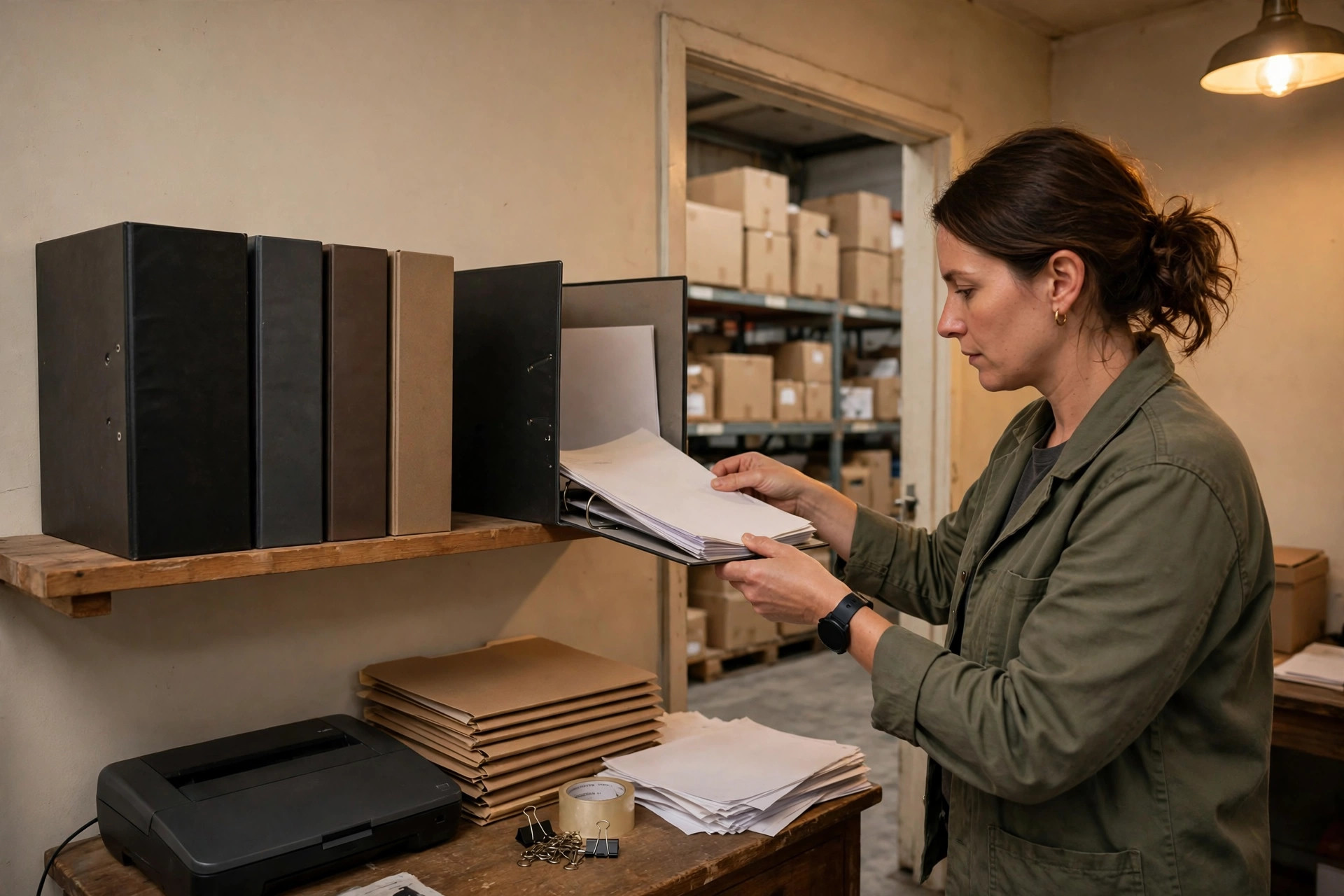
We run a small warehouse, about 3,000 square meters, and we cannot afford a fancy archive room or a fancy archive system. Our office is one room. After three years of stuffing paperwork into filing cabinets, one cabinet door would barely close. My thinking back then was simple: keep everything, because keeping it beats throwing it away. Then one day I spent 40 minutes digging through three cabinets for a delivery note from two years earlier, only to find it squashed under a pile of customs entries with a coffee stain across half of it. That was the day I learned the document retention lesson: archiving is not about keeping the most paper. It is about being able to find a document, produce it, and throw it away when its time is up.
Let me start with our mess. When we started in 2023, I kept everything: delivery notes, signed proof-of-delivery slips, count sheets, inbound and outbound slips, invoice copies, customs entries, driver handover sheets signed by hand. Cabinet full? Buy another cabinet. That one full? Stack boxes. Then in June 2024, a long-time customer said a shipment from November 2023 was short 12 cartons and asked us to reconcile it against the signed delivery note. I searched for two days. I found the slip, but the handwriting had bled through, and the customer would not accept it. That failure is what finally made me sit down and ask: which documents do we actually need, for how long, and stored how, so we are not helpless at the critical moment?
The opposite mistake taught me just as much. In February 2025, a fellow small-warehouse owner in Zhejiang told me his team had shredded all count sheets older than a year, figuring count sheets were internal and useless once the count was done. Then a tax inquiry asked about a cross-year inventory variance, and they could not produce the original count sheets. They spent a month reconstructing the story from memory. So paperwork cuts both ways: keep too much and you drown; throw it away too early and you pay for it later.
Document Retention Periods: Four Kinds of Paperwork, Four Different Clocks
There is no single number that covers all warehouse paperwork, and anyone who gives you one is selling you trouble. Different documents answer to different people, and the retention clock follows whoever might come asking. The table below is what our warehouse uses today. Treat these periods as commonly applied practice, not as a universal rule: the actual requirement depends on your jurisdiction, your contracts, and your business type, so always check your local rules before you shred anything.
| Document type | Our retention practice | Why this period |
|---|---|---|
| Signed delivery note / proof of delivery (POD) | At least 3 years; extend to 5 years for dispute-prone customers | The most common evidence for loss, damage, and billing disputes; without it you cannot prove delivery |
| Count sheets / inventory adjustment records | At least 3 years; keep cross-year variance records to 5 years | The working papers behind your inventory ledger; tax and audit questions need them to reconstruct history |
| Customs entries / import and export supporting documents | Per customs requirements, generally not less than 3 years; follow your local customs authority | Post-clearance audits and duty refund claims often run longer than internal paperwork cycles |
| Invoices / payment vouchers | Per tax rules, commonly 5 to 10 years; follow your local tax authority | Tax documents are the hardest to replace once destroyed, so the clock is longest |
Notice the pattern. A delivery note and a customs entry live under different regimes: one is governed by contract and claims time limits, the other by customs and tax authorities. My rough method is to ask, for each document type, "who will come asking for this?" The answer sets the floor: the customer, the tax office, customs, or your own future self doing a stock reconciliation. Above that floor, add a year or two of safety margin for document types that generate frequent disputes.
Here is the counterintuitive judgment most small operators get backwards: the document you should protect first is not the invoice, it is the signed delivery note. A lost invoice can usually be reissued by the seller or verified through a tax system. A lost delivery note cannot be rebuilt, because the driver, the receiver, the time, and the quantity only existed together in that one moment. Once it is gone, a customer who says "we never received it" wins the argument by default. That is why our delivery notes get the best treatment in our warehouse: scanned on arrival, filed separately by customer, and never mixed into general piles.
Document Archiving the Cheap Way: Paper Plus Electronic, by Customer and Month
Big-company archive systems are not for us, and honestly we do not need them. Our cheap method has three rules, and it works because finding things is the whole point.
First, paper goes by customer and month. Each customer gets a folder, and inside it, pouches labeled by month: customer name, year and month, document type. Count sheets sit in their own series by month, not by customer. Customs entries sit in their own series in entry-number order. When you need a document, you think "whose is it, and from which month?" and you are two steps from the pouch instead of digging through a cabinet.
Second, the electronic copy is scanned and named on the same day. A phone photo works; a scanner is better. What matters is the filename rule. Ours is date, customer short name, document type, and document number, for example "2025-03-12-WangTrading-POD-2025031208." Photos go to cloud storage the same day, in folders that mirror the physical cabinets exactly. Paper lost? The scan covers you. Scan lost? The paper covers you. Small warehouses survive on habits like this, not on expensive software.
Third, expired documents get a yearly cleanup, but only after a checklist. Every January we list what has passed its retention period, and the person in charge signs off that there is no open dispute and no unsettled item attached to it. Only then do we shred the paper and move the electronic copy to an "expired" folder rather than deleting it outright, so a desperate search can still find it. Cleanup is not throwing things away. It is keeping the live archive thin enough that the things you need stay findable.
When a Document Is Lost: Reissue Paths You Can Actually Use
A lost document is not the end of the world, but each type has a different reissue path, and pretending otherwise is how small warehouses get into real trouble.
If a delivery note is lost, start with the carrier or the driver, who often keeps their own signed copy or photo. Many carriers will provide a copy for a small retrieval fee. Next, ask the receiver to confirm receipt again on a copy or to issue a written receipt confirmation. If neither side has it, assemble substitute evidence: delivery photos, GPS traces, chat records confirming receipt. The customer may or may not accept substitutes, but a documented reconstruction beats an empty-handed argument. We did exactly this in 2024: a driver photo plus a chat confirmation from the customer that the goods had arrived, and the reconciliation went through.
If a count sheet is lost, do not quietly rewrite a fresh one and pretend it is the original. That crosses from sloppy into dishonest, and it is far worse than losing the sheet. Instead, write a reconstruction note: ask the people who did the count to recall and sign it, pull the system inventory movements to rebuild the book figures, and label the document clearly as a later reconstruction with the original lost. Honesty about the gap preserves your credibility; a forged original destroys it.
If a customs entry is lost, the path is the most formal: ask your customs broker or pull it from the single-window system, where stamped copies or electronic records are usually available. If a tax invoice is lost, ask the issuer to reissue it or verify it through the tax system; never present a photocopy as if it were an original. Write these reissue paths into your filing handbook now, while nothing is missing, so you are not inventing them in a panic later.
One last piece of advice for fellow small-warehouse owners: you do not need to fix your archive in one heroic weekend. Start today. File today's delivery notes by customer and month, scan them, name them properly, and in three months you will feel what "findable" is worth. As for those old cabinets full of chaos, tidy one batch each January during cleanup. Small-warehouse paperwork is not won by buying a better system. It is won by keeping a steadier habit.
By Xiao Ma, Small Warehouse Owner