Let me save you some anxiety right up front: OSHA does not require you to build a tornado shelter. Full stop.
Last spring, a storm-shelter salesman showed up at our little Kansas warehouse. Slide one of his deck: "OSHA MANDATES THIS. HEAVY FINES FOR NON-COMPLIANCE." Last slide: the quote — over forty grand for a twenty-person steel safe room, installation and foundation included. Then I went home, and something kept nagging me. That night I typed "warehouse tornado shelter osha requirements" into Google, word for word. Good thing I did, because it turns out that "OSHA mandates this" line was pure sales talk. No such mandate exists.
What OSHA Requirements Actually Cover for Warehouse Tornado Shelters
Here's what I found. OSHA has no regulation that says "thou shalt build a shelter." Multiple compliance outfits say it plainly: there is no federal mechanism forcing private businesses to construct storm shelters. But don't celebrate yet — no construction mandate doesn't mean no requirements. Three rules have you covered:
First, 29 CFR 1910.38, the Emergency Action Plan rule. Ten or fewer employees? You can communicate the plan orally. Eleven or more? It has to be written down and available on the floor. The plan needs at least six things: how alarms get reported, evacuation procedures with assigned routes, who stays behind to shut things down, how you account for everyone afterward, rescue and medical duties, and who to ask when something's unclear. A tornado scenario has to be in there. That's not a suggestion — that's the law.
Second, 29 CFR 1910.165, the employee alarm system. Your tornado alarm has to sound different from everything else. If the tornado siren sounds like the fire alarm, people freeze — and that's how people get hurt.
Third, the big stick hiding in the corner: the General Duty Clause, Section 5(a)(1) of the OSH Act. Short sentence, sharp teeth: employers must provide a workplace "free from recognized hazards." You run a warehouse in tornado country, a warning comes through, nobody's in charge, nobody knows where to go — OSHA can come after you with this one. After an incident they ask two questions: was this hazard foreseeable, and was protection feasible? "I never expected a tornado in Kansas" is not a sentence you want to say out loud to an OSHA inspector.
As for FEMA P-361 and ICC 500 — those are engineering standards. They spell out wind resistance, debris impact, and capacity (FEMA figures five square feet per person for tornado shelters). But they only become mandatory when a state or local building code adopts them. Nobody at the federal level is forcing you to build to that spec. In short: OSHA won't make you pour concrete, but it will make you use your brain. Plan, alarm, drill. Skip any of the three and it's on you. That's the whole honest answer to warehouse tornado shelter OSHA requirements — planning, not construction.
The Quote That Killed the Fancy Option
After he left, I got real numbers. See for yourself:
| Option | Price range | Notes |
|---|---|---|
| ICC 500-compliant shelter built with new construction | $150–$300 per sq ft | Cheapest compliant route, but only if you're building new |
| Commercial steel safe room, 50–200 people | $60,000–$100,000 installed | The big-company standard |
| Small prefab unit, 8–12 people | $6,500–$12,000 | Shell price; installation extra |
| Prefab for 15+ people | $15,000–$30,000 and up | Sky's the limit |
| Retrofit into an existing warehouse | 30–50% more than new construction | Demolition, lost space, downtime |
| Our DIY fix: harden an existing room | A few thousand dollars | Keep reading |
Our warehouse is 8,000 square feet with a dozen-odd people on the floor most days. Sixty to a hundred grand on a safe room? Our wallet filed an immediate objection. We lease, too — try telling your landlord you want major construction on their property. Big companies have EHS departments, capital budgets, and buildings they own. Their playbook is fun to read. Copying it with a small-warehouse budget is how you go broke.
Our $3,000 DIY Tornado Shelter Fix: Retrofit, Don't Rebuild
So here's our situation: can't afford to build, don't own the building, still need to be compliant. Our answer in eight words: don't build new, harden what you have.
Picking the room matters. OSHA's guidance says: lowest floor, most interior room, away from doors, windows, and outside walls, and avoid big open areas with wide flat roofs (cafeterias, open offices — when that roof goes, the whole span goes). We picked the old cleaning-supply closet. Under 200 square feet, tucked at the very back of the warehouse, a 40-second walk from the pick zone. At FEMA's five square feet per person, it holds 30. We have about half that. Plenty.
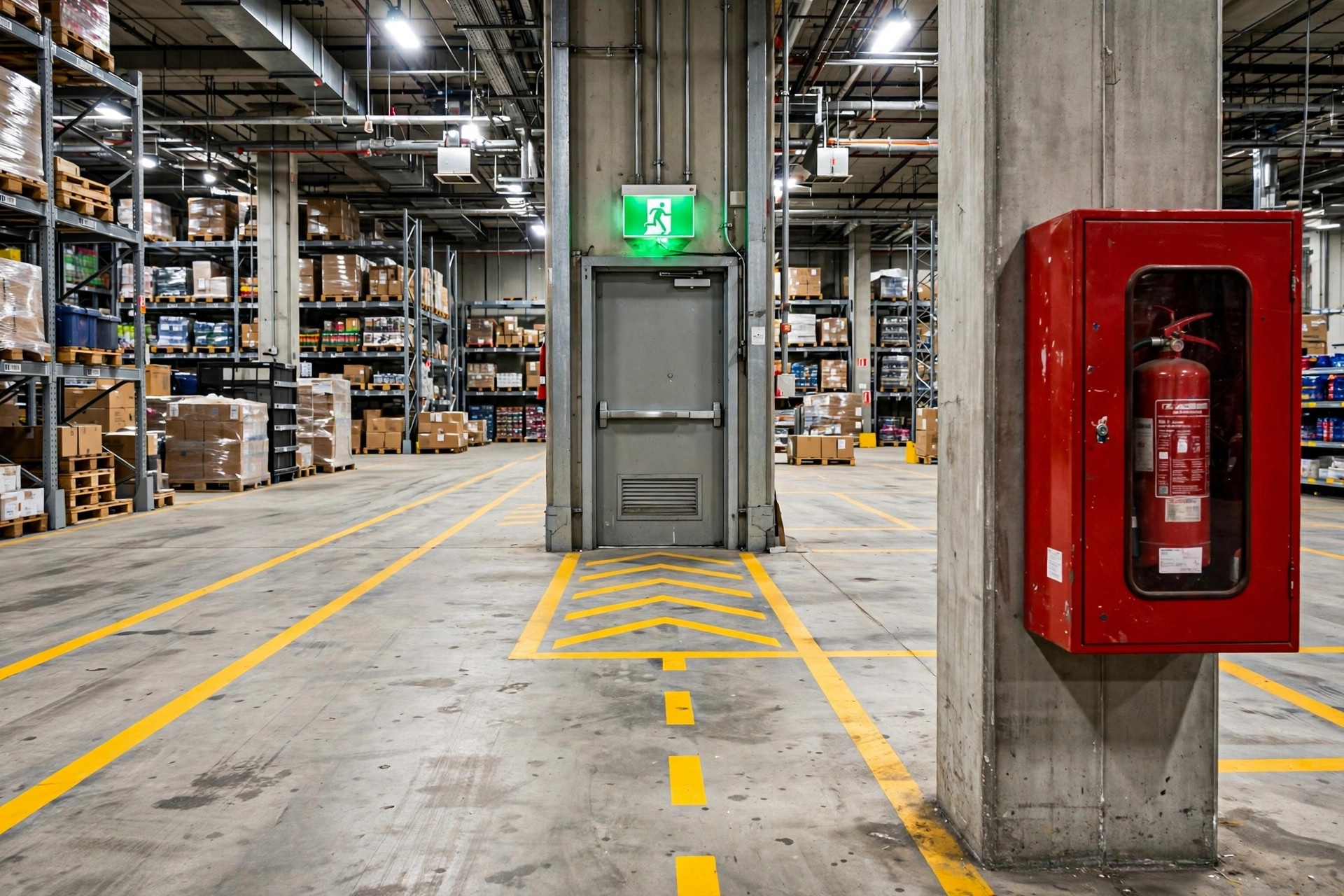
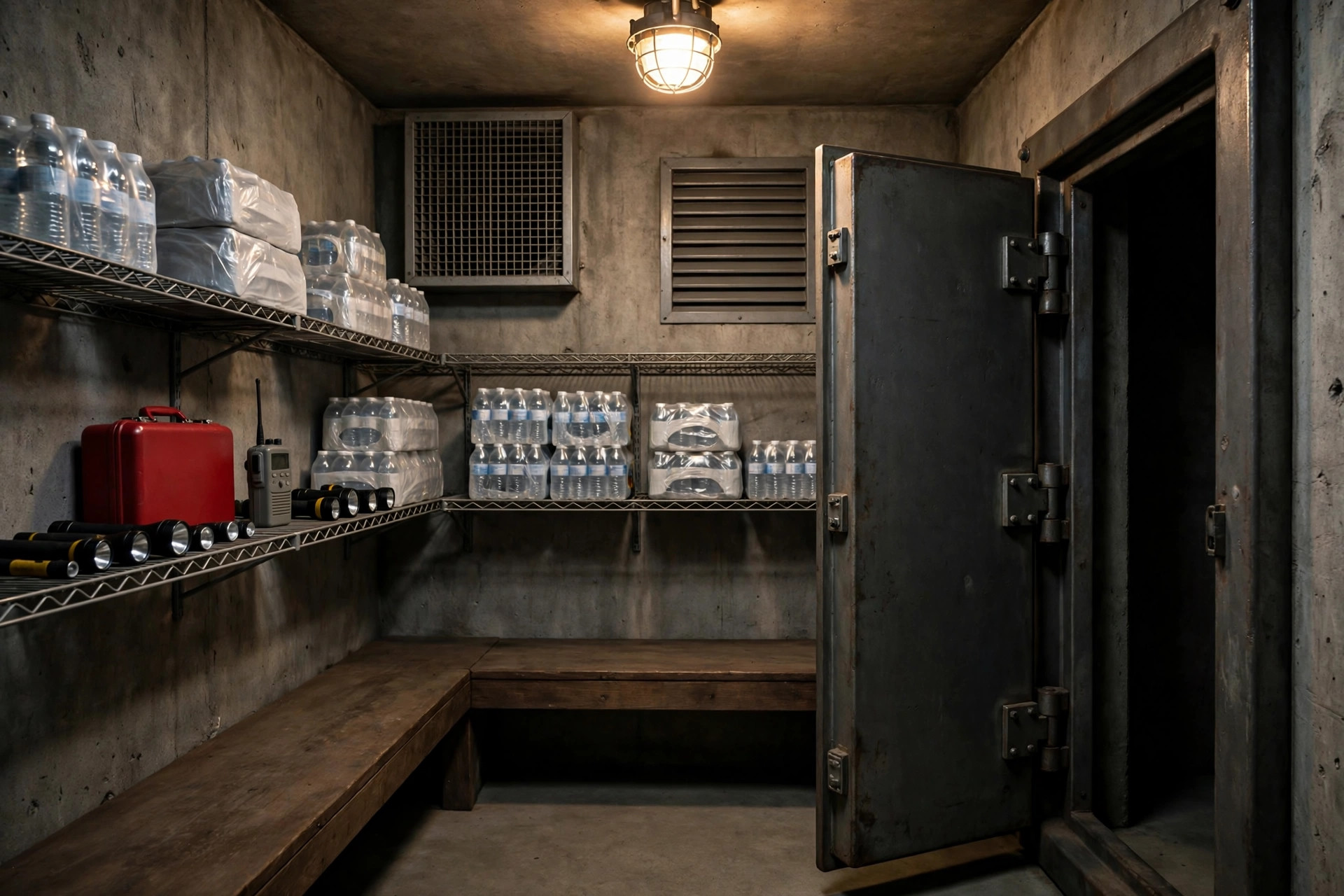
The hardening list: a heavy steel door with bolts on both sides; sealed up the little vent window; steel plate lining on the thin spots; mesh guards over the ventilation openings; benches along the walls so everyone can sit; shelves stocked with water, flashlights, a first aid kit, a NOAA weather radio, and a few whistles. Reflective sign on the door, yellow floor lines marking the route from the pick zone straight to the room. Materials plus labor: a little over three thousand dollars and two weekends. No structural changes, so the landlord didn't care.

The result? We drill quarterly. From alarm to everyone inside with headcount done: 90 seconds. The National Weather Service says tornado warnings for EF2 and stronger give an average of 10–15 minutes of lead time. Ninety seconds versus fifteen minutes — we're fine. Honesty corner: this room handles an EF2 or EF3. If an EF5 parks itself on top of us, even an ICC 500 shelter can't promise anything. So stop obsessing over "is it hard enough" and fix "do we have one, and can we get there fast."
The Counterintuitive Part: Warnings Beat Concrete
Here's the take that surprises people: for a small warehouse, money spent on warning and drilling saves more lives than money spent on rebar and concrete.
Two numbers. The Bureau of Labor Statistics counted 100 weather-related workplace deaths in the US in 2023. Tornadoes, hurricanes, and typhoons — directly or indirectly — accounted for just 7 of them. Small base, right? But in December 2021, an EF3 tornado hit a giant e-commerce warehouse in Edwardsville, Illinois head-on. The west wall caved inward. Six workers never went home. Afterward, the whole industry asked the same questions: where was the plan, where was the alarm, where were people supposed to go? Nobody asked about the shelter's engineering spec.
That's the real trade-off. Tornadoes don't kill people because shelters aren't hard enough. They kill people because nobody knew where to run, or ran too late. And that's why, whenever warehouse tornado shelter OSHA requirements come up in conversation, I steer it straight back to readiness, not concrete. A NOAA weather radio costs tens of dollars. A distinct-sounding alarm costs hundreds. A drill costs nothing. Those three together do more for a small warehouse than another layer of brick on the wall. The big-company narrative says safety equals spending. Our reality: the owner doubles as the safety officer and the janitor, the plan is two pages taped to the wall, and drills run until they're muscle memory. That works just as well as their three-ring binder.
One more thing: if you genuinely want a standalone shelter, don't pay full price out of pocket first. FEMA's Hazard Mitigation Grant Program can cover up to 75% of eligible project costs. Check with your state's hazard mitigation office before you write a check. Free money you don't claim is just money you gave away.
If You're a Small Warehouse in Tornado Country, Do These Five Things
First, confirm you're actually in tornado country. Check NOAA's historical track maps. If you're not in a high-risk zone, spend the money elsewhere.
Second, put the tornado scenario in your 1910.38 plan. Two pages is fine: what the alarm sounds like, which room to run to, who's doing headcount. Oral plans are legal under ten employees, but write it down anyway — "I told them" doesn't hold up well after an incident.
Third, make the alarm distinct and buy a NOAA weather radio. Phone alerts lag. The radio is the real deal.
Fourth, designate the most interior room on the lowest floor and harden it using the checklist above. Remember OSHA's advice: no wide flat-roof open areas, no window-lined exterior walls.
Fifth, drill quarterly and time it. Ninety seconds from alarm to headcount is the passing grade.
Small warehouses have their own way of surviving. A tornado doesn't care how big your company is — but a plan cares how seriously you take it.
By Xiao Ma, Small Warehouse Owner