One of our clients called me last fall in a mild panic, with a question nobody had ever put to me so bluntly: how high can you stack pallets? They'd just leased an 80,000-square-foot warehouse near Fontana for an e-commerce returns operation. Returns mean empty pallets, and empty pallets pile up fast — theirs had crept to 18 feet in the back corner of the yard, one sprawling pile covering 600-plus square feet, stacks practically touching.
The fire inspector showed up for the annual visit, hit it with a laser measure, and handed them a 30-day correction order. "Which regulation actually says how high I can stack pallets?" my client asked me. "I read through OSHA and couldn't find a single number."
He was right. OSHA doesn't have one.
What OSHA Actually Says About Pallet Stacking Height
The controlling provision is 29 CFR 1910.176(b), the "secure storage" paragraph, and it fits on half a page: storage must not create a hazard; bags, containers, and bundles stored in tiers shall be stacked, blocked, interlocked, and limited in height so they are stable and secure against sliding or collapse.
In plain English: don't let it fall over. How high is "stable"? That's your problem.
That's the thing about OSHA — it writes performance standards, not numbers. If you're searching how high can you stack pallets expecting OSHA to hand you a chart, stop scrolling: there isn't one. If an inspector looks at your pallet stacks and decides they're leaning, wobbling, or one gust away from coming down, 1910.176(b) is the citation. In 2018, federal OSHA's public records show exactly that: a warehousing company hit with a willful citation under 1910.176(b) for unstable stacking, initial penalty $99,589, settled at $12,500. No number in the rulebook can be scarier than no number at all — you can't wave a compliant measurement at the inspector.
The only height-adjacent number OSHA gives you lives in 1910.159(c)(10): at least 18 inches of vertical clearance between sprinklers and the material below. And OSHA later clarified in a formal interpretation letter that this isn't a little bubble under each sprinkler head — it's a horizontal plane across the entire room. Everything you store stays below that line.
But that rule governs distance from the sprinklers, not how high you can stack pallets. For the actual stacking numbers, you have to go to the fire code.
The Real Pallet Stacking Height Numbers Live in the Fire Code
Here's the counterintuitive part: empty pallets are far more dangerous than loaded ones.
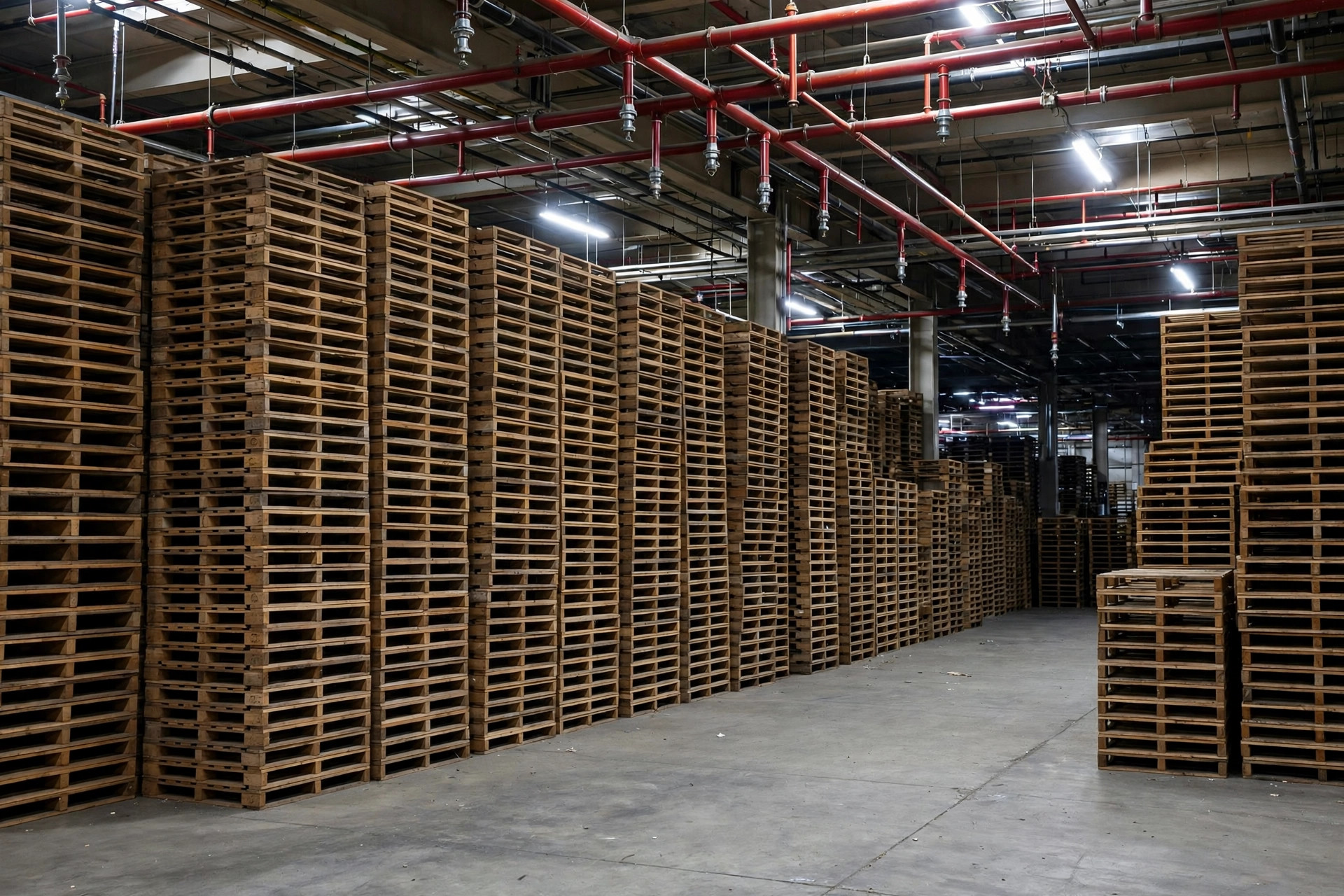
In the fire code, idle pallets sit in the same "high-hazard commodity" bucket as rubber tires, Group A plastics, and flammable liquids. The reason is surface-to-mass ratio — fire races up through the gaps between the deck boards far faster than it spreads across boxed goods. Most people assume "there's nothing to burn in an empty pallet." Wrong. An idle pallet stack is one of the nastiest fuel packages in a warehouse.
The numbers, split indoor vs. outdoor:
Outdoor idle pallets: NFPA 1. Section 34.11.3.3 of NFPA 1 (2024 edition) is explicit: idle pallet stacks may not exceed 15 feet in height, and no single pile may cover more than 400 square feet. Piles must be separated by at least 8 feet, sit at least 8 feet from the property line, and be arranged in stable piles.
Back to our Fontana client: 18 feet high — over. A 600-square-foot pile — over. Stacks touching each other — no 8-foot separation. Three strikes, and that correction order was fully earned.
Indoor idle wood pallets: NFPA 13. Indoors it's stricter. Under NFPA 13's Ordinary Hazard Group 2 density/area arrangement, indoor idle wood pallets are capped at 6 feet high, no more than four stacks per pile, with at least 8 feet of clear space — or 25 feet of other commodity — between piles. Plastic pallets get it worse: the 2025 revision pushes them down to 4 feet, because plastic burns even hotter than wood.
And there's a threshold most operators have never heard of: high-piled storage. For ordinary commodities, storage over 12 feet triggers high-piled rules. But for high-hazard commodities like idle pallets, the trigger is just 6 feet. Cross that line and you're into a different regime of sprinkler design and fire permits.
How High Can You Stack Pallets: The Three-Way Decision Table
| Scenario | Height cap | What else you owe | Source |
|---|---|---|---|
| Outdoor idle pallets | 15 ft | Single pile ≤ 400 sq ft; ≥ 8 ft between piles; ≥ 8 ft from property line | NFPA 1 §34.11.3.3 |
| Indoor idle wood pallets (ordinary-hazard sprinklers) | 6 ft | ≤ 4 stacks per pile; ≥ 8 ft clear space or 25 ft of commodity between piles | NFPA 13 (OH2 density/area) |
| Indoor idle plastic pallets | 4 ft | Same, stricter | NFPA 13 (2025 revision, industry reading) |
| Loaded pallets (indoors) | Per stability + sprinkler design | ≥ 18 in. below sprinklers (whole-room plane); ≥ 36 in. for ESFR | OSHA 1910.159(c)(10); NFPA 13 |
| High-piled threshold | Ordinary goods > 12 ft; idle pallets & high-hazard > 6 ft | Triggers high-piled permit + upgraded sprinkler design | IFC Chapter 32; NFPA 13 definitions |
Buried in that table is the second trap, and another one of our clients walked straight into it: the 36-inch rule for ESFR sprinklers.
This client runs a 120,000-square-foot building in the Inland Empire, 32-foot clear height, ESFR (early suppression fast response) sprinklers. Operations stacked loaded pallets to within 20 inches of the deflectors, figuring "OSHA says 18 inches, we're fine." The inspector's answer: NFPA 13 requires 36 inches of clearance for ESFR. Two top layers of product came down across the building.
That's the trade-off nobody puts in the pro forma: in a 32-foot-clear building, the 36-inch line eats a full layer of pallet positions off the top. Compliance and cube utilization are natural enemies. Lowering stacks saves you fines and insurance headaches; it costs you real, rentable pallet positions. Every operation has to do that math — but first you have to know the 36-inch line exists.
The Inside Scoop: Your Sprinklers Were Designed for the Last Tenant
Here's something we run into constantly on the 3PL sales side.
The sprinkler system in your leased warehouse was almost certainly designed for the previous tenant's commodity. The landlord built the place around, say, "cartoned consumer goods at 20 feet" — hydraulic calculations, head selection, all of it. You move in and start stacking idle pallets nine feet high. Sorry — the original design doesn't cover you anymore.
NFPA 13 requires every sprinkler system to carry a general information sign stating its design basis: commodity, height, density. In lease negotiations, 99% of tenants never look at it. Then the fire marshal walks in, points at the sign, points at your pallets: "This was designed for cartons. You're storing idle pallets. Fix it — on your dime."
So the idle-pallet problem isn't really a stacking problem. It's a the commodity changed and the sprinklers didn't problem. There are exactly two fixes: bring the height back down, or spend hundreds of thousands upgrading the sprinkler system. Nine out of ten of our clients choose door number one — a sprinkler upgrade costs several years' rent.

The Inspector's Walk-Through: Six Things They Check First
Before the fire department shows up, walk your own building. Here's what the inspector's eyes go to:
- Outdoor idle pallets: laser on the height (the 15-foot line), tape on the pile footprint (the 400-square-foot line), eyes on the separation (8 feet).
- Indoor idle pallets: anything over 6 feet. Past that, your ordinary-hazard sprinklers are decoration as far as the inspector is concerned.
- The plane below the sprinklers: 18 inches minimum, 36 for ESFR. Not just the spot directly under each head — the whole room lives under that line.
- Stability: 1910.176(b)'s "don't let it fall over" rule. Leaning stacks, wobbling piles, tall stacks with no stretch wrap — easy citations.
- High-piled permit: ordinary goods over 12 feet, idle pallets over 6 feet. If you can't answer "do you have the permit," you're in trouble.
- The sprinkler information sign: does the design commodity match what you're actually storing? If not, passing the first five doesn't save you.
Three Questions to Ask Before You Sign the Lease
We've been burned enough times by "move in, discover the fire code problem later" that I now make our sales team get these three answers in writing during lease negotiations:
One: What commodity and storage height were this building's sprinklers designed for? Send me a photo of the information sign.
Two: If we store idle pallets or go high-piled, who pulls the fire permit — and who pays for the upgrade?
Three: When was the last fire department inspection, were there any correction orders, and are they closed out?
Three questions, ten minutes. The next time someone in your operation asks how high can you stack pallets, the honest answer is: it depends on which pallets, where they sit, and what's above them. What those three questions can save you is a six-figure sprinkler retrofit — or a correction order giving you 30 days to bring every stack down. Landlords, this isn't scaremongering: our Fontana client now measures his yard pallets more religiously than his inventory.
By Susan, 3PL Sales Director