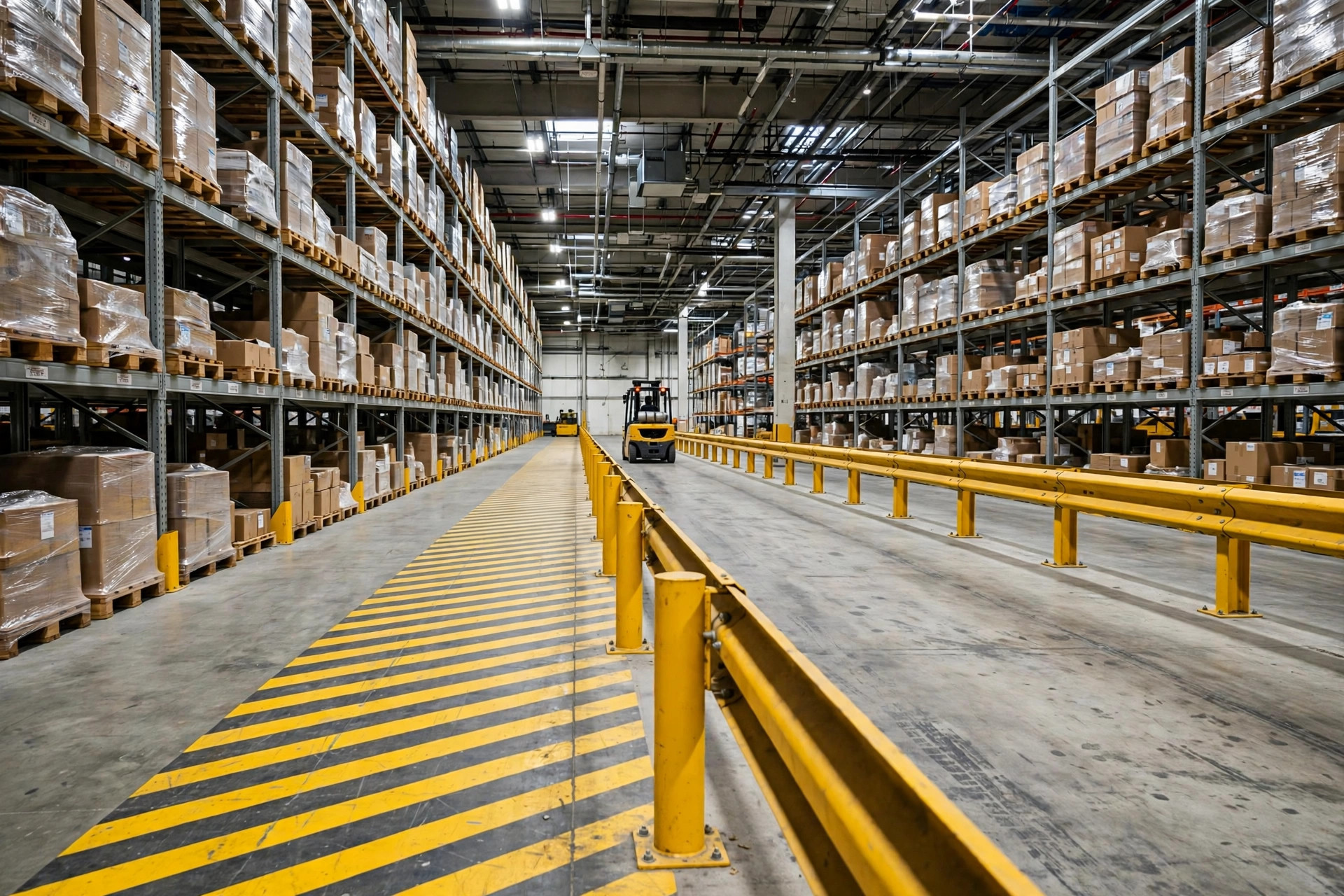
Here's the answer up front: OSHA's 29 CFR 1910.178 gives no number for forklift speed limits — only a "safe speed." So the number is yours to set and defend. My field-tested recommendation: 5 mph in main aisles, 3 mph in any pedestrian-mixed zone, dock area, or blind intersection, and slower still — horn on — for turns, grades, and obstructed views. But setting the number is only the start. Speed limit signs, floor markings, and signed training records: miss any one of the three and you effectively have no speed limit at all. I've seen this exact failure three times.
I'm a WMS implementation consultant. Forklift speed limits are EHS territory, not mine. But across 30+ go-live projects, I've hand-added the same line to at least 10 warehouses' "go-live night checklist": does a speed limit policy exist, are the signs up, has every driver signed off? After a WMS go-live, picking efficiency jumps and forklifts move faster than before — while nobody tightens the safety side in parallel. The smoother the system runs, the harder the crash.
OSHA Never Wrote a Number — That Doesn't Mean Nobody's Watching
Let's get the regulation straight, so nobody uses "OSHA doesn't specify" as an excuse. The speed requirements in 29 CFR 1910.178 are scattered but clear (always check the latest text on osha.gov): (n)(1) obey all traffic regulations including your own authorized plant speed limits, keep about three truck lengths behind the vehicle ahead; (n)(4) slow down and sound the horn at cross aisles and obstructed-vision spots, travel load-trailing if the load blocks your view; (n)(7) grades slowly; (n)(10) slow for wet floors; (n)(15) reduce to a safe speed for turns.
Get the logic? You set the number; OSHA judges "safe" after the fact. An inspector weighs truck type, manufacturer limits, load, stopping distance, floor conditions, pedestrian traffic — a "totality of the circumstances" call on whether your speed was safe. The kicker in (n)(1): your own speed limit becomes an enforceable "plant traffic regulation." Set 5 mph, have a driver hit someone at 8, and the citation quotes your own rule back at you.
The industry reference points: the Material Handling Equipment Distributors Association (MHEDA) suggests 8 mph maximum, no more than 3 mph where pedestrians are present. Most U.S. warehouses I work with land on 5 mph for main aisles. That's consensus, not law — but inspectors carry that yardstick in their heads.
3 Bases for Setting Your Forklift Speed Limit: Walk the Floor First, Then Set Numbers
Never one number for the whole building, and never copy the warehouse next door. Every time I help a client set limits, I walk the floor against three bases, aisle by aisle:
Base 1: Pedestrian density and mixed-traffic zones. Priority one. Packing stations, QC areas, office doors, shift-change routes — anywhere forklifts and feet share space gets 3 mph, no negotiation. Fall 2023, a 3PL client in Ontario, California: during a pre-go-live walkthrough I watched pickers shortcut across the main forklift aisle to pack-out while trucks ran it at 10+ mph. A near-miss the prior week had been buried by the shift lead. I stopped the walkthrough and required the aisle reclassified as a pedestrian-mixed zone within three days: 3 mph limit, yellow pedestrian walkways, red warning lines for the truck lane. The client grumbled about productivity. Two months later OSHA swept the area after a neighboring facility's incident. The inspector's first question: "What are your plant speed limits?" Policy on the wall, paint on the floor, signatures on the training sheets — the forklift items ended as a minor note. His words: "At least you know you're managing something."
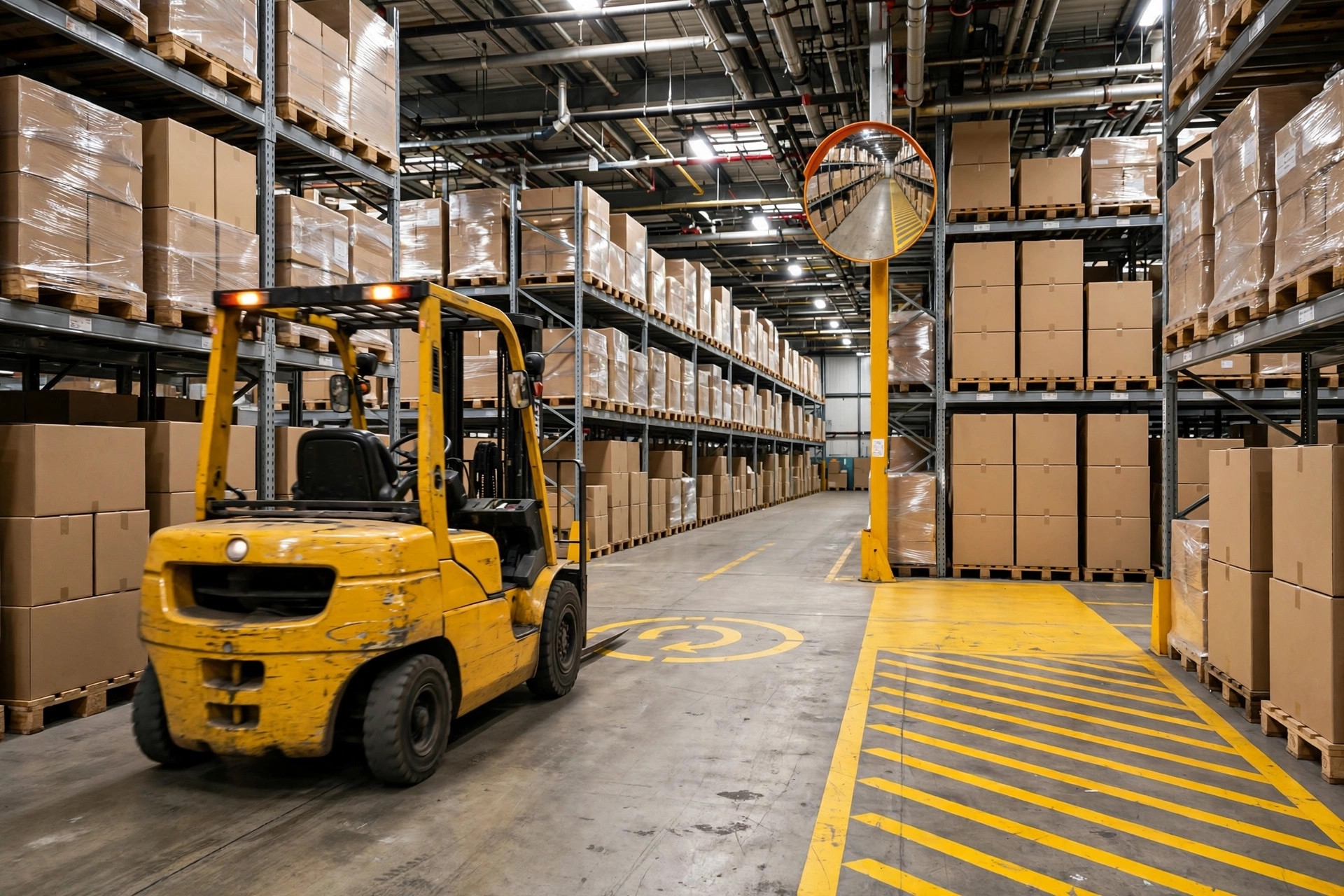
Base 2: Aisle width and blind spots. Narrower aisles and more blind spots mean lower limits. Rack end-caps, cooler doors, intersections, behind columns — a "slow down" sign doesn't cut it; these spots need specific numbers. My method: tape measure out. Single-direction aisles under about 13 feet of clear width get 3 mph. Intersections and blind turns become "stop-and-look points": full stop, horn, confirm clear, then move. That's no longer a speed question — it's a behavior standard.
Base 3: Load type and floor conditions. An empty truck and a 2-ton load of stacked cartons are different machines. Dry epoxy and a condensation-slick cooler floor are different worlds. Heavy loads, high stacking, blocked sightlines — drop one more tier. Coolers, docks in the rain, oil-stained floors get their own lower limits on their own signs. Then it all goes into one table, posted in the break room and the charging area:
| Zone | Speed limit | Basis |
|---|---|---|
| Main aisles (no pedestrians) | 5 mph | Industry norm, within MHEDA's 8 mph ceiling |
| Pedestrian-mixed zones, pack-out areas | 3 mph | Pedestrian density is priority one |
| Dock and staging areas | 3 mph | Complex floors, mixed people and vehicles |
| Intersections, blind turns | Full stop + horn | Blind spots can't be solved with a number |
| Turns, grades, wet floors | Below 3 mph | Directly required by 1910.178(n)(7), (10), (15) |
One counterintuitive call for you: lower is not always better. I watched a warehouse set 3 mph site-wide. Drivers physically couldn't do their jobs at that pace, so every one of them ignored it — and once the signs became wallpaper, nobody respected any limit. A strict-but-unenforceable number equals no number. A reasonable limit starts with being achievable, and continues with being checked.
The Three-Piece Landing Kit: Signs, Floor Markings, Signed Training
Numbers set. Landing it takes three things, none optional:
One: speed limit signs. At every zone entrance. Big, reflective, bilingual if your drivers include Spanish speakers. Three lines: zone name, the number, the consequence ("Speeding = retraining stand-down"). A sign costs tens of dollars — probably the highest-ROI safety spend in the building.
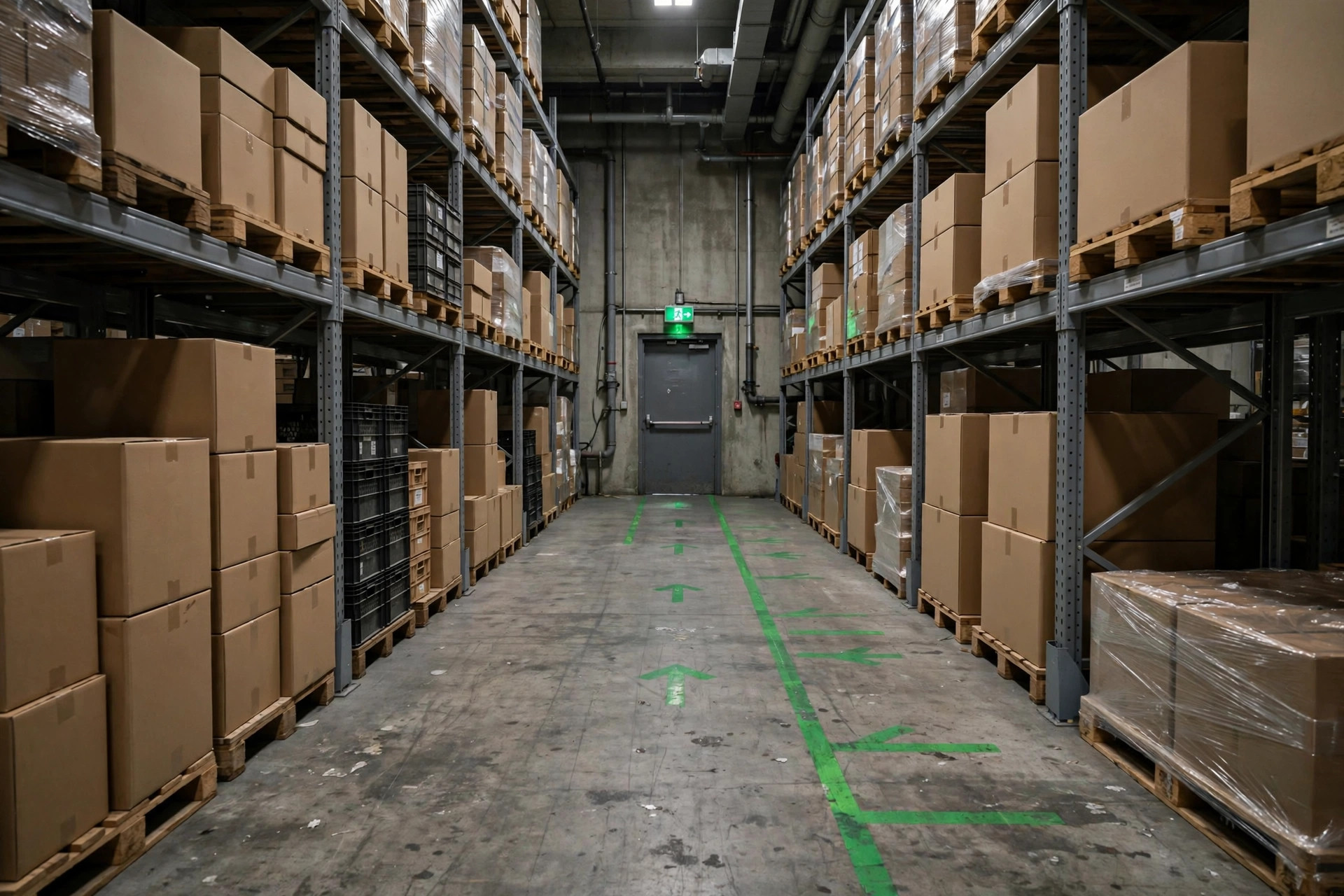
Two: floor markings. A forward-looking driver sees the floor, not the wall. Pedestrian lanes in yellow, truck lanes in white or red, stop bars and "STOP" at intersections, the speed number painted on the concrete. Early 2024, an e-commerce warehouse in Dallas ran a flat 8 mph site-wide (copied from the MHEDA ceiling). A truck took a dock-area blind turn too fast and clipped a rack end-frame, bringing down two pallets with it. The post-mortem: zero floor markings at that turn — the driver had no cue to slow down. They repainted by zone; same-category near-misses went from four a month to zero in three months. Floor paint costs hundreds of dollars; one rack strike's repair and downtime costs dozens of times that.
Three: signed training records. The most important piece, and the most skipped. 1910.178(l) requires trained, certified operators — and your speed limit policy must be in the training content, with every driver signing "I acknowledge the zone speed limits." In OSHA's citation logic, "having a policy" and "enforcing a policy" are two different things. An inspector who sees sign-off sheets sees a trained workforce; without them, your signs are decorations. Temps, seasonal hires, contract drivers — nobody gets skipped. The temp operator you bring in for peak season is statistically your highest-risk driver.
The Cost of Ignoring Speed Limits: How OSHA Citations Work + 6 Rollover Points
Let's do the math. OSHA penalties adjust with inflation each January; the schedule effective January 2025: serious violations up to $16,550 per violation; willful or repeat up to $165,514 per violation (check osha.gov for the current schedule). Note "per violation" — one speeding incident can produce several simultaneous citations. The prevention side? Tens of dollars in signs, hundreds in floor paint, one training session. Do the arithmetic yourself.
The six rollover points from my go-live checklist — check each one before you sign off:
- One number for the whole site. A speed limit with no zones is no speed limit. Zone it per the table above.
- Signs but no signatures. Inspectors don't accept signs; they accept training records and sign-off sheets.
- New hires never told. The speed limit policy goes in the onboarding packet, covered on day one.
- Temps slip through. Peak-season temp operators need their own briefing and signature.
- Night shift unmonitored. Night supervisors must run speed checks — the worst speeding I see happens at 3 a.m.
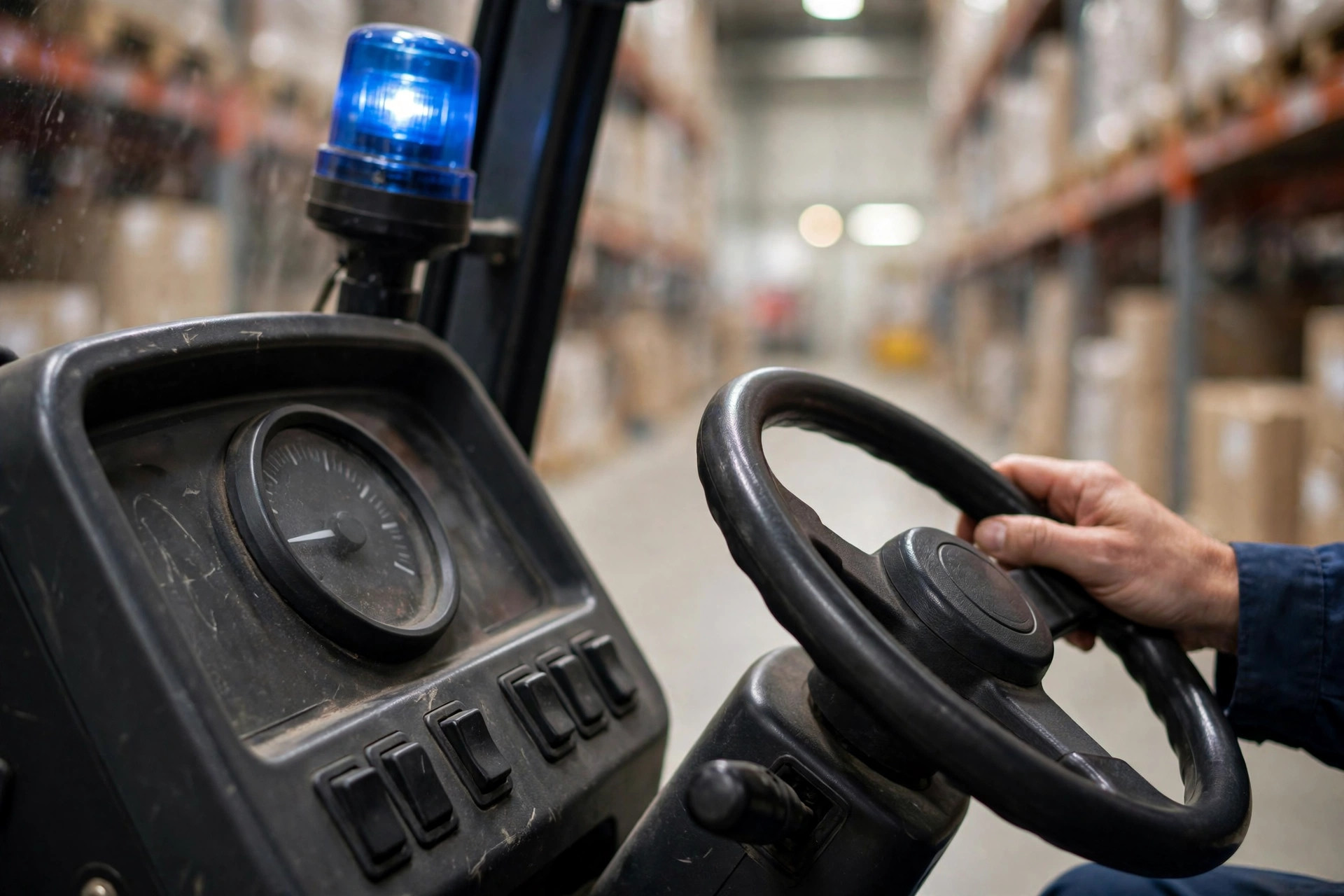
- No device-level control. If budget allows, add speed governors or blue-spot lights to the trucks. Hardware beats willpower.
The bottom line: OSHA not giving you a number is OSHA handing you the pen — while keeping the red ink. Three bases to set the number, three pieces to land it, six rollover points to avoid. A WMS makes you faster. The speed limit is the part you still have to tighten by hand.
By Lin Xiao, WMS Implementation Consultant