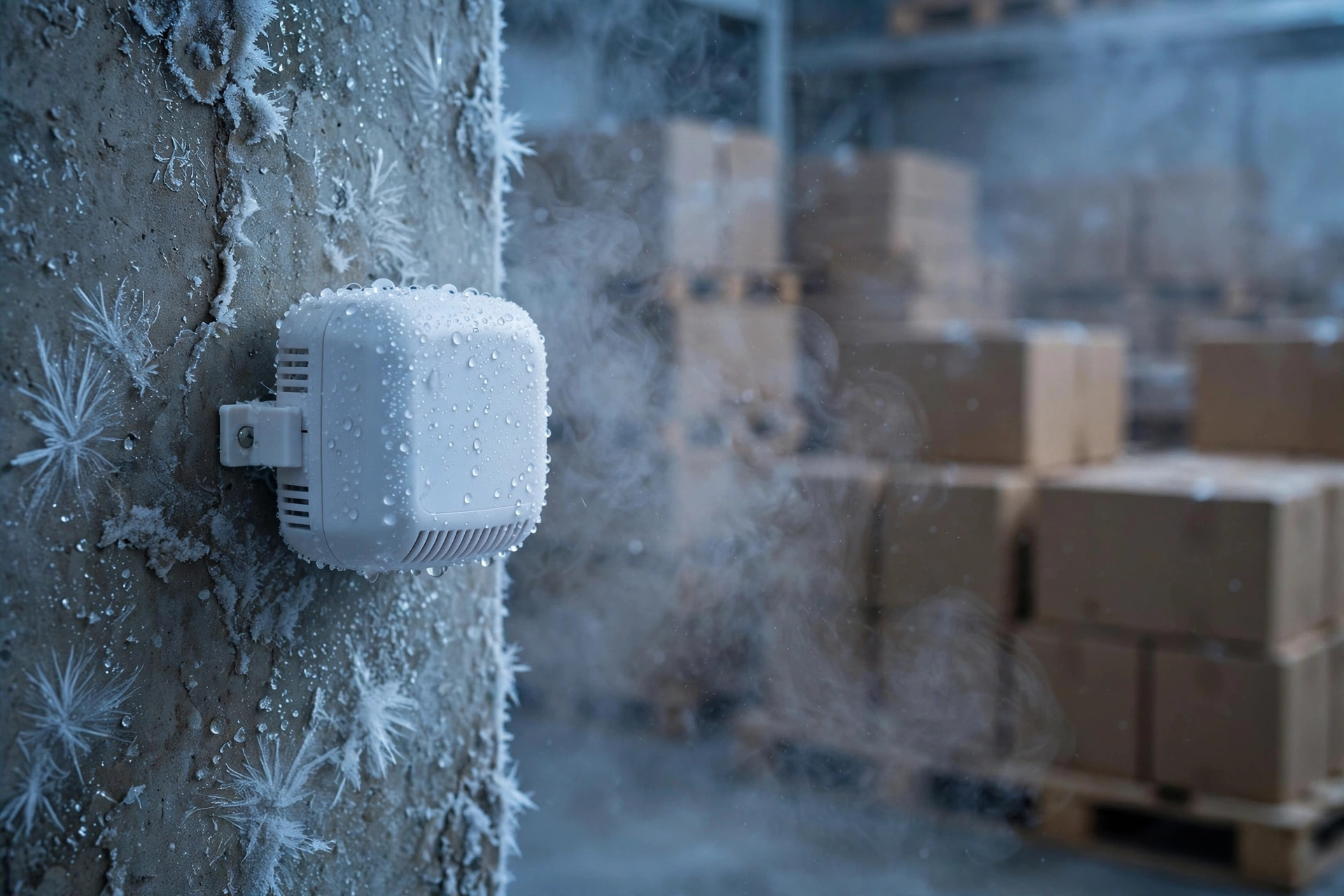
Last winter, a frozen-food distribution warehouse ran into a strange problem. The temperature dashboard looked perfectly flat, the system had never raised a single alarm, yet during a stock check the crew found frost on a row of cartons near the corner wall, melted and refrozen more than once. The sensor was not broken. The system was not offline. The problem was where the sensor had been placed: directly beneath a cooling fan, wrapped in the cold air blowing out of it. It was measuring the temperature of the discharge air, not the temperature of the goods.
That case is not unusual. Warehouse temperature humidity sensor placement is one of the most casually handled details in cold storage and food warehousing. Once the probes are up and the numbers are moving, everything looks monitored. But a probe only ever measures the small pocket of air around itself. Inside a warehouse of any size, air is not uniform: the dock door area swings with every opening, the zone near the fans runs cold, corners and the depths of a pallet stack run warm, and the top of a rack often sits several degrees above the bottom. Put the probe in the wrong place and the monitoring system becomes a comfort blanket.
The three most common warehouse temperature humidity sensor placement mistakes
The first mistake is putting the probe by the door. The doorway is where temperature swings hardest in a cold store: forklifts move in and out, cold air escapes, warm air rushes in. A probe mounted there can trigger a dozen alarms on a summer day, and after a few weeks of that, the night shift stops taking the alarms seriously. One food warehouse in eastern China learned this the hard way: its probe sat just inside the dock door, alarms fired constantly through the busy season, and in the end the team simply widened the thresholds, which was the same as switching the alarm system off.
The second mistake is mounting the probe directly under or opposite a cooling fan outlet. That was the frozen-food warehouse from the opening story. Air velocity is high and temperature is low at the outlet, so a probe bathed in that stream reads far colder than the depths of the pallet stacks. This error is the most dangerous kind, because it does not produce false alarms, it produces missed alarms, and everything it tells you is a false sense of security.
The third mistake is leaving the probe in a dead corner, or mounting every probe on the ceiling. Dead corners barely exchange air with the main flow, so their temperature and humidity drift away from the rest of the room. The ceiling, meanwhile, is usually the warmest layer in the building. Reading only the ceiling makes the whole warehouse look warmer than it is, and the refrigeration plant runs longer than it needs to. Read only the ceiling and you also miss what is happening deep inside the stacks, where the real cold spots and hot spots live.
Zoning principles for temperature humidity sensor placement in cold storage
The first step in placement is not counting probes, it is dividing the room into zones. Split the space by airflow: the fan coverage zone, the door transition zone, the dense racking zone, the corners and wall-adjacent areas. Each zone gets at least one probe, because the air in one zone is genuinely different from the air in another, and one probe cannot honestly speak for the whole building.
Layering follows the same logic. Cold air sinks and warm air rises, so the top and bottom of a rack start out different. In a warehouse with high stacking, probing only at waist height means measuring only the middle layer. The working approach is to probe top, middle, and bottom on a representative rack in at least one zone, so you actually know how large the vertical gap is.
Cold spots and hot spots need separate verification. A cold spot is the point closest to the cooling source and most prone to overcooling; a hot spot is the point farthest from it and most prone to warming. Before fixing probe positions, run a mapping exercise with the room empty or lightly loaded and the refrigeration running normally, walking the space with portable instruments over a period of time to find those spots, then place fixed probes near them. Mapping turns placement from guesswork into verification.

How to estimate temperature humidity sensor count and spacing
There is no universal number for how many probes a warehouse needs. The estimation method works bottom-up: divide the space into zones by airflow and storage layout, give each zone at least one probe, then add one at each cold spot and hot spot the mapping found, and decide whether the door transition zone and the area near the refrigeration equipment need denser coverage based on how much they fluctuate. Spacing is not derived from a fixed distance in meters; it follows airflow and stack density. Where stacks are dense and air movement is weak, the air varies more, so probes go closer together. Where the space is open and the air moves well, one probe can honestly represent a larger area.
Here is a counterintuitive judgment: more probes are not always better. Every additional probe adds false alarms and maintenance, calibration, battery changes, fault-finding, all of it human labor, and when the data volume grows past what anyone actually reads, nobody reads it carefully. What decides monitoring quality is not the number of probes but whether each probe's position is representative. Ten probes in the right places beat thirty probes mounted at fan outlets and doorways.
Calibration, drift, and balancing alarm thresholds
Probes drift with use. Drift is a slow-moving variable: it triggers no alarm, yet it quietly pulls readings away from reality. The only way to catch it is to compare against a reference instrument on a schedule. There is no single mandated interval; food warehouses generally set it by their own quality system and customer requirements, and the key is to keep the comparison records. When drift exceeds what is acceptable, the probe gets adjusted or replaced. For any specific regulatory numbers, follow the latest official policy and the contract requirements of your customers, which is the safest way to handle figures of this kind.
Setting alarm thresholds is a classic trade-off. Tight thresholds catch problems early but generate false alarms, and alarm fatigue eventually wears the night shift down. Loose thresholds cut false alarms but catch real problems late. The practical approach is two-tier: a first-level warning that asks for attention and a log entry but does not drag anyone out of bed, and a second-level action line that means someone must go and look in person. Separating warning from action brings the cost of false alarms down.
The trend is clear enough: temperature and humidity monitoring is moving from install-and-forget toward mapped placement plus scheduled calibration. Wireless probes and continuous logging have brought the cost of a full mapping exercise down to where even a mid-sized cold store can afford it. But cheaper hardware does not change the placement logic: zone first, find the cold spots and hot spots, and only then talk about how many probes. Probe position is the cheapest part of the whole monitoring system, and the easiest to overlook.
You can guess a good deal about how well a cold store manages temperature just by looking at where its probes sit. Good warehouse temperature humidity sensor placement is not a one-time installation; it is a placement that gets rechecked every time the layout changes. Is your probe measuring the temperature of the goods, or the temperature of the discharge air? That is a question worth asking seriously at the next walk-through.
By Dr. Chen, Supply Chain Researcher