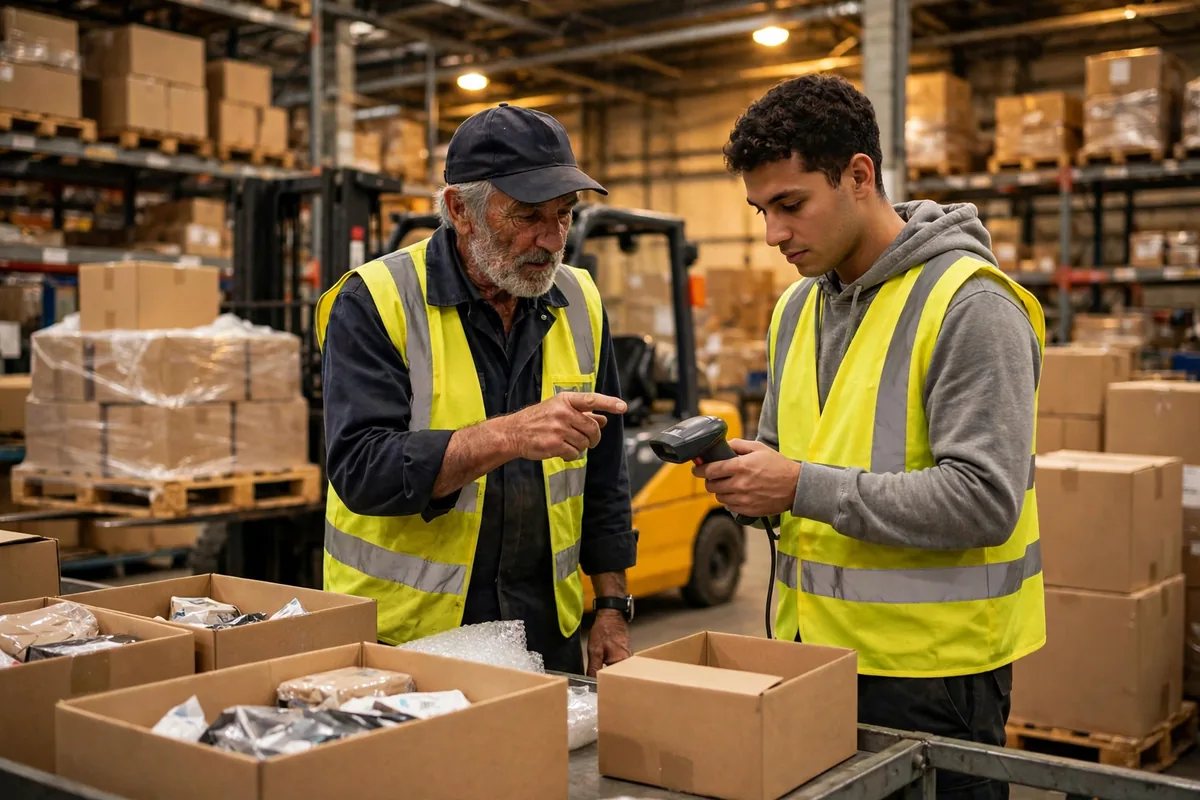
The temp workers vs permanent compliance question hit me a week before Black Friday last year, when my freight got stuck in my 3PL warehouse in Ontario, California. Not because of inventory. Because of people. The warehouse normally runs with about 40 staff. Peak season needed 90. The warehouse manager told me, "Don't worry, temps start tomorrow." On day three, one of them clipped a rack with a forklift. Pallets everywhere. Nobody was badly hurt, but the manager went paler than the racking.
That was the day I learned the uncomfortable truth about warehouse temp workers vs permanent compliance: if a temp gets hurt working in your warehouse, you cannot shrug and point at the agency. The liability follows the work, not the paperwork.
Temp workers vs permanent staff: whose injury is it, anyway?
Here is the counterintuitive part: for safety purposes, a temp worker has two employers at once.
OSHA's Temporary Worker Initiative (TWI) says it plainly. The staffing agency and the host employer are joint employers of temporary workers, and both share responsibility for a safe workplace. The agency handles general safety training and is supposed to check out the worksite before sending people. The host employer — the warehouse — handles site-specific training: your equipment, your processes, your hazards. That part is yours. No contract clause moves it to the agency.
Recordkeeping follows the same logic. Under federal rule 29 CFR 1904.31(a), the employer who supervises temp workers day to day records their recordable injuries on its own OSHA log, not the agency's. So when an inspector walks in, the first log they ask for is yours.
My 3PL learned this the hard way. The injury went on the warehouse's log, and both the warehouse and the agency were asked to produce training records. The temp had received about half an hour of general orientation, and his forklift "training" was a veteran employee showing him around twice and letting go. That kind of record protects nobody when something goes wrong.
As a seller, you can do something about this before peak season. Ask your 3PL three questions: is there a written record of site-specific training before a temp's first shift? Is forklift operation restricted to certified operators? Whose name goes on the injury log? Three questions, and you will know within a minute whether the warehouse is professional or winging it.
Writing "contractor" on the contract fixes nothing
The second trap is worker classification. Plenty of small warehouses and sellers label pickers and packers as independent contractors, pay them on a 1099, and skip payroll taxes and overtime. The label on the contract means nothing. California looks at the facts, not the header.
California's AB5 wrote the ABC test into Labor Code Section 2775. A worker is presumed to be an employee unless the hiring business proves all three prongs: the worker is free from the company's control and direction, the work is outside the usual course of the company's business, and the worker is customarily engaged in an independently established trade of the same nature. Fail one prong, and the worker is an employee. For warehouse picking and packing, prong B is nearly impossible to pass — picking is the business.
The federal side is no softer. Under the Fair Labor Standards Act (FLSA), non-exempt employees must be paid at least 1.5 times their regular rate for hours over 40 in a workweek. California goes further: daily overtime at 1.5 times kicks in after 8 hours in a day, and double time after 12 hours. Temps pulling 12-hour shifts through peak season rack up overtime fast, and if that premium is not in the quote, the month-end reconciliation will sting.
I know a seller in Los Angeles who found out in early 2025. His small warehouse had used a dozen "1099 packers" for almost a year. The audit ended with back wages, back taxes, and penalties that added up to more than everything he thought he had saved. His words: "I thought I was saving on labor. I was saving up for a fine."
California adds one more tripwire: AB 701, the warehouse quota law, effective January 1, 2022. A warehouse distribution center in California with 100 or more employees at a single site — or 1,000 or more statewide — must give each worker a written description of every quota they are subject to at hire: the numbers, the time period, and the consequences of missing them. A quota cannot require a worker to skip meal or rest periods, skip bathroom breaks, or violate safety rules. And a worker who believes a quota caused a violation can demand their own work speed data for the most recent 90 days, which the employer must provide within 21 days. Temps are covered too. If your warehouse sets a hard hourly pick rate for temps, that written notice has to exist.
Temp workers vs permanent staff: the math that actually matters
Temps look cheap. On total cost, they often are not. Take a mid-size warehouse peak-season example (hypothetical scenario): a temp bills at $19 an hour, with the agency adding its markup on top; a permanent employee earns $22 an hour plus payroll taxes, training, and retention costs. The temp looks $3 an hour cheaper — until you add the agency markup, the hours lost to training, higher error rates and rework, and the risk exposure of one injury or one misclassification audit. The "savings" usually live only on the invoice.
The counterintuitive truth about warehouse temp workers vs permanent compliance is that temps buy you flexibility, not cheap labor. The premium you pay is for the ability to scale up in November and scale down in January. If the same temp works the same job as your permanent staff for eight months straight, you are not buying flexibility. You are buying risk.
| | Temp worker | Permanent employee | | Who pays wages | Staffing agency | Host employer | | Site-specific safety training | Host employer | Host employer | | Injury record | Host employer (day-to-day supervisor) | Host employer | | Overtime | FLSA: 1.5x after 40 hrs/week | Same; California daily OT after 8 hrs | | Classification risk | Agency label does not shield host | ABC test and state law apply | | Best fit | Short seasonal surge | Stable, year-round roles |
So here is what I do now. Before peak season, I send my 3PL a one-page staffing addendum covering five things: which agency supplies the temps, the pre-shift training checklist, certification requirements for equipment like forklifts, who bears injury and overtime costs, and whether quotas have been disclosed in writing. One page. If a 3PL will not sign it, I would rather understock than put my freight in that warehouse for peak.
Should your best temp become permanent?
One more question sellers keep asking me: the temp who crushed it all peak season — do you hire them directly? My rule is three checks. Is the role needed year-round? Did this person work steadily through a full peak season? Is the total cost of hiring them lower than renewing the agency markup? If all three are yes, I make the offer.
My line is simple: the same temp, two peak seasons in a row, in a role that never goes away — that is a hire, not a renewal. The agency markup is paid every month; after six months it has usually cost more than recruiting and training a permanent employee. And an experienced hand makes fewer errors, which is exactly what peak season cannot afford to lose.
But do not fake the conversion. I have seen warehouses "convert" temps into part-time permanent staff with the same full-time hours and none of the benefits. That fails the ABC test on sight, and an inspector can tell in five minutes that it is a word game. A real conversion means real permanent terms: a fixed schedule, proper payroll, and the same training as everyone else. A half-hearted conversion is more dangerous than no conversion at all.
Compliance works like inventory planning: it looks like overhead until the day you need it, and on that day the missing piece of paper is the most expensive thing you own. Warehouse temp workers vs permanent compliance comes down to one sentence: if someone works in your warehouse, part of the responsibility is yours, whatever the contract says.
That trick is one I tested myself: before this peak season I sent that one-page addendum to two 3PLs. One signed it the same day. The other still had not replied two weeks later. Guess which warehouse is holding my freight this year?
By Ah K, E-commerce Seller (5 yrs)