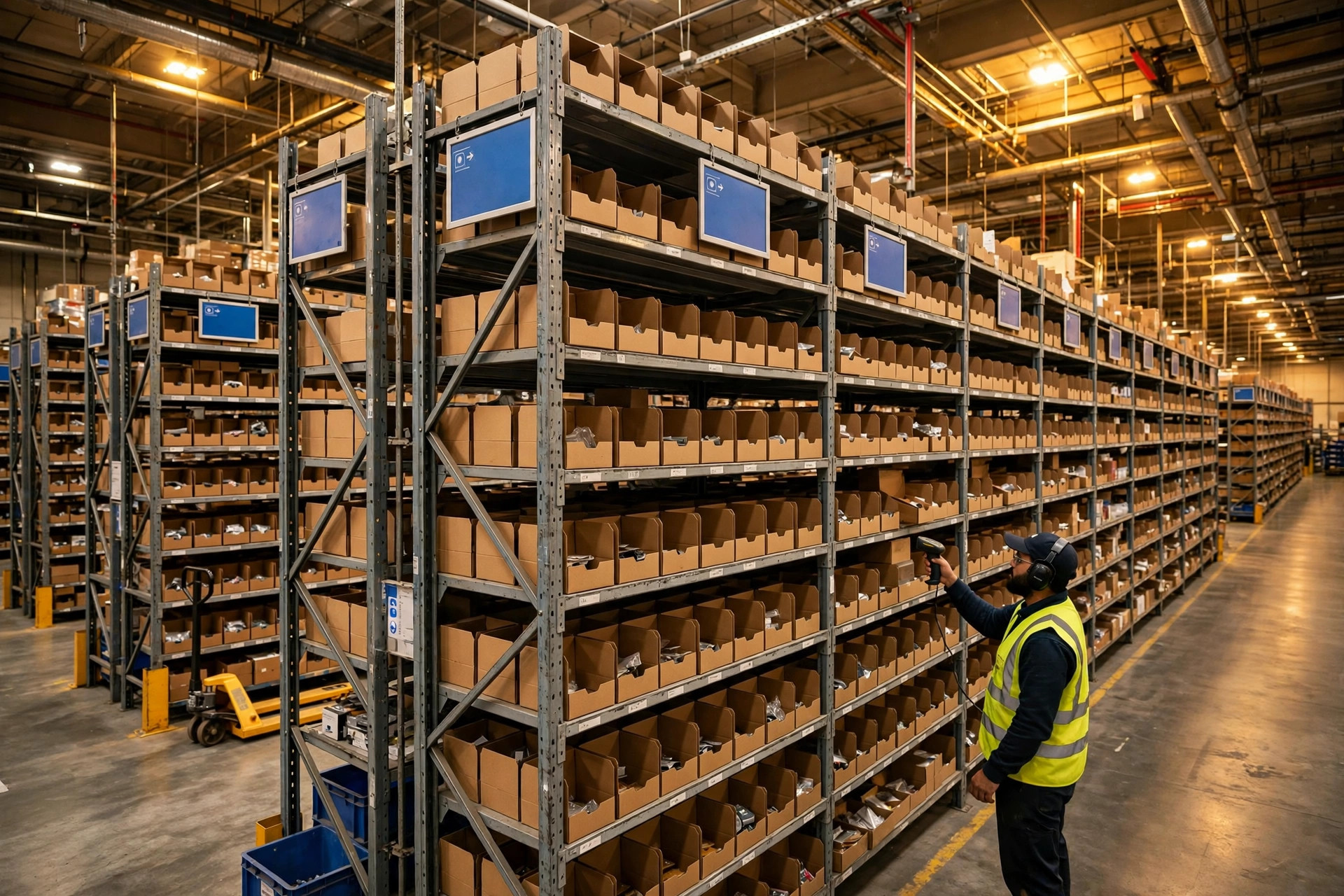
Ask me for one number that predicts warehouse trouble, and I'll give you this one: warehouse space utilization 85 percent. Cross it, and your warehouse isn't "full" — it's congested. The industry treats 70% to 85% as the healthy, efficient band; 85% is the warning line. Past it, picking slows down, forklifts start queuing, and replenishment errors pile up — while the WMS still reports "space available."
Short version up front: don't wait until 95%. The moment you cross 85%, run three moves — clear dead stock and take back the "zombie slots"; reclaim slots with an ABC re-slot and partial-pallet consolidation; change the putaway rules and kill "nearest empty slot" logic. Get back to around 78% and efficiency returns on its own. I've watched this movie three times: management thinks "full slots = saving money" until peak season proves full costs more than empty.
Why everything slows down once warehouse space utilization crosses 85 percent
First, align on what you're measuring, or you'll waste the exercise. Most WMS dashboards report slot occupancy — a position counts as "occupied" even holding half a pallet. My first question on every site visit: is your 85% slots or cubic volume? Eight times out of ten, nobody can answer. At 85% slot occupancy, true cubic utilization can be 60% — and the real problem isn't "too much freight," it's half pallets hogging full slots and mixed SKUs nobody can find.
Definitions straight, here's what breaks past 85% — three things at once:
First, empty slots turn to confetti. The remaining 15% isn't open area — it's scattered singles across aisles and levels. A driver putting away a full pallet cruises the whole building hunting for a slot that fits, and putaway time balloons. I've seen this pit three times: the system says space is available, but there's nowhere to put freight.
Second, aisles start jamming. Fuller slots mean more forklift turnarounds and yielding. In narrow-aisle buildings, two trucks passing is rare below 85% — above it, queues at aisle entrances become rush-hour normal. Pickers wait at aisle mouths for forklifts to clear, and units per hour quietly bleed out.
Third, replenishment runs out of runway. Staging overflows, replenishment tasks drop to occupied pick faces, so pallets get dumped at aisle ends — choking forklifts further. That's why error rates and damage claims climb past 85%: freight stops living where it should.
Last September, a small-appliance e-commerce warehouse in Ontario, California: peak buildup pushed utilization to 92%, WMS still showing 8% open. The manager told me: "The system says we have space, but my crew works an extra hour daily." Two days on the floor found the hour: forklifts crisscrossing the building for slots fitting full pallets, pickers waiting at aisle entrances for forklifts to yield. Open slots all confetti; aisles all jammed. Two weeks of reclamation later: 78% utilization, same freight, same headcount, overtime gone.
Three moves that took a warehouse from 92% back to 78%
Before touching anything, find yourself on this table:
| Space utilization | What it means | First move |
|---|---|---|
| Below 70% | Loose: room to grow, or hidden waste | Hunt "zombie slots": half pallets squatting for months, mixed slots nobody owns. Consolidate before giving space back |
| 70%–85% | The efficient band | Don't touch it — watch the trend weekly, 85% as your alert line |
| Above 85% | Red-line zone: efficiency drops, and it gets more expensive higher up | Run the three moves: clear dead stock → reclaim slots → change the rules. Above 92%, line up temp space |
Counterintuitive truth first: empty slots aren't waste — they're production capacity. That 15% is breathing room for forklift turns, wave-pick staging, exceptions. Squeezing to 95% to save rent costs more in overtime, mis-ships, and damage claims than the rent saved. A full warehouse isn't efficient — it just looks efficient.
Move 1: Clear — the dead-stock sweep
Dead stock is the most unjust slice of utilization: occupying slots, unmoved for a year. My working definition: 180 days, zero outbound movement (food/expiry goods: set the bar by shelf life). The steps:
- Pull the WMS "zero picks in 180 days" list, sorted by pallets occupied, biggest first.
- Walk it through with sales and purchasing, item by item: vendor returns, markdown clearance, transfers. This step needs a business sign-off — a consultant never authorizes a write-off. Hard line.
- What can't be cleared goes to one dedicated dead-stock zone, off the prime slots — centrally managed, not scattered.
- Release freed slots in the WMS the same day — don't let emptied slots linger in allocation logic.
- Monthly dead-stock report: auto-run on the 1st, flag 180-day+ in red. Without it, dead stock grows back in three months.
In 2023, an auto-parts distributor outside Dallas: utilization at 88%–90% year-round. Management loved it — "full means saving money" — until a wall-to-wall count found SKUs untouched 18+ months occupying nearly a fifth of all slots, while fast movers kept hitting "inventory on hand, no slot to put it in" and the company rented temp space across town. After the clear-out: 76% utilization, temp space returned the same month. One month of temp rent would have covered years of carrying cost on that dead stock — math most people learn only after paying tuition.
Move 2: Reclaim — ABC re-slot and pallet consolidation
After clearing dead stock, what frees up is usually scattered edge slots. Next, fix the flow:
- Rank SKUs by pick lines, last 90 days, into ABC. A-items (top 20% by lines) must live in the golden zone — closest to outbound, waist height, easiest to pick.
- Consolidate partial pallets of the same SKU — half here, third there. Check lot/expiry rules first; never mix lots.
- Move C-items to high bays and far ends. Don't be sentimental — prime slots make money on A-items.
- Re-slotting needs a freeze window: nights or weekends, never during live picking. Export a slot-change list, batch-update the WMS, cycle-count a 10% sample. I've watched this pit three times — moving slots during live picking doubles mis-ships on the spot.

Move 3: Change — the putaway rules
The first two moves treat symptoms; the third treats the disease. Most warehouses lose utilization at the root: the putaway rule. "Nearest empty slot" sounds efficient but scatters A-items randomly and wrecks pick flow within three months. Change three rules:
- Switch putaway from "nearest empty slot" to "ABC-zone putaway": A-items to the golden zone only, C-items straight to the far end. One WMS strategy change keeps flow clean for three months.
- Appointment receiving: during peak buildup, inbound trucks book slots. Unscheduled full truckloads are the most common trigger blowing through the 85% red line.
- Tighten mixing rules: one slot, one SKU (or one lot) — small C-parts excepted. Mixed slots are confetti factories.
Mistakes I've watched three times: where utilization projects go sideways
The three moves work fast, but four traps can zero out the gains in three months:
- Skipping the definition check. Teams clear and move, then discover the WMS 85% was slot occupancy and the real problem was half pallets hogging full slots. Align the definition before lifting a finger.
- Purging 30 days before peak. Dead stock must go, but not in the month before peak — you'll sweep fast-mover safety stock too, and a stockout costs ten times what high utilization does. Trade-off: lowering utilization matters; not stocking out matters more.
- Re-slotting without a freeze window. Moving slots during live picking is changing tires on a moving car. Night/weekend window, slot-change list, sample cycle count — all three, no exceptions.
- Going blind after the win. Two big inbound waves and you're back at 90% in three months. Without a weekly report, the three moves were swung for nothing.
The 15-minute weekly checklist for warehouse space utilization
Print it, tape it to the wall, 15 minutes every Friday afternoon — the simplified go-live-night checklist:
- This week's space utilization (slot basis): ____%, trend ↑ / ↓, distance to the 85% alert line
- Confetti check: contiguous open slots (fit a full pallet) below 30% of all open slots = alert
- Dead-stock list: SKUs crossing 180 days with no movement — moved to the dead-stock zone?
- A-item placement rate: what share of A SKUs are still in the golden zone? Below 90% means schedule a re-slot
- Receiving appointments: how many big trucks arrive next week? Any unscheduled?
- Staging area: any overnight dwell in receiving staging? If yes, putaway is falling behind
Utilization was never hard to bring down. The hard part is keeping it down. Guarding the 85% red line costs far less than crossing it.
By Lin Xiao, WMS Implementation Consultant