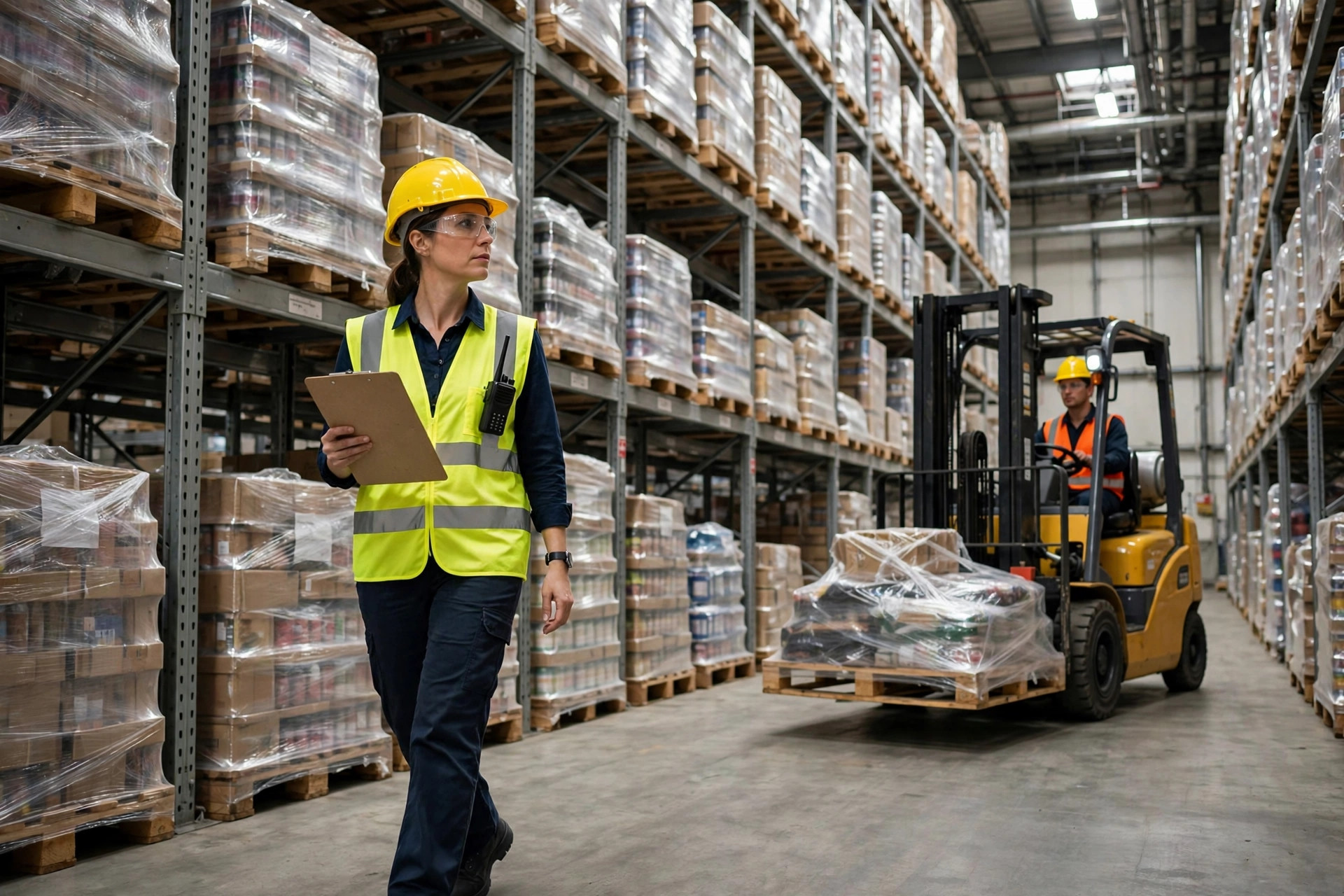
Let me tell you about a Tuesday morning. It was 6:50, I was standing by the dock door with my coffee, and I watched a forklift slam the brakes at the receiving entrance, stopping just a few steps from a kid walking out after night shift. The driver was shaking. The kid was frozen. And here's the kicker: our part-time safety coordinator had called in sick that day. There was nobody on the floor owning safety at that moment.
For Years, Our Warehouse Safety Coordinator Was a Part-Timer
We run a 180-person warehouse, two shifts. For the longest time, the safety job belonged to Marcus, a 12-year veteran who did it on top of his receiving duties. We gave him an extra $500 a month as a stipend. Good man. The crew respected him. But his real job was receiving, so safety got whatever time was left over. Forklift inspection sheets got filled in two or three days late. New-hire safety training was a 20-minute talk and a signature on a form.
Every morning at the shift meeting, Marcus spent ten minutes on safety: which floor area was slippery, which aisle not to block. The crew listened. Nights were the scariest part, though. Forty-plus people on night shift, forklifts and picking running full tilt, and Marcus was home asleep. Safety at night belonged to nobody. But let me be straight with you: that setup works only as long as nothing bad happens. It's safety by luck.

The OSHA Visit That Changed Our Minds
One Wednesday morning in September 2025, an OSHA inspector walked in unannounced and stayed for two days. Marcus got asked for forklift operator retraining records and couldn't find them. The monthly rack inspection sheets were missing three months. A few new hires' training sign-off dates didn't match their start dates.
We ended up with three serious citations. Per OSHA's published penalty schedule, a serious violation runs up to $16,550 per violation under the current standard effective after January 15, 2026 (check osha.gov for the latest figures). Three of those at the max is nearly $50,000. That would have covered more than half a year of a full-time EHS salary.
But the fine wasn't the part that stung. Before leaving, the inspector said: "It's not that you don't care about safety. It's that you can't prove you care." That line hit me hard. A part-time warehouse safety coordinator's biggest problem was never effort. It was never having time to build a paper trail. On inspection day, if you can't produce it, it didn't happen.
We Ran the Numbers: What Each Staffing Model Really Costs
After the citations, I laid out the three options on the table. These are our warehouse's real numbers. Your market will differ, so adjust accordingly.
| Staffing model | Rough annual cost | What you get | What you don't get |
|---|---|---|---|
| Part-time coordinator (veteran on stipend) | About $6,000/yr in stipends | Daily reminders, shift-meeting talks, informal new-hire onboarding | No time for documentation, no night-shift coverage, folds under inspection |
| Outside safety consultant | Around $30,000/yr for two days a month | Polished reports, inspection support, program documents | Not on the floor; useless when something happens at 2 a.m. |
| Dedicated full-time EHS | $75K-$95K salary in the Inland Empire, $90K-$120K loaded | Daily floor walks, training, records, owns the OSHA relationship | Small warehouses can't afford it; good ones get poached by bigger companies |
We actually tried the middle path first: a consultant two days a month. The reports looked great. But the day after the consultant left, everything went back to normal. Once, a night-shift forklift clipped a rack upright. By the time the consultant came back a month later, the scene was cleaned up and there was nothing to investigate. That's when I learned: you can't manage safety with someone who flies in and out.
The Uncomfortable Truth: A Dedicated EHS Earns Their Keep on Inspection Day
Let me be straight with you again. Don't hire a full-time EHS expecting zero incidents. No safety professional can prevent everything. The BLS 2024 data says it plainly: warehousing and storage averaged 4.8 recordable injuries per 100 full-time workers, with about 77,000 total cases across the industry. That's the industry average. No single warehouse is going to zero it out.
A dedicated EHS earns their salary the day OSHA walks in. Ours pulls out the full package: a year of training sign-in sheets, daily forklift checklists, hazard correction records with close-out dates, incident investigation reports. An inspector sees complete, closed-loop records, and the tone of the whole visit changes. We got audited by Cal/OSHA a year later. Our EHS manager handled the whole thing. We walked away with two other-than-serious items and a light penalty.
So here's the math that matters: a full-time EHS doesn't prevent the accident. They prevent the accident from turning into a massive fine. They're the circuit breaker between an incident and a citation.
So When Do You Actually Need Full-Time EHS? A Checklist
First, the honest legal note: OSHA has no rule that says "warehouses over X employees must hire a dedicated safety professional." If you see that claim online, don't believe it. Check osha.gov for the current requirements. What follows is industry practice, distilled from years of talking with fellow warehouse managers. If two or more of these describe you, stop hesitating:
- Over 100 people in a single building (not counting seasonal temps). Past that headcount, a part-timer's hours don't stretch far enough.
- Two or three shifts. A part-timer can't cover nights, and nights are when the worst stuff happens.
- Ten or more forklifts, or high-risk areas like high-bay racking or cold storage.
- An OSHA 300-loggable injury in the last 12 months. That means the risk isn't theoretical anymore.
- Seasonal temps over 30% of headcount. New people get hurt the most, and training volume doubles.
- You've been inspected and cited before. Once you're on the radar, the next visit goes deeper.
One note for the California folks: Cal/OSHA inspects more aggressively than federal OSHA, and a 100-plus-person warehouse in this state has a real chance of getting picked.
Here's where we landed: 180 people, two shifts, one full-time EHS manager. Marcus now works as his right hand, owning new-hire onboarding training. In two years, our OSHA 300-loggable injuries went from five a year to one.
Folks, a safety hire made too early is a cost. Made too late, it's tuition. Don't wait until the inspector is standing in your office to figure out which one you're paying.
By Chen Feng, Warehouse Operations Manager