We have a client who sells small home appliances. After last year's peak season, returns flooded back into the warehouse, and the missing step was returns grading. The team saw intact cartons and put the goods straight back into sellable stock. Then the next outbound wave shipped three coffee makers with scratches and two air fryers missing their manuals. Customer service phones lit up, the marketplace reviews turned ugly, and the client came to us asking whether our 3PL even inspects anything. Honestly, the contract never mentioned returns grading at all. The warehouse was simply doing "receive and put away," so the mess was almost inevitable.
That is why I keep telling clients the same thing: the first step for a return is not putaway, it is returns grading. Get the grade wrong and everything downstream goes wrong with it. Good stock thrown away as scrap is money lost. Defective stock shipped again is reputation lost. And if there is no standard, no named decision-maker, and no agreed fee for grading, the client and the 3PL will eventually argue over a pile of returns.
Returns grading works best with three grades, not ten
I have seen warehouses split returns into eight or ten grades, with fine distinctions like "minor wear, sell at a discount" or "damaged carton but intact product, repackage." It sounds thorough. On the grading bench, it falls apart. A worker staring at a complicated decision chart ends up guessing anyway. Start with three grades, and only add detail once the three are running smoothly.
Grade one is resell as-is. Outer carton, inner packaging, product, accessories, and manual are all complete, there is no visible damage, and a basic function check passes. This grade goes straight back to sellable stock. It moves fastest and it is worth the most.
Grade two is worth refurbishing. The product itself is not broken, but it is missing an accessory, the packaging is torn, the surface has a light scratch, or it needs cleaning or a small replacement part. The question for this grade is not "can it be fixed" but "is fixing it still worth it." We will come back to that calculation.
Grade three is scrap. Functional damage, a missing critical part, a safety issue, or a refurbishment cost already higher than the remaining value. This grade tests nerve, because throwing things away always feels wasteful. But shipping one appliance with a safety problem can cost far more than the item itself.
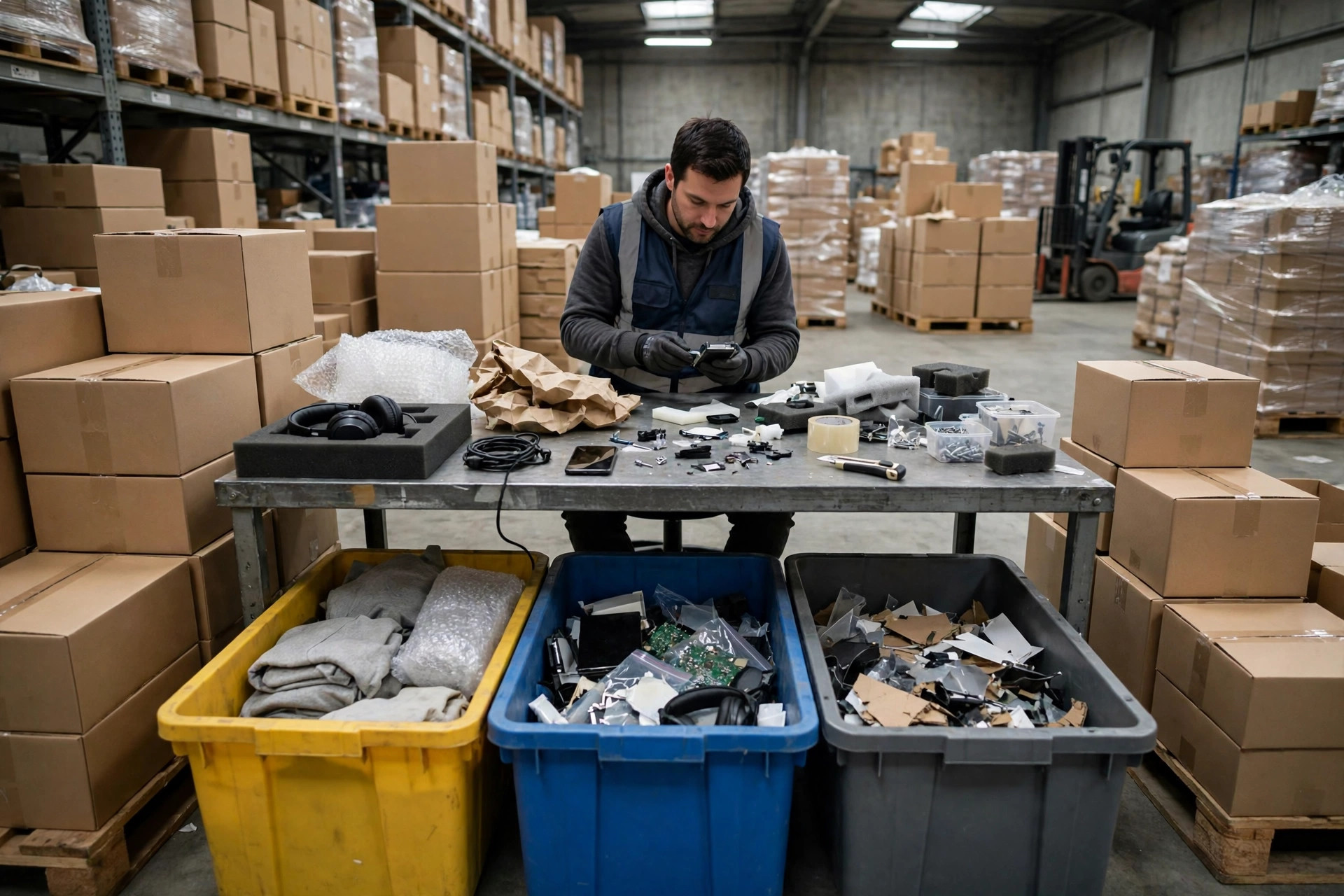
That home-appliance client rebuilt its process around those three grades. In the first week, the grading bench had three large cards: resell, refurbish, scrap. Nobody had to memorize a manual. Within a month, complaints on resold goods had dropped noticeably, and the warehouse no longer held meetings to argue about which grade a unit belonged in.
Put the decision-maker in writing
Once the standard exists, the next question is: who decides?
We have another client, an apparel brand, whose returns often arrive without hang tags or with light pilling. The client said, "Pilling can still sell at a discount." The warehouse said, "That will just come back again." Neither side would move, so the goods sat in the returns area for two months while storage charges kept running. That is what happens when decision rights are never written down.
My approach is to write three layers into the contract. First, day-to-day grading belongs to the warehouse, using a standard both sides have signed, preferably with photo examples. "Light scratch" and "obvious damage" should be shown, not just described in adjectives. Second, disputed units go to a separate hold area, get photographed, and are reviewed in a weekly batch by someone the client names, instead of being argued over one by one. Third, for safety, regulatory, or brand-image items, the client keeps a veto, but a veto carries the cost and timing consequences of the alternative handling.
One thing many clients overlook: refurbishment and scrapping also need a paper trail. Which part was replaced, how much labor went in, whether scrapping was photographed and documented. Those records become the evidence at month-end reconciliation. Without them, both sides stare at the same totals and tell different stories.
Set a refurbishment ceiling before anyone picks up a tool
Refurbishment is where grading loses the most money. Once a technician starts work, there is always one more part that could make the unit sellable. Part by part, the cost quietly passes the selling price.
So we set a rule with clients: calculate the ceiling before refurbishing. Take the resale price, subtract the outbound shipping, marketplace fees, and new packaging still to come, and what remains is the maximum refurbishment budget. Labor, parts, testing, and repackaging all count against it. If the work exceeds the ceiling, scrap the unit. Do not hesitate.
Take two everyday cases from the same warehouse. A low-priced appliance needs a main board plus two hours of labor, and the math is already underwater before testing begins. Insisting on refurbishing it is throwing money away. A higher-priced unit that is only missing its manual and outer carton, by contrast, can go back out at full price after repackaging, so refurbishment is clearly worthwhile. The same team handles both kinds of units every day, and it cannot treat them with the same instinct.
Here is the counterintuitive part: a higher refurbishment rate is not always more profitable. One client was delighted that refurbishment "saved" so many units, then built a bigger and bigger repair corner, only to find the repaired models going out of season and sitting unsold. Refurbishment rescues goods that can still sell, not goods that are merely hard to throw away. That distinction has to be made at grading time, not after the repair is done.
Negotiate grading fees by grade, not by flat piece rate
That brings us to money, which is what every client really wants to talk about: how does the 3PL charge for grading, refurbishing, and scrapping?
The worst structure I have seen is a single flat rate per returned unit, whether it is a quick visual check or a two-hour teardown. The warehouse has no incentive to grade carefully. Simple units lose money, complex units get rushed. The opposite extreme, billing every minute at actual cost, leaves the client feeling the invoice is impossible to audit.
A more workable structure prices each grade separately. Resell-as-is inspection is cheapest, because the work is unbox, verify, run a quick function check, and put away. Refurbishment is quoted separately, with labor and parts listed apart, parts at actual cost and labor as a banded flat fee, and any job that would exceed the ceiling requiring client approval first. Scrapping also needs its own price, covering sorting, photo documentation, and compliant disposal or destruction. Do not discover that scrapping was never priced when the first pallet needs to go.
Two clauses deserve special attention in negotiation. First, how many free days does a disputed unit get in the hold area, and what happens to storage and handling charges after the client misses the review window? Second, who keeps any residual value from scrapped goods, the client, the 3PL as a fee offset, or a compliant recycling channel? The amount is small, but arguments over it damage trust out of proportion.
When that home-appliance client renewed, we wrote all of this in, line by line. The next returns wave arrived, the warehouse graded to the standard without waiting for instructions, and the client could see every unit's grade and charge in the system. Fewer arguments, not more. Grading is not just an internal warehouse task. It is the moment when both sides agree what a return is actually worth. Put that agreement in the contract, and execution stops drifting.
Next time you negotiate a contract, ask these three questions: first, does the grading standard include photo examples, and who makes the final call? Second, how is the refurbishment ceiling calculated, and who approves scrapping when a job exceeds it? Third, are grading, refurbishment, and scrapping priced separately, and what happens when held units pass their review deadline? Get those three answers in writing, and at least half the returns arguments will never happen.
By Susan, 3PL Sales Director