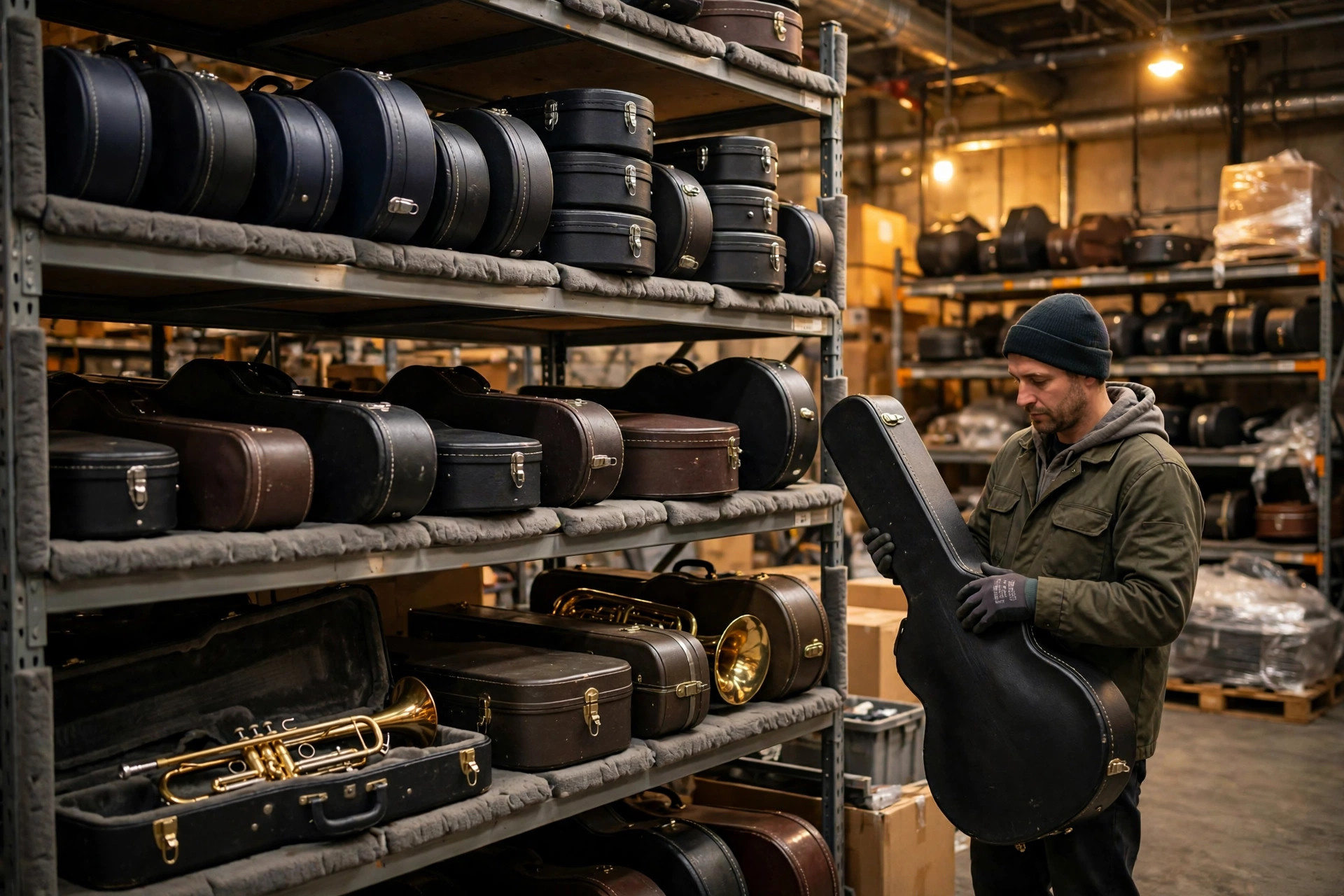
One of our clients in musical instrument warehouse storage called me in August 2024, a month before the school year started, with a shipment of guitars and violins headed for our warehouse near Los Angeles. His logic sounded airtight: general warehouse space was cheaper, every instrument traveled in its own case, and a closed case keeps out dust and weather. What could possibly go wrong? When he picked up the stock in early September, three of a dozen or so guitars had fine cracks in their tops, and two violins had cloudy finishes. The repair technician took one look and said it was not impact damage. It was dryness. The warehouse air conditioning ran during the day and shut off at night, so humidity swung with the clock, and the wood could not take it.
I tell that story to everyone who wants to store instruments, because this corner of warehousing plays by different rules. Ordinary freight worries about loss and crushing. Instruments worry about humidity, dryness, temperature swings, and vibration as well. Price the storage like ordinary freight, and you usually end up paying the difference at the repair bench, in one lump sum.
Why Musical Instrument Warehouse Storage Is Really a Climate Job
Wood has a temper. A guitar top or a violin body is a thin sheet of timber: it shrinks when the air dries out, swells when it gets damp, and the finish is usually the first thing to give when temperature swings. Plenty of owners believe a case is protection, full stop. Here is the vendor-side truth: a case protects against knocks and dust, not against climate. When the warehouse air dries out, the air inside the case dries out sooner or later too.
And here is the counterintuitive part: the tighter you seal a case and the longer you leave it untouched, the more you need to open it and check. A case left closed for months builds up its own little climate, and the shock of opening it after a long, dry stretch is when damage often shows up. In our instrument area we hold relative humidity in a steady band, the air conditioning never cycles off at night, and temperature and humidity are logged every day. Those logs go to the client. Stability matters more than hitting one perfect number: a warehouse that swings up and down every day is harder on an instrument than one that sits slightly dry but steady.
Brass has a different temperament. Trumpets and trombones do not mind dry air much, but they hate knocks, stacking pressure, and damp storage. Valves and keys left damp for months come back stiff. For brass, dry air and one instrument per slot matter more than precise temperature control. Never pack several horns into one carton to rub against each other.
Musical Instrument Warehouse Storage Layout: Hanging, Cased, or Shelved
Guitars hanging on a shop wall look great. That is display, not storage. For long-term storage, hanging is the worst option: the neck carries weight the whole time, dust settles on the body, and every climate swing hits the instrument directly. Our rule is simple: everything in a case, cases stored upright, never stacked, heavy cases never on top of light ones, and a gap between cases so a handler grabs a handle, not a body.
Violins lie flat, with bows stored separately rather than squeezed into the same slot. A bow's horsehair hates pressure and damp, and a bent bow is the price of a bow. Brass gets one instrument per slot, bell up, nothing resting on it, valves kept clear of hard objects. It eats floor space, and that is exactly the point: instrument storage should be priced on this kind of footprint. If you negotiate a rate based on ordinary stacking density, the warehouse will stack your instruments, and when something gets dented, you will be the one arguing about it.
Security and Insurance: Insure by the Instrument, Not by the Pallet
Instruments have an awkward profile for warehousing: high value per piece, small volume. A pallet of ordinary goods might be worth a modest sum; a pallet of instruments can be worth as much as a car. Here is an insider detail most clients never hear: many 3PL insurance programs are set by pallet or by whole-warehouse limits, and when that limit is spread across your stock, it does not come close to covering it. A contract line that says "provider carries adequate insurance" means nothing until you see the numbers.
Our instrument clients get three things. First, piece-level receiving: every serial number logged, photos taken at inbound and outbound. Second, a separate access-controlled area for high-value stock, with entry logs and two-person checks. Third, insurance limits negotiated on declared per-instrument values, with the limit and the deductible written into a contract exhibit. Serial numbers are the boring part nobody wants to pay for, and they are the only thing that saves you when an instrument goes missing, gets mis-shipped, or needs a claim. A warehouse with no piece-level record can never reconcile an instrument count.
The School-Band Peak: Why August Breaks Instrument Warehouses
Our second story is a school-band rental company. Every July and August, ahead of the school year, is their peak. In the summer of 2025 they brought in more than 300 student instruments at once: trumpets, clarinets, flutes, violins, all headed for band students across several school districts. The dangerous moment was not storage. It was the rush in and out. Temporary workers, moving fast, stacked cases on top of each other, and two brass instruments came back with small dents. The parents noticed immediately.
After that we set a rule with them: lock space and staffing a month before peak, and temporary workers never handle high-value instruments alone. Outbound orders are staged by school, with one school's instruments in one zone, so pickers are not crisscrossing the warehouse. Peak surcharges get negotiated with a cap in advance, not in July when space is tight and the warehouse holds all the cards. For a business this seasonal, the contract should really be written on a school-year basis: off-season rates, peak caps, and the per-unit price for overflow, all settled in one negotiation.
Three Storage Options, Side by Side
| Option | What the fee covers | Climate | Protection and records | Best for | Biggest risk |
|---|---|---|---|---|---|
| General warehouse space | Basic storage only | Air conditioning on a timer, wide swings | Pallet-level counts, no piece records | Low-cost student instruments, short stays | Cracked tops and cloudy finishes; one repair bill wipes out a year of rent savings |
| Climate-controlled space | Storage plus climate control | Steady all day, with logs | Pallet counts, piece service available | Mid-range production instruments, dealer stock | Costs more, but the risk is manageable |
| Dedicated instrument area | Storage, climate control, piece handling, insurance allocation | Steady all day, logs shared with the client | Serial-number records, inbound and outbound photos, access-controlled high-value zone | High-value instruments, rental fleets, school-band volume | The highest quote, and the most valuable line items are the first ones clients try to cut |
Run the numbers on that first client. Repairing three guitar tops and refinishing two violins ran into the thousands of dollars, before counting the delayed shipments. The premium for a climate-controlled pallet position, by contrast, runs to a few dozen dollars a month; over a full quarter that is a few hundred dollars. The rent saved in a cheap warehouse was handed straight back in a single repair bill, with interest. That is the classic instrument storage equation: you save in plain sight and lose where nobody is looking.
Three Questions for Your Next Contract Negotiation
First: "What humidity and temperature range do you hold, who monitors it, how fast do you notify me when it drifts, and can I see the logs?" If they cannot give you actual numbers, climate control is a slogan, not a service.
Second: "Does the quote include climate control, piece-level handling, and insurance, and if not, what does each one cost separately?" Break the quote apart. A low headline rate that strips out every service, then adds them back one by one, is the oldest trick in our business.
Third: "Is receiving and shipping done piece by piece, with photos, and what is the damage standard, the claim window, and the payout timeline?" If those three are not in the contract, you have no evidence when something goes wrong.
So before you ask what a pallet position costs, ask whether the warehouse understands instruments. A cheap rate on a warehouse that does not is not a bargain. It is a repair bill waiting for a date.
By Susan, 3PL Sales Director