Bottom line up front: if your warehouse racking safety inspection checklist is mostly looking at racks and taking photos, you do not have an inspection. You have a photo album. This warehouse racking safety inspection checklist covers exactly three things — beams, uprights and floor anchors — and grades each one red, yellow or green. Red means out of service immediately, no negotiation, no "let's watch it for another month." The checklist is short on purpose. Every line on it is something a person can actually do, judge and close out.
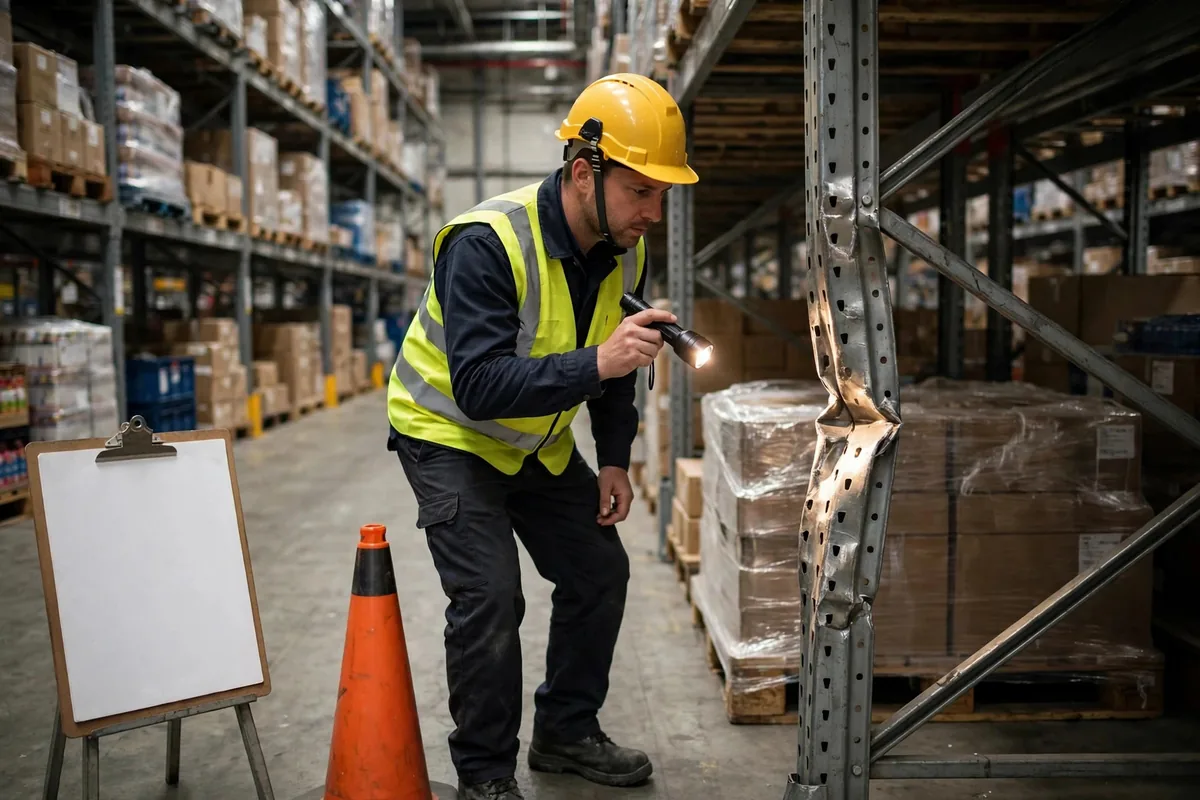
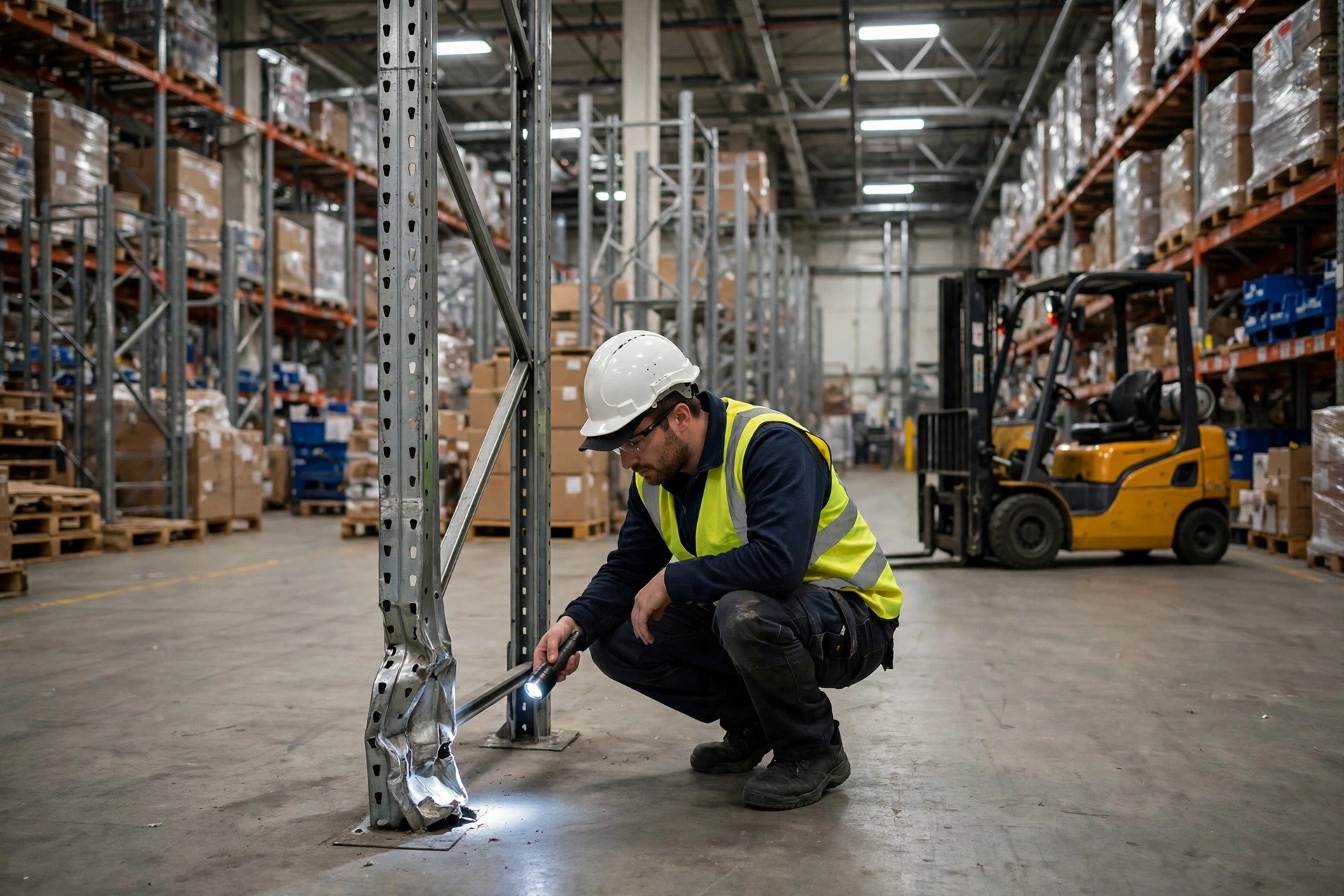
I have seen this pitfall three times, and the most recent one still bothers me. In the fall of 2023, I was walking a 3PL warehouse in Ontario, California — roughly 60,000 square feet, five-level high-bay racking — ahead of a WMS go-live. Down aisle 7, third bay in, one upright had an obvious dent near the base, with fresh paint over it. Two months earlier a forklift had clipped it while reversing. The shift lead decided it "looked fine," had someone paint over the dent, and kept loading pallets above it — four levels of heavy product. I had them empty all six pallet positions in that bay on the spot. The racking supplier came the next day and said the same thing: that upright could no longer be counted at its original capacity. Paint over impact damage is the most dangerous "repair" I know, because the cleaner it looks, the better the hazard hides.
Why Most Inspections Miss the Problem
Most annual inspections check whether parts exist, not whether they still work. Beam present? Yes. Upright straight? Looks fine from a distance. Anchor bolts all there? Counted, all present. Everything passes. But racks do not fail because a part went missing. They fail because a part stopped carrying its load while everyone kept loading it. A beam sags a few millimeters and the eye misses it. An upright gets dented and painted over. An anchor bolt works half a turn loose and nobody ever puts a wrench on it. The point of an inspection is not to prove the racking is fine. It is to find the few places that are already not fine.
How to Use This Warehouse Racking Safety Inspection Checklist: Grade First, Then Act
Grade first, then decide what to do, and the person inspecting only grades — they do not negotiate whether something "can last a bit longer." Green means normal use, just log it. Yellow means repair within a deadline, usually two weeks, with reduced load or a height restriction in the meantime. Red means take it out of service now: empty the positions, tape off the bay, escalate the same day. The grading rules must be written down before anyone walks the aisle. If the rules get invented on the spot, every problem turns into "let's keep an eye on it," and you end up with a list full of observations and zero actions.
Walk the aisle from both ends toward the middle. Check upright bases and anchors first, then look up at the beams, then the high connections last. The logic is simple: uprights and anchors are the root of the load path. If the root is bad, nothing above it matters. Low-level problems are also the easiest to find, so you clear a batch of them before anyone climbs anything.
| Component | Green (normal use) | Yellow (repair within two weeks) | Red (out of service now) |
|---|---|---|---|
| Beam | Straight, connectors fully seated, no deflection | Slight sag or loose connector, tighten or schedule replacement | Visible sag, cracking, connector dislodged or missing |
| Upright | Straight, no impact marks, paint intact | Minor dent or scrape, logged and scheduled for assessment | Clear dent, tear, lean, or damage hidden under fresh paint |
| Floor anchor | All bolts present and tight, base plate flush to the floor | Bolt loose or base plate slightly lifted, tighten within deadline | Bolt missing or broken, base plate floating, upright shifted |
Beams: Check the Sag, Then the Connectors
The most common beam problem is not breakage. It is bending. Pallets overloaded, loads placed off-center, a forklift setting a pallet down hard — beams sag gradually, and gradual is exactly what the eye misses. Do not inspect a beam from the front. Crouch and sight along its length; sag shows most clearly from the side. Put a hand under the middle of the beam and feel for abnormal flex. Then check the connectors: a connector not fully seated, a broken spring clip, a missing safety pin, and a beam can slide off the upright at the slightest knock. In early 2024, on another go-live project, I found a beam with a missing safety pin on one end. A driver bumped it lightly while retrieving a pallet, and the whole beam dropped a notch with the pallet on it. Nobody was standing underneath. That was luck, not a system. Since then, connectors and safety pins get their own line on my checklist, never folded into "beam appearance," because anything folded into appearance gets skimmed.
Here is the counterintuitive part: a bay with a freshly replaced beam deserves extra attention, not less. A new beam on old uprights can mean mismatched connector types or worn holes that only show up after the swap. Replacing a part is not the end of the check. The first re-inspection after the replacement is. During an annual inspection, pull out every bay that had parts replaced in the past year and re-check them one by one. That targeted pass beats spreading the same effort evenly across the whole building.
Uprights and Floor Anchors: Grade the Damage, Respect the Red Line
For uprights, remember one rule: look at the bottom meter. Forklifts, pallets and pallet jacks hit low — nine out of ten impact marks sit within a meter of the floor. Check four things: dents on the front face, tears on the side, cracks at the weld where the upright meets the base plate, and whether the whole upright leans. For lean, hold a long straightedge against the side of the upright; you will see it immediately. For anchors, use your hands: put a wrench on every bolt, one by one, and check whether the base plate sits flush on the floor or has been jacked up by a forklift wheel. A missing bolt is a non-negotiable red line. Lose one bolt and the load path through that upright has already changed.
I saw a subtler version of this in 2022. A warehouse had a clean annual report — everything passed — and a month later a full run of racking leaned forward during replenishment. Nobody was in the aisle, fortunately. The cause was not the upright at all. It was the floor: the concrete under one base plate had settled, the plate was floating, and half its bolts were carrying nothing even though they all looked present. An inspection that looks at racking but not at the floor will miss exactly this kind of failure. So my checklist has a dedicated line: base plate flush to the floor, floor free of cracking or settlement. Racking stands on the floor. When the floor moves, a "passed" inspection means nothing.
Three Places This Inspection Checklist Usually Misses
First, high beams. Inspectors do not like climbing, so high levels stay "visually OK" forever. My rule is simple: high levels get properly inspected, with a lift or a forklift cage, or they do not get marked normal. Second, aisle-end uprights. Ends are where forklifts turn, so they take the most hits, yet they get skipped because they are "not the main run." Third, the follow-up itself. The biggest inspection failure is not a missed defect. It is a found defect with nobody assigned to fix it. Every yellow and red item must carry three fields: who fixes it, by what date, and who re-checks it. A checklist without those three fields is scrap paper once it is written.
Run the trade-off in plain numbers and the decision makes itself. Emptying six pallet positions for two weeks costs you the throughput of those positions. A failed upright costs you the whole run, plus damaged product, damaged equipment, injured people and the shutdown that follows. These two costs are not in the same league. The labor and downtime an inspection takes is the cheapest safety money a warehouse spends. Saving that time means betting a full run of racking against nothing — a bet nobody can afford to lose.
That is why a racking page sits in my go-live-night checklist on every project. Set the grading rules before you walk in. Check low first, check high properly. Beams: sag and connectors. Uprights: the bottom meter. Anchors: every bolt, by hand. Red means out now, yellow closes within two weeks, and every item carries an owner, a deadline and a re-checker. The stamp on the annual report is not what keeps the building safe. The closed loop on every line of this warehouse racking safety inspection checklist is.
By Lin Xiao, WMS Implementation Consultant