How much does warehouse racking cost per pallet position? That is the wrong first question — and also the only question that matters, once you ask it correctly. Last month a client in Fontana, California put three integrator quotes on my desk for an 8,000-pallet-position retrofit: selective, drive-in, and a shuttle system. The totals were more than $3 million apart, and nobody in the room could say which one was actually cheaper. Because nobody had divided anything by anything yet.
So I did the one division that matters:
- Selective: ~$1.04M in equipment, or $130 per pallet position
- Drive-in: ~$960K in equipment, or $120 per pallet position
- Drive-in + shuttle: ~$3.84M in equipment, or $480 per pallet position
Look at those three lines and the shuttle looks absurd. But equipment is the smallest line item on the real ledger. The total cost of a pallet position is three things — equipment depreciation, rent per position, and labor per position — and the people who pick the wrong racking are almost always the ones who only priced the equipment.
Warehouse Racking Cost Per Pallet Position: the Equipment Number, Cleaned Up
Here is what the steel actually costs. Ranges below are compiled from multiple North American integrator quotes; steel prices and regional labor move around, so treat these as planning brackets and get current quotes before you commit:
| System | Equipment cost per pallet position (material + install) | Storage density | Selectivity |
|---|---|---|---|
| Selective | $80–160 | Baseline: one forklift aisle per rack row | 100%, any pallet directly accessible |
| Drive-in | $70–140 | Roughly 1.8–2.2x selective | LIFO, worst selectivity |
| Drive-in + shuttle | $300–650 (all-in: shuttles, charging, software) | ~15% above plain drive-in | FIFO possible, deep lanes still constrained |
Here is the part most buyers miss: drive-in racking is actually cheaper per position than selective on equipment alone. Less steel — the aisles are occupied by freight, so half the beams disappear. Ask "how much does warehouse racking cost per pallet position" and the cheapest answer is drive-in. The trap is not in the equipment line. It is in the other two.
Annual cost per pallet position = equipment cost ÷ depreciation years + annual rent ÷ total positions + annual labor ÷ total positions
Depreciate the steel over 10 years (illustrative assumption) and a $130 position costs you $13 a year. The rent allocated to that same position will easily be ten times that. A ledger without rent is not a ledger.
The Two Line Items That Actually Decide It: Rent and Labor
Fall 2023. A frozen-food 3PL in Fontana, California. 6,000 pallet positions, fewer than 50 SKUs, and hundreds of pallets per SKU — the classic few-varieties, deep-inventory profile.
We ran the full ledger for selective versus drive-in. Rent at the time was running $1.00–1.30 per square foot per month across the Inland Empire (check the latest market report; I am using $1.20 for this worked example):
- Selective: ~34,000 sq ft of storage area, annual rent 34,000 × 1.20 × 12 ≈ $490K; equipment 6,000 × $130 = $780K, depreciation $78K/yr
- Drive-in: ~19,000 sq ft of storage area, annual rent ≈ $270K; equipment 6,000 × $115 = $690K, depreciation $69K/yr
- Rent delta: $220K/yr in favor of drive-in; equipment delta: $9K/yr
- Labor cost: drive-in is slower to load and unload, and drivers run in and out of the lanes. Budget 1.5 extra drivers at ~$55K each (illustrative) ≈ $82.5K/yr
Net: 220 − 9 − 82.5 ≈ $128K per year. Over five years, drive-in beats selective by more than $600K.
Cold verdict: for deep, low-SKU freight, drive-in is a money printer. The $220K annual rent saving is more than double the combined equipment and labor penalty. That money is well spent.
The Auto-Parts Warehouse the Shuttle Could Not Save
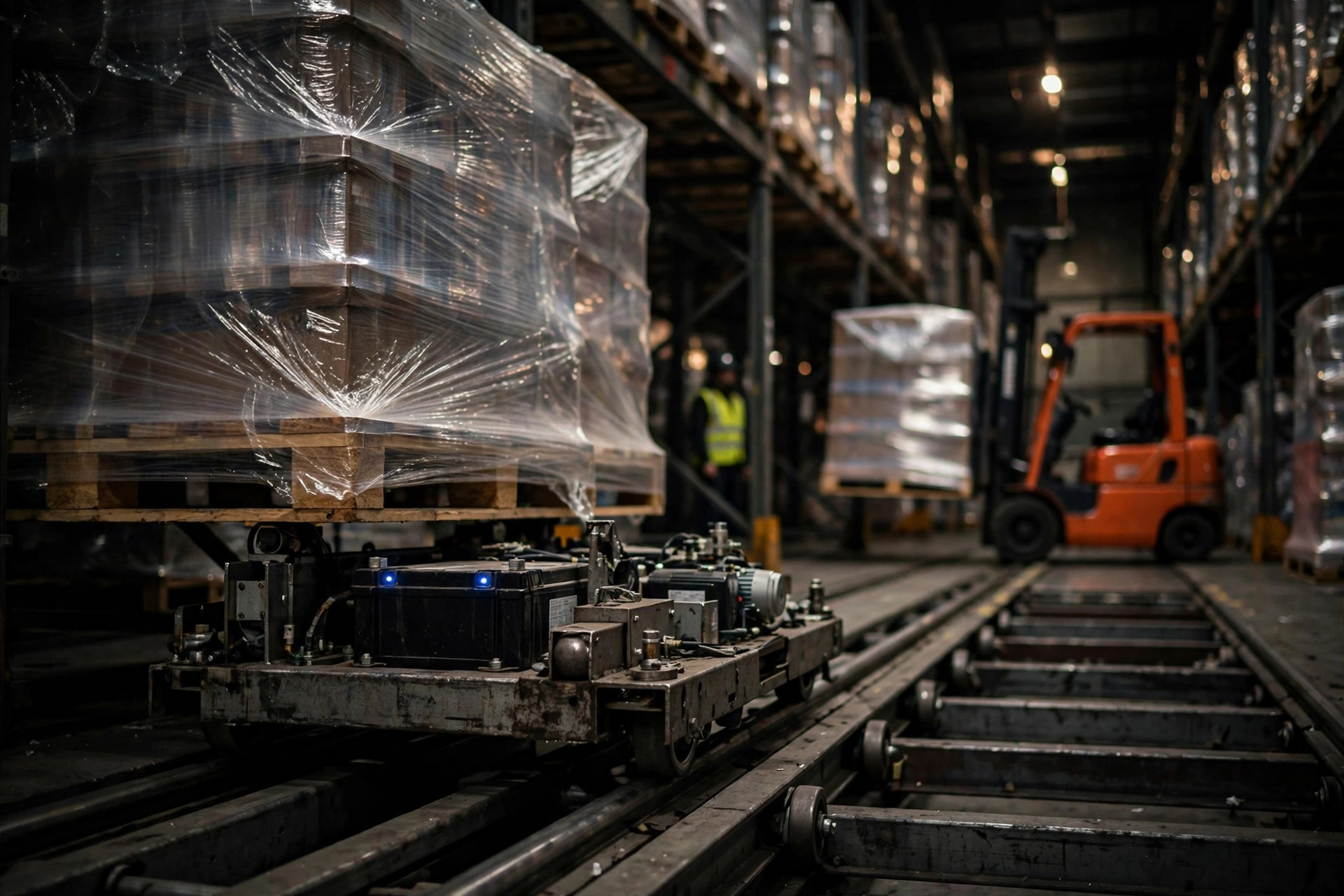
But density is not for everyone. Early 2024, an auto-parts distributor in Riverside, California asked me to audit their numbers. 2,400 SKUs, averaging 4 pallets per SKU. The owner had bought the integrator's pitch and installed drive-in racking with pallet shuttles: 8,000 positions, $3.8 million total, $475 per pallet position.
Eight months later I walked the books, and the damage was obvious:
First, with 4 pallets per SKU, they could not fill 6-deep lanes. Selectivity collapsed, deep-lane freight went dead, and 9% of the positions became permanent dead stock. The SKU profile ate most of the density advantage alive.
Second, replenishment staff were burning roughly an hour per shift waiting on and hunting freight — about $130K a year in labor. Shuttle batteries and rail maintenance added another $40K-plus annually.
Now run the selective numbers for the same building: equipment 8,000 × $135 = $1.08M; 20,000 extra square feet of storage at $1.20 × 12 = $288K a year in rent.
Five-year total cost of ownership:
- Shuttle system: $3.8M + ($130K + $40K) × 5 = $4.65M
- Selective: $1.08M + $288K × 5 = $2.52M
A $2.1 million gap. The shuttle is not bad equipment. It was the wrong freight.
Here is the counterintuitive call: a shuttle system makes the equipment cost per pallet position 3 to 5 times that of selective — and it was never designed to save equipment money. A shuttle buys exactly two things: the rent delta from compressing forklift aisles from 3-plus meters to about 1, and the labor delta from replacing "driver waits inside the rack" with "cart runs itself." With the wrong SKU profile you buy neither, and what remains is expensive steel. That money is wasted.
The Decision Rule: One Formula, Your Numbers
Should you go high-density? No gut calls needed. The break-even condition is a single inequality:
Annual rent savings > annual equipment depreciation delta + annual labor cost delta
Left side = (selective footprint − high-density footprint) × rent per sq ft Right side = (equipment price delta ÷ depreciation years) + extra labor
Five minutes with a sheet of paper. If the left side wins, go dense; if not, stay selective. And one rule of thumb from the field: if your average pallets per SKU is below 6, do not touch drive-in. Below that line, the selectivity losses will eat every dollar of rent savings and then some.
Instinct lies. The formula does not.
By Lao Zhou, Logistics Cost Analyst