Let me tell you something. Fifteen years behind the wheel, I have backed a truck into more warehouses than I can count, and I only really learned what a warehouse rack safety inspection checklist means the day I pulled up to a warehouse where something had already gone wrong.
It was a winter delivery a couple of years back, at a 3PL warehouse in eastern China. A forklift was pulling a pallet off a high-bay rack, and I could see with my own eyes that one of the uprights was leaning out by about a finger's width, with one end of a beam sticking up. The driver told me that unit had been leaning for close to half a year, and everybody just walked around it. So I asked the obvious question: whose job is this? He scratched his head and said he had no idea. Nobody had ever come to check.
That is when it finally clicked for me. One never collapses in a single day. An upright gets bent by a forklift, a bolt works loose, an anchor rusts through — these things pile up slowly, one small defect at a time. An inspection program is really just a set of rules: who inspects, how often, who signs off when something is found, and where the records go. Without those rules, it is a time bomb. It looks fine right up until the second it is not.
What a Rack Safety Inspection Actually Checks
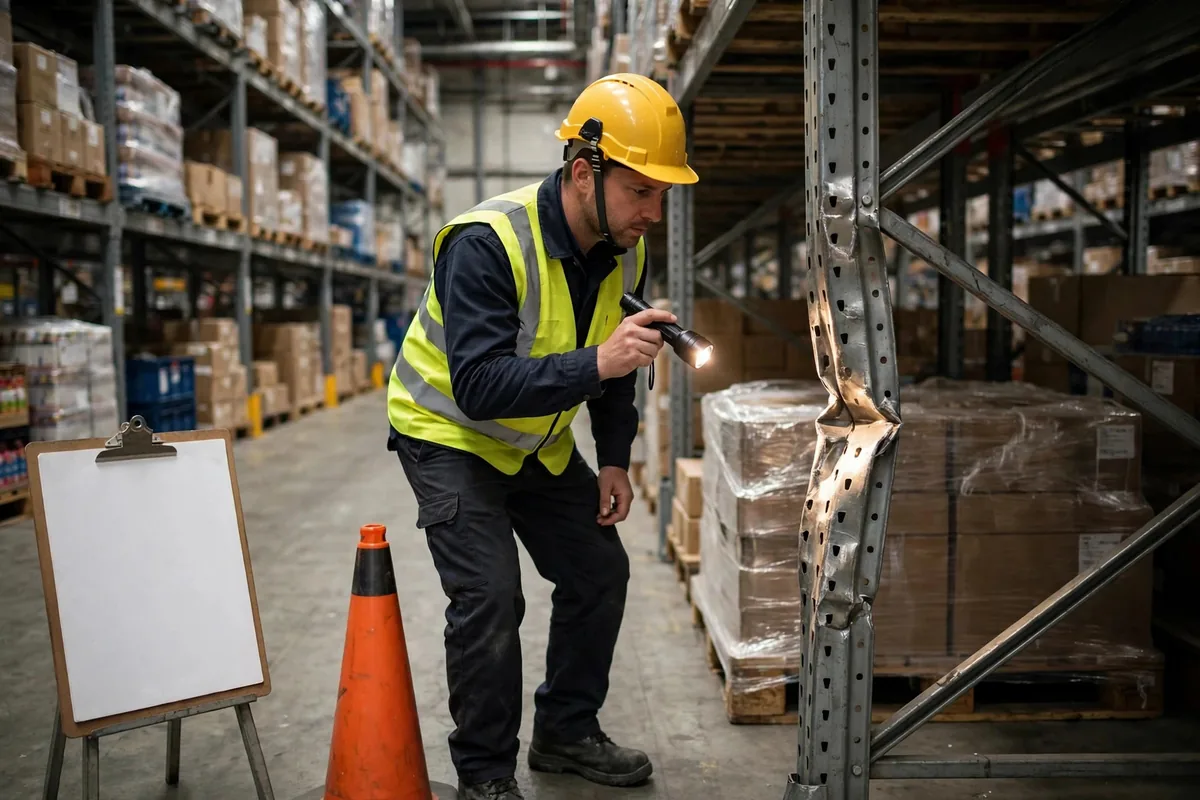
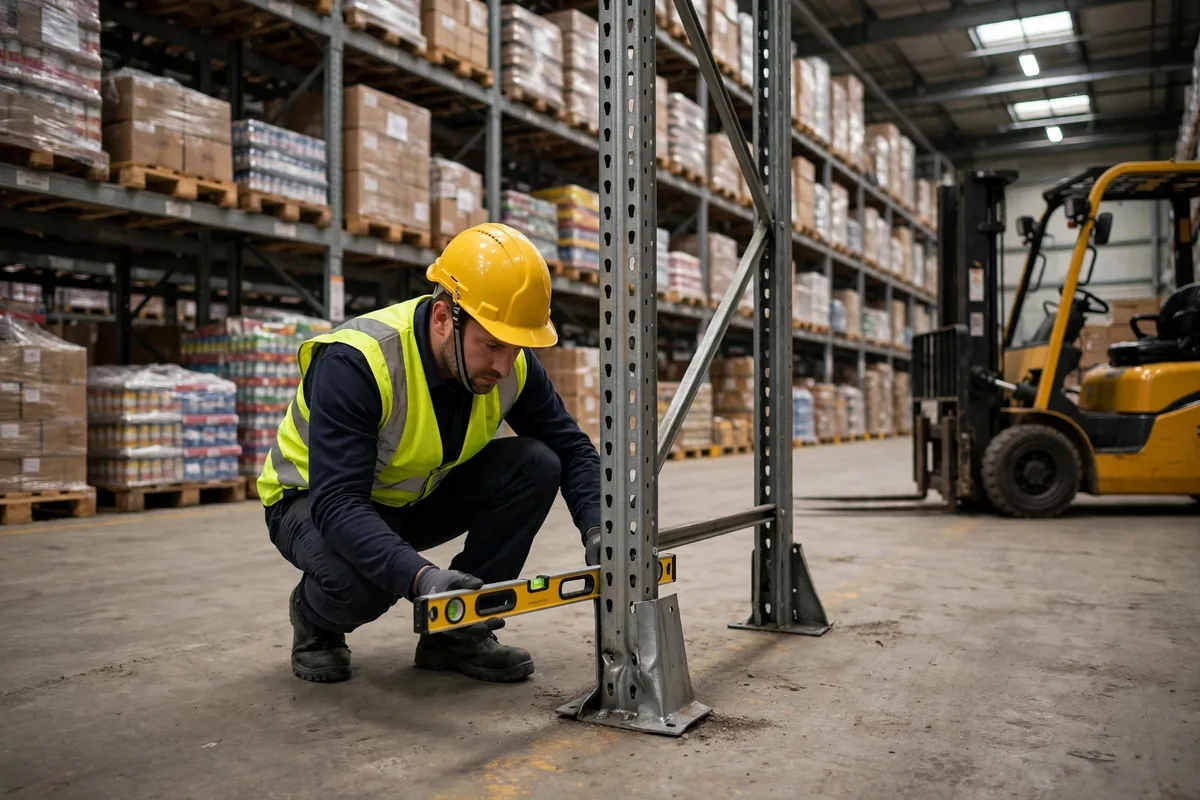
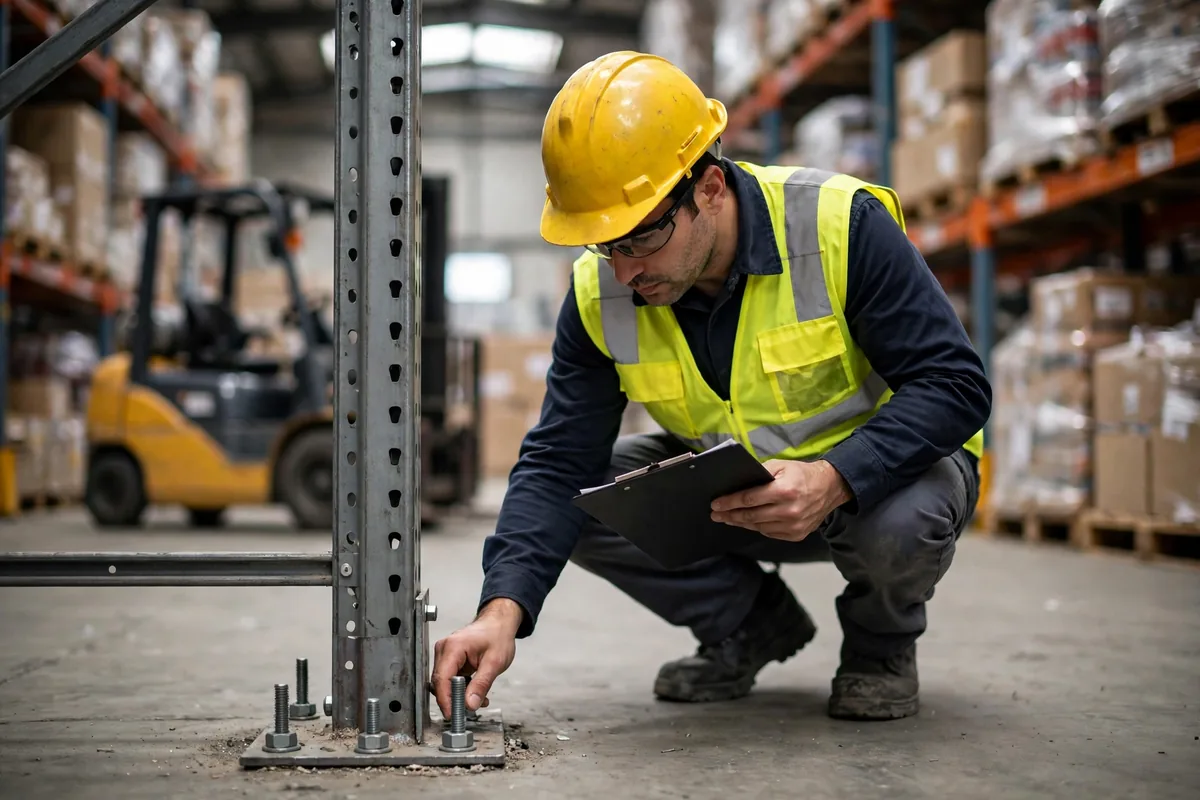
First, what gets checked. A warehouse safety inspection is not a stroll down the aisle to see if things look tidy. It checks four things: whether the uprights are bent or dented; whether the beam safety locks are in place and fully engaged; whether the anchor bolts are tight and the floor is free of cracks; and whether the load plaques are still there and the weight on the rack matches what the plaque says.
The in-house walk-through and the annual third-party inspection are two different animals. The walk-through is done by the warehouse's own people, every shift or every week — eyes on the racks, a hand on the beam, and anything bent or loose gets reported. The annual inspection is a formal job, once a year, done by a qualified outside firm that brings instruments, measures row by row, and issues a written report. Think of it this way: the walk-through is like a driver circling the truck before a run, and the annual inspection is the yearly vehicle inspection. You need both. Neither replaces the other.
Let me run some numbers for you — and to be clear, these are hypothetical figures, an illustrative example, not measured data. Take a 5,000-square-meter warehouse with about 40 rack rows. Spread the cost of one annual third-party inspection across those rows, and you are talking about the price of one dinner per row. Now imagine one row going down: damaged product, a stopped operation, claims and compensation. Any one of those costs a multiple of the whole inspection fee. Anybody can do that math. The problem is that too many people think "it won't happen to us," so they skip the inspection. Saving pennies to gamble with lives — in fifteen years of trucking, I have never seen that bet pay off.
How Often Should a Rack Inspection Happen, and Who Signs
How often should racks be inspected? Here is a table you can copy as-is:
| Inspection type | Frequency | Done by | Signs off |
|---|---|---|---|
| Daily walk-through | Every shift or weekly | Warehouse staff, forklift lead | Shift supervisor |
| Monthly check | Once a month | Warehouse manager with team | Warehouse manager |
| Annual third-party inspection | Once a year | Qualified outside inspection firm | Inspector plus warehouse manager |
The signature is the part that matters most. When a defect is found, the inspector signs, the warehouse manager signs, and the person responsible for the fix signs. Three signatures on the same page. Whoever signs owns it, and if anything ever goes wrong, the records tell the whole story, line by line. The worst case is an inspection with nobody's signature on it — or a signature from someone who was never on site. A report like that is waste paper, and when something happens, everybody can walk away clean.
Here is another scenario, again with hypothetical numbers used only for illustration. Last summer, a warehouse in northern China had its annual third-party inspection. The inspector found three beam safety locks missing on one high-bay row, and one upright dented at the base from a forklift strike. A red out-of-service tag went on the row right there, the warehouse manager signed it, and the whole row was unloaded and moved within two days. Only after the repairs passed a re-check did the tag come off and the row go back into service. Keep using that row with several tons of product stacked on it, and you do not want to think about what happens next. That tag looked like a delay. In reality it saved the people working under those racks.
When a Defect Is Found, What Happens — and Where the Records Go
Defects get three grades. Red means stop: the row is taken out of service and the product comes down immediately. Yellow means reduced load: heavy pallets move out, and only light loads go back in. Green means a minor issue to be fixed by a deadline, then re-checked. The grading cannot be fuzzy. Whoever says "it will hold for now" is gambling.
The paperwork matters just as much. Every inspection report, every photo, every signed sheet should be kept for at least three years, digital copy plus paper copy. Two reasons. First, when something goes wrong, people go back through the old records. Second, the insurer will ask whether you did your duty to inspect. If your records are a mess, one sentence shuts your claim down: you have no inspection records, so how can you prove you did your job?
Here is the part that surprises most people: a long list of defects in an annual inspection is not necessarily a bad sign. The most dangerous warehouse is the one that reports zero problems year after year — either the inspection is a formality, or someone is hiding the problems. A healthy warehouse always has a few items to fix, and the list gets shorter every year. That is what normal looks like. People who are afraid of finding problems usually end up blindsided by the ones nobody found.
They cannot talk. But they can fall. A warehouse safety inspection program is, in plain language, a way to give those silent racks a voice: somebody checks, somebody signs, somebody fixes. Next time you walk into a warehouse, look up at the beams over your head, then down at the uprights by your feet. Those few pieces of steel — are they worth one serious day of inspection a year? If the answer in your gut is yes, do not wait for the day something falls to prove it.
By Shifu Zhao, Trucking Veteran (15 yrs)