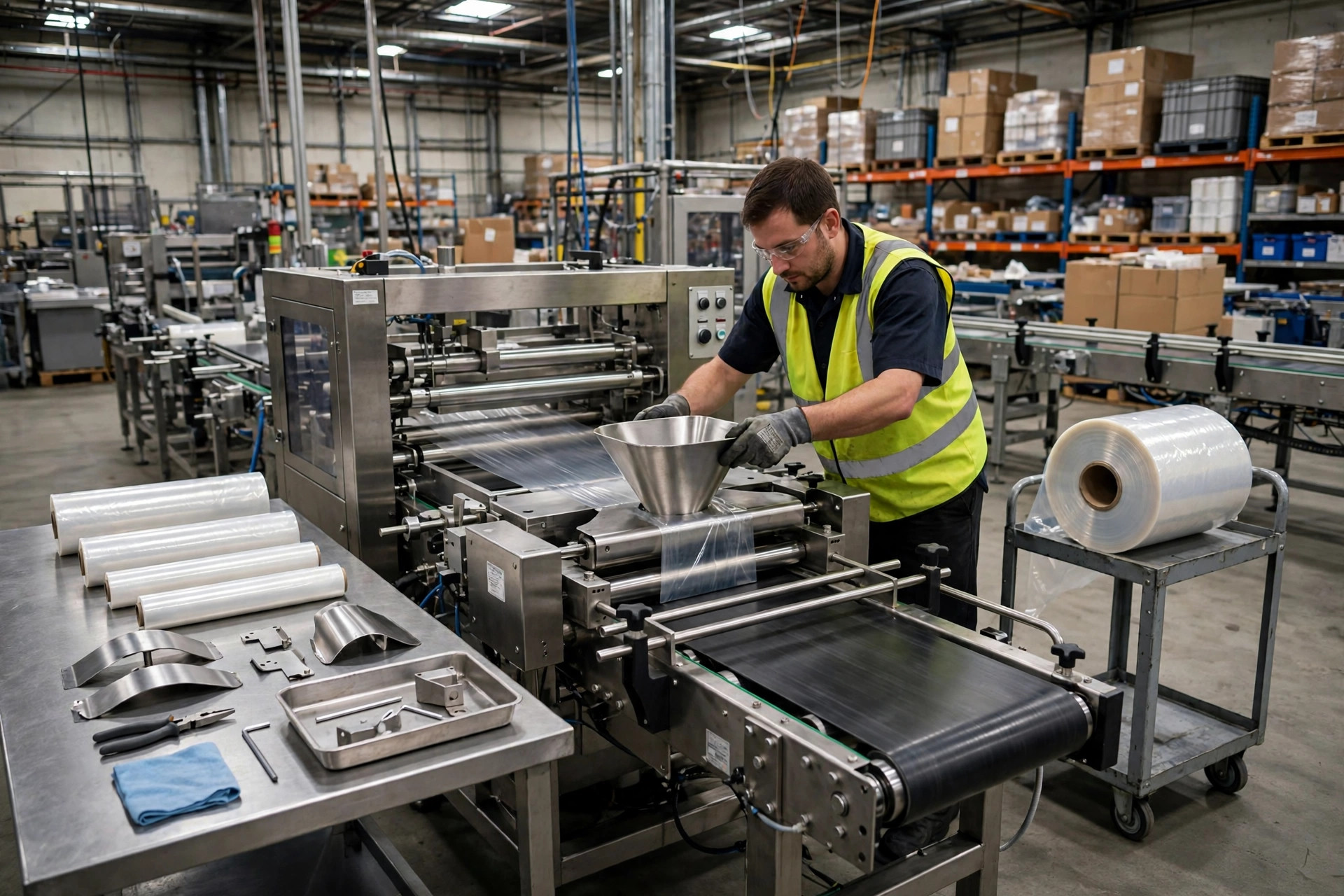
Last fall I spent a shift at a seasoning plant watching their new automatic packaging line. The owner was proud of it: 120 bags a minute, he told me twice. I watched three changeovers that shift, switching from 200-gram bags to 500-gram bags. Swap the film, swap the forming shoulder, adjust the sealing temperature, reset the weigher, run a dozen trial bags, weigh them, adjust, run more. Average time: 68 minutes — a textbook warehouse packaging line changeover small batch problem. The line can run fast, but for those 68 minutes it produces exactly nothing.
Think of it this way: line speed is your sprint time, and changeover time is the time you spend tying your shoes before the gun goes off. When orders are high-mix and small-batch, you spend more time tying shoes than running. That is the real question behind warehouse packaging line changeover small batch work: how fast your changeover is decides whether small orders make money or lose it.
Where the Changeover Time Actually Goes
Start with the principle: one complete changeover runs from the last good bag of job A to the first good bag of job B. Every task in between falls into two buckets: internal setup, which can only be done while the machine is stopped, and external setup, which can be done while the machine is still running the previous job. Shigeo Shingo built SMED — Single-Minute Exchange of Die — at Toyota in the 1950s and 1960s on one idea: pull the external work out of the downtime window first, then compress what is left. The SMED target is single-digit minutes, under 10.
Packaging lines that have never been through SMED typically take 45 to 120 minutes per changeover. Run the same line through SMED properly and it lands at 10 to 25 minutes, roughly a 50 to 80 percent reduction. Those ranges recur in published material; they are not one vendor's brochure numbers. What actually happens in a changeover? Take a vertical form-fill-seal line: stop, clean the hopper and contact parts, swap the film roll and forming collar, swap or adjust the seal jaws, change the filler tooling, load the new recipe, re-thread the film, run trial bags, and adjust until seal, weight, and cut-off meet spec. Count it up: a dozen-plus steps. Most plants do not have one step that is too slow; they have a dozen steps all crammed into the downtime window, done one after another.
The scene I see most often: the operator stops the line, then walks to fetch the next film roll, finds the width is wrong, and walks back. The film sat on a rack three meters from the line the whole time. That round trip burns ten minutes for nothing. The other classic: one operator does the whole changeover while the second watches, and five minutes vanish hunting through HMI menus for the sealing temperature page, because nobody saved the recipe.
The Warehouse Packaging Line Changeover Small Batch Dividing Line: 15, 30, or 60 Minutes
Dividing lines have to come from math, not gut feel. The table below is a hypothetical worked example — a line running 60 bags a minute at a contribution of 0.30 dollars per bag. The numbers are a scenario illustration, not any plant's real books, but the method drops straight onto your own line:
| Changeover time | Output lost per changeover | Contribution lost per changeover (hypothetical) | Lost per day at 4 changeovers | | 60 minutes | 3,600 bags | $1,080 | $4,320 | | 30 minutes | 1,800 bags | $540 | $2,160 | | 15 minutes | 900 bags | $270 | $1,080 | | 10 minutes | 600 bags | $180 | $720 |
Same line, same orders: cutting changeover from 60 to 15 minutes frees up $3,240 of contribution a day at four changeovers — before counting trial-bag waste and overtime. Now the dividing line reads clearly.
Over 60 minutes only works for big batches and few changeovers. More than three changeovers a day and small-batch orders are basically loss-making, no matter how fast the line runs. Around 30 minutes is the pass mark for small batches: four to six changeovers a day stay manageable, and scheduling stops bending around changeovers. Under 15 minutes is the comfort zone for high-mix, small-batch work — published vendor material shows a full format change, film plus a different pack height, done in about 15 minutes. Under 10 minutes is the SMED target: automated changeover systems on beverage lines are published at about 10 minutes for a product change and about 30 minutes for a format change.
Here is the counterintuitive part: the fastest changeover line is not necessarily the most expensive line. Plenty of plants assume they need to buy fully automatic changeover, when stripping out external setup, pre-staging format parts, and saving recipes usually cuts the time in half first — for a fraction of the money. And the reverse is just as true: buy a premium line with automatic changeover, skip changeover management, and you will still change over in 40 minutes. The machine saves motion time, not the waiting time of work nobody prepared. A good third of most changeover time is waiting — for people, for material, for parameters — and that has nothing to do with how expensive the machine is.
Why Small-Batch Changeovers Stay Slow: Three Traps
The first trap is recipes that live in someone's head. One line, a dozen SKUs, and the sealing temperature, fill weight, and cut-off position all depend on the senior operator's memory. He takes a day off and the line has to re-learn everything by trial. The fix is recipe management: every SKU's parameters saved on the HMI, called up at changeover, verified once, then run. If a parameter can be stored, nobody should have to memorize it.
The second trap is format parts that are not pre-staged. Forming shoulders, seal jaws, chain flights — they sit in a cabinet until changeover starts, and then they still need adjusting. The fast way is to stage them as a kit per SKU: while job A is still running, job B's format parts are already at the line, color-coded, matched one to one, and they go on without adjustment. Some vendors build forming shoulders as a two-piece set that swaps without adjustment, with film rolls that self-align. What those designs save is not effort but trial-and-error time.
The third trap is trial waste that nobody counts. A dozen or two dozen trial bags per changeover, film and product included, unrecorded — add it up at month end and it is real money. Trial bag count belongs in the changeover record: how many bags were trialled, how much film was scrapped. Next changeover, push that number down. Trials are not free, and cutting trial bags in half is the same as saving several more minutes per changeover.
One more thing that usually gets missed: can the changeover run in parallel? One person doing everything in sequence takes 60 minutes. Two people splitting the work — one on film, one on the forming set — turn serial tasks into parallel ones and the time roughly halves. SMED calls this parallel operation. It costs no equipment, just a task sheet: who does which steps, in what order, starting when. Many plants are slow because of one stubborn habit: treating changeover as a one-person job. In warehouse packaging line changeover small batch operations, where changeovers happen several times a day, the minutes saved by parallel work add up to nearly a full shift.
Schedulers need to read this table too. With 60-minute changeovers, a line fits about three SKUs a day; with 15-minute ones, eight without overtime. Whether to take a small order, and what price to quote, comes down to this table. Sales quotes on unit price without counting changeovers, production schedules on delivery dates without counting frequency, and the gap is paid in changeover time.
And one sacred cow deserves a direct hit: the plant that demands "one-touch changeover" before doing anything else, with a big budget attached. First question: how many changeovers a day do you actually run? On a line that changes over once a day, cutting changeover from 60 to 15 minutes may not save enough downtime in a year to cover the automatic changeover module. Measure first, calculate second, spend third. Film one full changeover on a phone, classify every minute — internal or external, action or waiting — and build that table before deciding where the money goes.
Whether the money is worth it comes down to one number: the total cost of a single changeover — the contribution lost to downtime, plus the film and product wasted on trials, plus the extra labor hours. Work that number out, then look at any machine that claims "quick changeover." Worth it or not, you will know at a glance.
By Da Liu, Automation Engineer