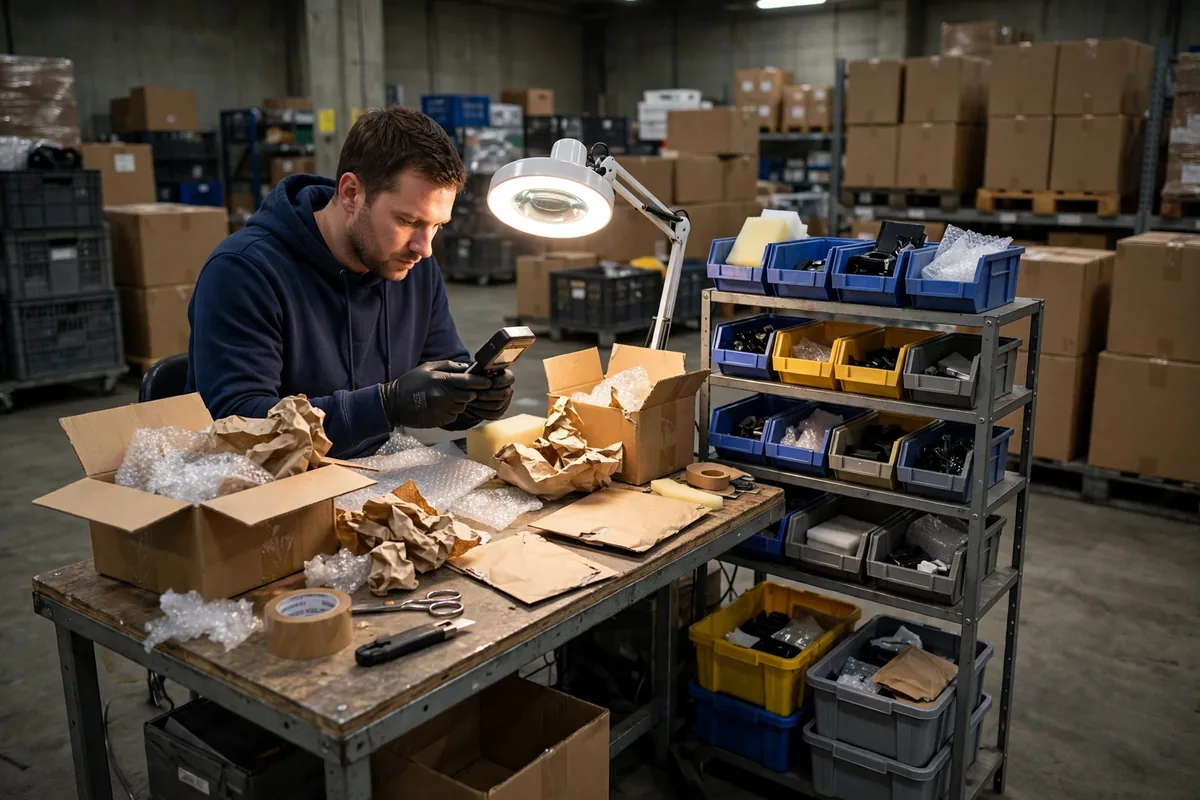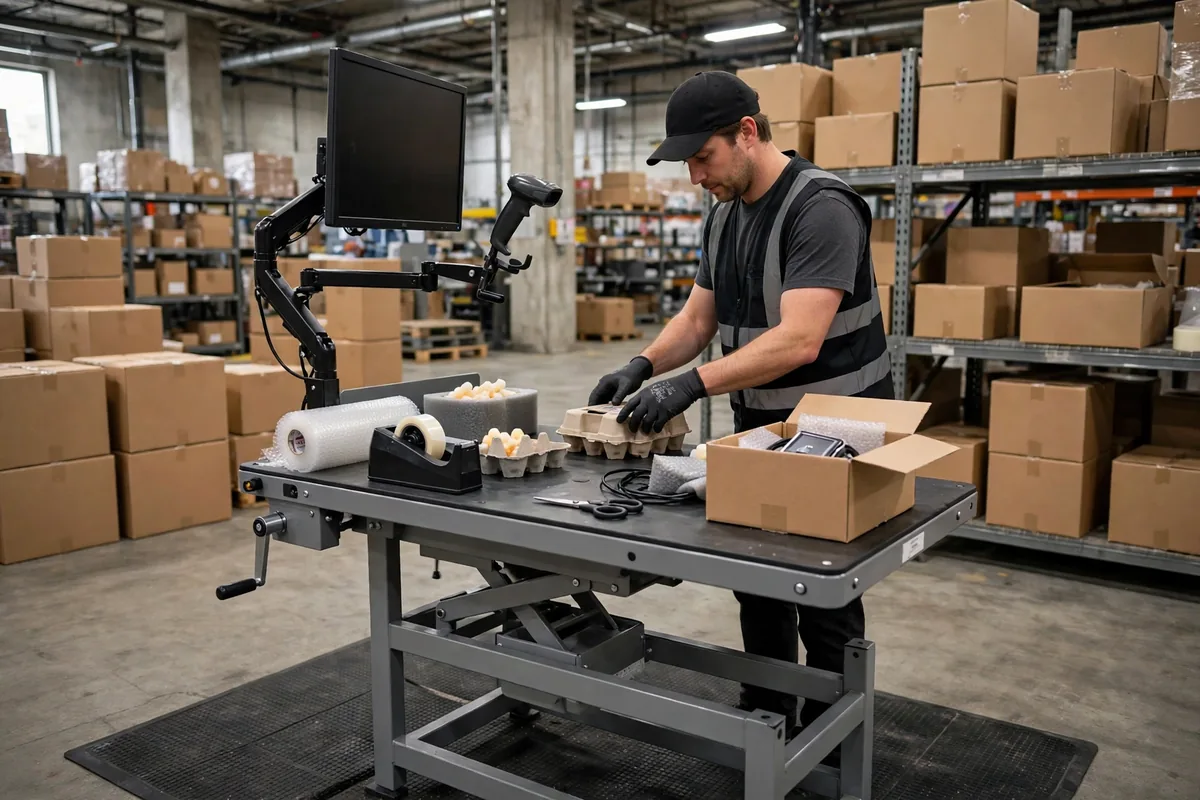
At 6:40 in the morning, before the light was fully up, the pack area was already stacked with totes waiting to be packed. I stood behind station three and watched a new hire work. He was tall, the bench was low, and every carton forced him to bend. The scanner sat in the far corner, so every scan cost him half a lunge. Honestly, a bench like that does not need peak season to hurt someone. By noon his lower back was talking to him. That is what warehouse pack bench ergonomics height means on a real floor: a person stands there for eight to twelve hours, and the bench should fit the person, not the other way around.
Do not treat this as a minor comfort issue. Packing is the last human touch before a carton leaves the building. When people get tired, their movements change. Labels get missed, paperwork lands in the wrong box, tape goes on crooked. In peak season, most of those small errors start with tired bodies. Our benches used to be one uniform height because purchasing wanted one simple order. Tall packers could not reach material comfortably. Shorter packers bent all shift. One night-shift packer quietly put cardboard under her feet, and a supervisor told her she was breaking the rules. I got annoyed, and not at her. The bench was the problem.
Warehouse pack bench ergonomics height starts with the work surface
We eventually set bench height the slow way, which is also the way that works. We took three packers of clearly different heights, gave them the same order mix and the same materials, and raised or lowered an adjustable bench a little at a time. Each person packed for a full hour at each setting. We tracked three things: cartons packed, a simple self-rated score for back and shoulder fatigue, and whether the packer had to lunge to reach tape or void fill. As an illustrative scenario with hypothetical numbers, imagine a mid-height packer on a bench set too low bending well over a hundred extra times in an hour. Move the surface up to where the elbows hang naturally and sealing does not require pressing down, and the same order mix produces fewer error prompts and a noticeably lower fatigue score. Those numbers are a worked example, not a standard. Your crew's heights are different, so copying a number is pointless. Copy the method.
Here is the counterintuitive part. Lower is not always easier, and higher is not always better. When a warehouse packs heavy, bulky cartons, a slightly lower surface lets a packer use body weight to seal and move boxes. When the mix is mostly small, light items with constant scanning and labeling, a slightly higher surface keeps the hands working near elbow height and stops the shoulders from hanging all shift. So do not ask me for one magic height. I cannot give you one. Ask what your order profile looks like: how much is large, how much is small, do people stand the whole shift or rotate between sitting and standing. Answer that first.
Feet matter just as much. Half of standing fatigue starts at the floor. An anti-fatigue mat is not a perk; it protects output. During long peak shifts, numb feet make people shift their weight to one side. Once the stance goes crooked, the back follows. We rotated packers between stations with and without decent mats on night shift, and the complaints in the second half of the shift were not close. You do not need the most expensive mat. One that is too soft is actually worse because it feels unstable. Pick one with real support and edges that do not curl.
Reach and screen position: the second half of pack bench ergonomics
A correct bench height still fails if everything on it is in the wrong place. The things a packer touches most — labels, tape, void fill, and the scanner — need to sit within one easy arm's reach, with no lunging and no turning around. Consider a second illustrative scenario, with the location and figures as a hypothetical example. Before a peak season, a mid-sized e-commerce warehouse rearranged its pack area. Void fill had lived behind the bench, so every carton cost the packer a turn and a step. Over a shift, that was hundreds of extra turns. The team moved void fill to a rack at the side of the surface, moved the label printer to the dominant-hand side, and put the scanner in the natural drop zone below the monitor instead of in a far corner.
| Change | Before (hypothetical example) | After (hypothetical example) |
|---|---|---|
| Void fill access | Turn and take a step | Side reach, no step |
| Scanner position | Far corner of the bench | Below the monitor, at hand level |
| Monitor height | Well below eye line, constant neck bend | Raised so the head stays mostly level |
| Extra motion per order | Repeated lunging and turning | Nearly all work done in place |
Read the table for its logic, not its numbers. A pack station problem is never just height. It is height, distance, and eye line twisted together. A monitor set too low bends the neck for an entire shift. A monitor set too far away makes order checks slow because the packer keeps leaning in. A scanner hung up high turns every scan into a shoulder lift. Our fixed practice now is simple: raise the monitor so the eyes do not have to drop much, keep the scanner where the dominant hand naturally lands, keep the cable out of the way, and arrange consumables by frequency — most used closest, least used farthest.
I have managed warehouses long enough to watch companies spend heavily on sortation and then buy the cheapest possible tables for packing. Packing is one of the stations where people spend the longest continuous time. Fatigue there builds by the month, and so does turnover. Hiring in peak season is hard; keeping an experienced packer is worth far more than a small saving on a bench. A veteran packer is worth two new hires. Do not let a bad bench wear that person out.
Our routine now has four steps whenever new benches arrive or we reset before peak. First, set height by order profile, with large-item and small-item stations adjusted separately instead of forcing one height on the whole floor. Second, test with three real packers of different heights for a full hour each, and ignore any supplier claim that a bench is ergonomic until your own people prove it. Third, photograph the final layout of materials and devices and keep that photo as the standard, so every shift sets the station the same way and new hires can copy the picture. Fourth, come back two weeks later and ask packers where it still hurts — back, shoulders, feet — and adjust again if the same complaint keeps appearing. One adjustment is never the end of it.
Where the budget allows it, keep one or two height-adjustable stations for experienced workers with bad backs, and rotate people between packing, labeling, and checking so nobody stands in one posture for an entire shift. One of our long-serving packers used to take leave every peak because of her back. We moved her to a mixed role that alternated sitting checks with standing packing, and she worked the whole peak. She told me the work was not lighter. Her body could simply tolerate it. That kind of thing never shows up on a spreadsheet, but a good lead should know it anyway.
One last word to fellow warehouse managers. Next time you buy pack benches, do not start with price. Pull three people from the floor and let them stand, sit, and actually pack at the bench. If they say it feels wrong, it is wrong, no matter what the catalog claims.
By Chen Feng, Warehouse Operations Manager