Let me tell you something. After fifteen years behind the wheel, I walk into a warehouse and I do not look first at how tall the racks are or how new the system is. I look at whether the forklifts can move. warehouse cross aisle design forklift travel sounds like a drawing-board topic — a few white lines on a floor plan. On the ground, those lines are the extra miles a forklift driver runs and the extra minutes a truck driver waits, every single day. Last summer at a warehouse in Nevada, I sat at the dock and watched one forklift travel the full length of a long main aisle, all the way to the end, just to get from one block of racking to the dock on the other side. The driver told me the detours added up to miles a day. His battery swaps came sooner, his legs were done by shift end, and out at the dock the trucks waited for freight while the freight waited for trucks. Both ends idle, nobody at fault, the layout quietly taxing everyone.
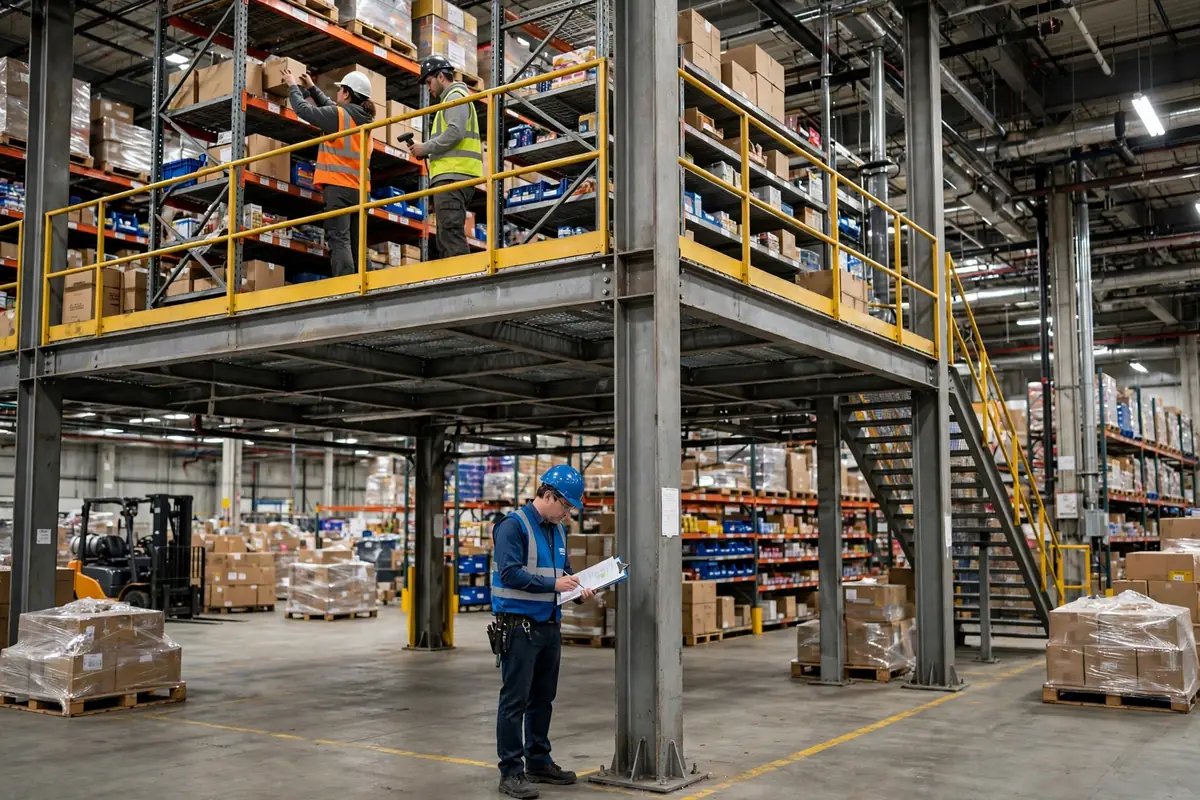
Plenty of warehouses are stingy with cross aisles — the transverse aisles that cut across the long runs of racking. Every cross aisle costs rack positions an owner can see on a plan. What he cannot see is the forklift looping to the far end a hundred times a day. Too few cross aisles and trips get longer, longer turns into congestion, and at peak the dock falls apart.
warehouse cross aisle design forklift travel, counted in daily detours
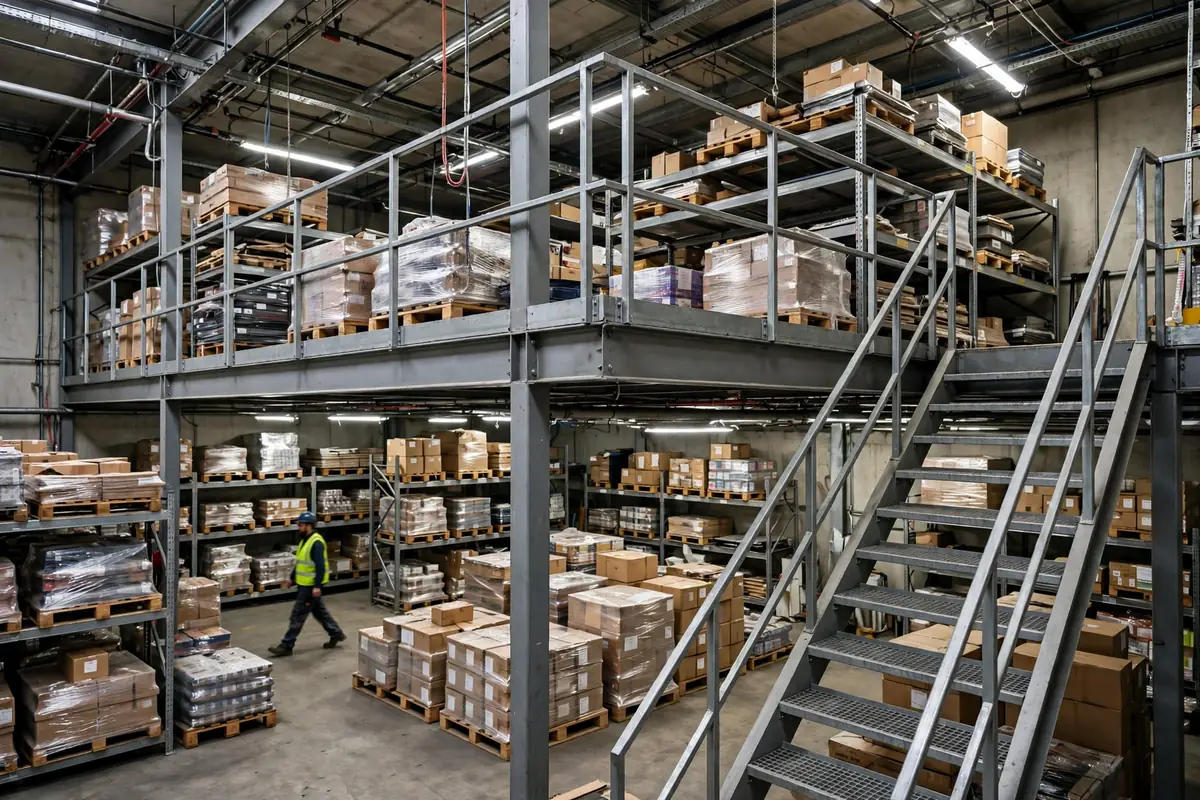
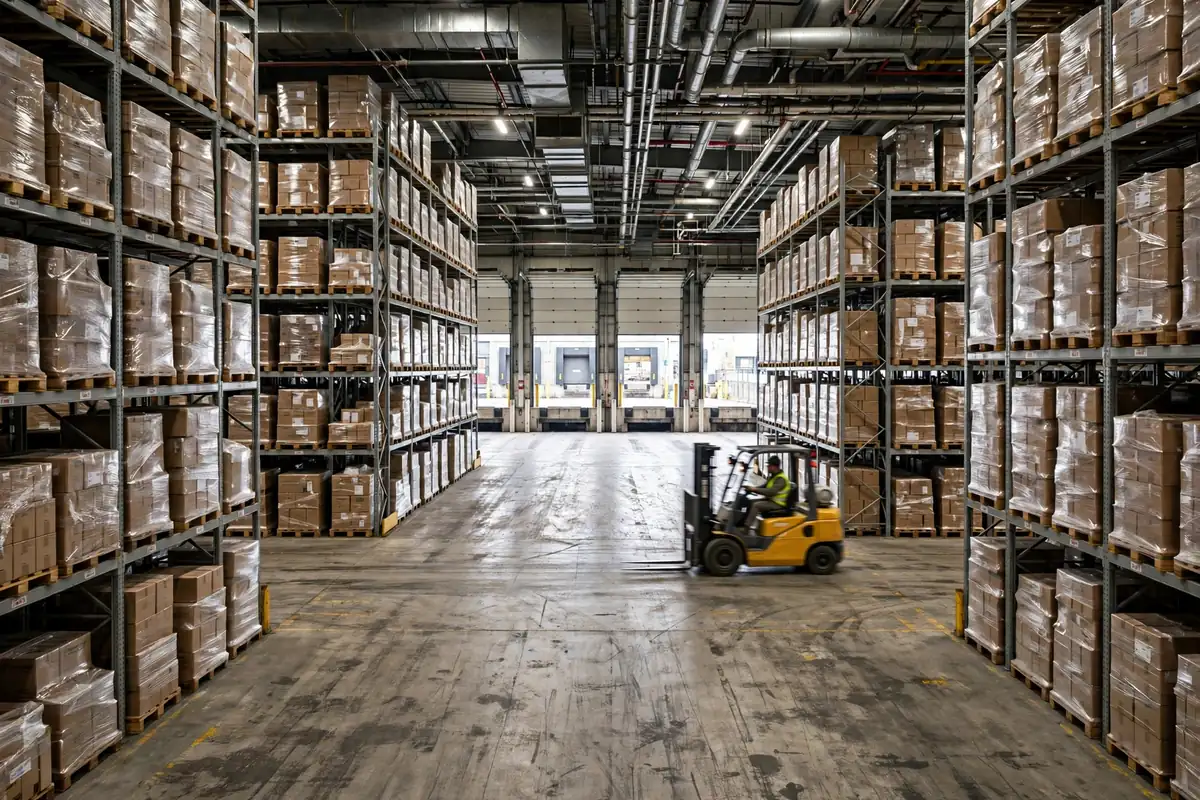
A concrete story first. In 2022 I ran a regular Arizona lane, delivering to and collecting from an auto parts warehouse. It was a big building, rack after rack laid out along its length, with cross aisles only at the two ends. A forklift coming out of a middle aisle that needed to reach the far block had two choices: run north to the very end, or run south to the very end. There was no opening in the middle to cut through. The drivers had their own saying about the place — half the shift picking, half the shift commuting.
Before peak that year they cut one cross aisle through the middle. It cost a row of racking, and the slow movers there moved to a small overflow corner. I will not print the lead's internal figures — that is his business — but the direction was plain: trips got dramatically shorter, the same freight went out with less waiting, and the truck line at the dock shrank.
The counterintuitive judgment: a cross aisle is not wasted space. It is rack positions traded for time. Positions are static; time burns labor, battery, and dock capacity every hour. A slow-turn warehouse should protect positions. A fast-turn warehouse earns money on every minute saved. Designing a fast-turn building like a storage barn is the most common mismatch I see.
An illustrative calculation — assumed figures, not a standard: a racking block 200 meters long, a forklift making 120 trips a day, each detouring an average 80 extra meters without a middle cross aisle. That is 9,600 extra meters a day, close to 10 kilometers, and over 200 kilometers across 22 working days. Price the missing rack row against that, and most people stop grieving for the row.
A rough field guide, from experience rather than any textbook:
| Building type | Cross aisle approach | Why |
|---|---|---|
| Slow-turn bulk storage | Ends only is usually enough | Goods sit long, trips are few, protect positions |
| Fast-turn, picking all day | At least one in the middle | Forklifts run constantly, distance is money |
| Shipping concentrated at one dock end | Bias the cross aisle toward the dock | Most trips should skip the far half of the run |
| Narrow aisles, people and trucks mixed | Treat cross aisles as passing and refuge points | Safety first, speed second |
Where you cut the cross aisle matters more for forklift travel than how many you cut
Running the road teaches you this: many warehouses do not lack cross aisles. They put them in the wrong place.
The classic mistake is cutting it dead center because it looks balanced. Warehouse work is not balanced. The dock sits at one end and most freight travels toward it, so a center cut still leaves far-half forklifts running half the building before they can cross. Shift the cross aisle toward the dock, and total travel falls further than any symmetrical plan gives you. Symmetry never saved a wheel a meter.
In 2024, at a Texas warehouse, I saw the opposite failure: three cross aisles, but the main aisle in front of the dock had been given to inspection staging and battery charging. Forklifts crossed easily, then jammed in the last stretch before the doors. Cross aisles are river channels and the dock is the river mouth — block the mouth and the channels do not matter. Keep turning space in front of the doors clear, and offset cross aisle exits from the busiest door.
A cross aisle is also a safety device. In a long aisle with no openings, a forklift and a pedestrian picker meeting head-on have nowhere to go. I once watched a driver reverse dozens of meters out of a narrow aisle with pickers on foot beside him because he had no way to turn. That warehouse later widened its junctions and marked yield points, and near misses visibly dropped. One serious accident zeroes out every efficiency gain.
My field method: follow one forklift for a full shift before you study the plan. Note where it detours, waits, and gets stuck. The three worst points are where a cross aisle belongs. That is the part of warehouse cross aisle design forklift travel drawings miss — it is a people's route before it is a line on paper.
Every minute a driver waits is dock turnaround leaking money
A truck arrives, the appointment time is right there in writing, and the freight has not yet reached the staging lane. So the driver waits. My longest wait of this kind was in Oregon in the winter of 2023, in a warehouse whose forklifts were all looping the long way inside. I sat in the cab for the better part of a day and refilled my thermos three times. I lost a run, the warehouse lost a load out, the shipper carried an extra day in transit. Nobody stole that time. The layout spent it.
The other kind exists too. In 2025 I loaded regularly at a California food warehouse with just one middle cross aisle plus the ends, placed exactly where it connected picking to the dock by the shortest line. Loading ran like water: a door on arrival, load, and roll. Drivers talk, and people compete for those runs because a smooth dock means an extra trip in the day. Half of a warehouse's good name is carried down the highway by drivers.
So here is my advice, from fifteen years of watching docks. Next time you redesign or lease, do not only count positions and rent. Put two more numbers on the table: how far your forklifts travel in a day, and how long a driver waits at your dock. Positions decide how much you can store; routes decide how fast you can turn it. Peak season is won by the warehouse that turned fastest, not the one that stored most. Old saying in my trade: to get rich, first build the road. Inside a warehouse it is exactly the same.
By Shifu Zhao, Trucking Veteran (15 yrs)