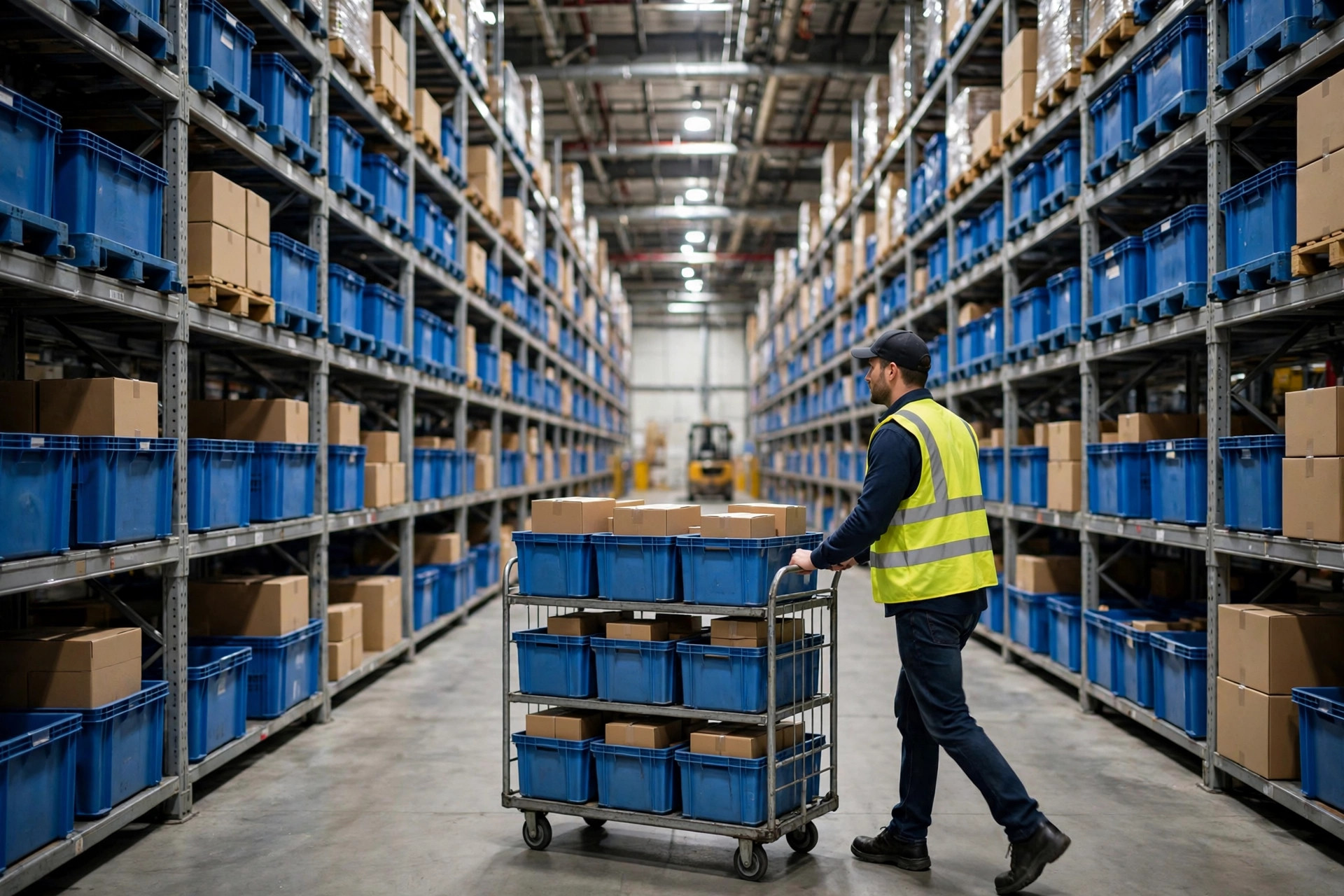
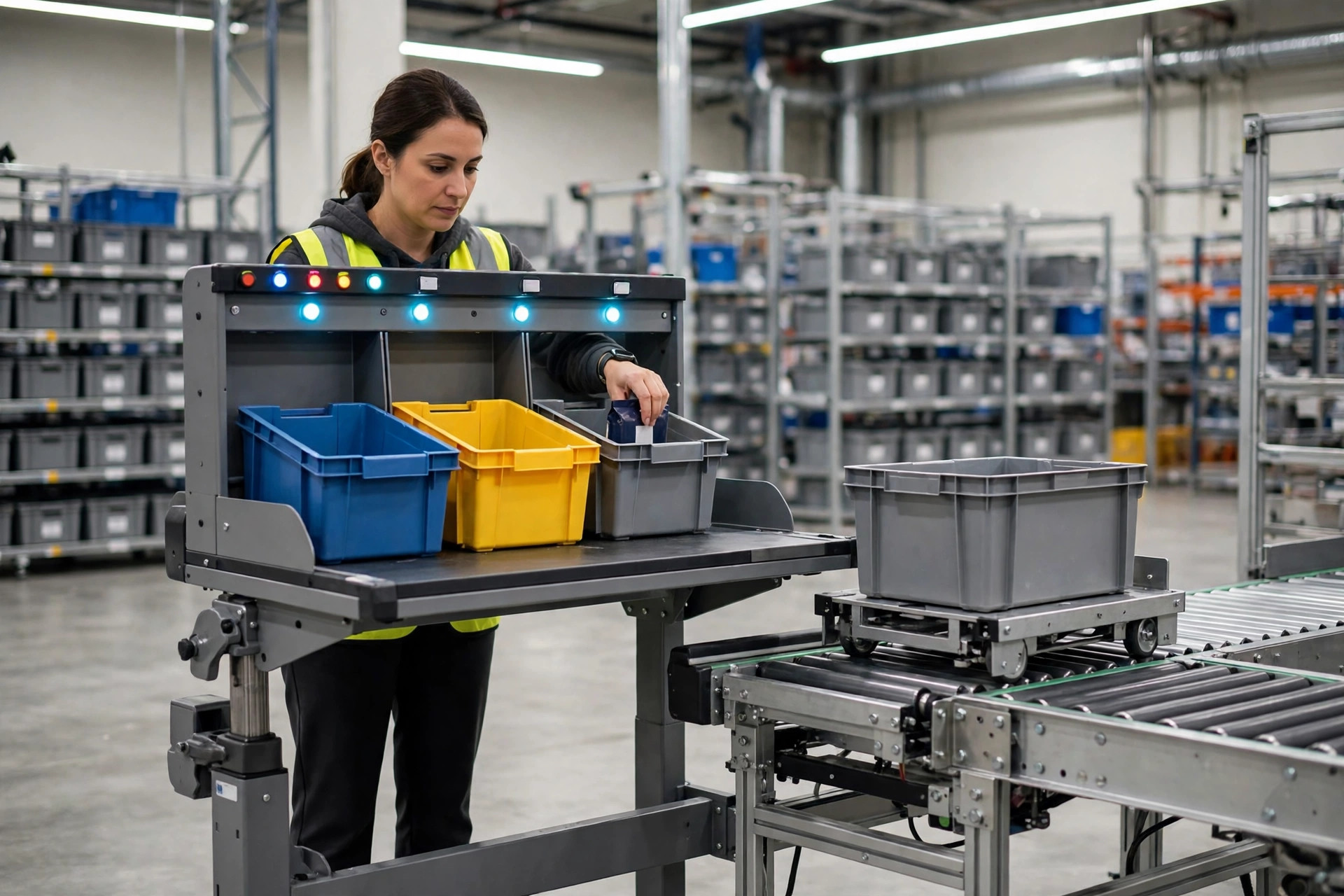
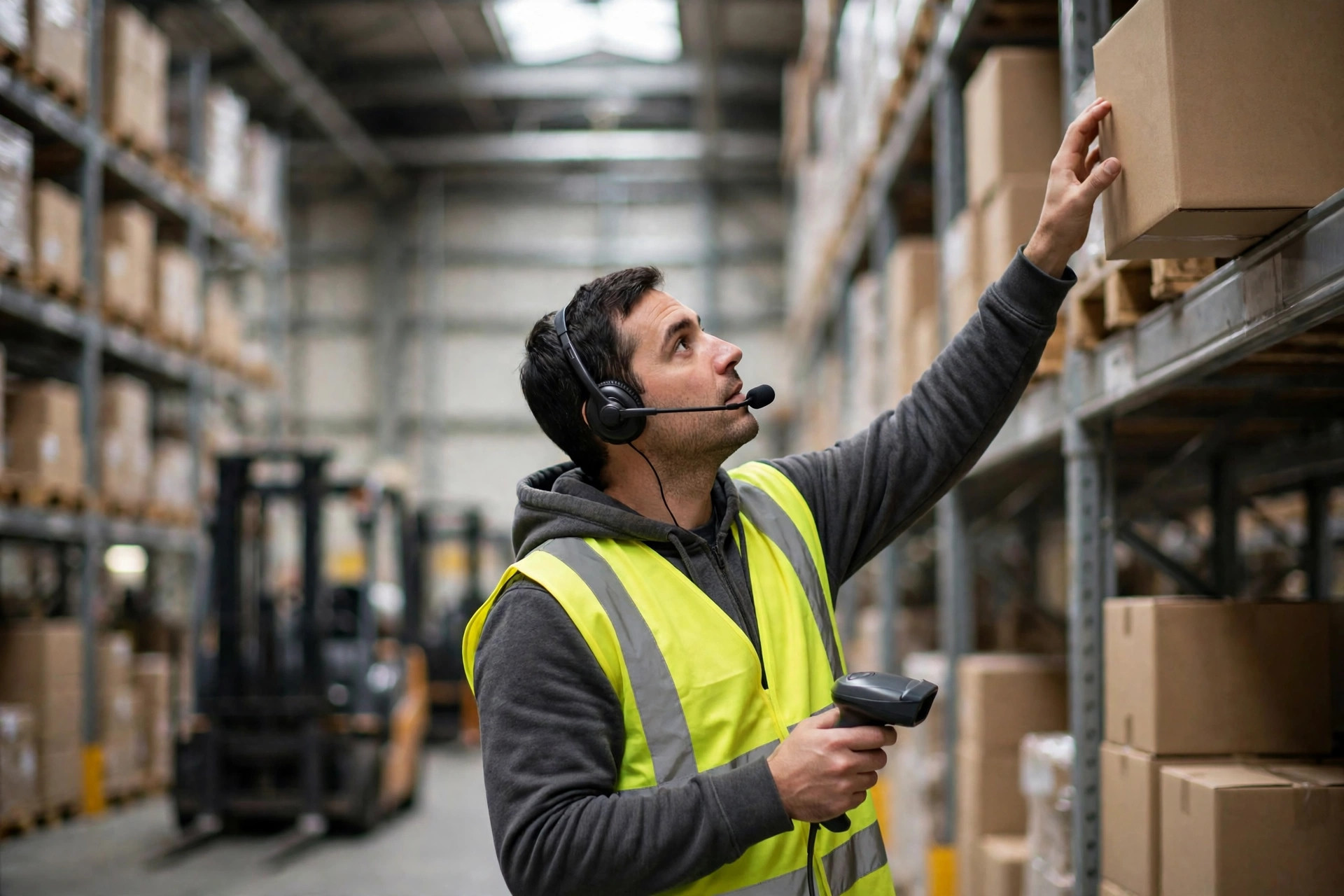
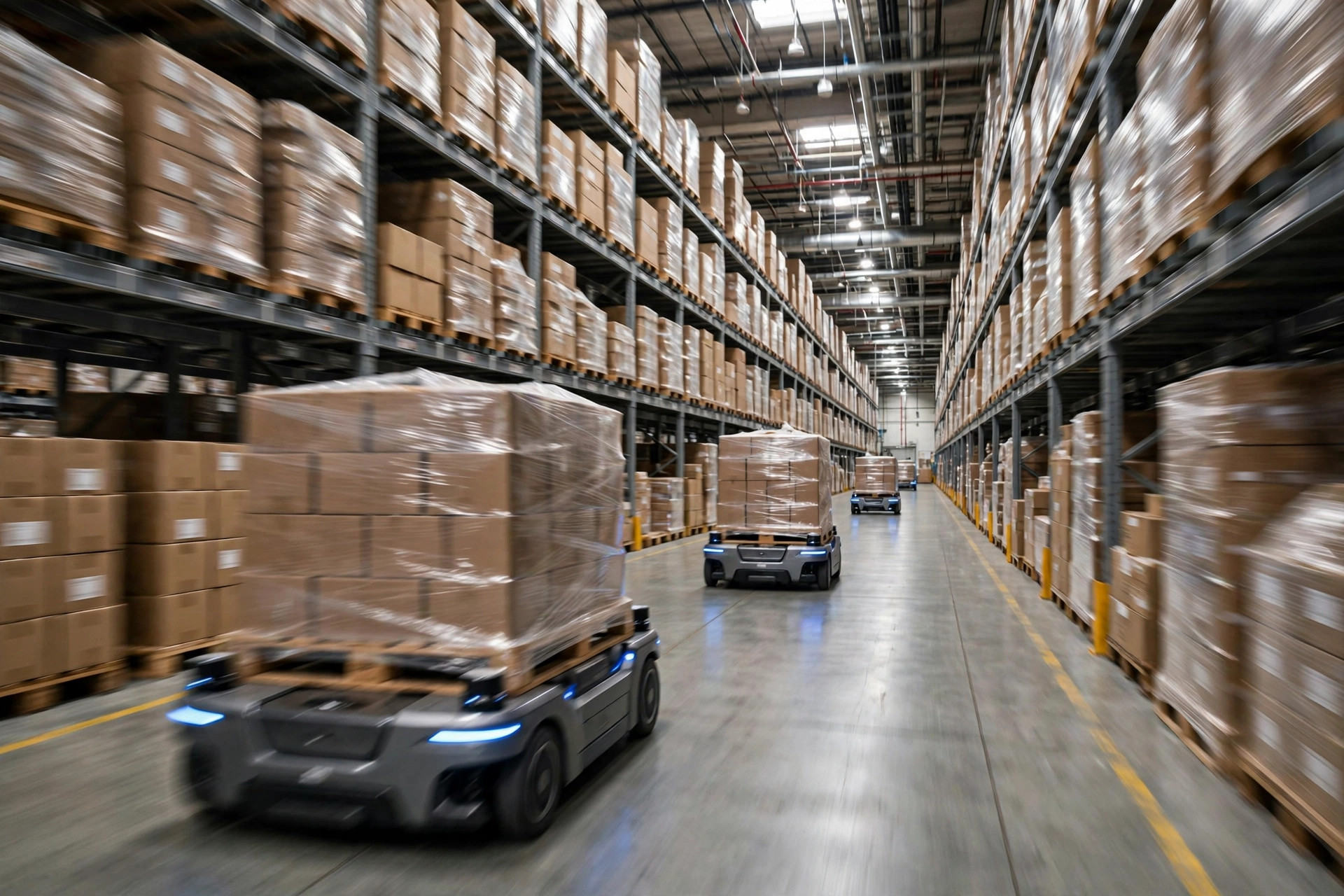
Last autumn I walked a spare-parts warehouse where a picker named Chen stood in front of a rack ten meters tall, order sheet in hand, a pallet the forklift had just dropped at his feet. The item he needed sat on the fifth level. The forklift could not drop a whole pallet for one piece, and climbing a ladder was not allowed, so he waited for a free forklift driver to lower the pallet, pull one piece, and lift it back. One order took more than twenty minutes. That is the classic high-bay picking trap: racks keep growing taller, but a person's hands still only reach about two meters. A warehouse order picker lift closes that gap. The platform carries the picker up to the slot, the picker pulls the piece at height, drops it in a tote on the platform, and rides back down.
What an Order Picker Lift Actually Does: the Person Goes to the Goods
You can think of it this way: an order picker lift moves the "person-to-goods" logic off the floor and into the air. A forklift brings a whole pallet down so a person can pick from it. An order picker lift brings the person up so they can pick piece by piece at the slot. It is like fetching books in a library. The forklift hauls the whole shelf to you. The order picker lift is you walking up to the exact book. The first approach fits full-pallet shipments. The second fits orders of a few mixed pieces scattered across slots.
That decides how the machine earns its keep. It does not win on speed. It wins on how much one trip up can pick. The platform typically holds one picker plus a few totes, enough for people and picked goods, never a full pallet. So the cycle looks like this: ride up, travel along the aisle, pick three to five slots in a row, ride down. The fewer lifts per shift, the lower the cost per order. Flip it around, and the math turns ugly fast. If one trip up and down serves a single piece, and the slot sits several aisles away from the next pick, that trip loses money.
A contract warehouse near Dongguan learned this in 2023. They bought two order picker lifts with a plan to convert all high-bay picking to manual picking at height. Pickers rode up and down dozens of times a day, and average pick time per order ended up longer than the old routine of lowering a pallet by forklift and splitting it on the floor. The fix was not a better machine. It was a better rule: order picker lifts only ran waves where order volume was high and slots were clustered. Stray single-piece orders went back to pallet lowering. Only then did the numbers come right. The equipment was fine. The dispatch logic was wrong.
The High-Bay Picking Line: When a Lift Beats a Forklift
The line is not in the spec sheet. It is in your racks and your order profile. I use three tests, and I want at least two of them to pass before talking about a lift. First, the racks are genuinely tall: a meaningful share of slots sits beyond floor picking reach, and people really do need to go up every day. Second, piece picking dominates: most orders are picked by piece or by carton, and full-pallet shipments are the minority. Third, slots cluster: one wave's picks can run down one or two aisles in sequence, without crisscrossing the whole warehouse.
| Situation | Better choice | Why |
|---|---|---|
| Mostly low racks, occasional high slots | Forklift lowers the pallet, split on the floor | A lift bought for rare use sits idle, and idle is a cost |
| Many high racks, many piece picks, clustered slots | Order picker lift for high-bay picking | One trip picks several pieces, so lift cost spreads thin |
| Mostly full-pallet inbound and outbound | Forklift | Sending a person up to split a pallet is a wasted motion |
| Scattered slots, one piece per order | Fix slotting or merge waves first | No machine rescues bad dispatch logic |
Here is the counterintuitive part: taller racks do not automatically mean you need a lift. Push racks to a dozen meters and above, and the lift spends its time turning in narrow aisles, lifting, lowering, and yielding to other traffic. Cycle time per piece can end up worse than moving fast-moving goods down to a low pick zone. In 2024 I saw a warehouse in East China move its few hundred fastest-moving items down below two meters into a golden pick zone, leaving high slots for slow movers and replenishment stock. Demand for lift trips fell by about half. An order picker lift solves high-bay picking. It is not an automatic accessory for tall racks. Ask one question first: why does this item have to be picked at height at all? Too often the answer is that putaway took the easy path years ago, not that the business truly needs it there.
Run a rough shift calculation and the picture sharpens. If one trip averages four pieces, the lift time spreads across four pieces and the cost per order stays manageable. If one trip averages one piece, the same lift cost lands on that single piece, and cost per order multiplies. You do not need decimal-point precision here. A supervisor can count "pieces per trip" from a week of wave data. If the steady answer is below two, do not buy the lift yet. Spend the money on slotting and wave merging instead. The return is bigger.
There is one hard boundary left: the lift has to work with the forklifts and the high-bay racks, not beside them. Aisle width, floor loading, beam heights, and the lift's turning and travel envelope must match. Otherwise the machine cannot enter the aisle, or it rises and still cannot reach the slot, and an expensive purchase becomes a decoration. Before buying, check your own measured aisle and rack dimensions against the machine. Do not trust only the headline maximum lift height on a brochure. That number is an empty, ideal-condition figure. Add a person, add totes, add traffic in the aisle, and the usable height and flexibility both shrink.
Where Order Picker Lift Maintenance Really Hurts
What wears an order picker lift out is not a dramatic breakdown. It is the same lift, travel, and stop repeated dozens of times a day. Chains, cylinder seals, drive wheels, and platform gate latches take the beating. The most common trap I see is a site that tracks charging and nothing else. Batteries get charged on schedule, but chain lubrication, gate latches, and the emergency stop button get no periodic check. Then one day the platform jams halfway up, and the repair is not one part. It is half a shift of a blocked aisle.
The second trap is using the lift like a forklift. Overloading the platform, leaning outside the guardrail to reach a slot, using the platform to nudge a rack: each shortcut looks harmless once or twice, and over months it bends structure and kills sensors. Then the maintenance bill doubles. A lift that carries people runs on a different safety logic from a truck that carries pallets. Operator training has to be separate. A forklift license alone does not qualify someone to ride a platform at height. Any site where people casually lean past the guardrail "just this once" is queuing up accidents and repair bills.
The third trap is buying the machine before sorting out spares and service response. Unlike forklifts, not every local shop can fix every lift model, and some controllers and sensors are factory-only parts with a wait of weeks. Ask before purchase: are common wear parts stocked locally, is service response measured in hours or days, and is there a backup plan while the machine sits idle? The answers matter more than a small discount on purchase price. A lift parked in an aisle eats the saving in lost throughput within days.
So is the money worth it? Watch one number: pieces per trip per shift. If it holds steadily above three, and high-bay piece picking is your everyday work, the investment stands up. If it sits at one or two for weeks on end, do not buy the machine yet. Sort out slotting and waves first.
By Da Liu, Automation Engineer