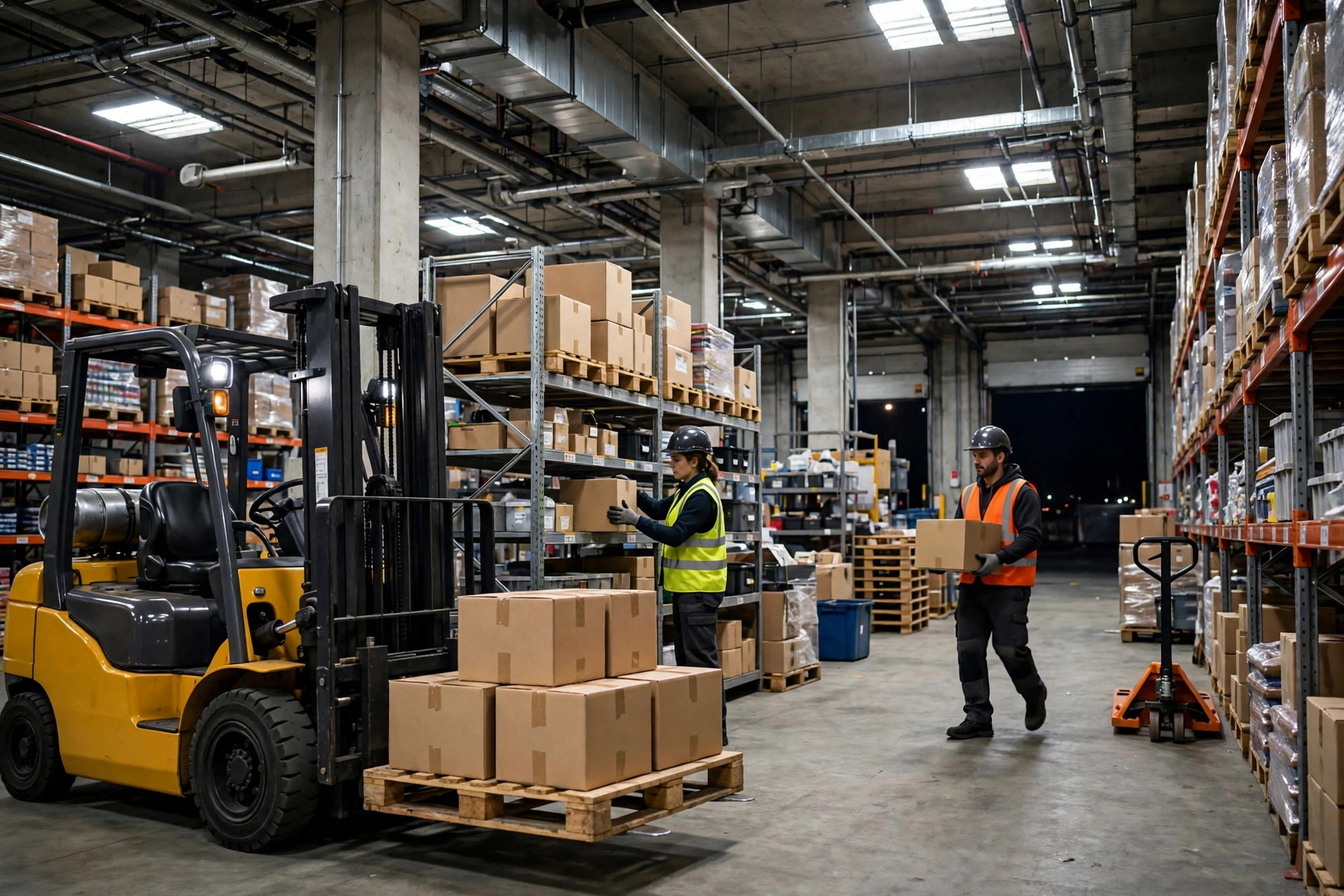
Excerpt: Warehouse night shift productivity is often blamed on the night crew. But in most warehouses I have managed, the problem sits in the schedule, the release of work, and the support around the shift. Before you blame people, check the setup.
Let me start with a night I will not forget. It was 2 a.m. on a Tuesday in November 2024, and I was walking the night shift in a 200-person warehouse in Chino, California. The day shift shipped 9,000 orders a day. The night shift had 40 people on the floor, and by dawn they had shipped 2,100. The supervisor was furious in the group chat, saying the night crew was dragging their feet. I walked the floor. Nobody was standing around. People were running, lifting, sweating. But the system had only released about half the night's orders by 1:30 a.m. For the first ninety minutes, people waited for work. Then all the orders dropped at once, and there were not enough people, forklifts, or packing benches. The queue backed up into the aisle. Let me be honest with you: that was not a people problem. That was a release schedule setting people up to fail.
Here is the comparison that changed my mind. In March 2025, the same warehouse changed its night shift pattern. The old pattern was a fixed shift from 10 p.m. to 6 a.m., five nights in a row, with only one day off. We moved to a rotating pattern that flipped every two weeks. Within a month, average picks per person on nights had recovered by close to twenty percent. Same people. Same pay. No new equipment. Only the schedule changed. So I ask you: was the original problem the people, or the arrangement around them?
Warehouse Night Shift Productivity Has Three Variables, Not One
When warehouse night shift productivity drops, do not start with attitude. Split the problem into three variables first, and check each one in turn:
| Variable | Typical night-shift symptom | Check this first |
|---|---|---|
| Work rhythm | No work early, a flood of work late | Order release times, wave splits, replenishment timing |
| People condition | Error rates climbing at 3 or 4 a.m. | Consecutive night shifts, rotation cycle, rest gaps |
| Floor support | No forklift, no pack bench, no one to decide | Night supervisor authority, maintenance response, escalation path |
Use the table as a checklist. Walk through it before any conversation about individual performance. If all three variables look fine and productivity is still down, then talk about individuals. If you start with individuals, you will usually fix the wrong thing.
Work Rhythm: People Waiting for Work Is the Most Expensive Waste
Many warehouses let the day shift's rhythm wreck the night shift. The day shift finishes late, waves are cut late, and the night crew spends its first two hours doing odd jobs and cleaning while waiting for orders. Then everything arrives at once in the second half of the night. Human energy runs in the opposite direction: people are sharpest at the start of the shift and weakest in the early morning hours. When the workload peak lands on the energy trough, errors go up. That is not laziness. That is biology meeting a bad schedule.
Here is a practical fix you can copy. Split the night's orders into three releases. Release 40 percent before 10 p.m., so the night crew has real work the moment they clock in. Release 35 percent around midnight. Release the last 25 percent around 3 a.m. for the closing team. Cutting waves this way is not a technical project. It is a supervisor spending fifteen minutes before going home to plan the night. Those fifteen minutes can save hours of rework later.
People Condition: Count the Cost of Consecutive Nights in Errors
Let me be honest with you: the hardest part of nights is not being tired for one night. It is being tired for five nights in a row. A person on their fifth consecutive night shift does not make decisions the same way they did on the first night. In warehouses I have run, night-shift picking errors peak on the fourth and fifth consecutive nights, and the people making those errors are usually the experienced staff, not the new hires. When veterans start making mistakes, that tells you it is a condition problem, not a skill problem.
Here is a decision framework for choosing a night shift pattern:
| Pattern | Strength | Cost | Best for |
|---|---|---|---|
| Fixed night team | Stable crew, experience builds fast | High turnover from long-term night work | Steady night volume with a real night differential |
| Two-week rotation | Better recovery, feels fair | Higher handover cost, re-adaptation each cycle | Enough staff to absorb handover periods |
| Voluntary nights plus premium | High motivation, fewer complaints | Unstable headcount, peak season may fall short | Night volume that swings a lot |
There is no perfect pattern. There is only the best fit for your current situation. Before you pick, ask the night crew one question: what bothers you most? The answer is often not money. It is "five nights in a row with no real sleep" or "when something goes wrong at night, nobody owns it in the daytime." Once you hear that, you know what to fix.
Morale: The Night Crew Hates Being Treated as the Second Shift
There is one more variable that does not show up in the numbers: being seen. The day shift gets client visits, leadership walk-throughs, and training slots. The night shift often gets none of that. When nights go well, nobody mentions it. When something goes wrong at night, the day shift starts asking questions first thing in the morning. Over time, people stop trying to do extra work. Why bother, if extra work only brings extra blame?
I later made a simple rule: every morning, the night supervisor writes three lines for handover. How many orders shipped last night. What went wrong. Who handled something well. Those three lines go on the notice board, and the day supervisor reads them first. It sounds small. But it was the first time the night crew felt that someone actually saw their work. Morale is not built with slogans. It is built by being noticed, once a day, consistently.
A Counter-Intuitive Judgment
Most managers think the fix for low night output is more people. Let me be honest with you: adding people sometimes makes nights slower. The night floor suffers most from narrow aisles, a single packing bench, and forklifts competing for the same lane. Add people, and they spend more time waiting for each other than working. I once saw a night crew grow from 40 to 55 people, output rise only about ten percent, and the error rate go up. Later we cut back to 45 people and added a second packing bench, and output passed the 55-person level. The bottleneck on nights is often the "road," not the headcount: the benches, the aisles, and the release rhythm. Widen the road first, then decide whether you need more people.
So, is warehouse night shift productivity a people problem? My answer is: check the setup first, then talk about people. Scheduling, order release rhythm, floor support, and morale, in that order. Reverse the order, and the harder a supervisor pushes, the faster the night crew walks out the door. In the end, the warehouse pays for that too.
To my fellow supervisors: the night crew is not short of effort. Most of them are holding up inside a rhythm that was never designed for human beings. Fix the rhythm, and a lot of them will come back to you on their own.
By Chen Feng, Warehouse Operations Manager