Warehouse mold prevention rarely makes headlines — until a multimillion-dollar claim lands on someone's desk. According to industry outlet Pallet Enterprise, an international coffee chain once destroyed several million dollars' worth of coffee beans contaminated by moldy pallets, then filed a $5.3 million lawsuit against its pallet supplier. In a separate case, Johnson & Johnson and Pfizer recalled products over a noxious odor traced to wooden pallets shipped from Puerto Rico — where the culprit was the anti-mold chemical treatment on the pallets themselves. Neither case unfolded in a factory; both played out in warehouses and in transit, and in both, the first exhibit at the negotiating table was the humidity record at receiving. This article is about humidity control as the decisive variable in inventory survival: the three lines of defense that keep goods from molding, and who pays when they fail.
The Data: Mold's Operating Window Is Narrower Than It Looks
According to the Corrective Action Plan (CAP) for pallet mold published by Pallet University, the environmental red lines for warehouses are strikingly specific: keep relative humidity below 60%, aim to hold temperature below 27°C (80°F), and back both with industrial dehumidifiers, ventilation, and hygrometers placed throughout the facility. These are red lines, not suggestions.
Wood moisture content is the other hard threshold. Research from the Virginia Tech Center for Packaging & Unit Load Design concludes that wood dried below 20% moisture content will not support mold or decay fungi — while recycled pallets in warehouse conditions naturally equilibrate to around 12%. 20% is the line between a pallet that can host mold and one that cannot.
The time dimension is equally well documented. At 25–30°C with humidity above 65%, mold spores can germinate and begin penetrating material surfaces within 24 to 48 hours. The U.S. National Institutes of Health draws its own line at the same point: dry wet materials within the first 48 hours and professional remediation is usually unnecessary; beyond 48 hours, the colony has already formed.
Put the three datasets together and mold's operating window is narrow: around 27°C, around 60% humidity, 48 hours. In spring and summer, those three conditions are essentially the default state of an unconditioned warehouse — which is why warehouse mold prevention cannot rely on averages alone.
Attribution: Why Inventory Still Molds When the Hygrometer Reads Fine
This is the most counterintuitive part of warehouse mold prevention: the hygrometer in the aisle reads 55%, fully compliant, and the goods mold anyway. Mold needs four things to grow — moisture, nutrients, suitable temperature, and oxygen — a framework used consistently across industry reviews from Pallet Enterprise and Conner Industries. In a warehouse, nutrients (wood, cardboard) and oxygen cannot be controlled; 25–30°C happens to be the human comfort zone too. Moisture is the only variable a warehouse can actually manage. And the moisture that matters rarely comes from the air — it comes from three overlooked corners.
The first culprit is the damp wooden pallet. Most hardwood pallets are manufactured from green lumber with high initial moisture. More counterintuitively, ISPM-15 heat treatment is an insect-killing standard, not a mold-prevention one: the process pulls internal moisture to the wood's surface, favoring spore colonization. As Pallet Enterprise's experts put it, heat-treated pallets are "not immune" to mold — new pallets mold more readily than old ones.
The second culprit is the carton stacked against the wall. Exterior walls develop condensation from temperature swings, so wall-flush cartons sit in local humidity far above the warehouse average. The aisle hygrometer measures the average — it never sees the pallet in the corner.
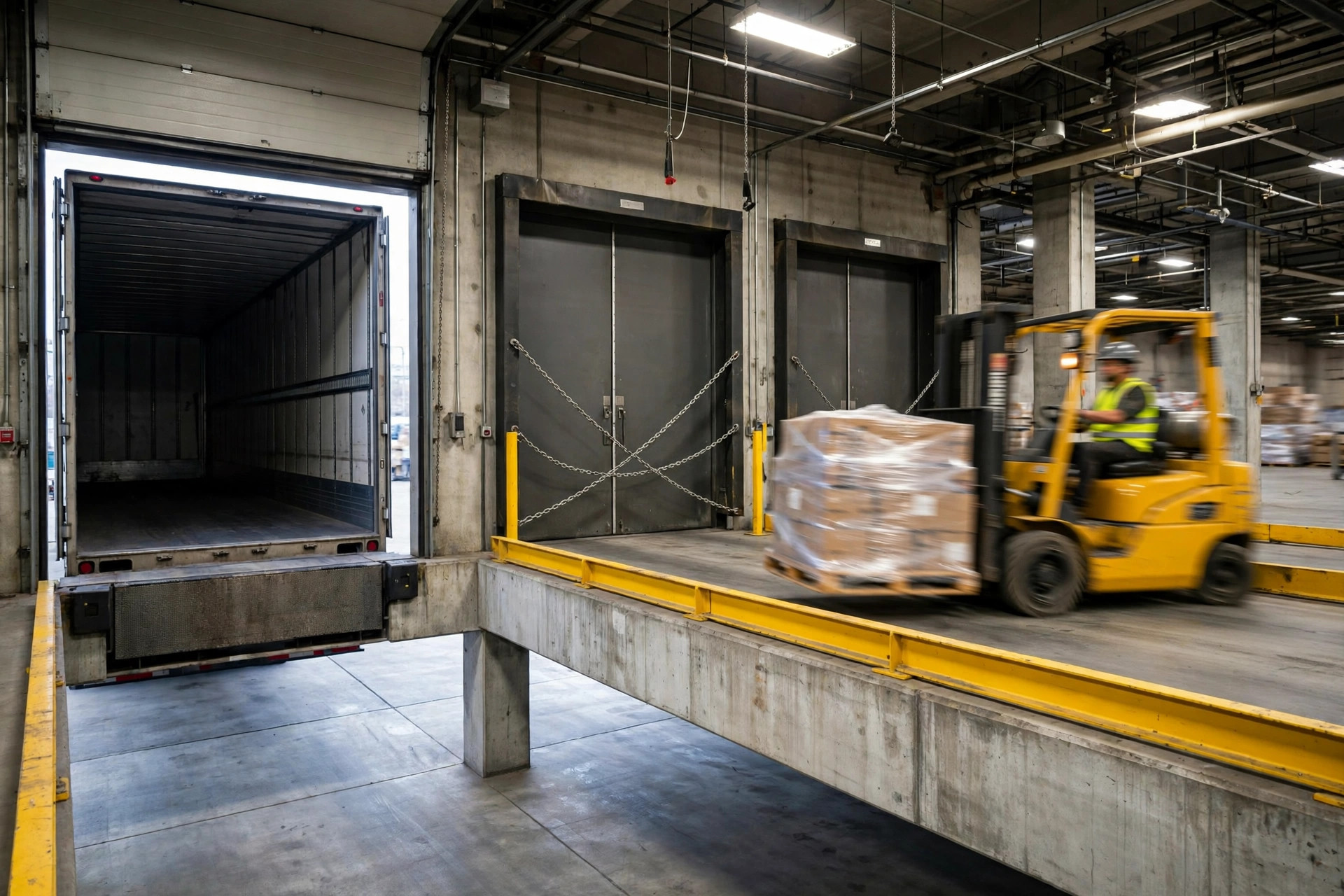
The third culprit is the receiving dock that never inspected for moisture. Pallet Enterprise warns that even staging pallets briefly outside on a rainy day can plant a future problem: rain-arriving pallets may look dry on the surface while already over the moisture line.
The causal chain is complete: moisture-laden pallets, wall-hugging cartons with no airflow, and a receiving process that never checked. Humidity control that ignores these three corners is, in effect, guarding the wrong door.
First Line of Defense: Inbound Moisture Inspection
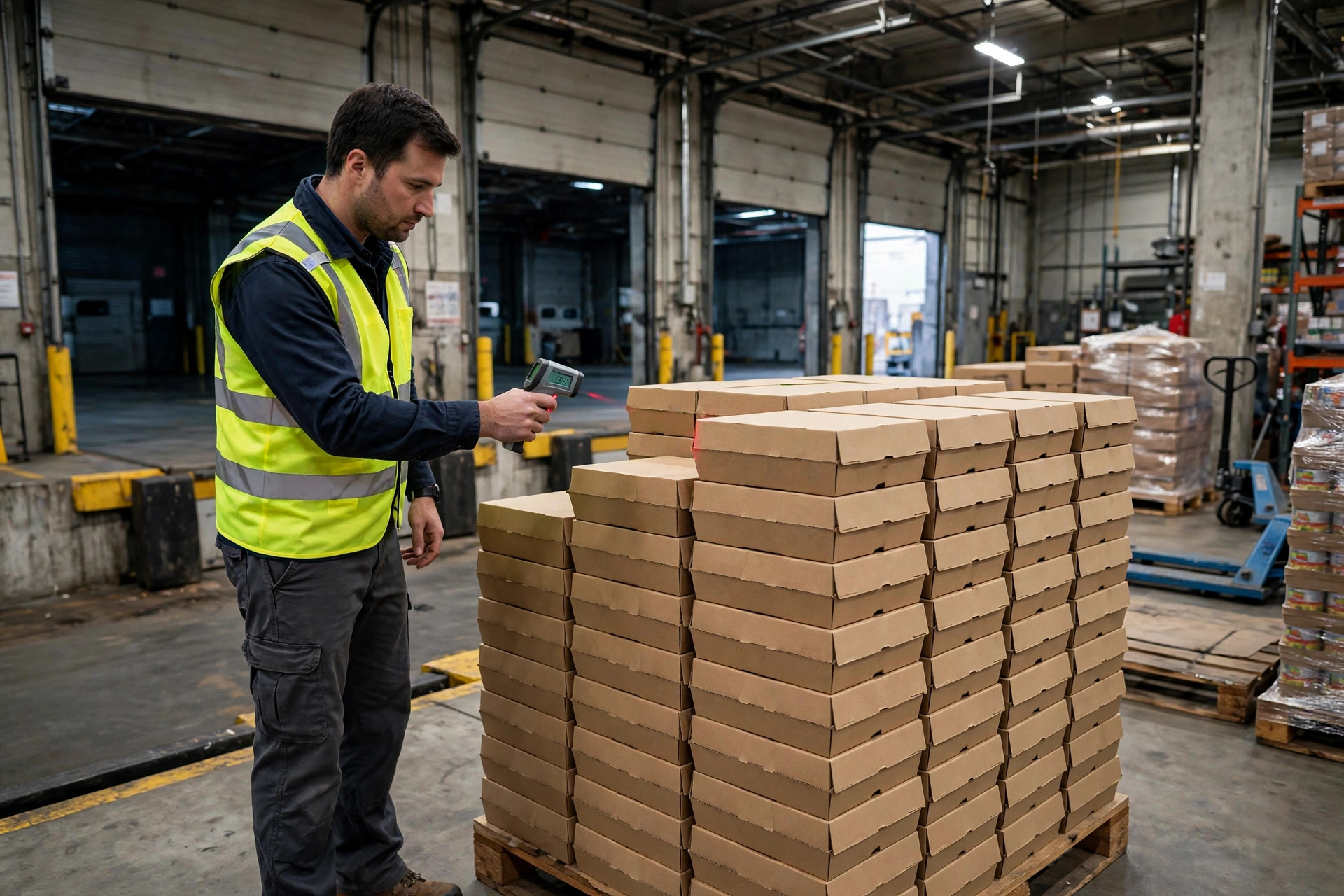
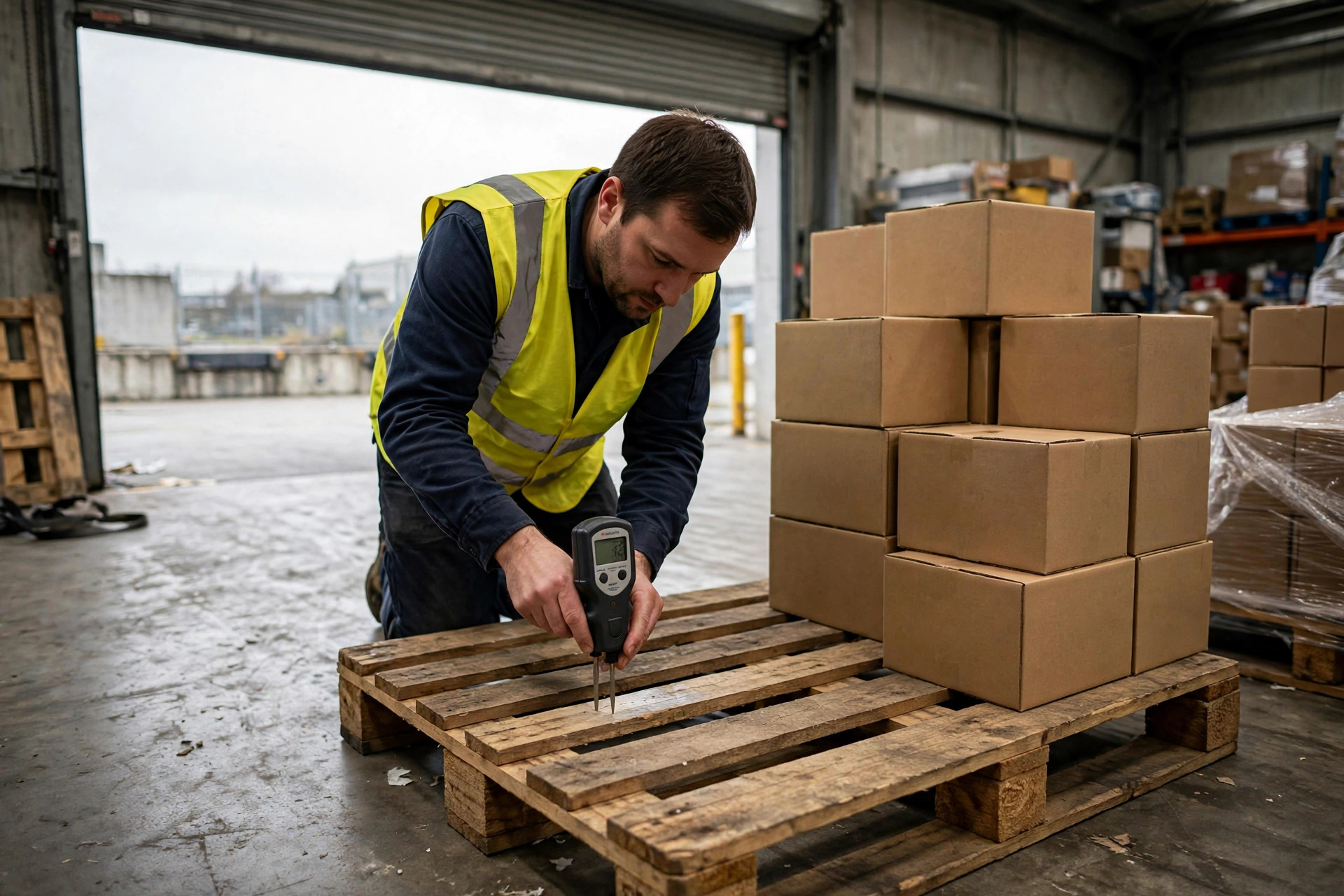
Of the three lines of defense, inbound inspection costs the least and delivers the most leverage. The practice is straightforward: for arrivals in rainy weather, or pallets that look dark and cartons with water stains, spot-check pallet moisture content with a pin-type meter — below 20% goes into storage, above 20% gets dried or rejected. Photograph abnormal batches and write the readings into the receiving record.
This step pays twice: as quality control that keeps damp pallets outside the warehouse doors, and as the first link of the claim evidence chain. Many warehouses lose mold claims not because their case is weak, but because they cannot produce a written record of whether the goods arrived dry or wet.
Humidity Control Below the 60% Line: The Second Line of Defense
Holding the 60% line takes industrial dehumidifiers, ventilation, and distributed monitoring together — no single measure is enough. One caution: sensors must not live only in the aisles. Corners, high racking tops, and dock-door zones each deserve their own, because mold grows precisely where the average cannot see.
The economics make the case:
| Item | Scale | Notes |
|---|---|---|
| Handheld pin moisture meter | A few hundred yuan, one-time | For receiving spot checks |
| Industrial dehumidifiers + electricity | Thousands to tens of thousands of yuan per year depending on warehouse size | The main force holding the 60% line |
| Distributed hygrometers | Tens to hundreds of yuan per point | Corners, high bays, dock doors |
| One molded batch | Goods value + rework + claims + lost customers — often dozens of times the prevention spend | See the $5.3M Starbucks lawsuit |
Prevention spending and mold losses are not in the same order of magnitude; once that math is done, dehumidification stops being a question worth debating.
Ventilation: The Third Line of Defense Nobody Budgets For
Ventilation is the cheapest line of defense and the most neglected. According to Pallet Enterprise's field guidance, even slight air velocity — a few feet per second — can help prevent mold from colonizing wood surfaces. The corresponding practices: keep cartons off the walls rather than stacked flush against them, leave airflow gaps in pallet stacks instead of building airtight solid blocks, and apply the rule Pallet University's CAP states explicitly — first in, first out for pallets, so no batch sits in a damp corner for months.
This line is about time management: mold needs its 48-hour window, and slow-moving inventory plus forgotten corner pallets hand it the most generous window of all. Turnover is itself a form of mold prevention.
Mold Claims and Liability: Who Pays for Moldy Inventory
Even with all three lines in place, mold can still happen — upstream packaging may not resist moisture, or extreme weather can overwhelm dehumidification. What decides the outcome then is the evidence chain:
| Scenario | Liability leans toward | Key evidence |
|---|---|---|
| Receiving moisture log exists, in-warehouse humidity compliant | Cargo owner or upstream | Pallets arrived damp, packaging not moisture-resistant |
| No receiving moisture log | Warehouse hard to defend | Cannot prove goods "arrived dry" |
| Warehouse-supplied pallets over the moisture limit | Warehouse | Pallet procurement and inspection records |
| Owner-supplied pallets, warehoused without inspection | Shared | Whether the contract assigned inspection duty |
There is a trade-off worth sitting with: one extra inspection step is a daily labor cost; skipping it is negotiating unarmed at the claims table. Against the $5.3 million scale of the Starbucks case, that cost rounds to zero. Better still, write the inspection duty into the contract — with it, liability boundaries are clear; without it, the warehouse is usually the one that loses.
Trend: Mold Control Is Becoming a Supply Chain Compliance Item
Two trends emerge. First, pallet-moisture sensitivity is rising across pharmaceutical and food supply chains: after the J&J/Pfizer recall, tolerance for pallet mold has dropped markedly, raising the compliance bar for 3PL warehouses. Second, since chemical anti-mold treatments themselves once triggered a recall, the industry is shifting toward physical moisture control — drying, ventilation, monitoring — and a sub-20% pallet moisture procurement standard.
An open question to close with: when sensors are cheap enough for every storage location and AI vision can spot pallet mold automatically, the era of discovering mold after the fact may end. Until then, what decides a claim may still be a handwritten humidity figure on a receiving slip. The question is: does your warehouse's receiving slip even have a line for it?
By Dr. Chen, Supply Chain Researcher