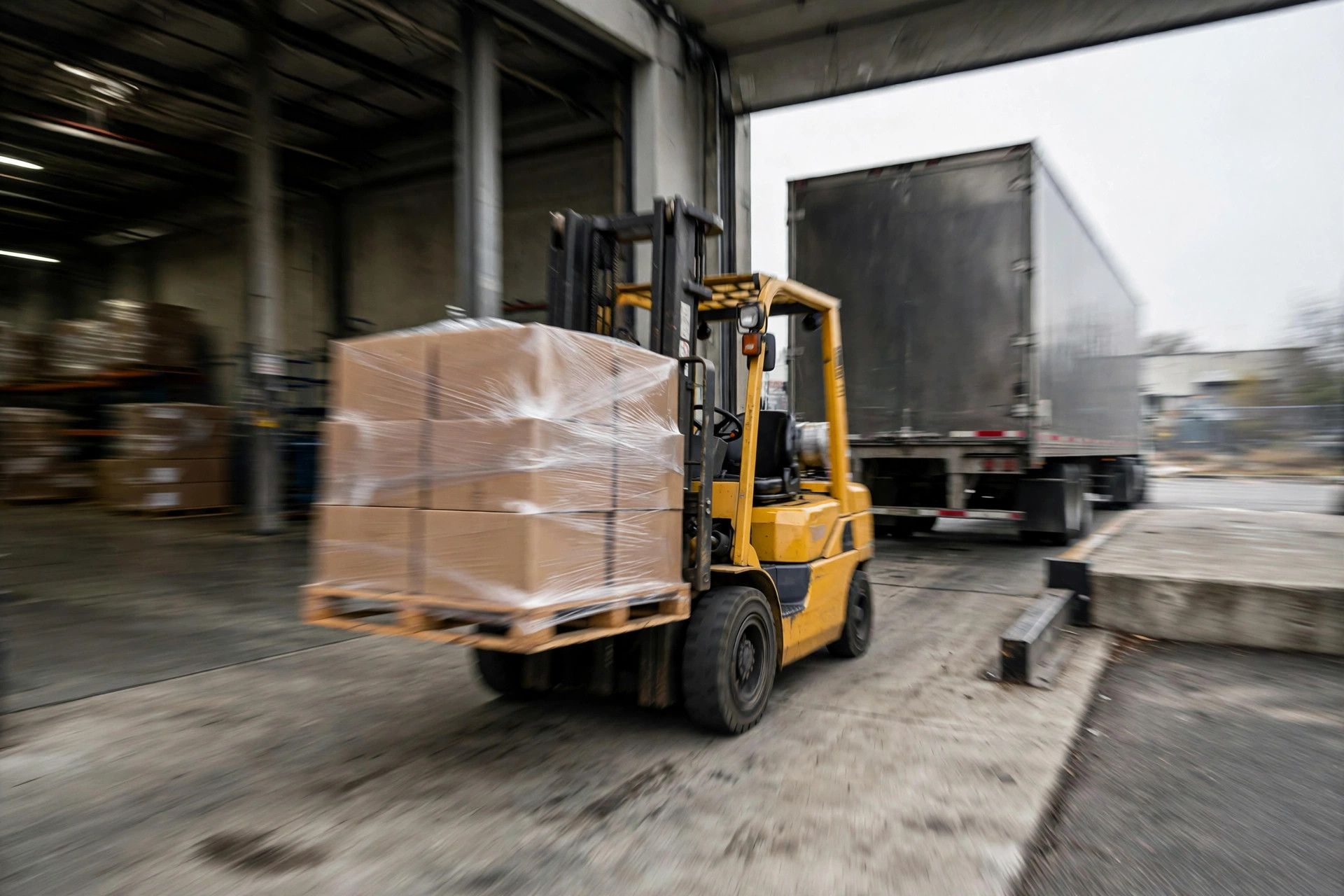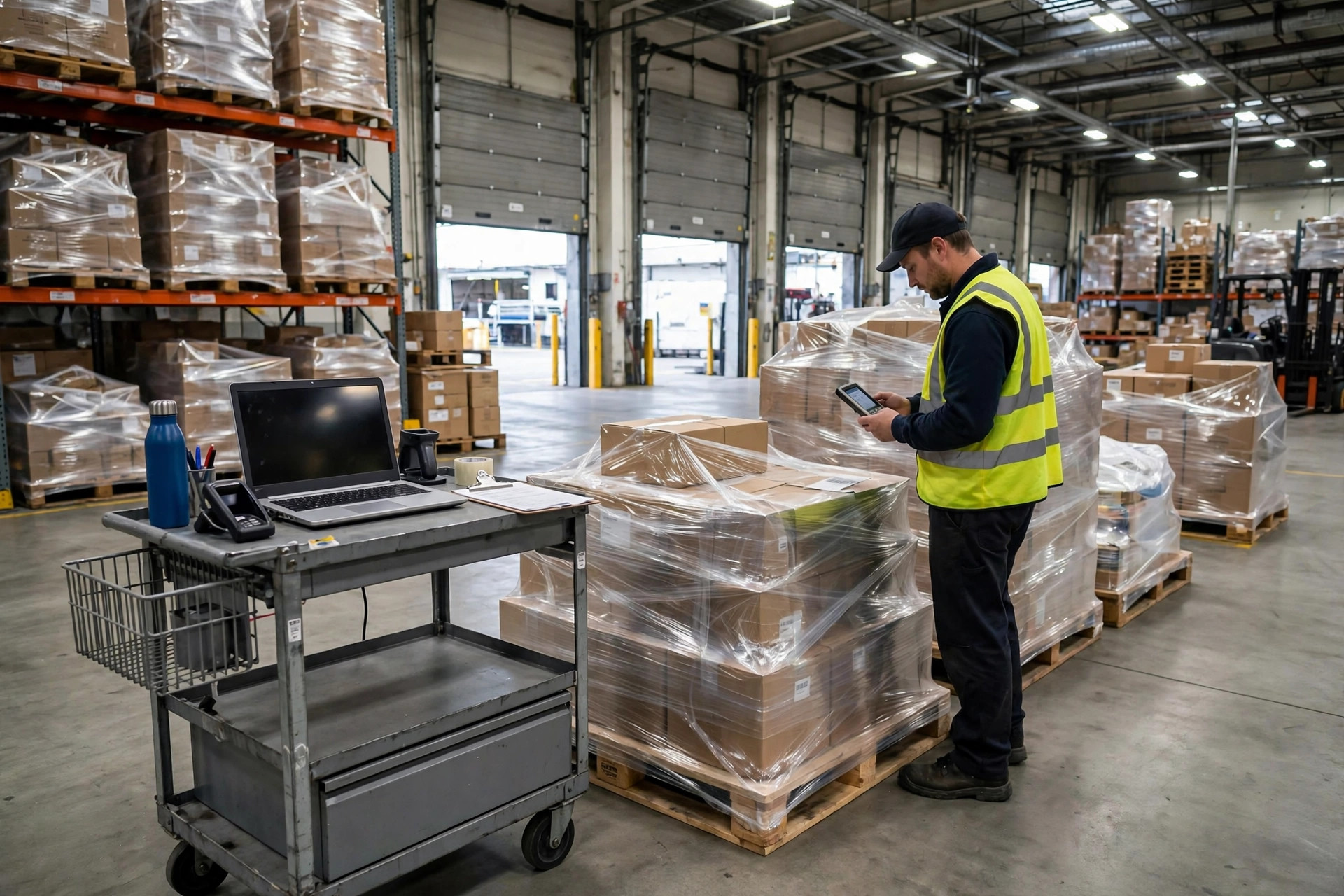
The hottest week of last August, we took in a 40-foot container — 1,200 cartons. That's the week I got serious about the warehouse mobile workstation, and here's why: our receiving guy, Xiao Wang, was drenched from 8 AM to noon. But guess where his time actually went? Not unloading. Walking. Thirty meters between the dock and the office, thirty-plus round trips in one morning, hugging paperwork and product samples. A mobile workstation is, at the end of the day, just a cart — a computer, a printer, and a scanner bolted onto it, so labeling, scanning, and data entry happen right next to the freight. Where the freight is, there the office is.
We can't afford the enterprise version of this. But we bought the same four words — "information follows the freight" — the cheap way.
The Real Warehouse Mobile Workstation? I Sobered Up After Asking the Price
Here's what the real deal looks like: an industrial cart with a big battery, a rugged tablet, a label printer, sometimes a scanner holster and a work light. Push it to the dock, push it down the aisle, no power cord needed, runs all day. Standard issue in big-warehouse receiving areas. The driver waits on the side while the receiver circles the pallets with the cart — labels printed on the spot, data entered on the spot. Looks slick.
Then I asked the price. At a trade show last year, finished mobile workstations started around three to four thousand dollars, and the loaded ones — big battery, rugged tablet — could top ten grand. The sales guy's smile changed when he looked at me. He could tell: this guy isn't buying.
I ran the numbers on the drive home, and they sobered me right up. We receive 20 to 30 pallets a day. A finished workstation is rated to print ten thousand labels a day — at our place, it would use maybe ten percent of its muscle. That's like building an eight-lane highway for a bike path. Great road. No traffic. Payback? Someday. Maybe.
Here's the counterintuitive part: a mobile workstation was never about the cart. It's about four words — information follows the freight. The biggest waste in receiving was never a shortage of hands. It's that labels, data, and confirmations — the information — live too far from the freight. People chase information all day and burn 40 minutes walking. Make the information follow the freight, and the problem disappears. The cart is just the vehicle. Vehicles come cheap or expensive; the four words don't care.
| Finished workstation | Our DIY version | |
|---|---|---|
| Price | $3k–$4k and up, loaded ones $10k+ | $300–$400 |
| Battery | Built-in, runs all day | Power bank + power strip, charge often |
| Computer | Rugged tablet, dust/water/drop-proof | Retired office laptop, $0 |
| Printer | Industrial label printer | Entry-level Bluetooth thermal printer, $200–$300 |
| Maintenance | Vendor warranty, wait for the tech | Fix it yourself, parts from the hardware store |
| Best for | Big sites, hundreds of pallets, multiple shifts | Small sites, dozens of pallets, one shift |
| Fatal flaw | Pricey, and you'll use a third of it | Ugly, and you trip over the extension cord |
Our DIY Mobile Workstation: One Cart, a Few Hundred Bucks
Two weeks after the trade show, "Mobile Workstation 1.0" went live. Here's the parts list — steal it freely:
- One three-tier utility cart from the hardware store: a few dozen dollars, swivel casters, holds a few hundred pounds fine;
- One retired laptop from the office: $0, just needs to open a browser and log into the system;
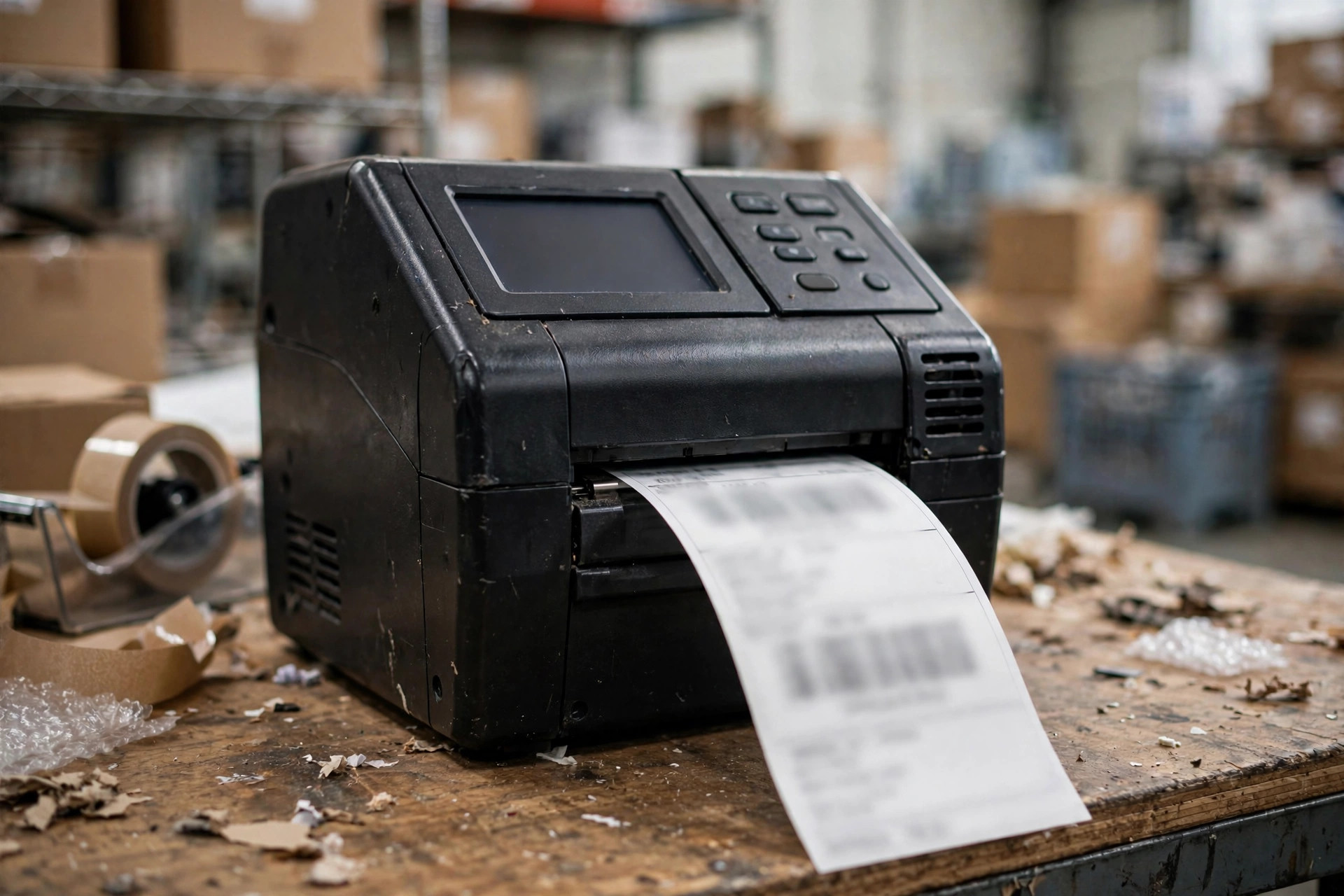
- One entry-level Bluetooth thermal printer: $200–$300, prints 4×6 shipping labels, that's all we need;
- One scanner: we already had it, plugs into the laptop via USB;
- One big power bank plus a power strip: when the laptop battery gives up, the power bank carries it; where there's an outlet by the dock, we just run the strip.
Total: three, four hundred bucks. Less than my monthly gas bill.
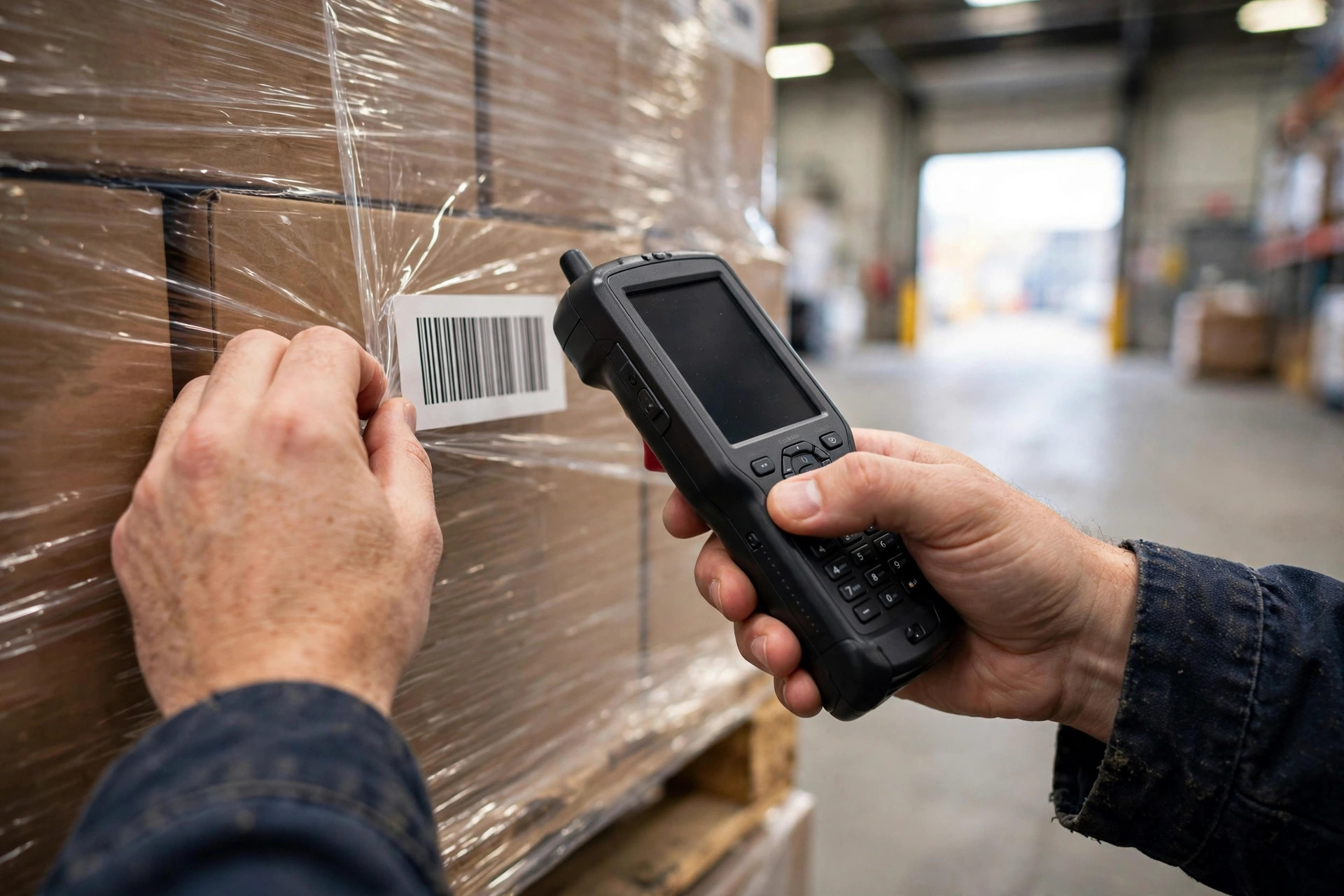
The results? Start with receiving. The old flow: unload → freight piles up on the dock → carry paperwork to the office to print labels → walk back to stick them on → scan everything into the system → realize you're two labels short → walk back again. For a 1,200-carton container, the whole print-and-stick circus ate up most of the day, plus rework. Now Xiao Wang trails the forklift with the cart: open a carton, check it, print the label on the spot, stick it, scan it into the system — one smooth pass. Unloading done, data done. Same container, total receiving time down by nearly a third.
I actually did the walking math: dock to office is 30 meters, and on a busy day we used to do 30–40 round trips, over a minute each — that's 40 minutes of pure walking per day. Once I had Xiao Wang turn on his phone's step counter: on a busy receiving day he walked nearly 3 extra kilometers, all of it donated to the dock-office commute. On an 8-hour shift, that's 8% of a person's day spent walking. Over a month, that's nearly two person-days of labor. A $300 cart pays for itself in a month. The finished workstation? Payback measured in years. Small warehouses do the math monthly; big companies do it yearly. That's the difference.
Full disclosure on the DIY downsides: the extension cord drags and you have to mind your step; the laptop isn't drop-proof, so you steady the cart over speed bumps; and on rainy days it stays under the canopy. But these are all tolerable flaws. The problems the finished workstation solves — IP65 dust and water sealing, working at minus 20 in a freezer, running three shifts around the clock — we will never have. Paying to solve problems you don't have is called waste. Paying little to solve the problem that hurts every day is called smart.
Putaway: Stop Letting Paper Into the Aisles
Receiving worked so well the cart got "borrowed" for putaway — and solved a case along the way.
Early last year we had a classic: the putaway guy worked off a paper list, misread location "B-03-2" as "B-08-2", and put a whole pallet in the wrong slot. At shipping time we hunted for two hours, the whole order shipped late, we paid expedited freight, and the customer gave me a fifteen-minute phone call I won't forget. Since that day we have an iron rule: no paper in the aisles. The cart rolls in with the putaway crew — scan the location label first, and if the system doesn't match, it beeps an alarm. Wrong sticker, wrong slot, caught on the spot.
The second putaway trick: printing location labels on the spot. New slot, temporary slot — print it right there and stick it on. The old way was scribbling it in a notebook and printing a batch back at the office, and missed or wrong labels were routine. Now it's what-you-see-is-what-you-get, and mislabeled locations went from "once or twice a month" to basically zero.
My buddy Lao Chen runs an auto-parts warehouse in the next industrial park — tens of thousands of SKUs. He heard our story and built his own cart, then took the wild idea one step further: a "putaway-and-check all-in-one." Scan the product barcode before putaway, and the system tells him which slot it belongs in — and batches nearby tasks into one trip. His words: "Putaway used to run on memory. Now it runs on the cart. I keep my brain for other things." See? DIY ideas evolve too.
Three Tips for Fellow Small Warehouses
- Do the walking math before you look at equipment. Have your receiver run a phone step counter for a week and see how far they walk just to print labels and ferry paperwork. Walking time times labor cost is your budget ceiling. Anything under the ceiling, try freely; anything over it, wait.
- Start with one cart, not a fleet. Build one for receiving first. If it works, clone it for putaway. The beauty of the DIY version is it's cheap — the cost of being wrong is low, and if it flops you still have a decent utility cart.
- Don't chase "done in one go." Our cart is on version 3.0 now: 1.0 was just cart plus laptop, 2.0 added a printer bracket, 3.0 got a welded cup holder — iced drinks finally have a home in summer. A cart gets better the more you use it. "Done in one go" is a rich company's romance.
Small warehouses have their own way of surviving: the big guys spend ten grand to buy "information follows the freight," and we bought the same four words for three hundred bucks. The cart is ugly, sure — but customers don't tour the warehouse. Work done beautifully beats a cart that looks beautiful, every time.
By Xiao Ma, Small Warehouse Owner