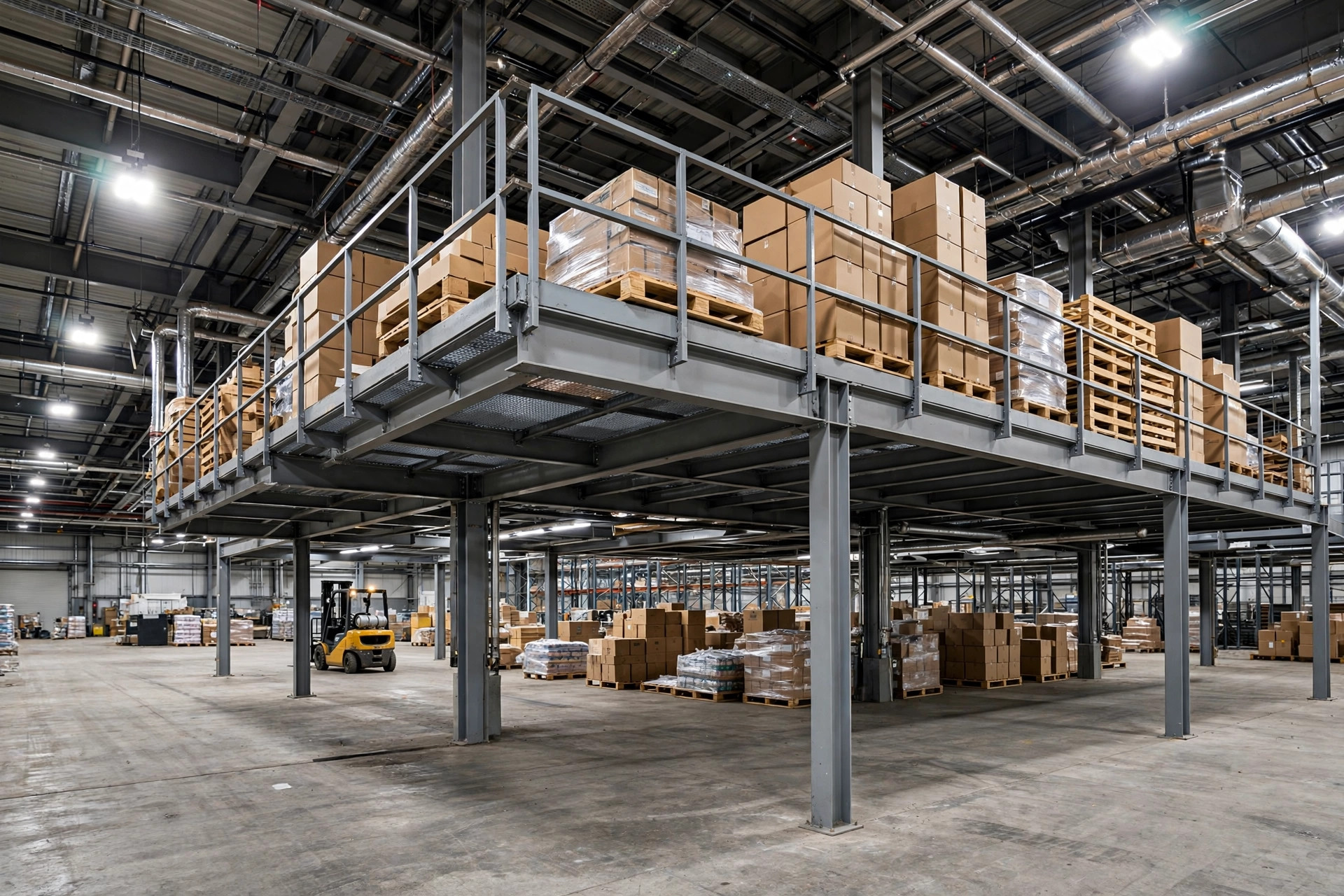
How much does a warehouse mezzanine cost per square foot? Every time someone asks me that, I ask one question back: do you want the steel price, or the installed price? Those two numbers can differ by a factor of two. So here is the first calculation, up front: in the US, bare steel plus decking runs $15–$40 per square foot. A fully installed warehouse mezzanine — stairs, rails, engineering, permits — typically lands at $50–$150 per square foot, with project data clustering around $70. Any quote under $35 that claims to be "all-in" is almost certainly bare steel. Before you sign, make the bidder itemize stairs, sprinklers, and permits line by line.
How Much Does a Warehouse Mezzanine Cost Per Square Foot — Installed, Not Just Steel
Start with the right price band for your use case. A storage deck and an office level are different projects wearing the same name:
| Mezzanine type | Installed cost (USD/sq ft) | Typical scope |
|---|---|---|
| Basic large storage platform | 35–70 | Big open area, regular column grid, light goods |
| Typical warehouse mezzanine | 50–150 | Averages ≈$70; stairs, rails, installation included |
| Heavy-duty equipment platform | 80–175+ | High loads, heavier steel, equipment supports |
| Warehouse office mezzanine | 125–250+ | Walls, HVAC, electrical, finishes |
(Price bands compiled from ThePricer's July 2026 industry pricing roundup and Speedrack West project data.)
This table alone kills the most common trap: suppliers love quoting the bottom of the first row, then billing you at the second or third row by the time the project closes. The gap is not in the steel. It is in the second calculation. My standing rule: demand a turnkey quote, itemized line by line — steel and decking, stairs and rails, pallet gates, freight and unloading, installation labor, stamped drawings, footings, sprinkler and electrical work, permits. Every missing line is a surprise waiting at closeout. Any bidder who gives one lump sum and won't break it down doesn't make the shortlist.
The Real Cost Breakdown: Where the Money Actually Goes
Take a standard 1,000-square-foot storage mezzanine and open up the total (example from ThePricer; I checked the arithmetic — it adds up):
| Line item | Cost (USD) |
|---|---|
| Mezzanine package (at $80/sq ft) | 80,000 |
| Structural engineering, stamped drawings, permits | 5,000 |
| New footings / slab reinforcement | 12,000 |
| Sprinkler and electrical modifications | 8,000 |
| Equipment rental + operational disruption | 4,000 |
| Total | 109,000 |
| Effective rate | $109/sq ft |
Notice the ratio: the steel is 73% of the project. The remaining 27% is money you never see in the brochure. Three items in that 27% get underestimated the most:
Sprinkler and fire protection rework. The moment the deck goes in, your existing sprinkler coverage is wrong. Under NFPA 13 the system needs new hydraulic calculations and added heads below the deck — a few thousand dollars for a small change, tens of thousands for a large one. If a bidder's quote has no line for this, walk away. He didn't forget it; he plans to add it after you sign.
Foundations. A column is a point load. Your slab handles forklifts fine and still fails under a concentrated column base. Engineers usually cut the slab and pour independent footings — $5,000 to $50,000+, depending on column count and soil.
There is a legal cap on mezzanine area. IBC 505.2 is explicit: in a sprinklered building, the aggregate mezzanine area cannot exceed one-half of the floor area of the room it sits in. Planning to deck the entire warehouse? The code says no. Measure your clear height and calculate the cap before you budget, not after.
And one counterintuitive truth: the smaller the mezzanine, the higher the unit price. Stairs, stamped drawings, permit applications, and crew mobilization are fixed costs. Spread them over 1,200 square feet and the per-foot rate can run two to three times that of a large platform. A small mezzanine is a luxury good, not a cost-saving move.
On saving money, three levers ranked by impact:
First, don't overspecify the load. 125 PSF (pounds per square foot) is a common platform design load in the industry (per Steele Solutions' project experience) — plenty for cartons and pick operations. A bidder who defaults to 250 PSF pushes every beam, column, and footing up a size, and the unit price follows. Load rating is the number-one cost lever; before approving drawings, ask the engineer what your goods actually require.
Second, buy used modular. A mezzanine's greatest virtue is that it unbolts — modular platforms can be disassembled and reinstalled in another building. The secondary market always has companies liquidating after a move, often in good condition. It is the most practical discount on a new build. Just verify the load rating and column grid fit your building, or you're buying scrap at a premium.
Third, straight stairs and early sprinkler design. A straight-run stair costs far less than a switchback; and the sprinkler rework plan must be locked in with the fire-protection engineer before steel arrives on site. Repiping after erection means scaffolding charges every single time.
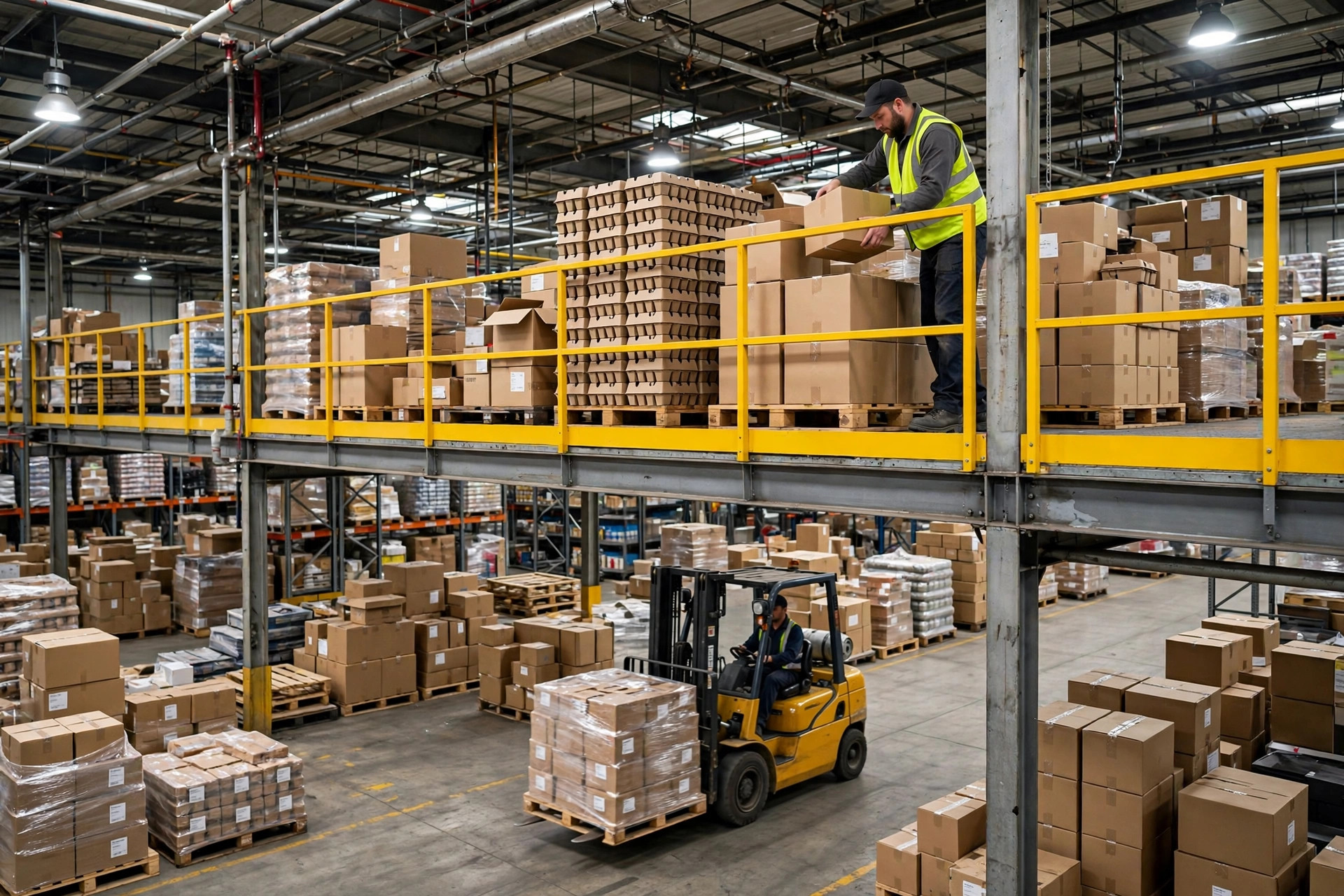
Warehouse Mezzanine Cost Per Square Foot: The Payback Math Against Leasing Bigger
Unit price and total cost are settled. The third calculation decides whether to build at all: how many years until it pays back versus simply leasing a bigger warehouse?
| Option | Upfront cost | Added annual cost | Notes |
|---|---|---|---|
| Build mezzanine | Hundreds of thousands | Near zero (depreciation only) | Can't take it with you; it stays with the landlord |
| Lease bigger space | Near zero | Added area × local annual rent | Walk away or renegotiate at renewal |
| Relocate | Six figures in moving + downtime | Rent delta at new site | Last resort |
First, a case where it pencils out. In 2024, a 3PL fulfilling home-goods e-commerce orders in Ontario, California (Inland Empire) was bursting out of a 32,000-square-foot lease with 32-foot clear height. They added 8,000 square feet of mezzanine for lightweight goods and returns: $528,000 for the structure at $66/sq ft, $28,000 in sprinkler repiping, $16,000 for engineering and permits, $22,000 in localized footing work — $594,000 total, or $74/sq ft. Local industrial rents were running about $13.50/sq ft per year, so the avoided rent was 8,000 × 13.5 = $108,000 a year. Payback: 594,000 ÷ 108,000 = 5.5 years, against 7 years remaining on the lease. Money well spent.
Now the opposite. In 2023, an auto-parts distributor in Dallas added a 1,200-square-foot mezzanine inside a 20,000-square-foot warehouse for offices and a sample room. Structure at $85/sq ft came to $102,000; office partitions plus HVAC and electrical added $78,000; sprinkler and fire work $19,000; permits $8,000. Total: $207,000, or $172.50/sq ft — the fixed-cost penalty of a small mezzanine, exactly as predicted. Local rent was about $8/sq ft per year, so annual savings were $9,600 against a 21.6-year payback, with 4 years left on the lease. When they move out, that $207,000 deck stays behind for the landlord. The calculator does not care about your feelings.
The Verdict: One Formula, Three Lines
Stop asking "is it worth it" and run the formula:
Payback (years) = Total mezzanine investment ÷ (Added area × Local annual rent per sq ft)
- Payback ≤ 5 years, with at least payback + 2 years left on the lease → build.
- Payback of 5–8 years → build only if the lease covers it; otherwise don't.
- Payback > 8 years → don't build. You are renovating the landlord's building with your own money.
One last rule: the years left on your lease decide how much you dare to invest. If the payback period exceeds your remaining lease term, the answer is always no. Gut feel is not a financial instrument — the calculator is.
By Lao Zhou, Logistics Cost Analyst