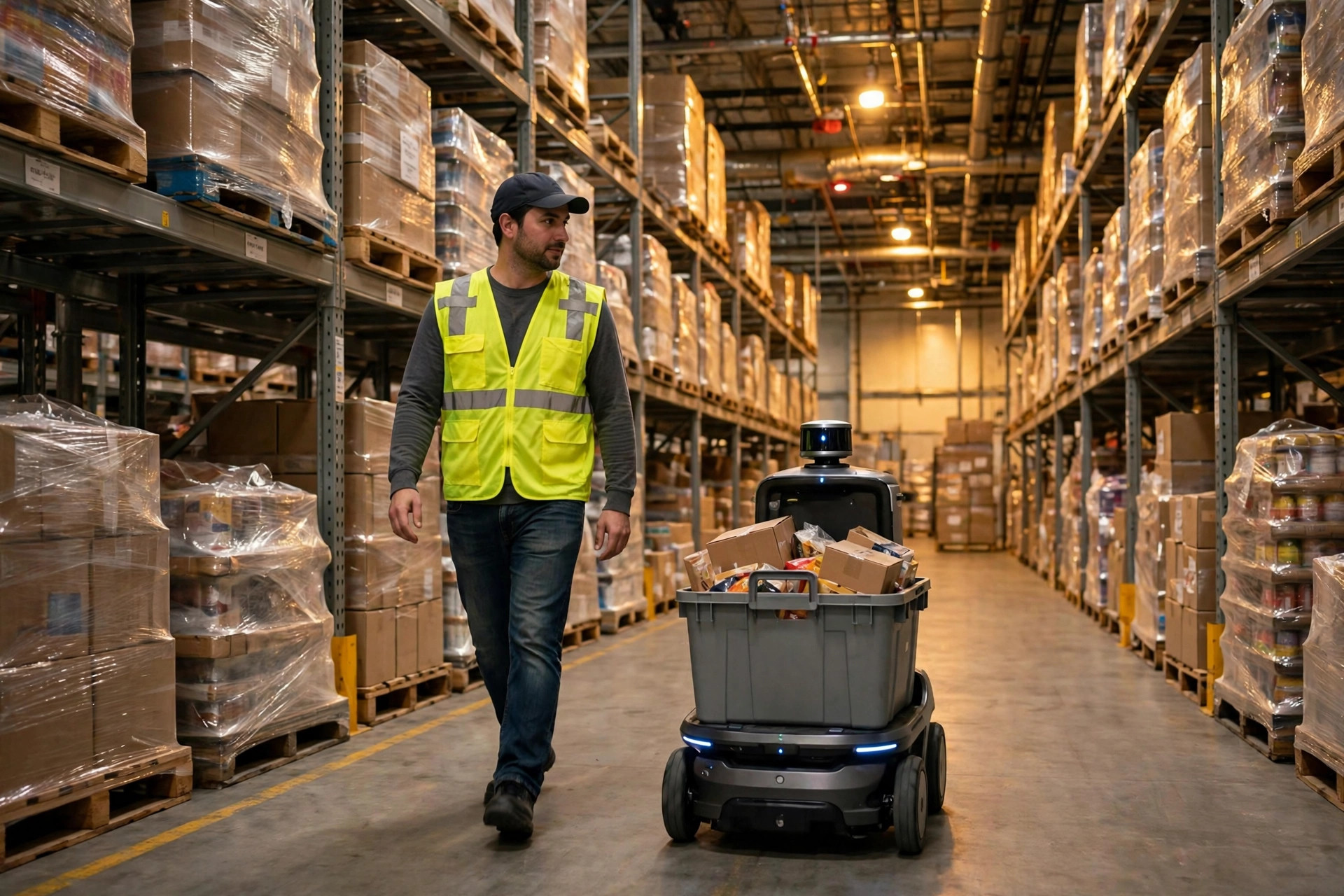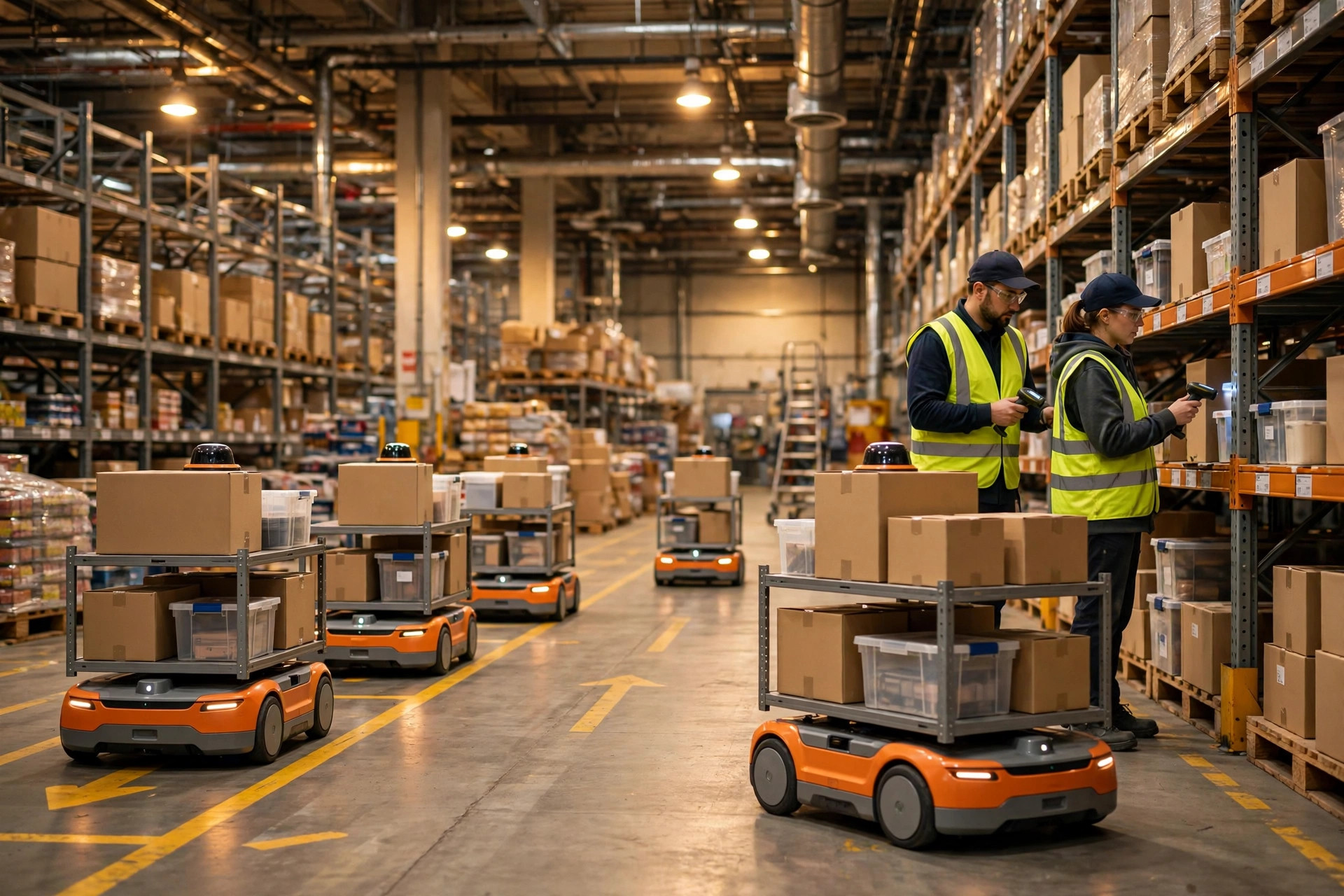
In July 2025, DHL announced a £550 million expansion of automation across its UK operations, adding more than 1,000 robots. Around the same time, Amazon's warehouse robot fleet crossed 750,000 units. Put side by side, these two figures stop being press releases and start being a scheduling question about AI replacing warehouse jobs: between now and 2028, which warehouse jobs disappear first, which ones survive, and which ones merely change their job titles?
The scale of AI replacing warehouse jobs: what the reports actually say
According to the World Economic Forum's Future of Jobs Report 2025, automation and digital transformation will displace roughly 92 million roles worldwide by 2030 while creating about 170 million new ones — a net gain of 78 million. The survey covered more than 1,000 employers representing 14 million workers across 55 economies. Notably, the report isolates "AI and information-processing technology" as its own category: by 2030, it is projected to displace about 9 million roles and create about 11 million. Displacement and creation happen simultaneously, but they land on different people. The same report found that 41% of employers plan to reduce headcount in areas where AI can automate tasks.
The McKinsey Global Institute's November 2025 report, Agents, Robots and Us, zooms in on the United States: 57% of US work hours are technically automatable with technology that already exists — McKinsey is careful to label this technical potential, not a forecast of job losses. Its timeline judgment: about 11 million US workers, roughly 7% of the labor force, may need to switch occupations by 2035, with a band of 6 to 16 million depending on adoption pace. The structure matters more than the headline: over 75% of workers likely to move sit in three fields — office and administrative support, retail and sales, and transportation and logistics. Workers in low-income brackets face nearly eight times the probability of occupational switching compared to high earners. Goldman Sachs, in April 2026, measured the current pace: about 16,000 net US job losses per month from AI displacement — roughly 25,000 positions eliminated, partially offset by 9,000 added through augmentation.
Taken together, these reports describe not a question of whether AI reaches warehouse employment, but a question of sequence. And sequence, unlike headlines, can be reasoned about.
A replacement-order matrix: three rulers for who goes first
Drawing on the logic of those reports and the task structure of a real warehouse, three dimensions determine a role's replacement priority: task repetitiveness, the share of work spent handling exceptions, and perceptual-motor complexity in unstructured environments. The more repetitive, the fewer exceptions, and the lower the sensing demands, the earlier the replacement. The table below applies this framework to 2026–2028.
| Role | Repetitiveness | Exception share | Perceptual-motor complexity | Replacement window |
|---|---|---|---|---|
| Document entry, invoice auditing | Very high | Low | Low | Already underway (2026) |
| Scheduling, dispatch clerks | High | Medium | Low | 2026–2027 |
| Container unloading, pallet moves | High | Low | Medium | Accelerating from 2027 |
| Replenishment, putaway | High | Low | Low-medium | Accelerating from 2027 |
| Structured piece picking (standard SKUs) | Medium-high | Medium | Medium | Partial, 2027–2028 |
| Returns inspection, exception handling | Low | High | High | Human-led beyond 2028 |
| Equipment maintenance, robot fleet management | Low | High | High | New roles being created |
The logic is straightforward once you see that replacement runs on two separate tracks: AI agents (replacing cognitive labor) and robots (replacing physical labor). Their cost curves look nothing alike — and that difference sets the order.
The counterintuitive part: pickers are not first in line
The common intuition is that AI comes first for the picker pushing a cart down the aisle. The cost structure says the opposite: deploying an AI agent to process documents, build schedules, and reconcile discrepancies costs a fraction of deploying a robot that can reliably grasp irregular items in an unstructured environment. One is software; the other is hardware plus algorithms plus months of on-site tuning — separated by at least an order of magnitude of investment and several years of maturity.
That means the people who feel the pressure first, in 2026–2027, are the warehouse's office workers: the clerks processing inbound paperwork, checking variances, building rosters, answering emails. McKinsey's data backs this up — about 40% of the most vulnerable roles involve drafting, information processing, and routine reasoning, exactly the tasks where AI agents already excel. On the physical side, the first to fall is the most structured corner of the building: DHL's Boston Dynamics Stretch unloading robots handle up to 700 boxes per hour. Container unloading is one of the most standardized, exception-poor zones in any warehouse, so it gets automated first. The matrix holds.
Two sites where this is already happening
The first site is Shreveport, Louisiana. Amazon's 3.1-million-square-foot fulfillment center, opened in September 2024, carries roughly ten times the robotic equipment of a previous-generation facility, and the company estimates a 25% cut to fulfillment costs. The telling detail is what happened to the workforce mix: Amazon says the deployment created about 700 new categories of technician roles that did not previously exist — people who maintain, tune, and troubleshoot systems like the Sequoia inventory platform and the Vulcan tactile robotic arm. Jobs did not simply vanish; they were exchanged. Repetitive operation shrank; equipment-related skill demand grew.
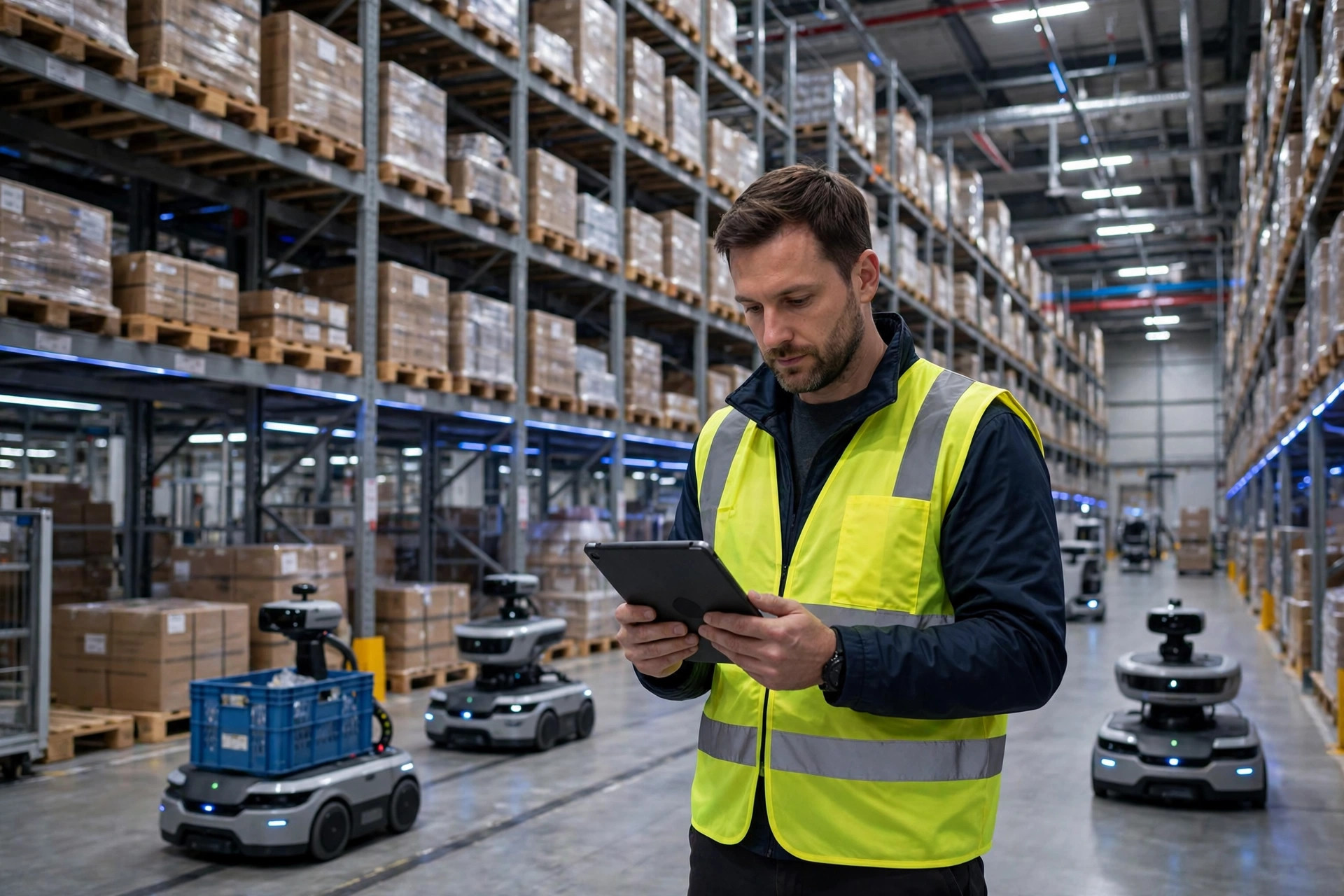
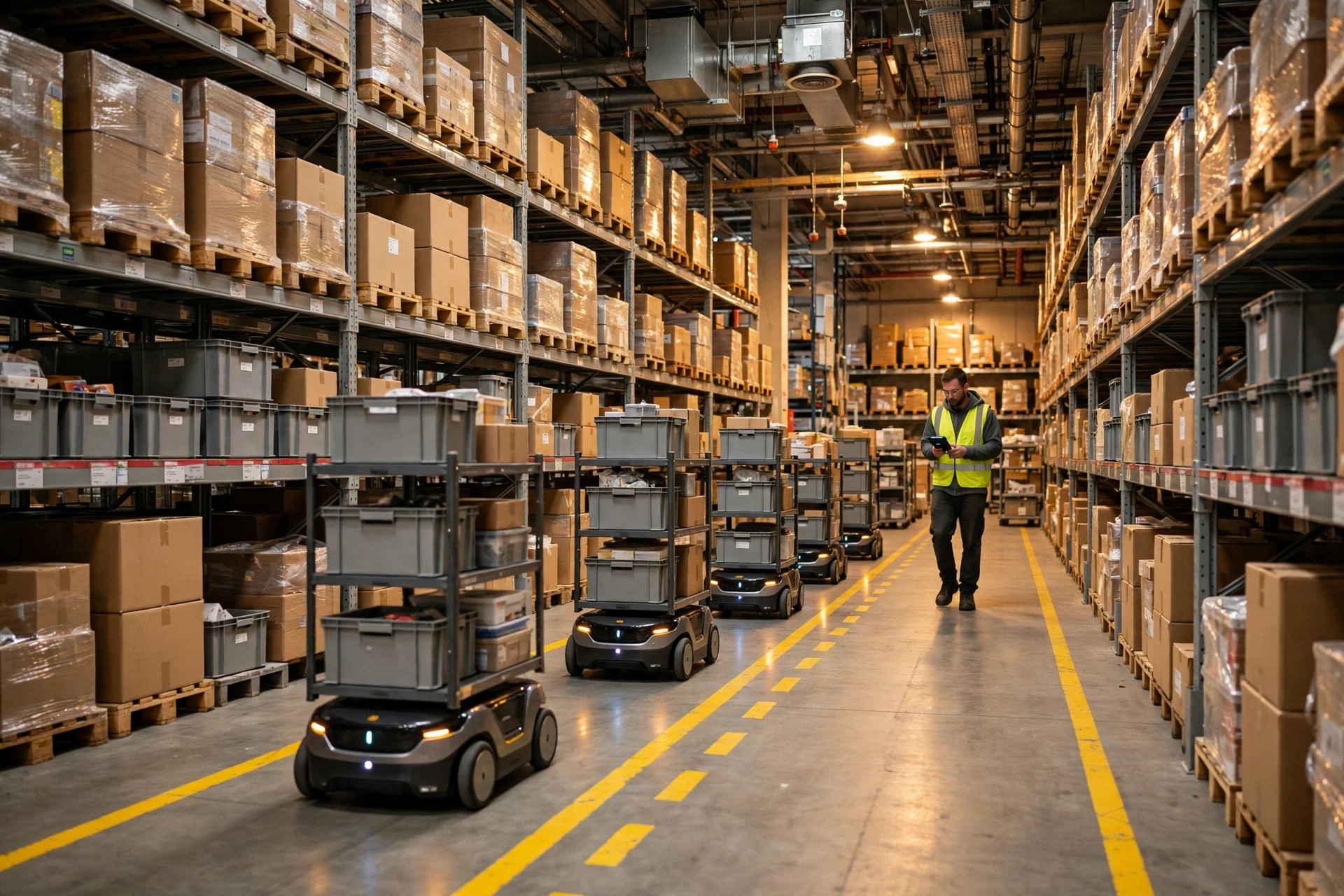
The second site is DHL's global network. By May 2024, Locus picking robots deployed across more than 35 DHL-managed sites had completed their 500 millionth pick — the milestone unit was retrieved at a facility in Toledo, Spain. In the UK, Ireland, and the broader EMEA region alone, over 750 collaborative picking robots are live across 18 sites. The £550 million follow-on investment announced in July 2025 signals that this is no longer a pilot — it is a replication phase. Both sites share a pattern: what got replaced first was the walking (robots bring goods to the person, who makes only the final grasp decision), not the grasping itself.
A 2026→2028 timeline for AI replacing warehouse jobs
Synthesizing the data and the field evidence, here is a timeline with its reasoning attached. 2026: clerical roles enter a substantive replacement phase, as AI agents take over documentation, scheduling, and first-pass exception screening — this is where the WEF's 41% employer-reduction figure is most likely to land. 2027: unloading, transport, and replenishment accelerate toward automation, with AMRs and automated forklifts becoming standard in new builds; DHL's Stretch deployment and Locus's scaling are the footnotes to this phase. 2028: structured picking sees partial replacement, starting with standard SKUs and full-case scenarios — while returns inspection, exception handling, and maintenance, with their high exception density and sensing demands, remain human-led and may even see rising demand as equipment fleets grow.
One caveat belongs on this timeline: Interact Analysis's May 2025 report cut its forecast for mobile-robot market growth from a 26% to a 21% compound annual rate, citing tariffs and economic uncertainty pushing companies to delay capital spending. Hardware replacement in 2027–2028 may therefore run a beat slower than raw technological readiness would allow. Sometimes the budget decides the pace more than the technology does.
Looking toward 2028, warehouse headcount does not disappear — it recomposes. Under McKinsey's framework, the genuinely scarce capabilities will be threefold: handling the exceptions machines cannot, maintaining and optimizing automated systems, and making operational judgments on top of data. Transition pressure falls hardest on low-income, repetitive roles (their switching probability runs nearly eight times that of high earners), and the transition points exactly toward those three capabilities.
In the end, AI replacing warehouse jobs was never a "humans versus machines" question. It is a sequencing question — decided by cost curves, exception density, and perceptual complexity. Once the operations are handled, a more interesting question opens up: in an industry that lives and dies by efficiency, what is judgment actually worth? And how much of the judgment currently done by the people sitting in the warehouse office could machines already do? The answers to those two questions may decide who is still standing in the warehouse after 2028 — more than any replacement timeline.
By Dr. Chen, Supply Chain Researcher