
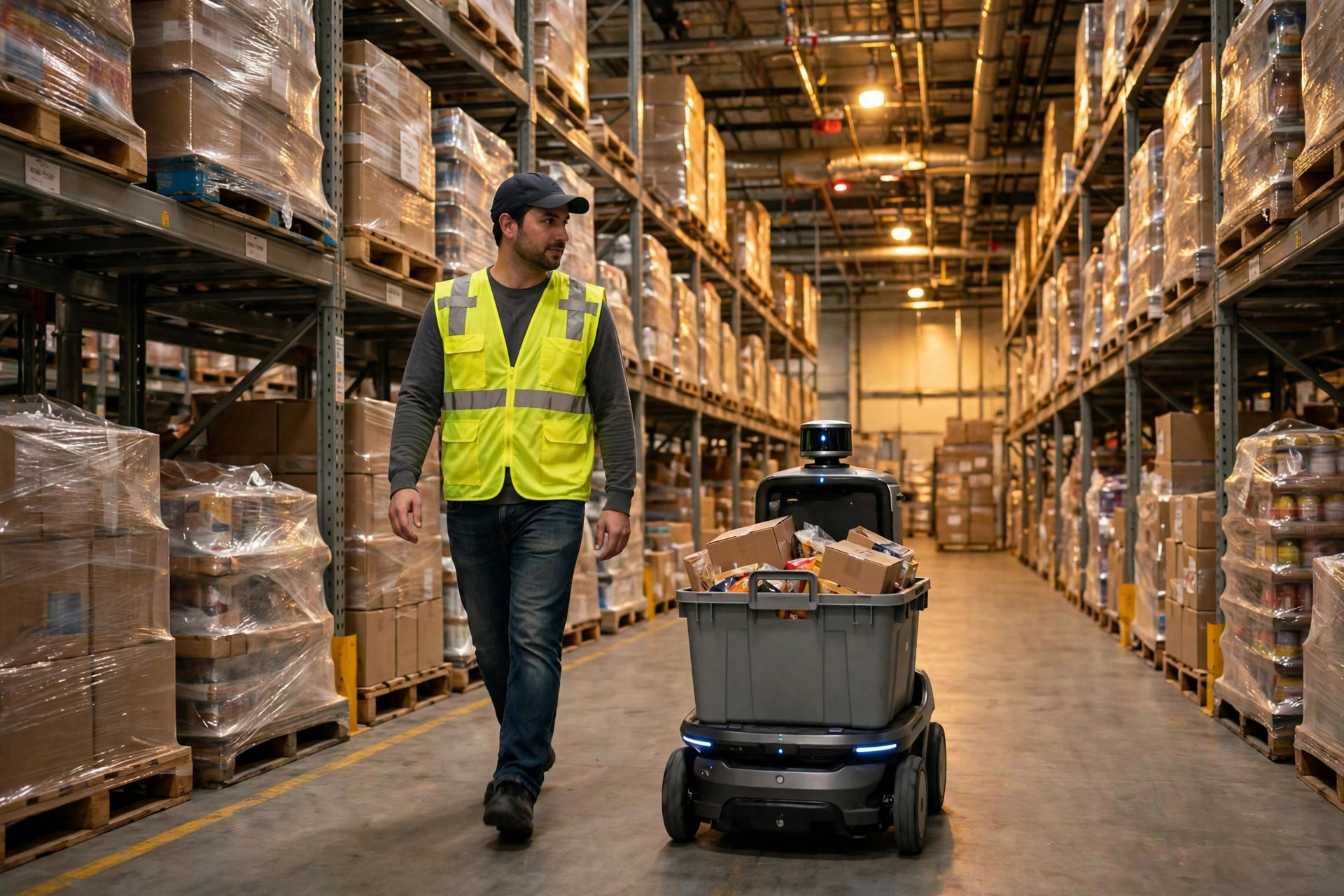
Here's my call: by 2028, US warehouses won't be empty of people — but the jobs will be a different breed. The purely physical roles keep shrinking. The roles machines can't do keep getting more expensive. I've seen too many "lights-out warehouse" projects quietly rehire the very people they let go. And the rehires always cost more than the originals.
Two things are true at once. The tech is genuinely eating jobs: US Bureau of Labor Statistics data (NAICS 493) puts warehousing and storage employment near 1.8 million, in one of the most aggressively automated industries of the last decade. A 2026 industry automation survey found only about one in ten warehouses has fully automated picking — yet more than four in ten still run fulfillment mostly by hand. The other truth: automation never replaces "people." It replaces repetitive motions. When the motions go, the people either level up or leave. This piece is about which manual warehouse jobs survive to 2028, which ones fade, and where the survivors should be heading.
My verdict first: three tiers of warehouse jobs in 2028
Put simply, one question decides whether a role makes it to 2028: is judgment the core of the job? I sort everything into three tiers:
The fading tier: highly repetitive, standardized environments — manual piece picking, basic pack-and-label, short-haul pallet moves. By 2028 these shrink hard in big DCs and 3PLs. Not to zero, but close.
The morphing tier: the job title survives, the actual work doesn't — forklift drivers become AMR dispatchers, cycle counters become inventory analysts, pickers become exception handlers. Same badge, completely different skill set.
The premium tier: the more robots you install, the more these people are worth — equipment technicians, WMS exception handlers, receiving QC inspectors, shift leads. Automation doesn't reduce your dependence on them. It deepens it.
That framework came out of a bruise. Here's the story.
The bruise: the "lights-out" DC in Ontario that rehired 12 people
2022, Ontario, California. A 120,000-square-foot 3PL hired me for an automation selection project. They went big: goods-to-person plus a 20-unit AMR fleet, $2.8 million all in, and cut 32 pickers in one move. The math looked beautiful — pickers at $19 an hour cost roughly $50K a year fully loaded, so 32 heads meant $1.6 million a year in savings. Payback in under two years.
The bill came due in peak season 2023. One Tuesday night in November, a WCS upgrade patch failed to handshake with the goods-to-person system. The stations sat dead for five hours. The whole building froze. They shorted 9,000+ orders that night, and SLA penalties plus emergency freight burned over $400K before sunrise. But the real damage was this: nobody on the floor knew how to improvise. A dozen of those 32 pickers had been unofficial "human exception handlers" — when the system choked, they knew which aisle to walk to find the carton manually; when a label misprinted, one glance told them which SKU was mirrored. None of that lived in the WMS. None of it was in an SOP. It was all in people's heads.
The owner rehired 12 of the old crew under a new title — "exception handler" — at $24 an hour instead of $19, plus retention bonuses. The automation still paid off, but payback stretched from two years to three and a half. Why? Of the $1.6 million in labor savings, $600K+ went right back out the door to pricier new roles, plus a $60K annual maintenance contract and a $90K-a-year robotics technician.
There's the trade-off nobody puts in the pitch deck: automation swaps out cheap, easy-to-hire, replaceable labor for expensive, hard-to-hire, irreplaceable labor. If your building can't keep one person who can fix an AMR, automation isn't a strategy — it's a landmine with a timer.
The math: what automation saves, and what it adds
Let me break out just the AMR fleet from that Ontario site, because the numbers are cleaner:
| Item | Amount |
|---|---|
| 20 AMRs, turnkey with implementation | ~$800K |
| Annual savings: 12 pickers × $50K | ~$600K/yr |
| Annual addition: maintenance contract | ~$60K/yr |
| Annual addition: 1 robotics technician | ~$90K/yr |
| Annual addition: spares and downtime | ~$30K/yr |
| Net savings | ~$420K/yr, ~1.9-year static payback |
A 1.9-year payback looks great on paper. The trade-off hides below the table: those 12 pickers took two weeks to recruit. The $90K technician took four months to find — poached from an auto plant. Automation turns a hiring problem of quantity into a hiring problem of quality. Peak-season headcount used to be the headache; money could fix that. Now the headache is keeping the one person who can fix the robots — and money doesn't always fix that.
A second case stings more. 2024, Memphis, Tennessee. An auto-parts DC installed robotic picking cells for odd-shaped parts, sold as replacing four pickers. In practice the arm failed on 12% of picks, so every cell needed a full-time "feeder" watching it — straightening parts, clearing jams. The feeders earned $2 an hour more than the pickers they replaced, because the job needed fast hands and basic equipment sense. Net result: four pairs of legs swapped for four pairs of pricier eyes, plus one temperamental robot to babysit. The owner's line to me: "Lao Mi, this isn't unmanned — it's expensive people plus a machine with an attitude."
The 2028 matrix: replacement odds × where each role goes
Here's the framework I use with clients for workforce planning. Calibrated for large DCs and 3PLs at a 2028 horizon; small warehouses can push it out about two years:
| Role | Replacement odds by 2028 | Where it goes |
|---|---|---|
| Manual piece picking | High | Exception handler, goods-to-person station operator |
| Basic packing / labeling | High | Packaging engineering, quality inspection |
| Short-haul pallet moves (forklift) | Medium-high | AMR dispatcher; narrow-aisle high-reach driving (where robots can't go) |
| Cycle counting | High | Inventory analysis (variance, ABC slotting) |
| Receiving QC | Low | Keep and pay more — damage, shortages, mislabels are things machines can't read |
| Returns processing | Low | Keep — "resellable or scrap" is pure judgment |
| Equipment maintenance tech | Very low | Worth more every year; lock them in early |
| WMS exception handling / sysadmin | Very low | Core role; the more automation, the more critical |
| Shift leads / supervisors | Low | Managing human-robot mixed operations — two skill sets, not one |
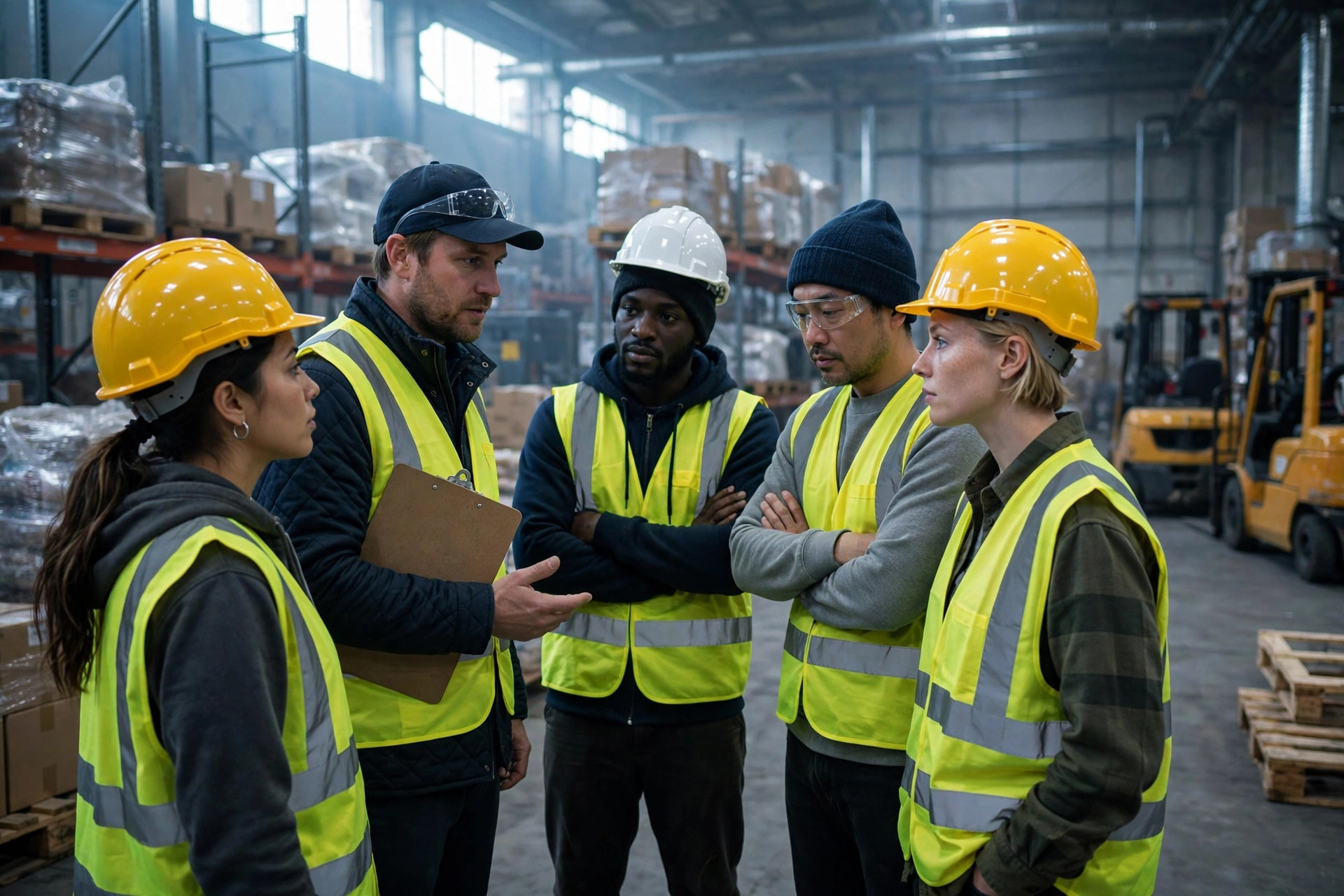
The pattern is clean: every role where a human has to make the call when something goes wrong sits in the low column; every role that's fixed motions in a standard environment sits in the high column. The people left in a 2028 warehouse are, essentially, the machines' after-sales department — they fix the robots, rescue the exceptions, and make the judgments.
The counterintuitive part: the office might go before the floor
Here's the take most people get backwards: AI and software will likely eat the middle layer — the people who sit at desks staring at screens — before they eat the floor.
Scheduling, daily reports, KPI tracking, exception alerts — a WMS with AI does all of it faster and more accurately than a person, and it never asks for overtime. I've already watched several DCs merge their "data specialist" and "scheduling clerk" into half a position. Meanwhile the veteran forklift driver, the receiving inspector who spots a leaning pallet from across the dock — robots aren't touching those jobs within three years.
So stop asking "will warehouses still need people in 2028?" The right question is: what kind of people will warehouses need in 2028? My answer: people who can fix machines, handle exceptions, and read data. Look at your crew — which direction are they training toward? Because if they're still training to "pick faster and walk faster," they're training for exactly the thing machines do best.
By Lao Mi, Supply Chain Veteran (20 yrs)





