Warehouse heat stress prevention OSHA compliance starts with a number you can calculate, not a feeling about the weather. Take a 60-person warehouse. Once the heat index passes 90°F, the proposed rule requires at least 15 minutes of paid rest every 2 hours. Over an 8-hour shift that is four breaks, 60 minutes per worker, 60 work hours gone from the floor in a single shift. That is the first cost of compliance, and it belongs in the budget before summer starts, not in a surprise after the first heat wave.
Get the regulatory picture straight before talking money. OSHA published its proposed Heat Injury and Illness Prevention rule on August 30, 2024, covering indoor and outdoor work. As of 2026, that federal rule has not taken final effect. Enforcement today runs through the general duty clause, section 5(a)(1) of the OSH Act, and OSHA's National Emphasis Program on heat has been extended to 2031. I will not quote a penalty figure here: check OSHA's website for the latest policy before you put any fine amount in a budget. A rule that is not final is not the same as a rule that does not exist. Inspectors are already on site, and the general duty clause is the tool they are using.
Warehouse heat stress prevention OSHA compliance: where the money actually goes
Work it through with one warehouse. An 80,000-square-foot 3PL site in California's Inland Empire, 60 floor staff, an afternoon shift in July 2025, heat index pushing past 90°F. At the high-heat trigger, every worker takes at least 15 minutes of paid rest every 2 hours: four breaks, 60 minutes each, 60 work hours per shift pulled off the floor. Multiply by your own hourly rate and the answer is right there. No industry average needed; your payroll is the source.
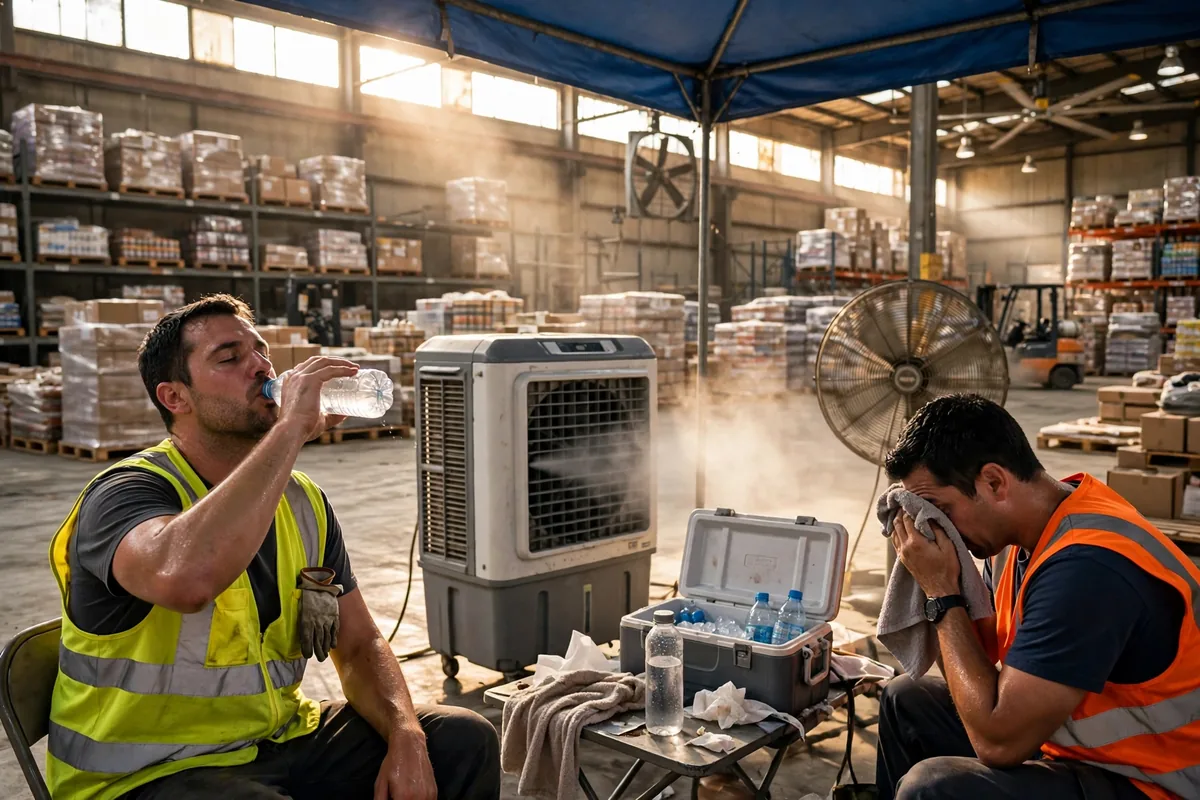
Split that cost into three buckets, because each one behaves differently. Together they are what warehouse heat stress prevention OSHA compliance actually costs in a real warehouse, not a separate safety project. Water and a shaded cool rest area are fixed costs: build them once, use them all summer. Paid rest breaks are variable costs: you pay on hot days and you do not pay on cool ones. New-hire acclimatization is the third bucket: short shifts, light work, and a named observer for the first days, with lower output while it lasts. Lump the three together and you will never see which one you can trim and which one you cannot touch.
Here is the counterintuitive part: the most expensive item is not the cooling equipment, it is the rest time itself. A fan or a shaded rest area is bought once and stays yours. Rest time has to be paid again every single hot day. I have seen warehouse owners haggle over a few hundred dollars on equipment quotes, then lose dozens of work hours in scheduling without noticing. That money was wasted in the wrong place.
The 80°F and 90°F triggers in warehouse heat stress prevention: two lines, two ways to spend
The proposed rule sets only two triggers, and they are easy to remember. At a heat index of 80°F, the initial trigger, you need water, a cool rest area, paid rest, and a new-hire acclimatization period. At 90°F, the high-heat trigger, you add at least 15 minutes of mandatory paid rest every 2 hours, plus symptom observation. Between the two lines, the difference is not temperature. It is how you schedule the shift.
| Trigger | What must be in place | Cost behaviour |
|---|---|---|
| Heat index 80°F | Water, cool rest area, paid rest, new-hire acclimatization | Mostly fixed cost, built once |
| Heat index 90°F | Everything at 80°F, plus at least 15 minutes of mandatory paid rest every 2 hours and symptom observation | Mostly variable cost, charged per hot day |
Read the trade-off off that table. The 80°F money is spent up front, once. The 90°F money is spent every day, for as long as the heat lasts. Keep two budgets: one for the fixed build-out before summer, one for rest hours on hot days. Merge them into one line and you will overspend by July without knowing where the overrun came from.
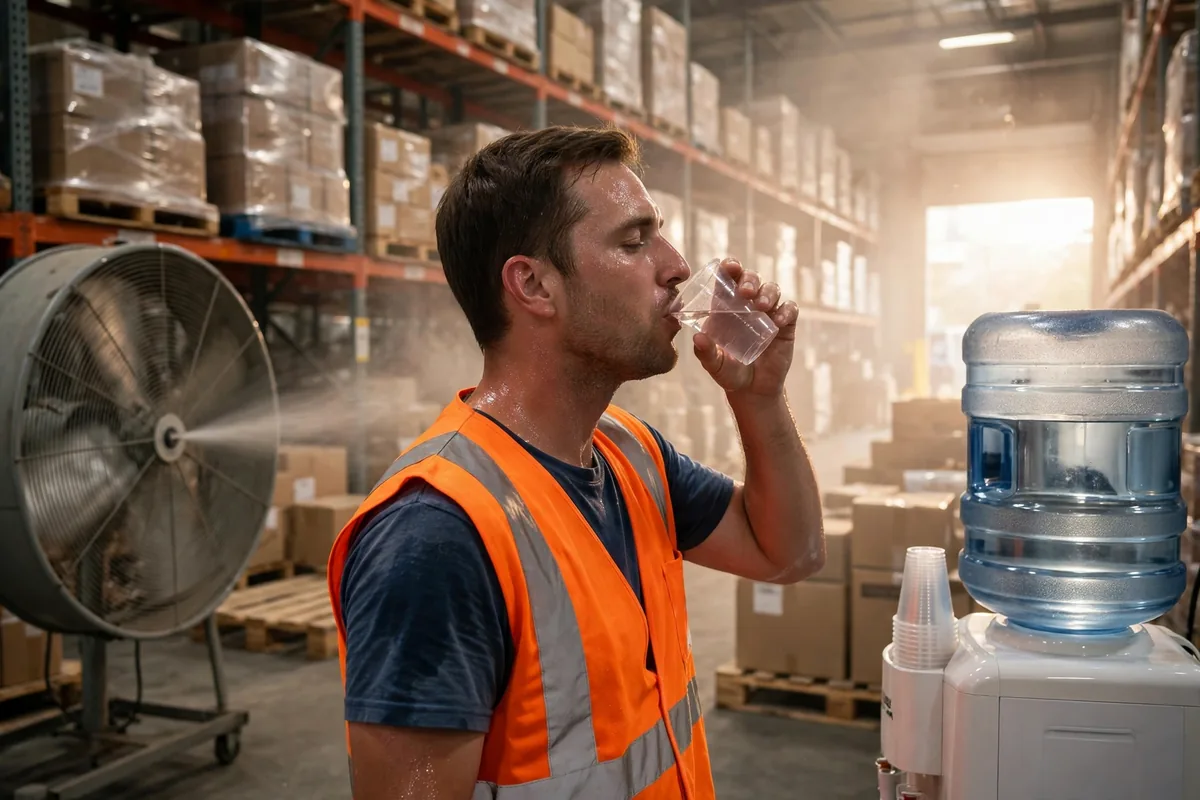
Execution details decide whether the rest time works at all. Put the rest area close to the work. If a worker walks five minutes each way for water, a 15-minute break leaves five minutes of actual rest; on paper you gave the break, in practice nobody recovered. Water, shade, and fans belong beside the pick face, not in a distant break room. Symptom observation needs a named person on each shift: who watches, who calls the stop, written on the roster. Do not wait for workers to raise their own hands. When heat stress sets in, judgment goes first; by the time someone speaks up, it is already late.
Scheduling is the cheapest lever in the whole account. Move heavy picking to the morning and keep only light work and replenishment for the afternoon once the heat index passes 90°F. The number of breaks is fixed by the rule and cannot be changed; what you do between the breaks is your call. The same orders, the same rest hours, a different result — heavy work done before the heat peaks, light work after. Check the heat index forecast before the shift starts; reworking the roster in the morning costs far less than reworking it at noon.
New-hire acclimatization: the hidden cost of warehouse heat stress prevention OSHA compliance
The second scenario is a warehouse outside Houston, Texas, in the first week of June 2026: four new hires start on the floor. The veterans have worked three summers at 90°F and their bodies know the heat. The new hires do not. Put a new hire on the same shift and the same intensity on day one, and the risk concentrates on exactly the people least ready for it. That is why the proposed rule names a new-hire acclimatization period.
The economics run against instinct. Short shifts and light work for the first days mean low output, and the hours look wasted. Skip those days, run the new hire at full load in week one, and what you save is a few days of low output. What you gamble is a worker going down mid-shift, the whole line stopping, an investigation, and a replacement to hire and train. The acclimatization period is not kindness to new hires. It is insurance for the roster.
Documentation is the other small cost nobody budgets for. Log the daily heat index, how many rest breaks were actually taken, and how many acclimatization days each new hire worked. Keep it in one place. When an inspector asks whether the 80°F measures were in place, a record closes the question; without one, work you actually did counts as work you cannot prove. The record costs a few minutes at the end of each shift. In compliance, evidence is worth as much as the measure itself.
So here is the calculable conclusion. A 60-person warehouse above a 90°F heat index spends 60 work hours per shift on paid rest, every shift, for as long as the heat lasts. The 80°F fixed build-out is settled once, before summer. New-hire acclimatization is booked per head, for the first days only. Put those three numbers in the budget and the daily cost of a hot day is a known figure — that is warehouse heat stress prevention OSHA compliance priced honestly, instead of discovered in July. When the final rule takes effect is a matter for OSHA's website; the general duty clause and a National Emphasis Program extended to 2031 are already in force, and the account is due today.
By Lao Zhou, Logistics Cost Analyst