To understand what OSHA's machine guarding requirements demand of warehouse conveyors, start with two cases that refuse to stay in the past. On March 10, 2014, at a scrap metal shredding and sorting facility in South Beloit, Illinois, a 37-year-old worker's arm was caught in an unguarded conveyor belt. OSHA found the conveyor unguarded and the shredder not locked out before workers entered the pit; at least three others had faced the same unguarded machines during cleaning. The result: seven willful violations, one serious violation, $497,000 in penalties.
Seven years later the script repeated in Cambridge, Ohio. In November 2021, a production manager clearing a jammed thermoforming machine was fatally crushed by a conveyor component. The same machine had produced near-misses that very day and two days earlier — workers "barely escaped injury," in OSHA's phrasing — yet nobody stopped the line or rewrote the procedure. OSHA proposed $291,086 across one willful, one repeat, five serious, and two other violations; the company had already been cited twice for lockout/tagout in 2020.
Separated by seven years and two states, both cases expose the same structural problem: a conveyor's danger was never about whether the machine can hurt someone, but about the moments when a worker has no choice but to reach into it. That is why conveyor guarding is best read through 29 CFR 1910.212, a standard written over half a century ago that still governs the outcome.
The data: conveyor accidents are not edge cases
According to preliminary data OSHA presented at the 2024 NSC Safety Congress, 1910.212 drew 1,541 citations in fiscal year 2024 — tenth on the most-cited list. Machine guarding's stubborn top-ten presence suggests even conscientious employers find OSHA's machine guarding requirements for warehouse conveyors hard to satisfy in one pass — the rules are scattered across several standards and the floor is full of gray areas.
BLS's Census of Fatal Occupational Injuries reports 62, 65, 75, 71, and 65 transportation-and-warehousing deaths from "contact with objects and equipment" for 2016–2020. Caveat: BLS publishes no standalone conveyor-fatality series — this is the closest official proxy, and caught-in deaths dominate the category. For conveyor-specific figures, defer to the latest BLS releases.
OSHA's Safety Pays tool notes U.S. employers pay almost $1 billion per week in direct workers' comp costs alone. Behind Behr's $497,000 sit indemnity, downtime, investigations, and higher premiums — the true cost was never just the penalty number.
What 1910.212 actually says: reading OSHA's machine guarding requirements for warehouse conveyors
29 CFR 1910.212(a)(1):
"One or more methods of machine guarding shall be provided to protect the operator and other employees in the machine area from hazards such as those created by point of operation, ingoing nip points, rotating parts, flying chips and sparks."
Wherever nip points, rotating parts, or points of operation exist, the employer must protect everyone in the machine area. Note "one or more methods" — OSHA prescribes an outcome, not a specific cover. Paragraph (a)(2) adds the overlooked corollary: guards must be affixed where possible and must not create a new hazard — a cover lashed on with wire reads as no guard at all.
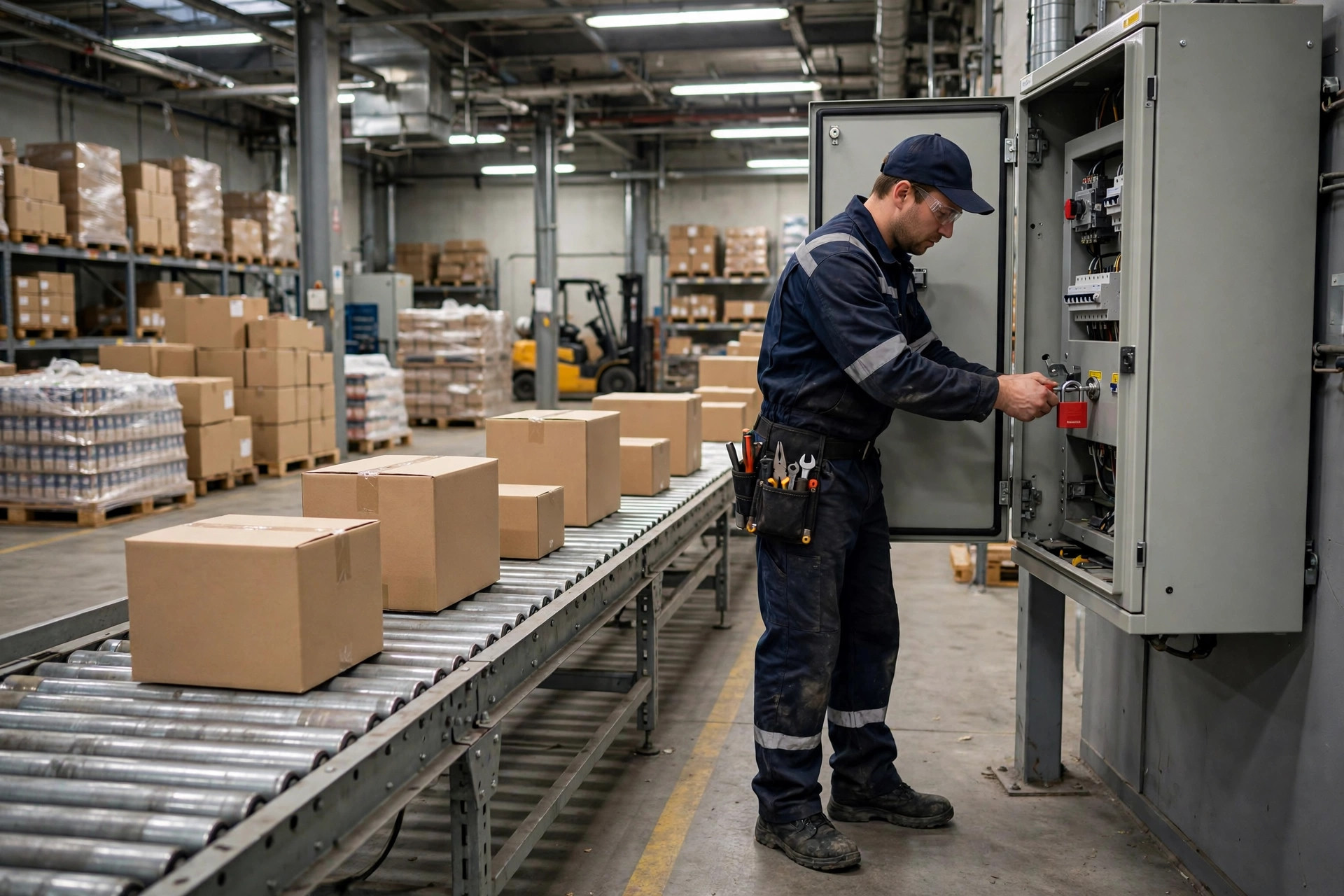
In practice 1910.212 is enforced as a package with three companions. 1910.219 (power transmission): drive chains, couplings, and shaft ends must be fully enclosed — the exposed drive-end chain is an inspector favorite: explicit clause, self-photographing evidence. 1910.147 (lockout/tagout): Encore's death happened during jam clearing, not normal operation; guarding answers "don't touch it while it runs," lockout answers "don't let it start while you're inside." The General Duty Clause (OSH Act §5(a)(1)): where 1910.212's coverage is debatable, OSHA cites this backstop — recognized hazard, foreseeable, feasible to abate. "The standard didn't spell it out" was never a defense.
The inspector's walkthrough is now legible: nip points (1910.212), transmission covers (1910.219), lockout in maintenance (1910.147), the General Duty Clause closing every "I didn't think it applied."
Attribution: why guarded conveyors still kill people
The files point to a counterintuitive finding: the most fragile link is often not the missing cover but the installed one left open because maintenance found it inconvenient. Encore's manager died clearing a jam, and warehouse conveyors jam daily. Fixed guards are awkward here: weld it shut and the mechanic can't reach in; make it removable and after the third removal nobody puts it back. "Guard removed and not replaced" recurs in OSHA reports with depressing regularity — the hazard comes not from a design flaw but from an unserious trade-off: safety wants zero accessible hazard points, maintenance wants the shortest repair time, and fixed covers lengthen it.
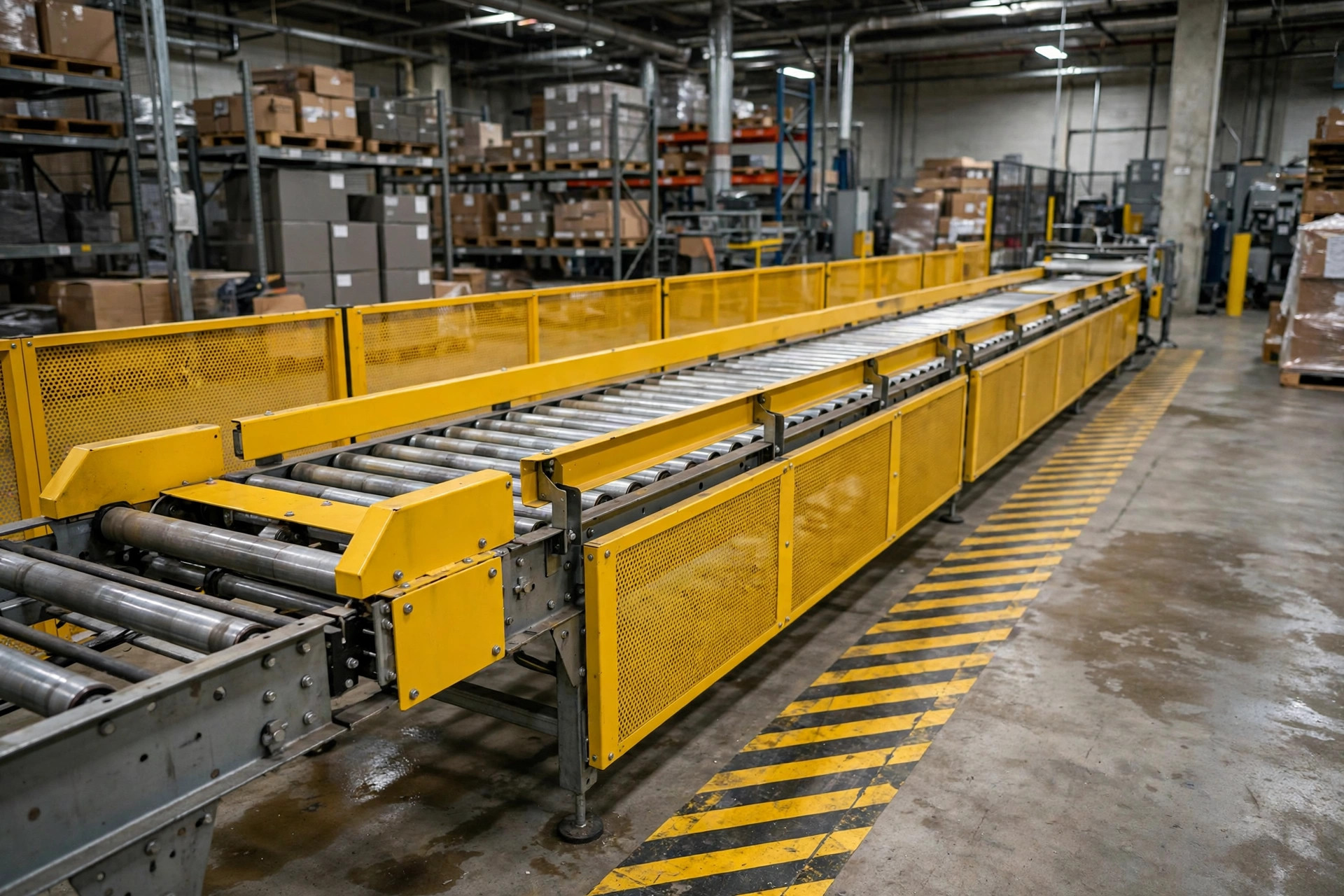
The fix is not a thicker cover but quick access designed into the system: interlocked doors, quick-release chain guards, pull-cord e-stops. OSHA never demanded "covers" — only that nobody gets hurt when approaching the machine.
Deeper sits management: Behr exposed "at least three workers" during cleaning; Encore's machine produced three incidents in three days — known, foreseeable, never acted on. OSHA classified both as willful, which escalates penalties and explains much of Behr's $497,000. That is why 1910.212 never leaves the top-ten list: it punishes not ignorance but knowledge without action.
The math: guarding investment versus one serious accident
Two public penalties as reference: $497,000 (Behr, 2014) and $291,086 (Encore, 2021) — citations only, before indemnity, downtime, and insurance hikes. Retrofitting a mid-size sortation conveyor — covers, interlocked doors, pull-cord e-stops, signage — runs in the low tens of thousands by industry experience: one citation costs roughly five to ten times the entire retrofit. Guarding budgets die on "no accident budget this year"; OSHA's logic runs in reverse — no accident does not mean no hazard, and a foreseeable unguarded hazard is citable on its own.
| Guarding retrofit | One serious accident | |
|---|---|---|
| Order of magnitude | Tens of thousands of dollars | $291k–$497k in citations alone |
| Added costs | Brief installation downtime | Indemnity, downtime, insurance, reputation |
| Certainty | One-time spend, lasting effect | Probabilistic — expected loss dwarfs investment |
| OSHA's view | Compliance baseline | Willful classification escalates penalties |
A decision framework: matching the guard to the hazard
The wrong guarding method is nearly the same as none. Match method to hazard type and access frequency:
| Hazard point | Typical location | Guarding method | Regulatory logic |
|---|---|---|---|
| Rotating transmission parts | Motors, chains, couplings, shaft ends | Fixed full enclosures | 1910.219 |
| Ingoing nip points | Belt-to-roller contact | Fixed guards / gap control | 1910.212(a)(1) |
| Service / jam-clearing access | Routinely opened points | Interlocked doors (open = stop) | 1910.212 + 1910.147 |
| Long conveyor runs | Lines tens of meters long | Pull-cord e-stops along the run | General Duty / B20.1 |
| Operator stations | Manual sort / induction posts | Two-hand controls / light curtains | 1910.212(a)(3) |
The logic: the more often people approach, the less the method may rely on discipline. Any design requiring a worker to "remember to put it back" reads as a management failure.
Trend: warehouse conveyor guarding is becoming a system, not a cover
Three time-bounded judgments follow. First, the accident scene is shifting from operation to maintenance. E-commerce density and speed have matured normal-operation guarding; what remains is jam clearing, cleaning, belt changes. Over the next three to five years, expect enforcement to pivot from "is there a cover" to "is there an energy-control program" — more packaged 1910.212-plus-1910.147 citations. Second, technology is moving from fixed covers to interlocked systems — safety-controller-linked doors, area scanners, pull-cord integration — driven not only by safety but by 3PL customer audits that now score conveyor guarding during facility qualification. Third, the foreseeability bar is tightening. Both cases drew willful classifications on "the company already knew"; as ASME B20.1 grows more detailed, that defense shrinks. Start with a B20.1-based hazard survey of every conveyor — fixing it yourself is cheaper than having an inspector find it.
1910.212's core never changed: separate hazard points from people. What changed is the conveyor — longer, faster, denser. An open question worth watching: as conveyors automate further, should guarding's boundary sit on the equipment or on the work process? OSHA's answer appears to be both, while most facilities have neither fully in place — and that gap is where every story in this space will come from.
By Dr. Chen, Supply Chain Researcher