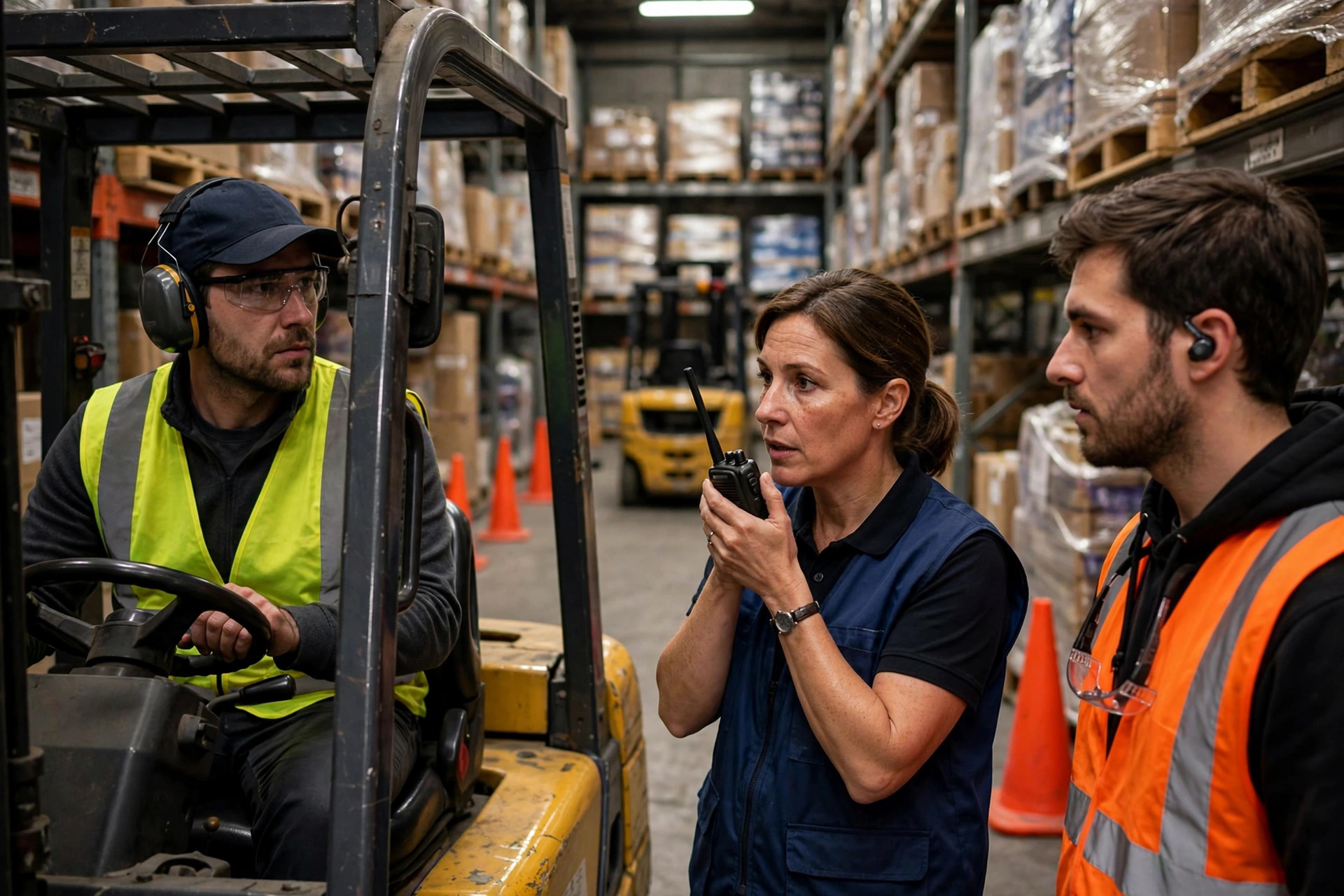
It was 10 a.m. on a Tuesday in May 2025 when two people from the San Bernardino County Fire Department walked into my warehouse. I was in the office eating a sandwich. My first instinct was to show them the sprinklers — they waved me off. "Let's see your fire inspection files first."
My stomach dropped. Our "files" were three overstuffed binders in the corner of the office and an ancient PC nobody could find anything on.
Forty minutes of digging produced three things: last year's sprinkler test report, a three-year-old evacuation map, and a half-signed extinguisher log. The inspector wrote in his notebook and handed me a correction notice — 30 days to fix everything. Before leaving he said something I still remember: "Your sprinklers look fine, but NFPA 25 requires test records. No records means it never happened."
The Marshal Doesn't Look at Sprinklers. He Looks at Paper.
Here's the counterintuitive part I figured out later: a fire inspection isn't really about fire. It's about files.
Think about it — the inspector comes once a year. He can't tear apart every sprinkler head in a 32,000-square-foot building. His entire judgment of whether you're legit comes down to one thing: is your paperwork in order? Paper in order means somebody's minding the store. Paper missing means whatever looks good on the floor is probably luck.
And here's the thing about small warehouses like mine: we can't afford to burn money — literally. Not the money for equipment, the money for work done for nothing. We pay a licensed contractor for sprinkler testing every year, and because the report wasn't filed properly, in the inspector's eyes it never happened. That's like paying for dinner and the guest never shows up.
The 2023 incident sealed it for me. One winter morning a forklift battery started smoking in our charging area. An employee grabbed an extinguisher and put it out — close call, no damage. When the fire department came by afterward, they flipped through that extinguisher's monthly check card. Last signature: four months earlier. They didn't fine us, but one of them said, "If this had been a real fire, your insurer's first question would be about this card." That's when I got it: fire files aren't for the inspector. They're for the day something actually burns. The inspector is just the dress rehearsal.
Our Ghetto Fix: One Binder Runs the Whole Show
The big-company compliance software? Not for us. We can't afford a full-time safety guy either — 17 people total, and safety is the boss's side gig (mine). Our fix has three parts:
First, a fat three-ring binder labeled "FIRE INSPECTION," sitting in the first cabinet to the right of the office door — retrievable within 30 seconds of an inspector walking in. Everything filed in checklist order, with a cover index at the front of each section.
Second, a mirrored cloud folder with every page scanned, files named like 2025-sprinkler-annual-report.pdf. Read-only access for the landlord and our insurance broker — if something happens, I can pull it up on my phone.
Third, one A3 sheet taped to the office wall: this month's fire self-check list. Extinguisher monthly checks, aisle patrols, charging-area inspection — check the box, sign your name. I review and sign it myself at month's end. That sheet is our "compliance software."
Time for the math:
| Item | Big-company way | Our small-warehouse way | Annual cost | | Sprinkler/alarm testing | Full-service maintenance contract | Licensed contractor for quarterly + annual NFPA 25 tests only; we patrol the rest ourselves | ~$3–4K | | Extinguishers | Outsourced monthly checks | We sign monthly ourselves; pro does the annual | A few hundred | | Fire drills | Hire a consultant | Run it ourselves, twice a year | $0 + half a day of production | | File management | Compliance software | One binder + cloud drive | $0 |
See the pattern? The money you must spend (licensed testing — NFPA 25 is non-negotiable, your own signature doesn't count) — spend it. The money you don't need to spend (software, consultants, outsourced monthly checks) — don't. In fire compliance, the gap between big and small warehouses isn't money. It's whether somebody treats "writing it down" as a real job.

The 10-Document Checklist — Steal It
During those 30 days I rebuilt everything the inspector's notebook had flagged. This list now sits on page one of our binder:
- Building fire approval / Certificate of Occupancy — get a copy from your landlord. Inspectors love asking "when was this building signed off?"
- Sprinkler test & maintenance records — NFPA 25 requires periodic inspection, testing, and maintenance. We do an annual plus quarterly tests by a licensed contractor; every report filed, no exceptions.
- Fire alarm test records — same deal as sprinklers: periodic testing, reports on file.
- Extinguisher check cards — NFPA 10 wants monthly visual checks: gauge, pin seal, placement — then sign. Annual professional service on top. Hang the card on the extinguisher, not in a drawer.
- Evacuation map + Emergency Action Plan — OSHA 1910.38: employers with more than 10 people need it in writing. On the wall, not on a hard drive.
- Fire drill records — at least twice a year, with sign-in sheets, photos, and evacuation times. Our first drill: 17 people took 11 minutes to assemble, and two were in the bathroom and never heard the whistle. I'll be laughing about that for years.
- Hot work permits — OSHA 1910.252: welding and cutting need advance approval plus a fire watch on site. Small warehouses do rack mods and buildouts all the time — this permit is the one everybody forgets.
- Employee fire training records — once at onboarding, refresher every year, sign-in required. Inspectors randomly ask workers "where's the nearest extinguisher" — a blank stare costs you points.
- Deficiency close-out log — the inspector's favorite: issue found → fixed → rechecked → signed, every item closed out. This log proves you're actually managing the place.
- Aisle / stacking self-checks — NFPA 13 wants 18 inches (about 45 cm) of clearance below sprinkler deflectors; OSHA wants extinguishers reachable within 75 feet (Class A). Peak season clogs aisles fast — snap a photo every month and file it.
Wherever I wasn't sure about exact frequencies or standards, the rule is: check with your local fire department. Every county fire marshal in California has their own temperament. Don't argue with me; confirm with yours.
Paper in Order, Inspector Out in 20 Minutes
Thirty days later, the same inspector came back. I handed him the binder. Twenty minutes of flipping, three questions, zero findings. On his way out he joked: "This binder is clearer than some big warehouses' systems."
My one-line summary of fire inspections: the inspector doesn't care how rich you are; he cares how much you care. Big warehouses run on systems. Small warehouses run on people — on the boss spending ten minutes a month signing that A3 sheet.
So here's something you can do tonight: walk into your warehouse, flip over the monthly check card hanging on an extinguisher, and look at the last signature date. If it's more than a month old — congratulations, you just found your first gap.
Small warehouses have their own way of surviving. Big companies have compliance departments; we have a binder. They have software; we have a pen. Paper in order, mind at ease.
By Xiao Ma, Small Warehouse Owner