Last Tuesday, 6:55 a.m., shift handoff. My lead, Xiao Wu, shouting from his little notebook: "Zone B high-bay picks today! Pedestrians yield in the forklift lane! Nobody touches yesterday's damaged pallet!"
The Mexican guys nodded like bobbleheads. The Vietnamese guys nodded. Then everyone walked off and did whatever they were going to do anyway — and by noon, somebody had moved yesterday's damaged pallet with a forklift. Again.
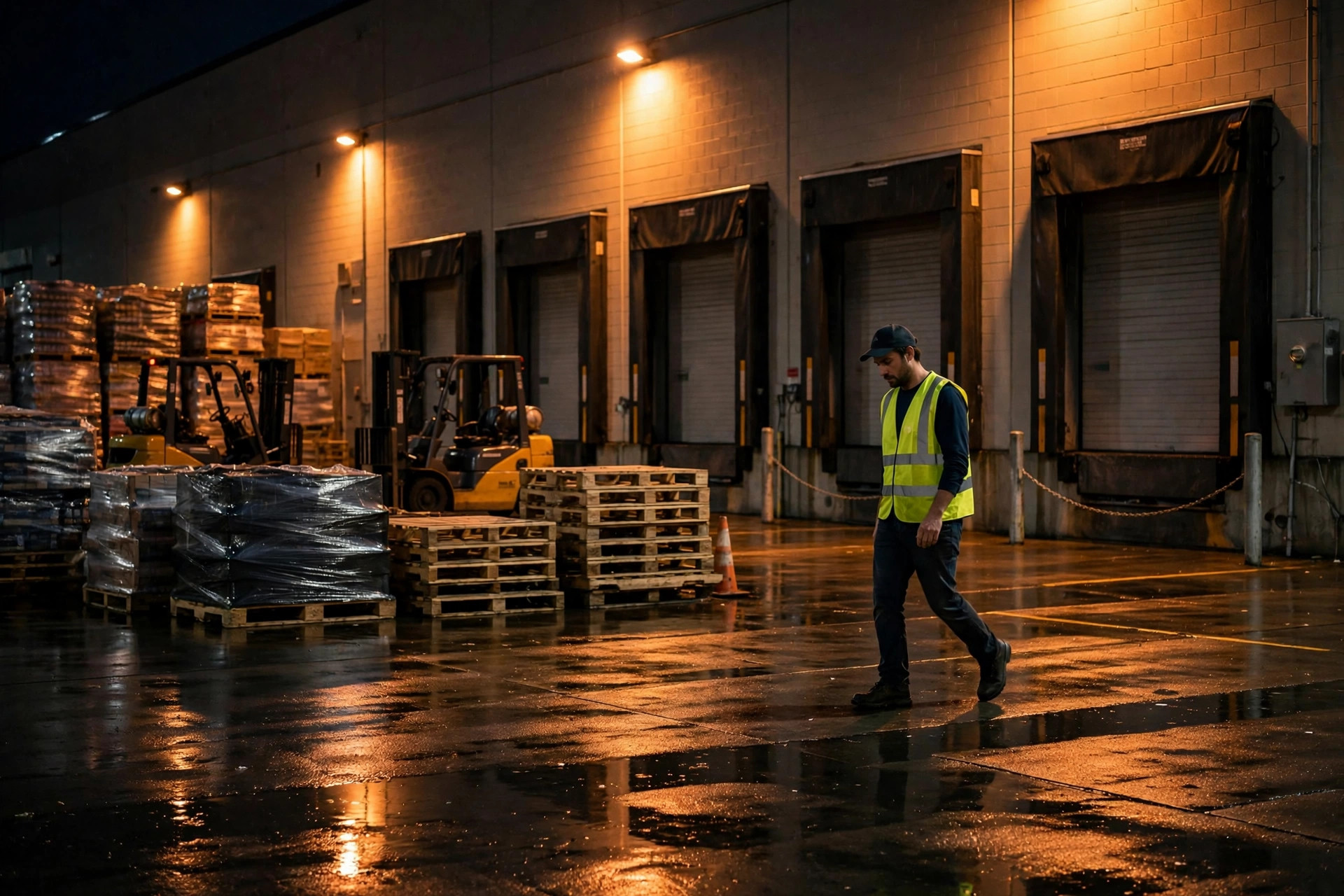
That is the daily opening act at my warehouse. Three thousand square meters, twelve people, four native languages: Chinese, Spanish, Vietnamese, English. Fifteen minutes of handoff, half of it lost in translation, the other half spent checking whether anyone actually understood a word.
Hire a bilingual lead? I asked around. One who can run the Spanish-speaking crew and still reconcile inventory with me costs a big premium over a regular lead — and the big warehouses keep poaching them. The full multilingual training systems the big companies run? We small warehouses can't burn money like that.
But here's the thing: we really can't afford an accident either.
Do the math first: an accident costs more than we have
OSHA estimates that language barriers are a contributing factor in roughly 25% of job-related accidents. And the fines — 2026 figures, straight from osha.gov: up to $16,550 per serious violation, up to $165,514 per willful or repeat violation. My little warehouse's annual profit would cover maybe a few serious citations. One forklift-versus-pedestrian incident and we're basically done.
OSHA has also been clear for years: safety training has to be delivered in a language workers actually understand. We used to wave an English SOP around and hope for the best. Every audit season, that hope felt thinner.
| Option | Cost | Solves | Doesn't solve |
|---|---|---|---|
| Bilingual lead | Big wage premium, and they leave | Communication plus supervision in one | One person can't cover every shift |
| 3× AI earbuds | A little over $1,000, one time | Handoffs and daily comms understood | Emergency shouts, noisy zones |
| One injury accident | OSHA fines from $16,550, willful up to $165,514 | — | Might shut us down |
(Figures: OSHA 2026 penalty schedule — serious up to $16,550 per violation, willful/repeat up to $165,514 per violation, per osha.gov. Earbud pricing per the manufacturer's current list price.)
That math made my $1,000 feel like the cheapest insurance I've ever bought. A bilingual lead's annual premium alone would buy a dozen earbuds. So late last year, I did something completely off-brand for a warehouse guy: I bought AI real-time translation gear.
The cheap fix: AI translation earbuds plus three free tricks
Here's exactly what we bought. Translation earbuds — Timekettle W4, $349 a pair, 40-plus languages, the company claims 0.2-second latency and 98% accuracy. I bought three pairs: one lives with Xiao Wu, two sit on the handoff table for whoever needs them. A free translation app on a spare phone is the backup for dead batteries and the occasional Vietnamese-speaking driver who shows up unannounced.
But the gadgets are the garnish. The real fix cost nothing, and it's three things.
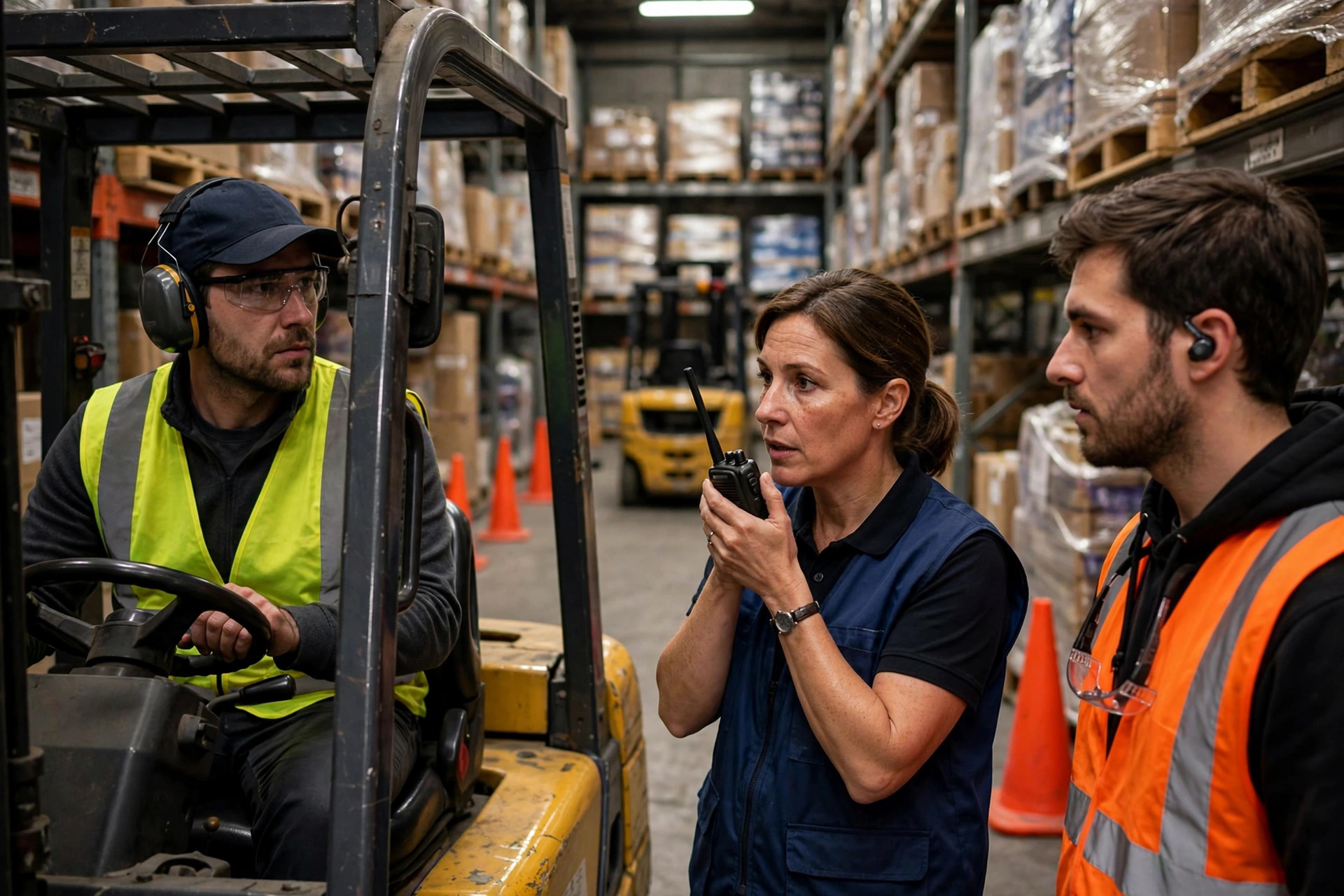
First, the three-minute handoff script. Handoff used to be improv — five minutes or fifteen, depending on Xiao Wu's mood. Now it's fixed: one minute on yesterday's exceptions, one minute on today's priorities, one minute on safety. Three minutes, not a second more. He speaks Chinese; the earbuds turn it into Spanish and Vietnamese in real time. For the first time, the crew learned that "yesterday's damaged pallet" meant the pallet at B-08-35-4 — not, as they'd assumed for months, "don't touch anything from yesterday."
Second, the "20 lifesaving phrases" card. Forklift coming, step aside, falling objects overhead, stop, don't move — twenty safety shouts, printed on a card, one per person, taped to pick carts, forklifts, and the handoff table. These twenty are never allowed to depend on the earbuds. Chinese, English, Spanish on the card; our Vietnamese guy Nguyen translated his own version, because machine translation mangles Vietnamese industrial vocabulary and a native speaker does it right the first time.
Third, the lead learns three foreign phrases. Xiao Wu now knows three Spanish words: "¡Cuidado!" (watch out), "¡Para!" (stop), "¡Despacio!" (slow). Don't laugh — in an emergency, those three words beat the earbuds by ten seconds.
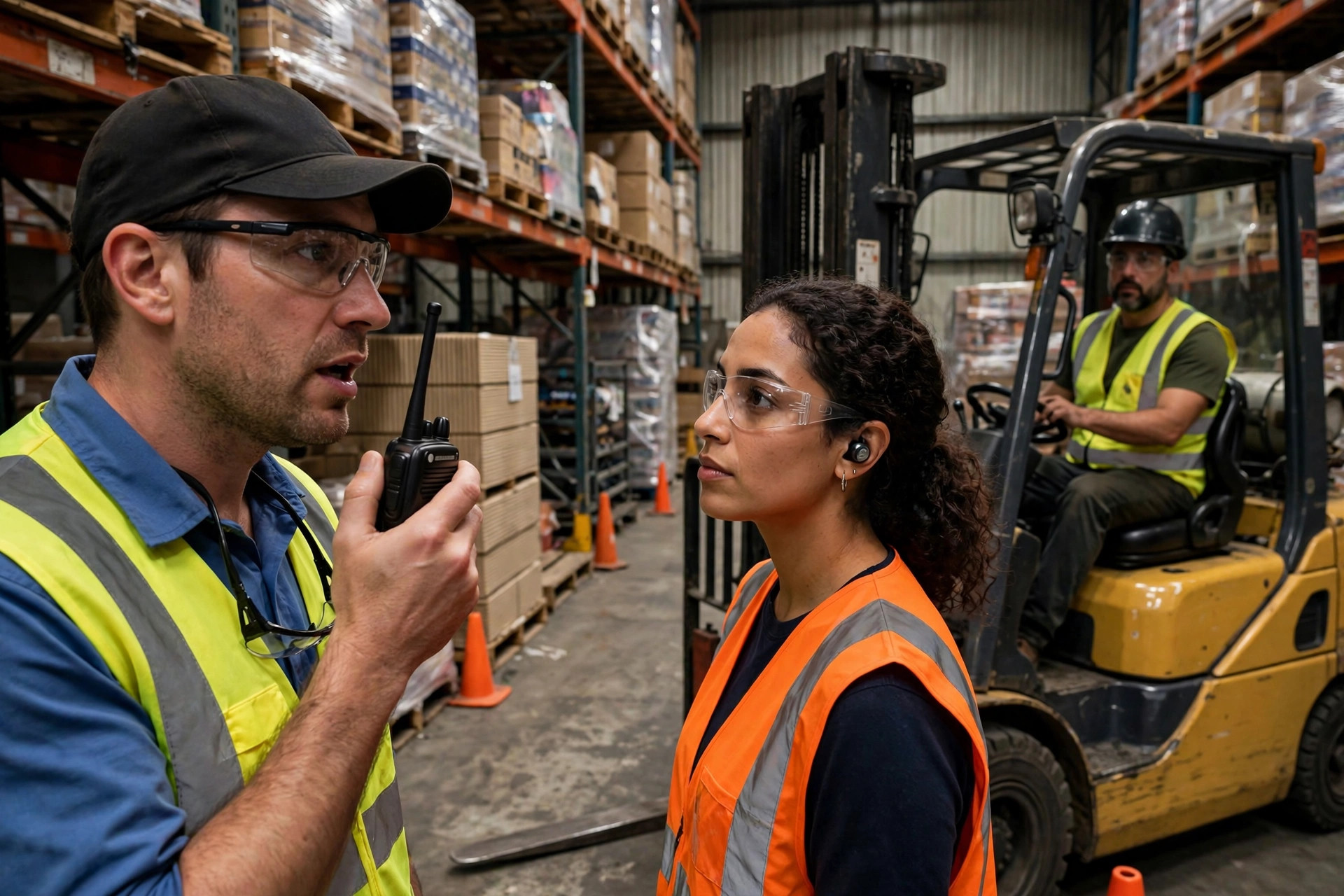
Two true stories. Story one: the handoff. We replayed that Tuesday scene this week, earbuds on. Midway through, one of the Mexican pickers raised his hand — the first question ever asked at our handoff: "The high-bay pallets in Zone B — are those the ones we skipped in yesterday's cycle count?" They never asked questions before, not because they didn't care, but because they didn't know where to start. Handoff dropped from fifteen minutes to eight. Mis-picks and wrong-pallet moves fell by nearly half that month.
Story two: the shout. Last month, our forklift driver Lao Chen turned a corner in Zone B, honked, yelled "coming through" — the Mexican picker didn't react. Emergency brake, the pallet wobbled, thirty centimeters from a very bad day. After that we made it ironclad: every forklift entering a pick zone shouts the fixed triple — "Forklift coming! 叉车来了!¡Cuidado!" All three, every time, no skipping. Pedestrian incursions in the forklift lane: zero this month.
The uncomfortable part: the smoother the AI translation, the riskier the crew
Here's the counterintuitive bit nobody selling earbuds will tell you: the smoother the translation, the more dangerous the crew gets.
When the earbuds work well, everyone relaxes into the illusion of understanding. But a warehouse isn't a conference room. Next to a running forklift at 85 decibels, recognition accuracy drops. That 0.2-second latency is measured in a quiet lab. In a real emergency, latency plus one misheard word equals not hearing it at all.
Worse is the tone. The machine renders "watch for falling objects on high-bay picks" flat as a weather report. Nobody's pulse moves. A human shouting it moves pulses. In safety, the pulse is the whole point.
And there's a side effect I didn't expect: once Xiao Wu had the earbuds, he stopped bothering with his three Spanish words. "The earbuds handle it." Then one day the battery died mid-shift and he stood in the forklift lane with nothing to say. New rule since then: emergency shouts are always human, never machine. Machines explain; humans stop. Keep the jobs separate.
Three months in, the result is one sentence: the crew finally understands. Handoffs are translated, the cards are trilingual, and if an inspector ever walks in, I can show the training records with a straight face.
Three suggestions for other small warehouses
Don't try to do it all at once — start by making handoff understood; that's the highest-return link in the chain. Buy enough gear, not the best gear — three earbuds plus a free app cover twelve people just fine. And the lifesaving phrases must live in human mouths, never in a battery.
Big companies have their multilingual training systems. Small warehouses have our own way of surviving: a few hundred bucks, a laminated card, three foreign words — and a crew that finally gets it.
By Xiao Ma, Small Warehouse Owner