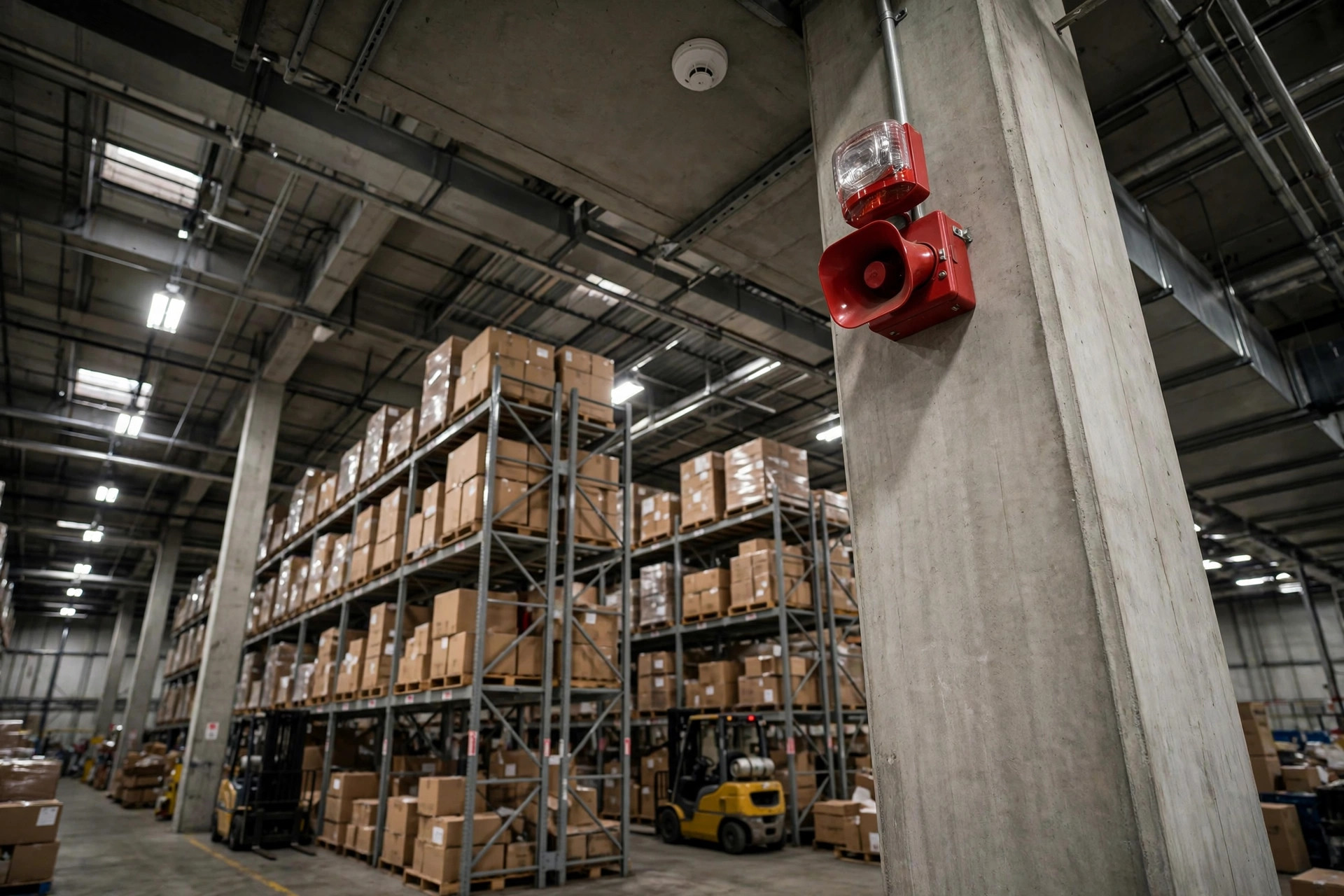
Last fall I sat in on a fire drill at a 120,000-square-foot 3PL outside Fontana. The script was simple: a smoke detector trips in the pack area. The panel sounded, and I watched from the control room. Strobes went off everywhere at once. The exhaust fans never moved. The fire shutters stayed up. Forklifts kept rolling through the aisles like nothing was happening. The drill coordinator turned to me and asked, "So — pass or fail?" I told him: "If this were real, you just got the loudest minute of your life. Then nothing."
I've seen that scene more than once. A lot of warehouses treat fire alarm systems as a checkbox: detectors installed, panel lit up, manual pull station makes noise when the inspector presses it. Done. But an alarm by itself saves nobody. What matters is the chain of automatic actions that should follow — exhaust, compartmentation, evacuation guidance, power shutdown. Nobody runs around flipping those switches in a fire. They happen because somebody programmed linkage logic into the panel. When nobody did, the detector trips — and then what? Nothing.
Warehouses make this harder than office buildings. Ceilings run forty feet up; smoke takes its sweet time reaching a detector. Rack rows block and redirect smoke plumes, creating blind spots right where the product sits. Dust is everywhere, so detectors false-alarm. That's why the first job in warehouse alarm linkage isn't programming logic at all. It's getting the zoning right.
First, Make the Zones Speak Plain English
Linkage starts with zones — and a zone has to match real fire compartments and real evacuation routes, not just boxes drawn on a plan.
A sensible warehouse zoning: receiving, storage (split by actual fire compartments), pack and ship, office, and the battery charging area — forklift battery charging is its own high-risk spot and deserves its own zone. Every detector, pull station, and strobe in a zone gets programmed under that zone number, and the zone names need to read like human language. "A3-Storage-East" beats "Loop-2-Zone-17" by a mile. In a fire, nobody has time to look up a cross-reference table.
There's a warehouse-specific trap here: whether strobes should fire building-wide. A lot of facilities take the lazy route — any alarm anywhere, every strobe in the building goes off. It sounds like maximum safety. It's actually the worst option. In a 120,000-square-foot building with every strobe screaming, nobody can tell where the fire is or which way to run. The right approach is zoned linkage: the alarm zone and its neighbors get strobes first, voice evacuation plays per zone with directions, and distant zones stay quiet or get a simple advisory tone. Every modern panel can do this. Most just aren't programmed to.
I once walked a building where zone numbers followed the contractor's wiring order, so detectors inside a single fire compartment belonged to three different zones. The day a real alarm came in, the control room operator stared at the panel, and nobody knew which zone to announce over the PA. Zone naming is the kind of thing nobody argues about at acceptance. It only matters when it matters.
Second, Write the Linkage Logic Into the Panel, Line by Line
Zones sorted, now the linkage targets. Ranked by "what saves lives first in a warehouse fire," here's my list:
Exhaust comes first. When a zone alarms, that zone's exhaust fans start, exhaust dampers open, and the supply air and ventilation for that zone shut down. Running supply air during a fire is like pointing a fan at it. Exhaust isn't about fighting the fire — it's about buying evacuation time. In most warehouse fires, it's the smoke that kills, not the flames.
Second is compartmentation. Fire shutters drop on signal, sealing fire and smoke inside one compartment instead of letting it race across a wide-open floor. A warehouse's big open bays are exactly where fire spreads fastest. Shutters that don't drop make the whole fire compartment concept decorative.
Third is evacuation guidance. Strobes per zone, voice messages per zone — telling people in that zone which exit to take. Warehouses don't have many exits to begin with. Get the zone mapping wrong and the PA sends people toward the fire.
Fourth is elevator recall and power shutdown. Where there's a freight elevator, it should recall to the ground floor, open its doors, and lock out — nobody gets trapped in a car. Non-fire power circuits get cut to prevent electrical re-ignition, while fire circuits (emergency lighting, fire pumps, exhaust fans) run on their own dedicated feeds.
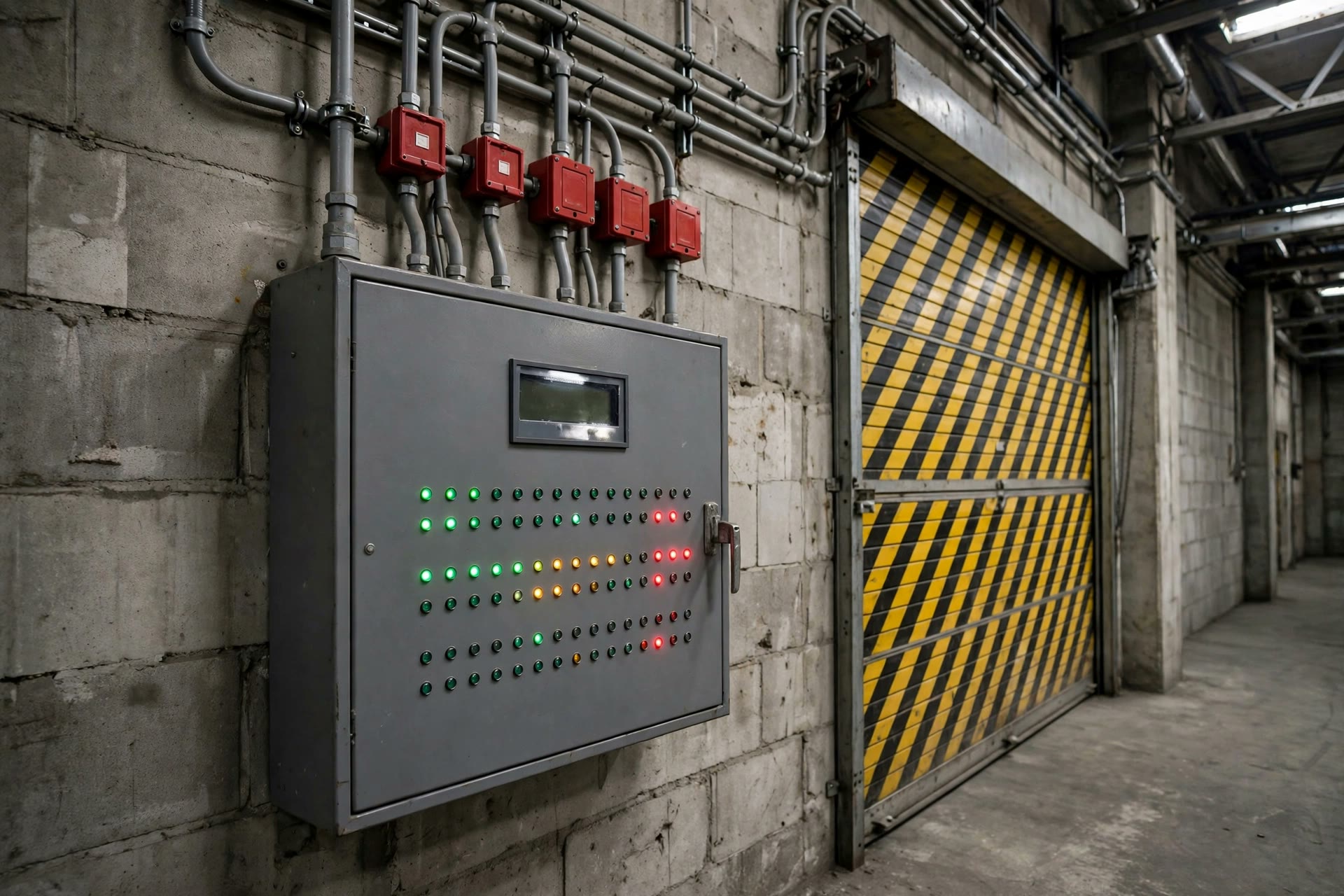
In the panel, all of this is built as linkage formulas: "any two detectors in Storage-East, or one detector plus one pull station, starts that zone's exhaust fans and drops the shutters." The AND/OR relationships, delays, and zone numbers are all configurable. There's a trade-off to calibrate: set the trigger too loose and one dusty detector sets off the whole building — after a few false full-building events, the staff stop taking any alarm seriously. Set it too tight and you're waiting for two detectors to agree while the fire grows. Warehouses run dusty and tall, so false alarms are a fact of life. My preference: two-stage response — zone-level strobe advisory first, full linkage on confirmation — rather than conditions so strict they never trigger.
After programming, run a full-chain test with test smoke (not a real flame): trip one detector and verify each link in person. Fans spinning? Shutters dropped and fully seated? PA playing the right zone? Elevator recalled? Watching "linkage activated" on the panel screen doesn't count. I've stood in a building where the panel said activated and the fan on the roof never turned — the wire from the control module to the fan was never connected.
Third, Test the Linkage for Real, Every Month
Linkage systems die from neglect. The fire maintenance contractor shows up twice a year, tests detector sensitivity, checks the panel for fault codes, and leaves. They rarely touch linkage, because touching it means things move — shutters drop and have to be raised again, fans cycle, and the owner finds it disruptive.
My experience: linkage that goes untested for three months might as well not exist. Modules corrode, wiring gets knocked loose by a forklift, shutter tracks get blocked by pallets, fan belts age. Any one of those turns a programmed sequence into a silent failure on the day it counts.
Monthly testing doesn't have to shut down the building — rotate through zones. This month Storage-East, next month pack. The checklist is short: trip one test point in the zone and confirm each item. Did the strobes sound, and in the right zones? Did the exhaust fans start? Did the shutters drop and seat fully? Was the PA message correct? Did the elevator recall? Log every item; anything abnormal gets a work order the same day. Run tests during shift changes or low-volume windows, and notify the whole building in advance so nobody panics.
At acceptance inspections and annual maintenance, linkage is a required check — but it's usually checked by reading records. Keep monthly test logs and inspections go smoothly. Have no records, and the inspector asks for a live demo; one shutter that won't drop turns into a very bad day. Logs are annoying to write and priceless when they matter — they protect the people in the building, and they protect you as the responsible party.
One more warning: warehouse modifications are where linkage goes to die quietly. A new rack row goes up, a pack mezzanine gets built, a rolling door gets replaced — and nobody updates the zones or the linkage formulas. The panel still runs a three-year-old configuration. I worked with an Ontario facility whose system passed acceptance in 2021; by 2023 they'd added a refrigerated section whose detectors were never added to any linkage formula. Two years of "fire compliant" — compliant with a three-year-old drawing.
A fire alarm system has two layers: knowing there's a fire, and automatically doing the right things after. Most warehouses spend all their money on the first layer — enough detectors, a bright panel, a passed inspection — and call themselves safe. The second layer, the whole chain of linkage, goes unprogrammed, untested, unmanaged.
So here's my question for you: when did your warehouse's detectors last go off? Test or false alarm? That day — did the exhaust fans start, did the shutters drop, and which zone did the PA announce? If you can't answer any of those, then whether your detectors sound or not makes no real difference.