2:40 a.m., night shift.
Late August, heat wave still hanging over the Inland Empire. A dull thud from the electrical room, and every light in the building went out at once. Twenty-six of us on nights, me included, standing in the dark between thirty-foot racks. Nobody moved. When it goes black like that, the worst thing you can do is move.
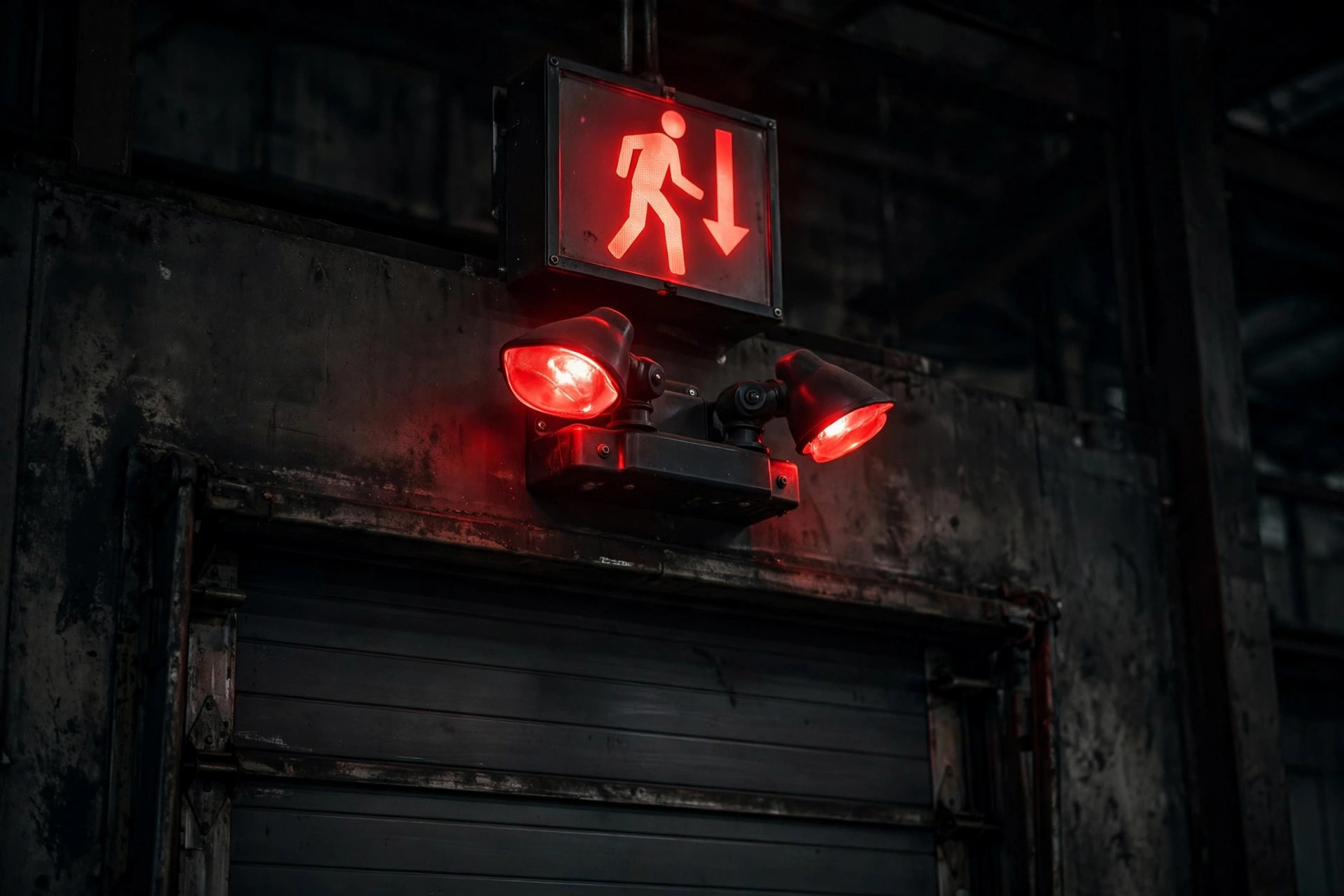
Three seconds later, the emergency lights kicked in. Little red heads up and down the aisles, cutting a path down the main artery. Then the fire alarm started screaming. Relax — this was a drill, and we'd filed the paperwork. A dual-fault drill: power outage plus fire alarm, once a year.
We formed up and started walking to the muster point. First fifteen minutes, everything fine. Then we hit the longest high-bay aisle in Zone C, and I looked up. My stomach dropped. Two of the emergency heads on that row were dead.
Twenty-some people walked the second half in the dark. Lucky it was a drill. Lucky nobody fell. If that had been a real fire, with smoke rolling in, those two dead lights would have been the difference between walking out and crawling out.
Here's the thing nobody tells you: those little green charging lights lie. Green means the unit is charging. It does not mean the battery will hold for ninety minutes when the power dies.
Where the problem came from
Next morning, our electrician Lao Wang went up thirty feet and pulled those two heads down. The batteries were swollen. Date code: five years old.
Five years. Nobody had touched them. Every daily walkthrough, somebody glanced up — green light, fine, move on. Five years of glances.
Lao Wang said it best: "Feng, these lights are like the fire extinguishers. Decoration, until the day they're not. And on that day, decoration gets people hurt."
So I went and read the code. NFPA 101 is blunt about it: emergency lighting has to hold for a minimum of 90 minutes after power loss. Test every unit for 30 seconds monthly, run a full 90-minute discharge test annually, and keep written records — because the fire marshal will ask for them. That's not a suggestion. OSHA wants exit routes adequately lit too; that's 1910.37.
And then the math that scared me: 200-plus people across three shifts. Twenty-six on nights, eighty-plus on a busy day shift. If the power dies and something's burning during peak season, those 90 minutes are the window for eighty people to get out in order. If the lights quit at minute twenty, what's lighting the other seventy?
This wasn't just us, either. A couple years back, a buddy running a 3PL warehouse out in the Inland Empire got a surprise visit from the fire marshal. First thing the guy asked for: twelve months of monthly test logs. My buddy had nothing — he'd never kept the book. Correction notice on the spot: reconstruct the records, redo the annual 90-minute test, and wait for re-inspection. He told me his palms were sweating at the re-inspection. Not because of the money. Because when that lands in peak season, the whole building loses its nerve.
Three rounds of fixing it
Round one, the cheap way: buy batteries, swap them ourselves. Turns out the sockets were corroded, new batteries made bad contact, and some of those heads were ten-year-old models you can barely find batteries for anymore.
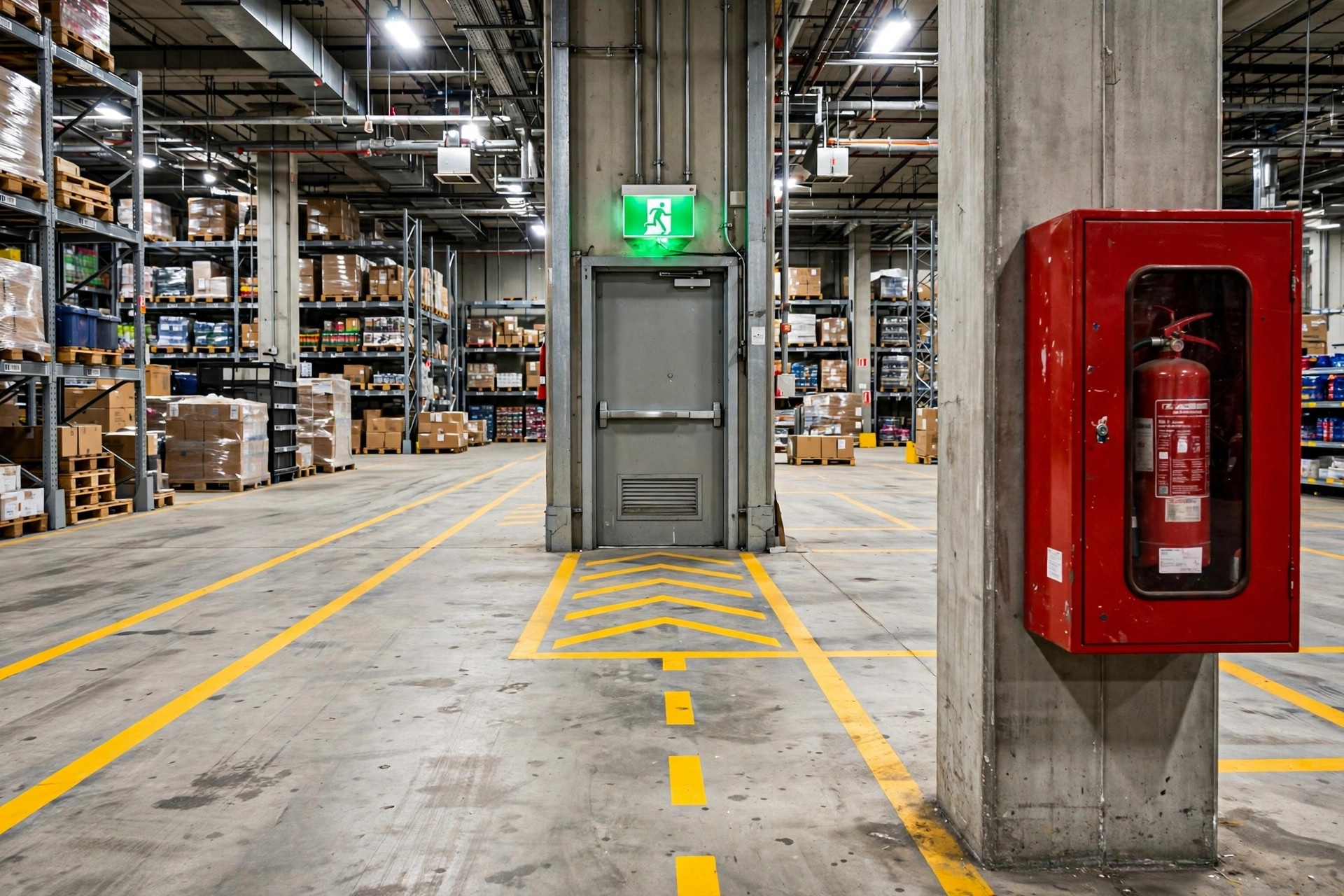
Round two, we brought in a licensed electrician for a full survey. Two big findings. One: in Zones C and D, the heads were mounted on a thirty-foot ceiling, and by the time the light reached the floor it was nothing — the code wants an average of one foot-candle along the egress path, and those little heads from that height weren't even close. Two: we had exit signs on the main aisles but nothing at the intersections, and in smoke nobody can tell which way to turn.
Round three, we did it right. Added low-mounted egress markers near the floor — smoke rises, so light down low is what people actually see. Replaced every head that couldn't hold 90 minutes with new UL 924-listed units. And started two logbooks: one for the monthly 30-second test, one for the annual 90-minute test. Whoever tests, signs.
One more detail: don't toss swollen batteries in the dumpster. Lead-acid batteries are hazardous waste in California — they go to a certified recycler. We save them up in a box and have a recycler pick them up once or twice a year. Small thing, but don't trip on it.
I also put this comparison on the office wall. Every new supervisor reads it first:
| Option | How fast it lights | What it needs from you | Fits which warehouse | Note |
|---|---|---|---|---|
| Battery-in-head units | Instant | Monthly check, batteries every few years | Most warehouses — this is what we run | Individual heads are cheap; get a quote for bulk replacement |
| Central UPS | Instant | Battery bank in a room, periodic replacement | Warehouses with a server room where the WMS can't die | Covers critical loads only, not the whole floor |
| Diesel / natural gas generator | Carries load within 10 seconds (NEC Article 700) | Monthly test runs, fuel on hand | Big sites, cold storage | Those first 10 seconds still ride on the battery heads |
See the catch? Even with a generator, there's a ten-second gap. For ten seconds, the whole building rides on the batteries in those little heads. So "we have a generator, the emergency lights don't matter" is exactly backwards — ten seconds with no light is when an orderly evacuation turns into a stampede.
What we do now, no exceptions
Three years since that drill, and this routine hasn't changed:
One, monthly 30-second test, no excuses. Night supervisor plus two people, kill the power for thirty seconds, walk the floor. Anything dark gets written up and replaced the next day. The logbook lives in the electrical room. When the fire marshal walks in, the first thing he asks for is that book.
Two, one full 90-minute discharge test a year, on a slow-season day shift. Somebody stands watch for the whole ninety minutes and logs when each head dies. Anything under ninety gets a new battery on the spot; any batch of batteries past four years gets replaced wholesale before peak season. Don't wait for a drill to surprise you.
Three, one dual-fault drill a year: outage plus fire alarm together. Remember, the fire panel has its own backup batteries under NFPA 72 — a separate system from the emergency lights. Don't assume one covers the other. Test both at once.
Four, the simplest math in the building: a monthly test is three people for half an hour; the annual test is one day shift. One correction notice from the fire marshal — fix it on a deadline, then a re-inspection — landing in peak season costs you ten years' worth of testing time. Everybody here can do that math.
And one counterintuitive call for my fellow managers: emergency lights being on does not mean keep working. The moment power dies, the WMS is down, the RF guns are dead, no labels print, the conveyors stop. The universe is telling you: stop, walk out. I've seen warehouses keep people picking under emergency lights after an outage. That's trading ninety minutes of life-safety time for a few orders. Don't be that guy.
Fifth, a fifteen-minute debrief right at the muster point after every drill. Night shift talks: which stretch was too dark, which intersection was confusing, how long roll call took. Roll call deserves its own note. Twenty-six people, called one by one, matched against the headcount. That night we counted twice before it matched — somebody had slipped to the restroom without staying with the group. In a real fire, one missing person means firefighters go back inside. So now the rule is simple: alarm sounds, everybody to the muster point, roll call, nobody missing, no exceptions.
Walk your floor tonight on nights. Find the farthest emergency head from the electrical room. The green charging light doesn't matter. What matters: when was the last time it burned a full ninety minutes?
If you can't answer that, schedule a 90-minute test tomorrow morning. Don't wait for the alarm to ask the question for you.
By Chen Feng, Warehouse Operations Manager