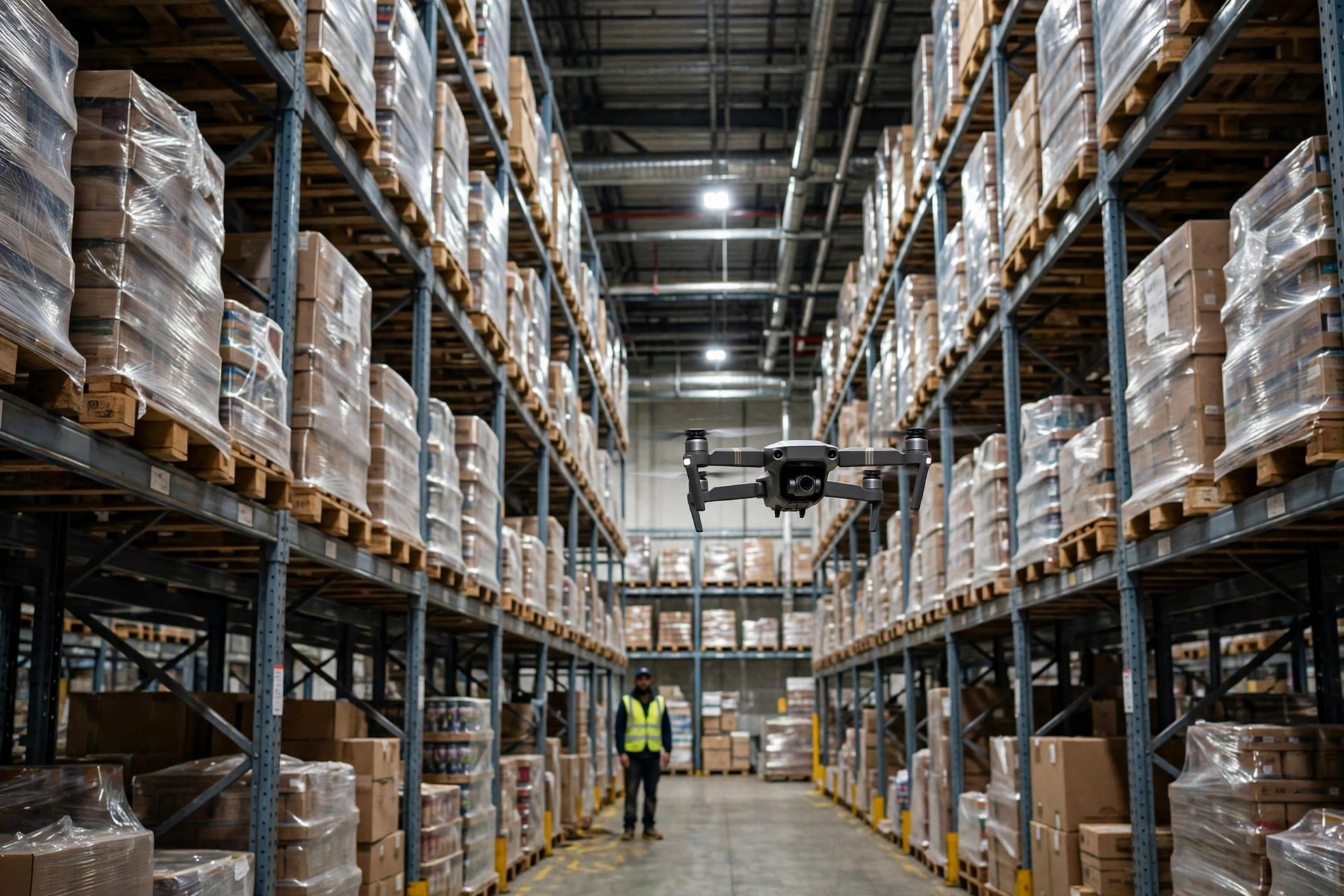
Let me be blunt: warehouse drone inventory counting is worth a serious look if you have high-bay racks, slow and expensive cycle counts, and shutdowns every time you count. If your racks are low, your warehouse is small, and your fast movers turn over daily, skip the hype.
I have seen too many warehouses buy a shiny tool and expect it to fix a messy operation. In 2023, an auto-parts distributor outside Ontario, California — roughly 30,000 square feet, racks eight meters high, more than 20,000 bin locations — did quarterly wall-to-wall counts the old way: four people, lifts, two full days, and outbound shipping paused for half a day. The owner watched a vendor demo, bought two counting drones, and assumed one flight would settle the books. The first flight exposed everything at once. Forklifts were still moving in the aisles, so the drones kept pausing for obstacle avoidance. Some bin labels were printed on reflective film and would not scan. Worst of all, nobody owned the exception list: the system flagged bin A as short two cartons, and a manual check found the cartons sitting in the neighboring bin. The drone was not wrong. The process around it was missing.
That is the trade-off, stated plainly. Warehouse drone inventory counting saves you the cost and risk of high-bay manual work and the cost of shutting down a zone to count it. A drone can sweep hundreds of high locations in an hour without a lift or a safety spotter. What it cannot save you is judgment. Damaged labels, misplaced stock, mixed lots — the drone can only report a variance. A person still has to walk over and confirm what actually happened. Anyone promising that one flight makes the books balance is selling a demo, not an operation.
If you want to try it, do it in this order, and do not roll it out across the whole warehouse on day one.
Start with one aisle — the hardest high-bay aisle you have — and fly it for two weeks alongside your manual count. Log every variance in three buckets: label problems, misplaced stock, and genuine discrepancies. Two weeks of that comparison tells you where your real bottleneck lives. In many warehouses, the pilot reveals that the bottleneck was never the counting tool at all; it was putaway. Stock was never placed in the right bin to begin with, so no counting method, drone or human, could make the numbers agree.
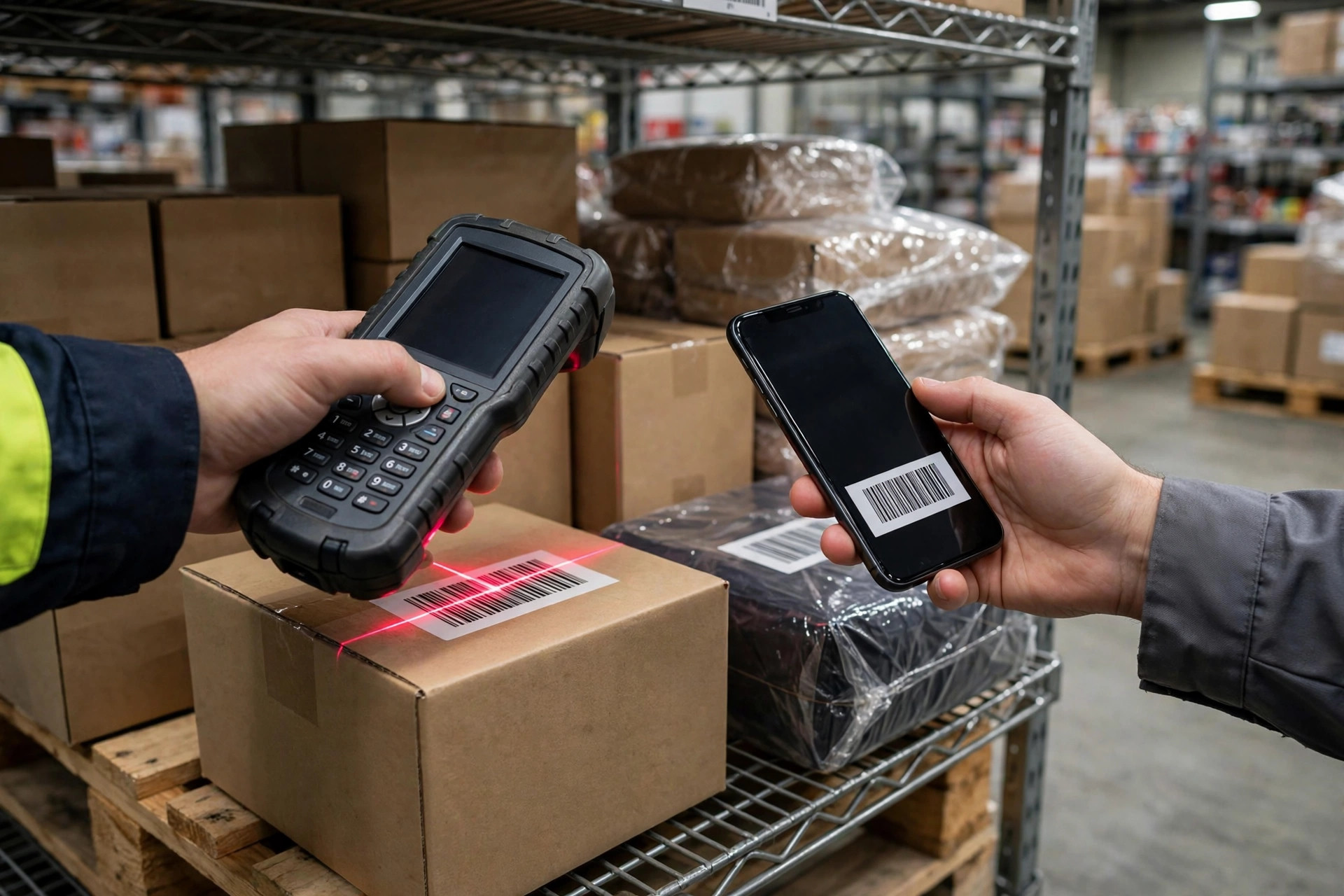
The second thing people underestimate is the data link. Scanning a barcode is step one. That scan has to match a bin and a lot in your WMS, and the variance has to turn into a recheck task assigned to a person by location. If that chain is not built, your drone is just an expensive flying camera, and someone still spends the afternoon exporting spreadsheets and reconciling by hand. Before you sign anything, ask the vendor two questions: can variance data flow directly into our WMS, and can recheck tasks be dispatched by bin? If they cannot answer clearly, walk away no matter how good the price looks.
Where Warehouse Drone Inventory Counting Actually Pays Off
Do not compare a drone's price tag with a headcount. Split the comparison three ways, because the savings live in different places.
| Comparison | Manual high-bay counting | Warehouse drone inventory counting |
|---|---|---|
| Labor per count | Four people for two days, working at height | One operator supervising plus one person clearing exceptions |
| Shutdown impact | The counted zone mostly stops shipping for half a day | Aisles can be flown in off-peak windows, often with no full stop |
| Hidden costs | Lift rental, safety spotters, injury risk | Label remediation, WMS integration, flight scheduling |
The math only works when shutdown time and height risk are real costs for you. If your counts never stop shipping and your racks are low enough to scan from the floor, there is nothing meaningful to save — and admitting that is cheaper than a purchase you will regret.
Warehouse Drone Inventory Counting: Four Pitfalls to Avoid
The first pitfall is labels. Reflective, torn, or crooked labels do not scan from the air, and a high miss rate makes the whole count untrustworthy. Before the pilot, replace every label in the pilot aisle and standardize placement: same side of the beam, same height, every time. This small expense prevents a large amount of rework later.
The second pitfall is flight timing. Do not fly during peak outbound. The workable pattern is the first hour before shipping starts, or over lunch, in the high-bay zone only, with forklift traffic routed elsewhere. Put the schedule in the standard operating procedure. Leaving it to the operator's judgment on the day guarantees conflicts.
The third pitfall is the exception workflow. If a drone reports one hundred variances and a person has to recheck all one hundred, you have saved nothing. Triage by type instead: unreadable labels get relabeled and reflown; suspected misplacements go to a floor recheck; only variances that fail twice go to an inventory adjustment process. Good triage cuts the recheck workload by more than half.
The fourth pitfall is expectations. Drone counting fits cycle counts, high-bay spot checks, and pre-counts before a quarterly wall-to-wall count. It does not replace rechecks on fast-moving bins, which change the day after you count them. Flying those bins is wasted effort.
Here is a second example, on the other side. In 2024, a small home-goods warehouse in the Inland Empire — under 10,000 square feet, racks no more than four levels high, SKUs turning over fast — tried a drone pilot and stopped after a week. Bin contents changed faster than the count could keep up, floor-level scanning with a handheld was already fast enough, and every flight added setup work: clearing the aisle and marking exclusion zones. That warehouse switched to rolling daily counts of twenty fast-moving bins instead, and accuracy improved. The lesson is not that drones are bad. It is that the tool has to fit the size of the warehouse. A small warehouse wearing a big company's shoes will only twist an ankle.
A Self-Test Before You Buy a Drone Counting System
Score yourself on four questions. If you check three, talk to vendors. If you check fewer than two, fix your manual process first.
| Self-test question | Yes | No |
|---|---|---|
| Racks five levels or higher, and high-bay counting eats half your count hours | Good fit for flight | Floor scanning is already fast enough |
| Counts force a shutdown, and an hour of shutdown has a visible cost | Shutdown savings are real | No shutdown, little to save |
| Labels are standardized and WMS bin data is mostly trustworthy | Flight results are usable | Messy labels mean false variances |
| Someone owns exception rechecks and flight scheduling | The loop closes | Nobody owns it, the drone gathers dust |
One more cost people leave out: a drone is not a one-time purchase. Batteries, propellers, camera calibration, software fees, and operator training recur every year, roughly equivalent to half a headcount when amortized. When a quote shows only the unit price, ask for each of those line items and get them in writing. Budget on a three-year total cost, not a single machine price. And treat flight safety as a hard line: ceiling fans, fire-suppression pipes, and hanging light fixtures all limit where you can fly, operators need proper training, aisles need warning signs during flights, and forklift drivers need to know the flight windows in advance. One accident wipes out every saving the drone ever produced.
The counter-intuitive payoff is this: the biggest gain from warehouse drone inventory counting is often not the counting itself. It is that the project forces you to fix labels, bin discipline, and WMS data — the basics. Once those basics are fixed, even your manual counts get faster. The drone is a mirror. It shows you the state of your fundamentals.
So my advice is one sentence: pilot one aisle, price the shutdown and the recheck workload honestly, fix the basics first, and only then talk about a warehouse-wide rollout. Getting airborne is easy. Landing with books you can trust is the hard part.
By Lao Mi, Supply Chain Veteran (20 yrs)