Here is the honest truth: warehouse dock board plate selection is not something I learned from a catalog. I learned it from a traffic jam at my own dock. One Tuesday morning last fall, our little warehouse in the Inland Empire had trucks backed up into the yard, drivers leaning on their horns, and my forklift driver inching across a dock board like he was crossing a tightrope. I thought we were short-staffed. We were not. We were standing on the wrong board, and it was charging us a delay fee every single day.
Warehouse Dock Board Plate Selection Starts With Our Bottleneck
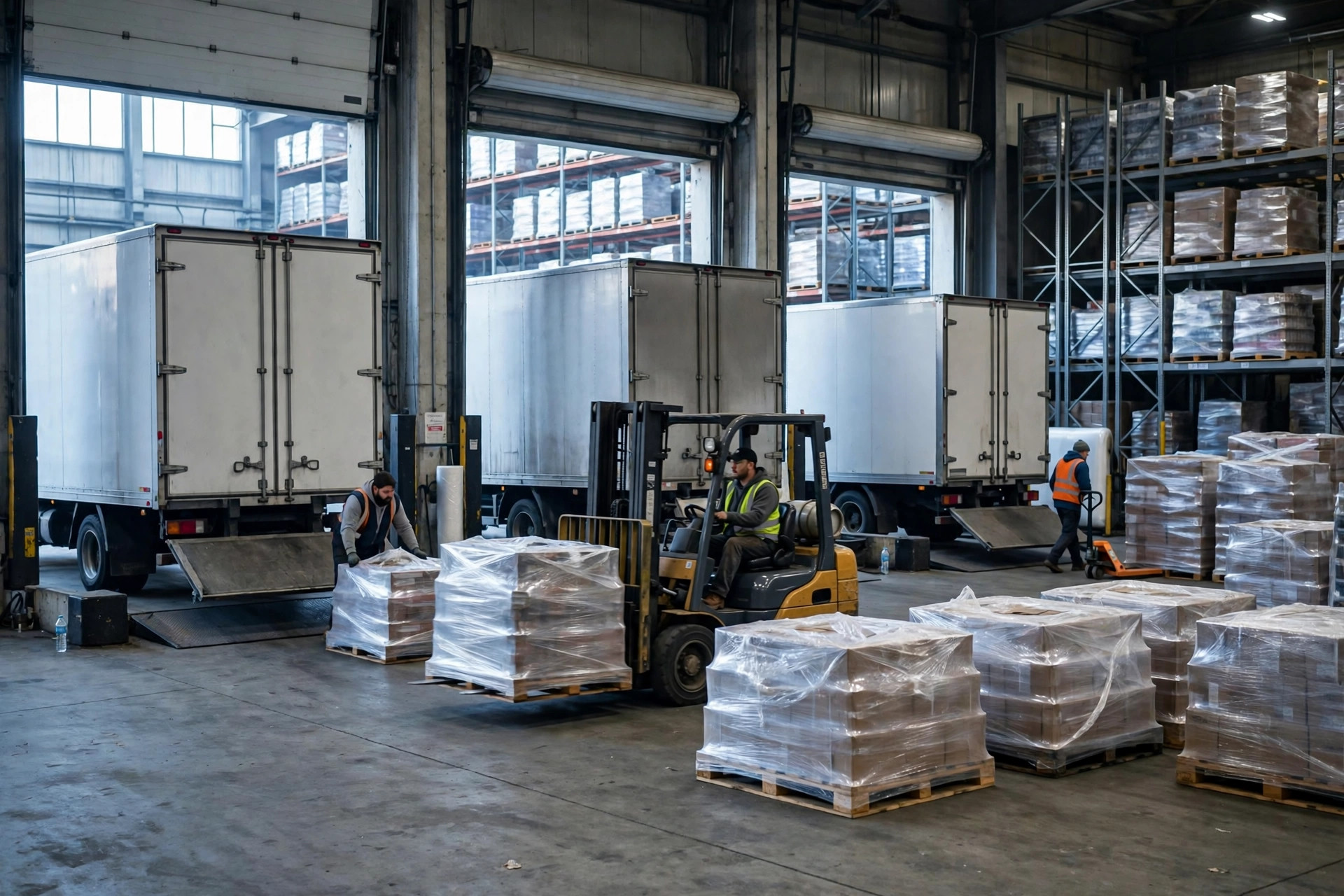
Our warehouse is about 32,000 square feet, which sounds respectable until you see the dock: two doors, one old forklift, and three people doing everything. The big-company playbook — buy the full system first, optimize later — is not available to us. Our dock has an old problem: the dock floor and the truck bed are almost never level. A tall truck sits high, a low van sits low, and one portable board bridges the gap. If that board does not fit, every crossing gets slower and the whole morning backs up behind it.
The worst morning was that Tuesday in October last year. A box truck arrived, its bed noticeably lower than our dock. Our old board was short and narrow, and as the forklift carried a full pallet toward the truck, the board tipped up slightly at one end. The driver stopped dead, a carton slid half an inch, and we all held our breath. A thirty-minute job took well over an hour, and the two trucks behind it waited while their drivers complained our dock felt like a plank over a ditch. That day I understood: a dock board is the throat of the dock, and when the throat is blocked, nothing else moves.
We had already made the classic cheap mistake once before. That summer, chasing a bargain online, we bought a board that looked tough in the photos, without checking the spec sheet carefully. Within two weeks, the middle had started to sag, and the forklift made an awful grinding noise every time it crossed. Our veteran operator said it plainly: that board was built for light loads, and we were using it like a heavy-duty bridge. A workaround is not the same as guessing. The numbers you skip are the numbers that come back to bite you.
Capacity: Never Size It for an Empty Forklift
Here is the counterintuitive judgment most buyers get wrong: people size a board for the weight of the cargo, and that is the wrong number. What actually presses down on the board is the forklift itself, plus the load, plus the pallet, plus the driver, all at once, with margin left over. An empty forklift and a fully loaded forklift crossing the same board are two completely different jobs. Buy for the empty run, and you are digging a hole for the loaded run.
We fixed this by writing down our heaviest real combination, not our average one: our old forklift, our heaviest typical pallet, the pallet itself, and the driver. Then we compared that total against the rated capacity in the manufacturer's spec sheet — not the seller's chat message, not a review saying "works great," only the spec-sheet number. The rated capacity has to sit clearly above our total, not just barely equal to it. Barely enough is a gamble you repeat dozens of times a day.
This is the simple capacity worksheet we now use before talking to any seller:
| Item | How to get the number | Our rule |
|---|---|---|
| Forklift weight | Read the nameplate | Never estimate it |
| Load plus pallet | Use the heaviest pallet we run | Not the average pallet |
| Driver and margin | Add the driver, then add margin | Rated capacity must clear the total |
With that sheet, the seller conversation changes: instead of "is this board strong?" we ask for the rated capacity, the spec sheet, and the margin it leaves us. If the seller cannot answer, we walk away. A small warehouse does not pay for cheap; it pays for a calculation it can defend.
Warehouse Dock Board Plate Selection: Width and Height Difference
Once capacity is settled, the next trap is width and height difference, and both are killed by the phrase "close enough." Width sounds simple — if the forklift fits, it fits — but wheels wobble and drivers correct their line, so a board that is only just wide enough turns every crossing into a precision exercise. Our rule now is to leave generous room beyond the outside of the tires, so the driver can drive instead of aiming. The money saved on a narrow board gets paid back many times over in slow crossings and nervous drivers.
Height difference is the quieter killer, because it changes with every truck. Our dock height is fixed, but truck beds are not, so the slope changes all day. A board that is too short makes a steep ramp: hard to climb loaded, harder to brake coming down. A board that is too long eats floor space we do not have. Our fix was to measure the bed heights of our most frequent trucks and choose a length covering that range. Before buying, test it: empty run, loaded run, listen for noise.
There is a real trade-off here. A longer board is gentler for the driver, but harder to store in a small warehouse. A shorter board stores easily, but a steep slope keeps the driver tense all day. Our compromise was a length covering our usual range without going to the maximum, plus a simple rack by the dock wall, welded from scrap by our veteran operator, so the board stands upright instead of lying in the walkway. It cost almost nothing — a three-person team surviving on a smarter corner, not a bigger budget.
Aluminum or Steel: Let the Math Decide
Then comes the aluminum versus steel argument. Aluminum fans say it is light and easy to move. Steel fans say it is tough and built to last. Both are right, and both are wrong for somebody. For a small warehouse, the only fair test is the whole cost over the life of the board: who can move it, how long it lasts, and how much hassle it causes.
Our math was very practical. Aluminum is light enough for two people to shift, which matters enormously when trucks change all day and the board moves with them. But aluminum usually costs more upfront, and a hard knock can still bend it. Steel is usually cheaper and tougher for repeated heavy loads, but every move feels like a workout, and over months that shows up as slower changeovers and tired backs. Here is how we compared them:
| Factor | Aluminum | Steel |
|---|---|---|
| Moving it | Light, two people can shift it | Heavy, every move costs effort |
| Durability | Good enough, dislikes hard knocks | Tougher for repeated heavy loads |
| Price | Usually higher | Usually lower |
| Best for us | Frequent truck changes | Fixed heavy routes |
We chose aluminum: we change trucks often, so the board moves often, and the time saved paid back the price difference within months. That does not make aluminum better in general. A big operation running the same heavy route all day might be far better off with steel. Somebody else's best answer is not automatically yours. Check your own truck frequency, heaviest load, and available hands before copying anyone's homework.
Two tricks we verified the hard way. First, borrow a board from a neighboring warehouse for a couple of days, or negotiate a trial period, so a bad fit can go back without a fight. Second, inspect edges and grip on arrival: curled edges or worn grip are no bargain, because one slip costs more than several boards.
The result was visible within a week. Drivers stopped hesitating at the edge of the board, the morning queue shortened, and our three people could spend their time loading trucks instead of wrestling with equipment. warehouse dock board plate selection, done right, is not a purchasing detail. It is the difference between a dock that flows and a dock that stalls, and for a small warehouse, that difference is the whole business. So size for your heaviest run, trust only the spec sheet, leave room on width, and let your own math choose aluminum or steel. Small warehouses have their own way of surviving, and it starts with refusing to let one wrong board block the dock every single day.
By Xiao Ma, Small Warehouse Owner