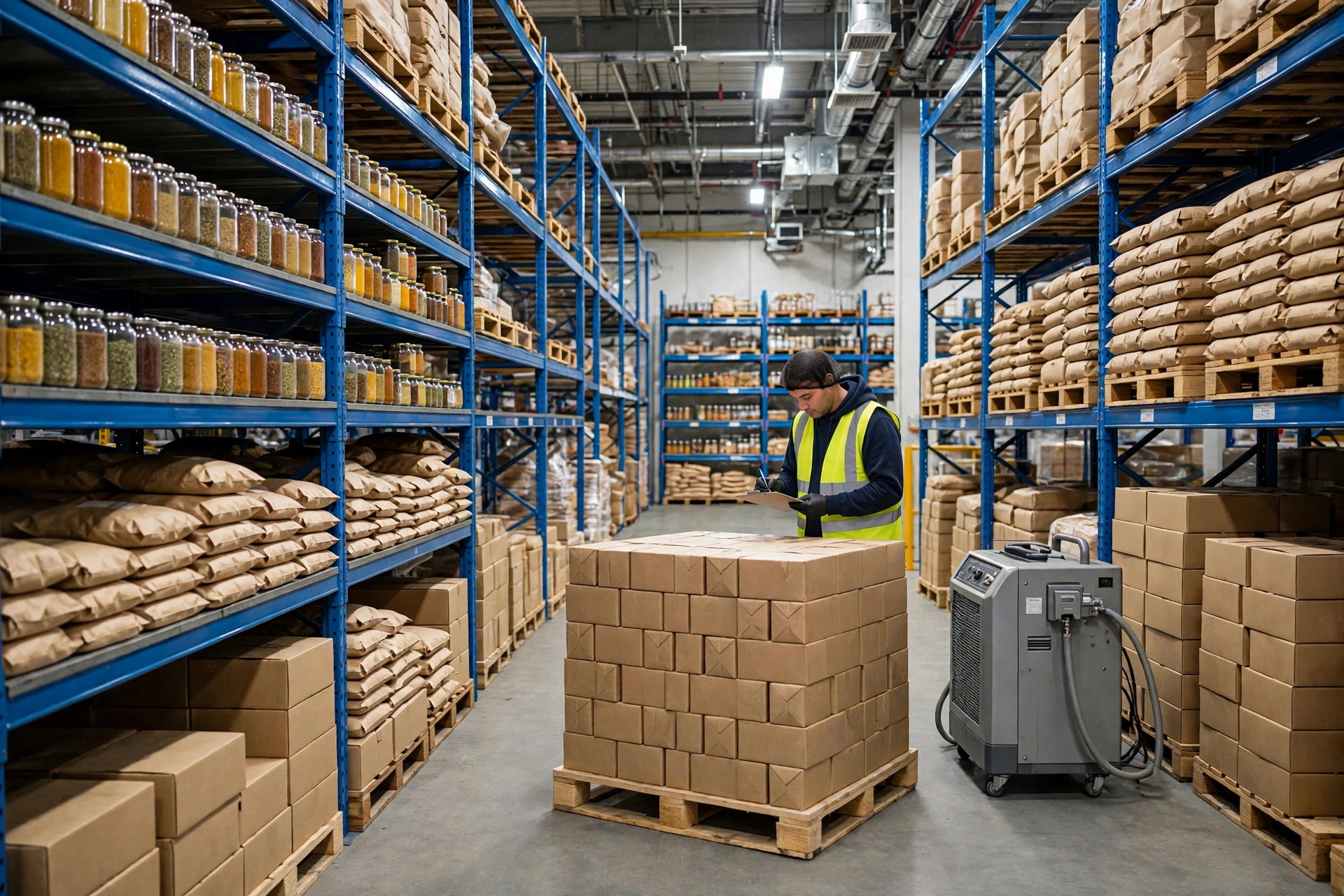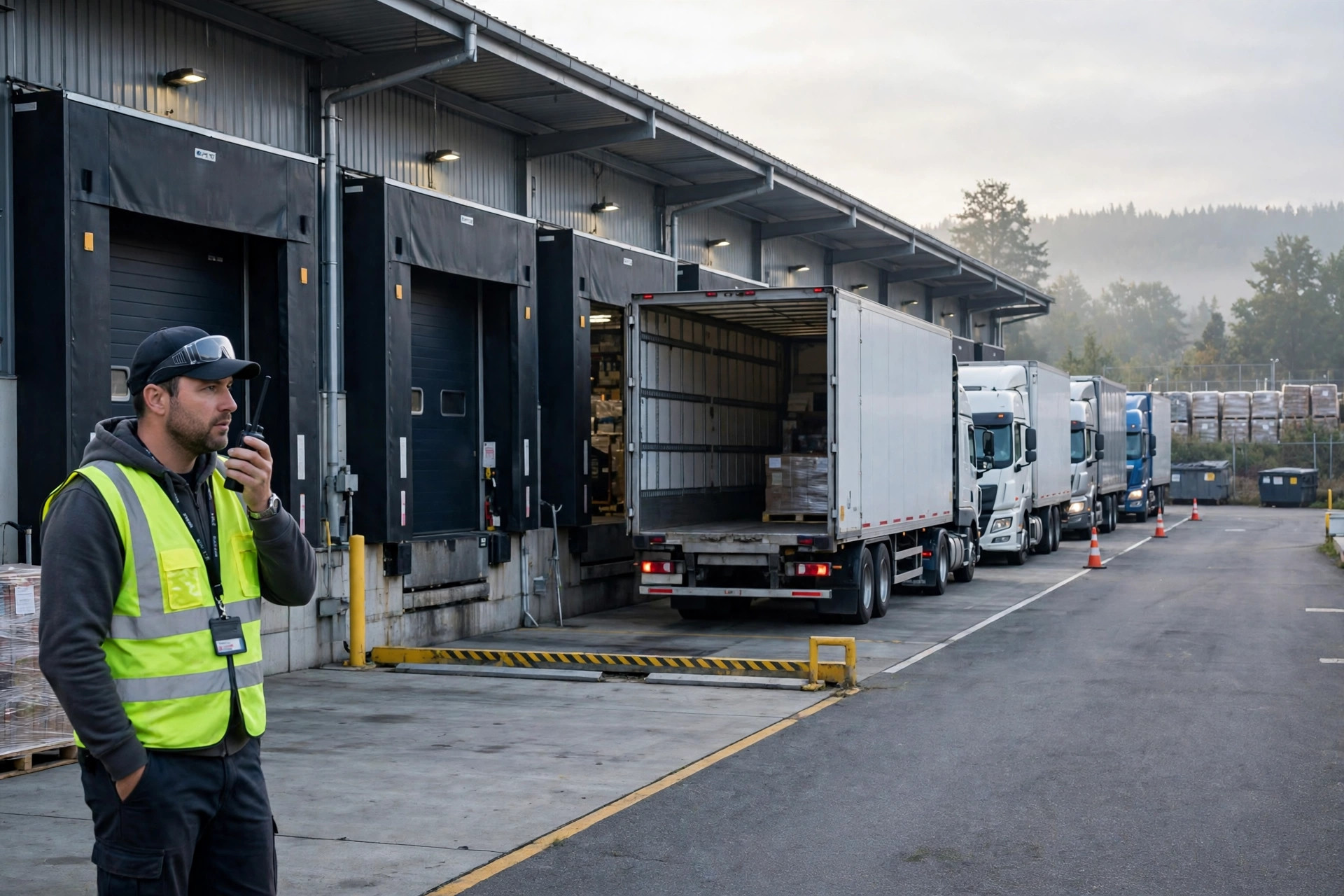
Start with the arithmetic, because everything else in warehouse dock appointment scheduling is commentary on this one number. A warehouse with four receiving docks had seven trucks arrive at 9 a.m. on a Tuesday. Average extra wait: 3.5 hours per truck. At an illustrative waiting cost of $45 per truck per hour, that single morning burned about $1,100 before overtime, before damage, before a single mis-shipment. The dock was not short of doors. It was short of spread.
When Dock Appointments Collide, You Pay in More Than Time
The first warehouse was a third-party site in eastern China handling fast-moving consumer goods: four docks, roughly eighteen inbound trucks a day, a schedule that looked fine on paper. The failure was structural. Three suppliers all ran the same outbound rhythm — load on Monday, deliver on Tuesday morning — so nine trucks arrived between 9 and 11 a.m. on Tuesdays. Four docks could take four. Five waited outside. The unloading crew merged two shifts to catch up, worked four hours of overtime, and pushed the next morning's work into noon.
Break that morning down and the bill gets worse than the waiting line suggests:
| Cost line | How it arises | What a bunched morning typically costs |
|---|---|---|
| Driver waiting and detention | Trucks queue outside the gate | Thousands per incident, and suppliers eventually price it into their rates |
| Overtime and temp labor | Bunched unloading can only be met with extra hands | Overtime at 1.5x quickly erases a week's labor savings |
| Mis-shipments and damage | Rushed scanning and putaway under pressure | One wrong shipment costs multiples of its freight in returns handling |
| Idle dock hours | Docks sit empty in the afternoon after a jammed morning | Equipment and labor utilization dragged down across the whole day |
The second case ran in the opposite direction: a fresh-food warehouse with enough docks, but not enough cold-chain docks. One Friday morning, three refrigerated trucks arrived together and only one dock connected directly to the cold store. Two trucks sat outside for over two hours, and the temperature logs came back right at the edge of tolerance. The goods were not rejected. But the customer docked the service score that month and brought it up at renewal to push the price down. That is the hidden tax of bad dock appointment scheduling: it shows up in the contract, not just the yard.
Three Hard Rules Before You Buy Any Scheduling Software
Software only enforces rules. If the rules are wrong, the software faithfully produces the wrong result faster. Get these three right first.
First, release time slots, not first-come-first-served chaos. Cut the morning into 30-minute windows and cap each window at two trucks. When the popular window fills, the next booking rolls automatically to the next open window. Suppliers will complain once. They will complain less than they charge you in detention fees every month.
Second, grade the trucks. Cold chain and fresh product go to docks with matching facilities. General less-than-truckload goes to general docks. Returns and exception freight get their own window, never competing with inbound receiving. Write the priority on the appointment confirmation and hold the gate to it. "We will sort it out when you arrive" is not a policy; it is the absence of one.
Third, price no-shows and lateness. A truck more than an hour late drops to the next open slot — no queue-jumping. Two no-shows in a week downgrades that supplier's access to peak slots the following week. It sounds harsh. In practice, once suppliers learn the rule is real, on-time arrival typically climbs from around sixty percent to above eighty percent within a month, because they fix their own dispatching rather than asking you to absorb it.
The Counterintuitive Part: One Fewer Morning Slot Beats One More Dock
The instinctive fix is to build another dock. Run the numbers and it falls apart. A new dock means construction, a dock door, handling equipment, and staffing, all year, to solve a peak that concentrates into two or three mornings a week. The rest of the year it stands empty.
Cut Tuesday morning bookings from nine to six instead, and move three trucks to Tuesday afternoon and Wednesday morning. Total weekly volume does not change by a single pallet. Waiting time falls by more than half. The leverage in warehouse dock appointment scheduling sits on the demand side — spreading arrival time — not on adding supply. Add a dock only after you have flattened the curve and the flattened curve still overflows.
A Dock Appointment Scheduling Checklist You Can Actually Run
Do this in order. First, pull eight weeks of arrival records and count trucks by hour. Find the real collision windows; do not trust memory, memory flatters the schedule. Second, write the dock-to-freight-type mapping on one page and pin it in the dock office. Third, make the appointment confirmation state the window, the dock number, and the lateness rule, and treat a booking as confirmed only when the supplier acknowledges it. Fourth, review weekly: on-time rate, average wait, overtime hours. Post all three on the wall. If two consecutive weeks deteriorate, reduce the number of slots in the worst window.
The Daily Numbers That Keep Dock Scheduling Honest
Rules decay without daily attention. Many warehouses build a beautiful appointment sheet, run it for two weeks, and slide back to the old chaos. The cause is always the same: nobody watched the numbers every day. Watch just three, and dock appointment scheduling stays honest.
First, tomorrow's arrival distribution: how many trucks are booked into each hour tomorrow morning, and does any hour exceed the dock count? If it does, call and rebook today, not when the truck is at the gate. Second, today's on-time rate: booked time versus actual arrival, with anything over thirty minutes late logged and summarized to the supplier at week's end. Data in hand makes the rescheduling conversation easy; opinion does not. Third, the hourly dock-utilization curve: mornings full and afternoons empty means slots are still not flat enough; full all day means you genuinely lack capacity, and only then is it time to talk about adding people or doors.
One more link is routinely missed: appointment information must reach the warehouse before the truck does. If the dock team only learns the product type, piece count, cold-chain need, or special equipment when the truck arrives, the yard will be chaotic no matter how good the slot plan is. Require that information at booking time so the dock and labor can be prepared in advance. It costs nothing and removes most of the on-the-spot negotiation. An appointment without that information is barely an appointment at all.
Here is the calculable conclusion to take to your boss: multiply last month's number of bunched mornings by the waiting-plus-overtime cost of one such morning. That is the monthly ceiling this rulebook can save you. If that number does not justify one person owning appointments, your bunching problem is not yet big enough for a hire — but the time-slot rule alone is still worth running, because the arithmetic will make itself visible within a month. Once the savings exceed one person's salary, make the role permanent and let them own those three daily numbers; at that point the return on the hire is already proven.
By Lao Zhou, Logistics Cost Analyst