Let me tell you something. I learned about warehouse roofs the hard way.
A couple of years ago, running a night delivery, I pulled into a warehouse outside Ontario past two in the morning in the middle of a downpour. Inside, buckets stood under the racks near the wall, plastic sheeting covered the floor, and two workers pushed water toward the door with mops. Above them, a dark stain crept across the ceiling from the wall to the rack tops, dripping. That night's shipment was in cardboard cartons; the bottom dozen cases were soaked through, the goods water-stained. The manager said they had noticed a ceiling stain a month earlier, but with nothing dripping, they figured it was fine.
After all these years on the road, I have seen that story more times than I can count: nobody looks at the roof until it fails. But here is the thing about warehouse roof leak prevention maintenance: a leak is almost never sudden. It is a gutter clogging for months, a drain rusting through, a seam cracking in the summer heat. By the time water drips on your inventory, the damage underneath is already done.
Where Warehouse Roof Leaks Actually Start
The first step in warehouse roof leak prevention maintenance is knowing the four places leaks love to hide: gutters, drains, skylight strips, and pipe penetrations.
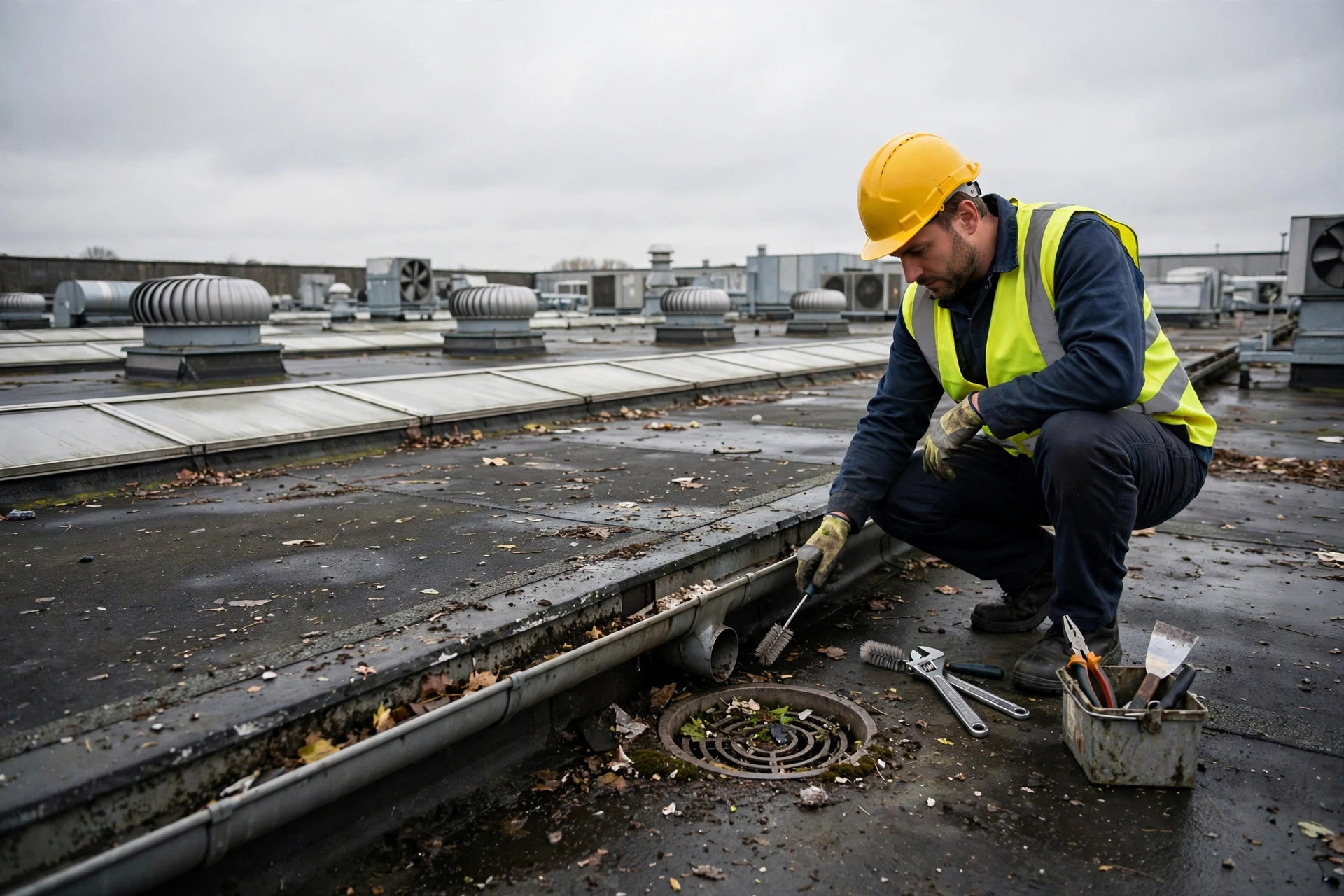
Gutters are the troughs along the roof edge that catch rainwater. In the fall, leaves blow in, mix with dust and nesting material, and pack into a solid mat. Once blocked, rainwater spills over the edge and runs down the inside of the wall. I once visited an older warehouse near Fontana whose gutters had not been cleaned in the better part of a year. After one good storm the wall base was soaked and the paint bubbling, and the worker who finally dug the gutter out hauled down two big bags of rotten leaves and sludge.
Drains are the small outlets that carry water from the gutter down to the ground, and because the opening is small, they clog even more easily. Some warehouses do not even fit a screen over the drain, so leaves, plastic bags, and small stones slip right in. Once a drain is blocked, water backs up, rises, and pushes out through the seams, working its way down the wall and into the building. From the ground, the warning sign is a streak of staining running down the outside wall. That streak usually means a drain is blocked.
Skylight strips are the translucent roof panels that let daylight in, and the panels themselves handle rain fine. The trouble is the ring of sealant where each panel meets the roof. After a few years in the sun, that sealant hardens and cracks, and rainwater slips through. Worse, skylight leaks rarely drip straight down: water travels along the roof structure to the low point and comes out somewhere else, so fixing the spot above the drip often means fixing the wrong place.
Pipe penetrations deserve the same attention: every vent pipe and exhaust stack through the roof has a waterproof collar at its base. Over time that material shrinks and splits, and rainwater runs down along the pipe. And when a warehouse later adds equipment and cuts a fresh hole, the sealing is often rushed. It holds for a while, until the first big storm exposes it.
A Pre-Season Checklist That Pays for Itself
The cheapest move in warehouse roof leak prevention maintenance is inspecting before the rainy season, not during it. Here is a checklist pieced together from watching good warehouse managers work. No special tools needed; two people can walk it in half a day.
First, clean the gutters and drains. Scoop out leaves and sludge, rod the drains clear, and fit screens over any drain openings missing them. A screen costs next to nothing and stops the big debris that causes most blockages.
Second, look at every seam. Walk the skylight strips, the panel joints, and the base of every pipe. Note sealant that is cracked, lifting, or dark; dark staining around a seam usually means water has been sitting there, even with no drip yet.
Third, look for low spots that hold water. Walk the roof after a rain and note where puddles still stand. Any spot that stays wet long after the rain stops has a drainage slope problem, and that is where waterproofing wears out fastest. Mark any hollow deep enough to cover your shoe sole.
Fourth, go inside and look at the ceiling. With the lights on, walk the walls and rack rows, photographing every water stain, mold spot, and patch of peeling paint. The stain may not sit under the leak, but it shows which roof section has already let water through.
Fifth, pull out the last repair record. Whatever was patched last time gets checked first, because patched spots fail again most often. A spot only smeared with sealant, without proper preparation underneath, rarely survives more than a couple of rainy seasons.
Run this checklist twice a year: before the rainy season, and after it ends.
Patch It or Replace It: Run the Numbers Before You Decide
Managers and shippers often ask me: the roof is leaking, so do we patch it or replace it? You cannot answer that by gut feeling. Size the problem first.
| Situation | Right move | Why |
|---|---|---|
| A few small leaks, roof still has years left | Local patch | Cheap, done in a day, no freight disruption |
| Leaks in many places, stains joining up | Replace the worst section | Repeated patches soon cost as much, and leaks keep returning |
| No leaks yet, but roof is past its service life | Plan a replacement now | One big storm can open several leaks at once |
A local repair fits a warehouse with one or two small leaks a year: scrape out old sealant, lay fresh material, replace a rotted gutter section or rusted drain, and you are done. When leaks pop up everywhere, stop patching one spot at a time; you will keep sending workers up every few weeks while inventory waits for the next drip. Redo the worst section as a whole instead: new waterproofing, fresh seams, drainage sorted in one job. It costs more at once, but it buys several quiet years.
The third row gets overlooked most. For a roof near the end of its life, get a professional survey done while things are dry and put the replacement in the budget on your own schedule. An emergency repair, plus downtime, plus a damaged goods claim, almost always costs more than a planned replacement. Small leaks get small repairs. Widespread leaks get a section replacement. A roof near the end of its life gets a plan, not a prayer. The most expensive roof work is always the emergency job after the goods are already wet.
"It Is Not Leaking" Is Not the Same as "It Is Fine"
Here is a judgment that surprises a lot of people: a roof that is not leaking is not necessarily a healthy roof.
I knew a warehouse that went three straight years without a leak, whose manager bragged about how well they maintained their roof. In the fourth year, one big autumn storm opened four leaks at once and ruined two rack rows of goods. Up on the roof, the gutters were packed nearly solid with sludge, the skylight sealant was cracked like a spiderweb, and the pipe collars had worked loose long ago. The three dry years were not proof of good maintenance, just years when the rain never got heavy enough, or the wind never blew the wrong way, to push water past the breaking point. The problems had been piling up all along, waiting for the right storm.
A warehouse roof is a lot like a truck tire: you do not wait for a blowout to check the tread. The tread can look fine until you hit a wet road and brake hard, and then the worn tire gives out. Gutters, seams, and waterproofing are the tread on a warehouse roof. Looking fine on a dry day does not mean they hold up in a real storm.
People also get one trade-off backwards. Money spent on inspection feels like money spent when nothing is wrong, and that bothers people. But compare it with the alternative: an emergency repair bill, lost operating days, a damaged goods claim. Every one of those costs more than the upkeep would have. Upkeep money is small money on your schedule. Emergency money is big money in a panic.
So here is my parting advice, the way the old drivers put it: look at the roof while the sun is out, and the rain will give you ten times less trouble. Clean the gutters, check the seams, clear the drains before the season turns, and you can sleep knowing the goods in that warehouse are dry.
By Shifu Zhao, Trucking Veteran (15 yrs)