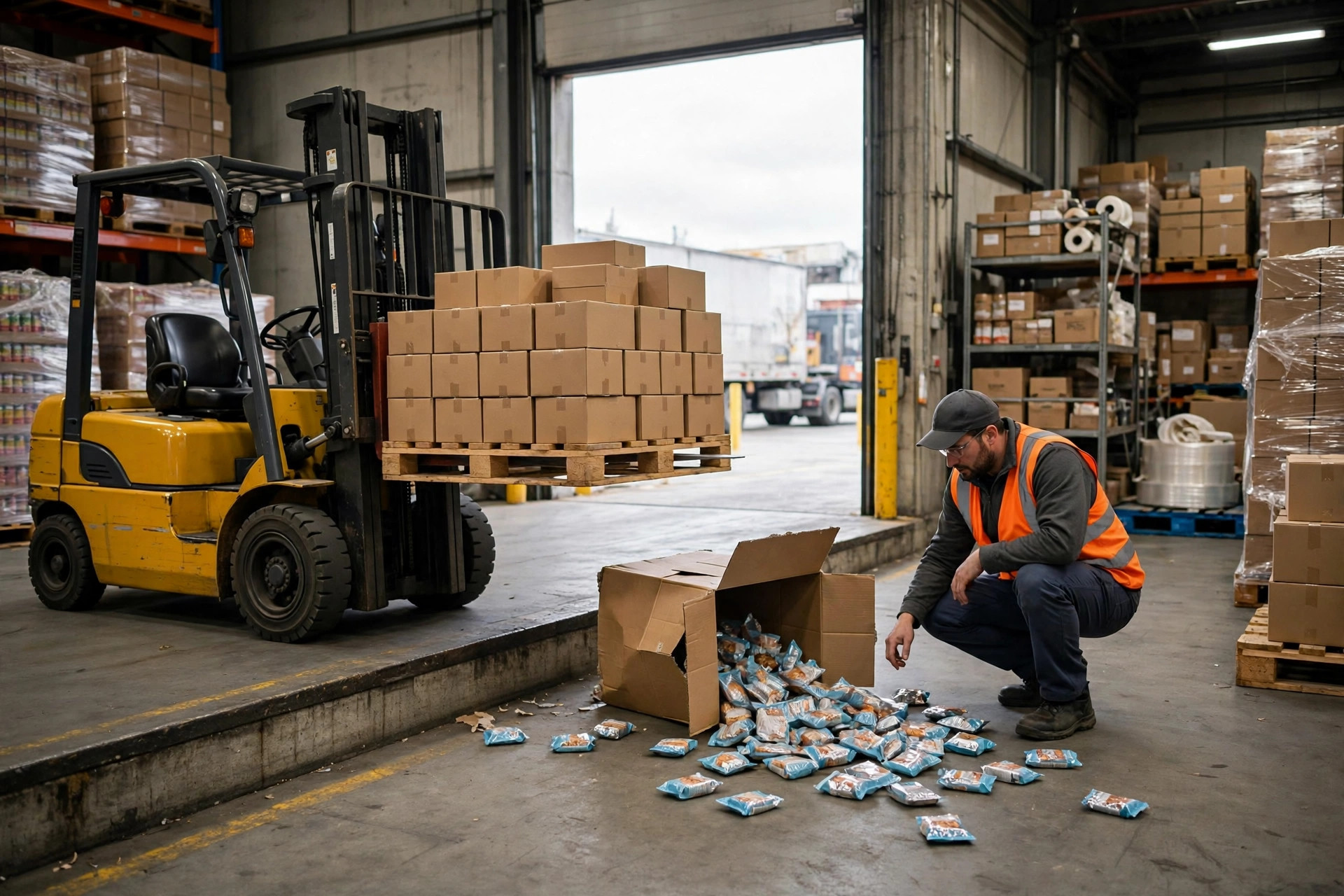
Let me start with the rough-handling bill. In September 2025, a small-appliance seller had a container devanned at a third-party warehouse in Los Angeles: $60,000 in goods across 48 pallets. The loading crew was rushing to clock out; the forklift driver set the last pallet down hard, and it slid off the forks. Twelve cartons burst open, three units cracked. Direct loss: $4,300. The entire crew cost $900 for the job. One rough-handling incident wiped out the equivalent of nearly five crew hires. Many people never run this math and assume cheap loading labor is a win.
Rough handling is not a tail risk. Industry data attributes 37% of cargo damage incidents to handling errors during loading and unloading. Cargo damage as a whole eats 1% to 3% of a company's transportation spend — multiply that by your annual freight bill and the number stops looking small. The industry generally tolerates a damage rate between 1% and 2%, averaging around 1.5%. Above that line, money is leaking. The 1.5% also gives you a budget anchor. Say your annual freight spend is $2 million and damage runs at 2% — that is $40,000 leaking a year, with roughly 37% happening at the dock, about $15,000. That $15,000 is your annual ceiling for everything that controls loading: evidence labor, contract review, all of it. Price every measure against that number first.
The rough-handling math: whose money burns
Get the responsible party straight first, because it decides where the money comes from.
An in-house crew means the damage is an internal cost — lost goods plus rework labor — with nobody external to claim against; only management and incentives can push it down. An outsourced crew can theoretically be held liable, but in practice every claim turns into an argument: "the cartons were already broken," "it happened upstream." And you have no counter-evidence.
A California food importer in early 2025 is the perfect counter-example: 280 cartons of seasoning, a tilted pallet during unloading, 23 cartons split open. The difference was process — they filmed the full unload, photographed every pallet at handover, and had both the driver and the crew lead sign the receipt noting the damage. Complete claim file, full compensation in three weeks. The appliance case above? No footage, a receipt that just said "48 pallets received," four months of back-and-forth, and a final payout of $1,100 on the grounds that the damage could not be proven to have happened during unloading.
Put the two cases side by side and the conclusion is plain: a cargo claim succeeds not on how clear the fault is, but on how solid the evidence is. Industry data backs this up — claims with visible damage noted on the delivery receipt at handover clear at far higher rates than concealed-damage claims discovered later, and incomplete documentation is the most common reason claims get denied.
The true cost of one damage event is also more than the goods line:
| Cost item | What it covers | Who usually fronts it |
|---|---|---|
| Lost goods | Purchase cost of the damaged units | Shipper |
| Rework labor | Re-sorting, re-boxing, re-labeling | Warehouse or shipper |
| Delivery delay | Expedited replacements, customer chargebacks | Shipper |
| Claim labor | Hours spent assembling files and chasing the claim | Shipper |
Add the four lines up and the real cost runs materially higher than the goods line alone. That is why "cheap loading labor" is a false economy: saving $200 on the crew while gambling thousands in damage exposure.
The claim math: what evidence is actually worth
Evidence collection is the cheapest link in the whole claim chain. Three standard moves: photograph or film the key moments of unloading (pallet touchdown, pre-racking), note exceptions on the receipt ("carton damage on pallet 12," not "48 pallets received"), and get both sides to sign. Fifteen minutes of labor protects thousands of dollars in recovery. Storage matters too: file footage by date plus plate or container number, keep it in the cloud for at least 90 days to match the contract's retention clause. In a dispute, the other side does not ask whether you have photos — they ask which shipment, which pallet, and what time each photo corresponds to.
Run the expected value on the two cases: on $4,300 of damage, complete evidence recovered everything in three weeks; no evidence recovered $1,100 — about 26% in this case — after four months, plus months of chase time. Fifteen minutes of documentation for several thousand dollars of recovery delta. That is the highest-return fifteen minutes in the loading operation.
Three contract clauses that actually hold a crew accountable
Many people think the way to control a loading crew is to write the harshest penalty clauses. My experience says the opposite: the harshest clauses are the ones that never get enforced, because you have no evidence. What actually works is flipping the burden of proof. Three clauses worth writing into the contract:
First, an image-retention obligation. Key loading moments must be photographed or recorded, with footage kept for 90 days (negotiable). A shift with no image records is deemed to have waived its right to dispute damage claims.
Second, a damage-rate red line with tiered deductions. Use the trailing three-month average damage rate as the baseline (new engagements can start from the industry's 1%-to-2% acceptable band); the portion above the line is deducted from the period's service fee at an agreed multiple of the damaged goods' value, with the formula written into the contract. Worked example: trailing average 1.2%, this month 2.0% — the 0.8 points above the line, applied to the damaged goods' value for the month, gets deducted at the agreed multiple (say 1.5x). Formula fixed in writing, no argument at month-end reconciliation. Review the baseline quarterly — it only moves down.
Third, reversed burden of proof plus suspension. Damage backed by image evidence is paid by the crew first, disputed later; two consecutive settlement periods above the red line suspends new assignments until remediation passes review.
A calculable way to close: before your next loading contract negotiation, get three numbers — last year's damage spend, the share that happened during loading, and the share backed by evidence. Multiply them and you get what you legally leak every year at the dock. Divide by twelve and that is your monthly budget ceiling for evidence collection and contract enforcement. Run the arithmetic this far and rough handling stops being a luck problem — it becomes a solvable equation.
By Lao Zhou, Logistics Cost Analyst