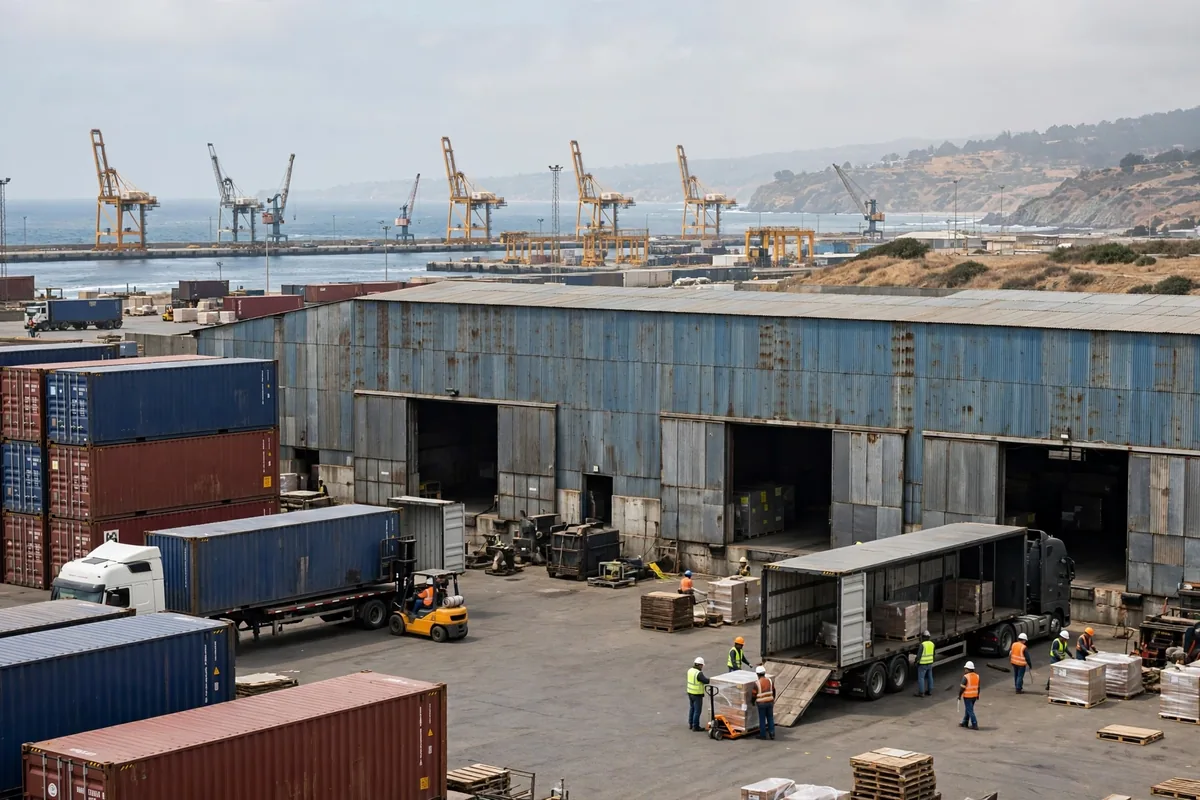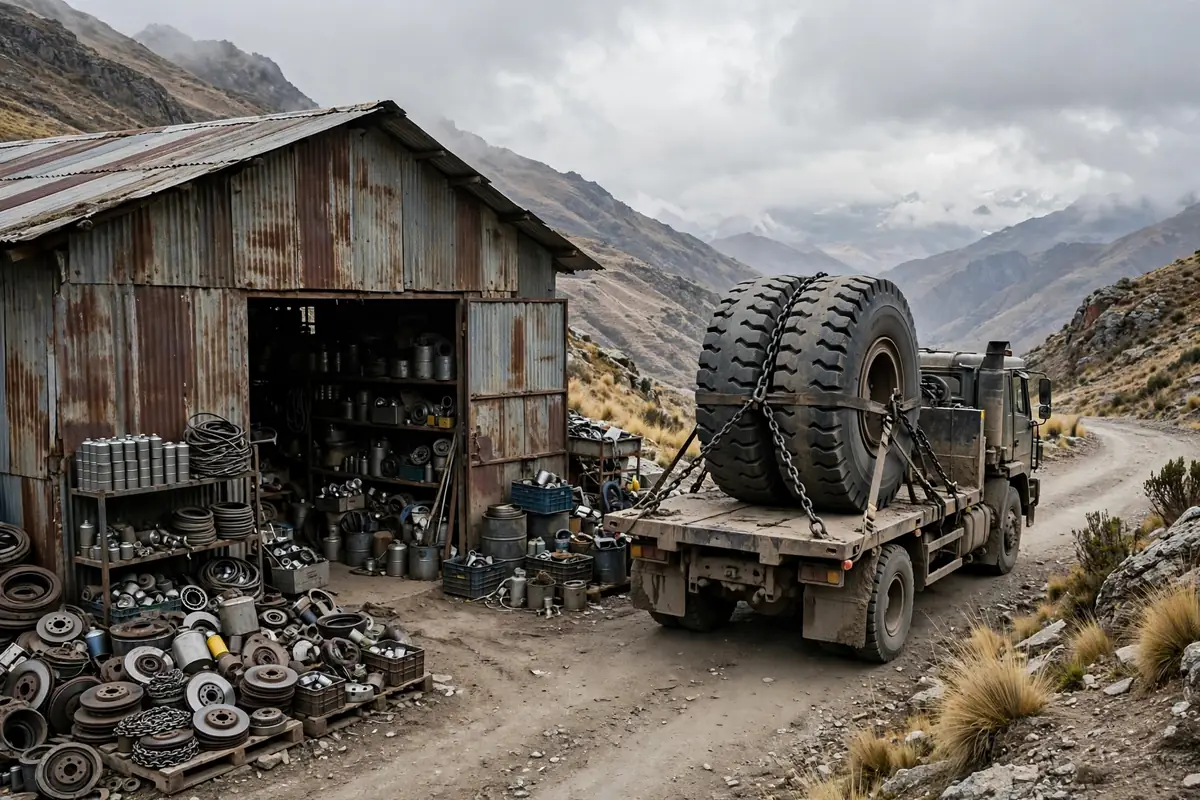
Let me tell you straight: hauling into the Peruvian Andes is nothing like running freight on flat ground, and peru mining spare parts warehouse logistics boils down to one rule I learned the hard way — the parts have to wait on the mountain for the breakdown, not the other way around. My first run up from the port warehouse near Callao started before dawn, switchback after switchback, the air getting thinner as we climbed. What looks like a half-day drive on a map can eat a full day in good weather, and in the rainy season a slide or a washed-out stretch can park a whole convoy halfway up, waiting on clearing crews, with nobody able to promise when the road opens again.
After fifteen years behind the wheel, the worst sight I know is not a broken truck. It is a broken mine machine with its spare part still sitting down at sea level. I once hauled a set of filters and hydraulic hoses up to a site and found the repair lead squatting beside a dead excavator, smoking, telling me the machine had been down since the day before and the whole crew had been standing around waiting on those small boxes. Filters cost next to nothing. You do not need exact figures to do that math, just orders of magnitude: one hour of downtime burns through enough lost production and idle labor to cover months of storage for a shed full of common spares. On a mountain, the question is never what a part costs. It is whether the part is there.
Why peru mining spares must live uphill: the spare parts time problem
People in a Lima office love keeping everything in one port-side warehouse: rent is cheaper and counting is easier. But between the port and a high Andean mine sits a wall of uncertainty: engines lose power on the climb, drivers feel the altitude too, big rigs crawl through tight bends, and the rainy season brings rockfalls, mudslides, and closures that can cut a route for days, not hours.
One wet-season run still sticks with me. I was taking a water pump uphill when a slide blocked the road ahead. We sat in the cab for most of a day while a loader worked the other side, then slept rough in a small town. The main road opened next morning, yet the last access track had gone soft, so that single pump still spent far longer on the road than anyone planned.
That is why a forward stock point is not waste. It is buying time in advance. The heart of peru mining spare parts warehouse logistics is spending the waiting time early: use the good-weather windows to move what the mine will need up the mountain, into the on-site store, so that when something fails the fitter walks a few steps, grabs the part, and gets the machine earning again.
warehouse logistics grading: what must sleep at the mine site
You cannot stock everything uphill either. Space is tight, staff are few, and a warehouse stuffed with everything is a warehouse where nothing can be found. The storekeepers I respect grade parts by three questions: does its failure stop the machine, how often does it wear out, and how hard is it to replace from downhill?
| Grade | Test | Typical parts | Where it lives |
|---|---|---|---|
| A — critical | Failure stops production, wears fast | Filters, belts, hoses, bucket teeth, common sensors | On-site store, generous safety stock |
| B — regular | Failure slows work, wear is predictable | Tires, pumps, motors, brake parts | Common sizes on site, backup at port warehouse |
| C — backup | Rarely fails, bulky or costly | Engines, gearboxes, large structural pieces | Mainly Lima/Callao, with a transport plan ready |
Here is the counterintuitive part: the parts that most deserve shelf space uphill are often the cheapest ones. A worn bucket tooth, a burst hose, a clogged filter — none of them is worth much, yet without them the machine does not move. A full engine is the opposite: it rarely fails, and when it does the repair is a major job anyway, so it justifies one planned heavy haul. New buyers often do this backwards, fussing over the big iron while treating small consumables casually.
The trade-off cuts the other way too. Higher on-site stock means lower downtime risk, but more tied-up cash and more rubber seals aging on shelves. Grade A stock still needs a ceiling based on real consumption, regular counts, and first-in, first-out discipline. In the end, peru mining spare parts warehouse logistics is not about who has the biggest warehouse. It is about who grades their parts most honestly.
Two levels, two jobs: port warehouse versus site store
Running this route taught me the division of labor. The warehouse near Lima and Callao is the reservoir: imports land there, customs and inspection happen there, and several mines can share its deep, wide inventory. The site store is the front line: a narrow, sharp selection of the parts that keep that one mine alive, watched closely and counted often.
The craft is in the replenishment rhythm. A site store must never wait until the shelf is empty. When stock hits its trigger level, the order goes down early enough to ride the next good-weather window, and the port warehouse consolidates loads so trucks climb full, not carrying two lonely boxes at full mountain risk.
Here is a hypothetical example to make the logic plain. Suppose a mine burns through ten batches of Grade A spares a month, the port warehouse runs one consolidated truck a week, and the site store always holds roughly two weeks of cover. If rain then cuts the road for a week, the site keeps working and nobody waits on a part. That hypothetical example has no fancy formula in it — it simply trades two weeks of modest storage for more than a week of road-closure insurance. Hold only three days of cover instead, and the small saving in storage gets handed back, with interest, the first time the road closes.
The paperwork has to match the metal, too: one shared inventory record, daily consumption reported from the site, and replenishment driven by those numbers — simple, and rarer than you would think, since I have seen systems show stock nobody could find on the shelf.
Oversize loads uphill: tires, teeth, and engines
Now the part drivers know best: the big stuff. A mining tire or a complete engine is merely wide and heavy on the highway. On a mountain road it meets tight bend radii, tunnel clearances, and bridge limits at every turn. Before loading, someone has to scout the route — which section is under repair, which bend a long rig cannot swing, which bridge must be crossed slowly and alone. There is no turning around up there if you guess wrong.
Loading and lashing deserve the same respect. Tires stand upright, chocked against rolling. An engine sits low with straps on solid points, because every climb and every brake on the descent tests that rigging. Uphill, slow beats sorry: brake early for bends, save your brakes on long descents, and never let a schedule talk you into hurrying. At the site, unloading needs its own checks — where the crane stands, whether the ground will hold it, and how the high-altitude wind pushes a swinging load.
One last point people forget: plan the big hauls outside the rainy season. If a rebuild is scheduled, move the engine and tires up in the dry months, even if they sit in the site store a while. That is another time calculation inside peru mining spare parts warehouse logistics — storage is the visible cost, while a wreck on a wet road or a machine waiting on a part is the hidden one, and the hidden bill is always bigger.
Peru mining spare parts work, seen from the cab, is a race against the mountain and the weather. Get the life-saving small parts uphill early, move the giants in the good season, and keep the port and site records telling the same story. Do those three things and machines spend less time dead, and drivers spend fewer nights answering emergency calls. The road is not going anywhere. Smart operators let freight wait for the weather — they never let a machine wait for freight.
By Shifu Zhao, Trucking Veteran (15 yrs)