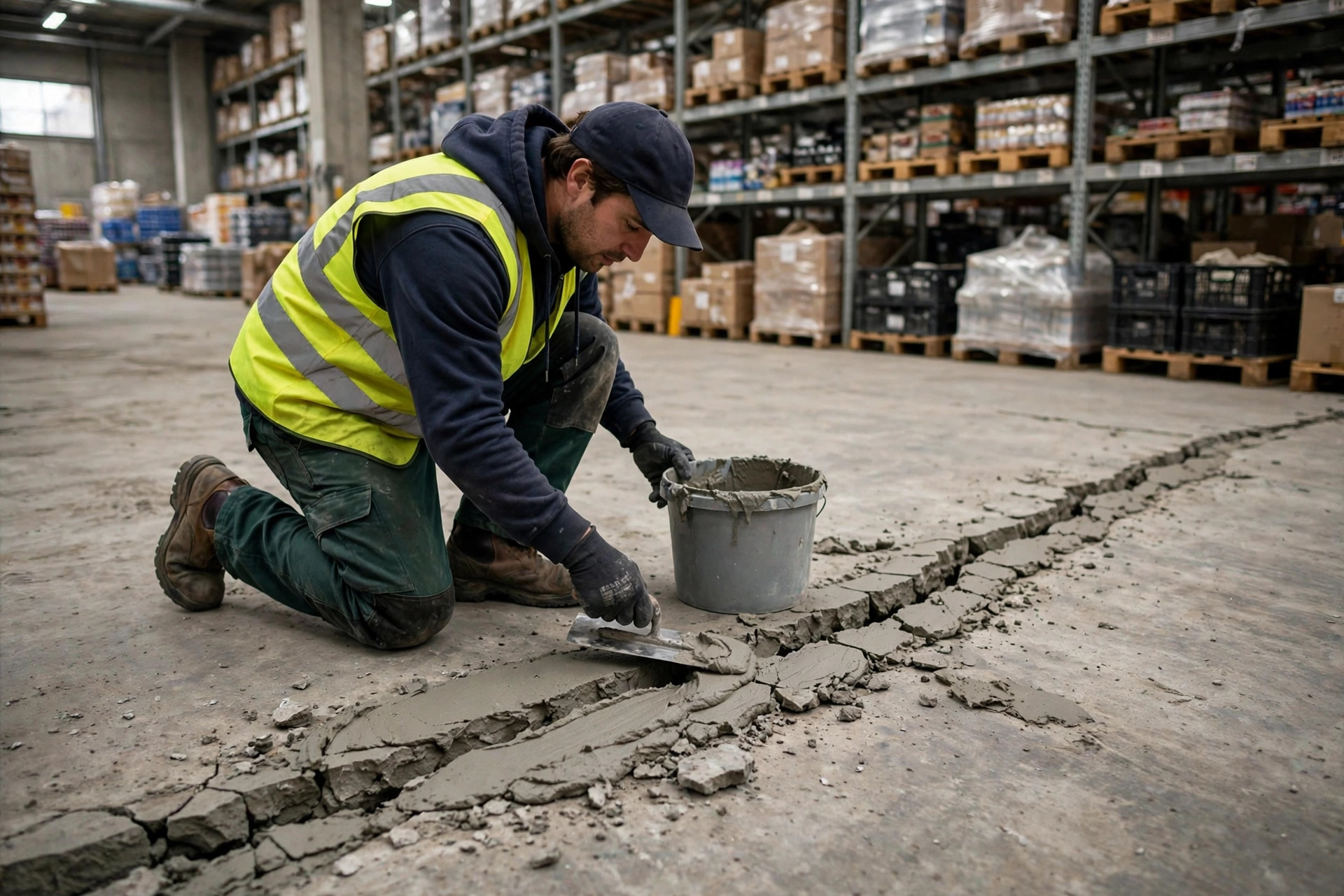
Warehouse concrete floor crack repair is not a topic I ever wanted to learn. I run a small warehouse, about three thousand square meters, and every dollar I spend on concrete is a dollar I cannot spend on stock, labor, or a truck repair. Last summer, I found a thin line under the racking near the wall. I told myself concrete cracks, that is what concrete does. Two months later, forklifts had run over it hundreds of times, the line had widened, and small flakes had lifted at the edges. Pallets started to jolt as they crossed it. That was the day I learned that a cracked floor is not cosmetic. It is a daily tax on everything that moves through the building.
How I Grade Floor Cracks Without Fancy Equipment
I use three grades, and they are enough for a small operation. Grade one is a hairline crack. It is as thin as a hair, you cannot catch it with a fingernail, and a forklift rolls over it without a bump. Most of these come from surface shrinkage. I photograph them, note the date, and check them once a month. If they do not move, I leave them alone.
Grade two is a structural crack. You can fit the edge of a bank card into it, the edges start to crumble, and a forklift gives a small jolt as it crosses. This is the grade that needs action, because something underneath may have hollowed out or started carrying load unevenly. Grade three is settlement. The two sides are no longer level, or the crack runs diagonally across several bays. My rule is simple: once the floor has stepped up or down, I stop guessing and call a structural engineer. A small warehouse cannot afford to be brave about that one.
I learned the difference the expensive way. One winter, we stacked heavy goods beside a column where a thin crack already existed. I planned to fix it in the slow season. Three months of heavy loads later, the crack was wide enough to catch a small cart wheel, and the floor beside it had dipped slightly. When the repair crew cut it open, the base underneath had loosened. A one-day fix had become a three-day shutdown, and the bill roughly doubled. Since then, I walk the whole floor once a month with a cart, looking only at the ground, photographing every new crack with its date.
Three Repair Methods, Three Very Different Bills
Surface sealing suits hairline cracks. The crew cleans the crack, fills it, and smooths it over. It is cheap and fast, often finished in half a day, and forklifts can usually run that same evening. Its weakness is obvious: it treats the surface. If the ground underneath is still moving, the crack will come back in a few months.
Pressure grouting suits structural cracks. Grout is pumped into the crack under pressure to fill voids deep below the surface. It costs several times more than sealing, takes about a day, and needs curing time. The advantage is durability. After grouting, the forklift stops jolting, and the repair holds for years. Full cut-and-replace suits settlement or large damaged areas. The bad section is cut out, the base is rebuilt, and new concrete is poured and cured. It is the most thorough option and the most painful one for a small warehouse, because one area can be out of action for three to five days.
Do not compare these options by the unit price on the quote. Compare them by downtime. Sealing one crack may cost only a few hundred dollars in materials and labor, with almost no lost shipping time. Grouting costs much more up front, but spread over several years of trouble-free use, it is often the cheaper choice. Cut-and-replace is the most expensive once you add the days when orders cannot leave the building. My rule now is: seal and watch a hairline crack, grout a structural crack rather than patching it again and again, and never improvise on settlement. Repeated small patches look thrifty. Added together, they often cost more than one proper fix.
Small-Warehouse Tricks the Big Vendors Never Mention
First, schedule repairs for the slow season or a weekend gap. One lost shipping day during peak season can cost more than the repair itself. Second, bundle cracks in the same area into one visit. The crew's call-out cost is spread across several fixes instead of being paid three times. Third, move the stock and sweep the area yourself before the crew arrives. If they do not spend hours moving your pallets, you do not pay for those hours. Fourth, respect the curing time. I once let a heavy forklift onto a fresh repair the next day, and the joint lifted slightly. The crew fixed it free, but they also told me plainly not to rush it again. Now I put a small sign beside every fresh repair with the date on it, so everyone routes around it for a couple of days.
Price comparison taught me another lesson. Last autumn, three crews looked at the same structural crack. The first wanted to cut and replace it, with the highest price and the longest shutdown. The second proposed grouting, finished in a day. The third was cheapest and would only skim the surface. I chose the second. More than a year later, with forklifts crossing daily, the crack has not widened. The highest price was not the right answer, and the lowest price was not a saving. The right match between crack and method was the saving.
Here is the counterintuitive part: earlier and more expensive is not always better. A stable hairline crack that is only shrinking on the surface does not need to be cut open. Cutting it creates a new joint, and that new joint can become the next weak point. On the other hand, dressing up a settlement crack with surface filler is like putting a bandage on a sinking floor. The question is not how scary the crack looks. The question is whether it moves. Measure it for two months. If the width stays the same, observation is reasonable. If it widens within a month, or steps out of level, stop saving on the assessment fee.
That, in the end, is what warehouse concrete floor crack repair comes down to for a small operator. My wall chart is short enough to remember. Hairline, stable, no jolt: watch and record. Structural, widening, forklift jolts: grout it. Settlement, stepped, spanning several bays: get an engineer to assess, then decide. I also have three hard triggers for calling an engineer immediately: a stepped floor, a crack running near a column, or the same area cracking again after two repairs. Any one of those ends the do-it-yourself phase. A small warehouse cannot burn money on concrete, but it can burn far more if the floor fails underneath a loaded rack. A small warehouse has its own way of surviving, and that way starts with grading cracks honestly, counting downtime properly, and fixing each crack once, properly.
By Xiao Ma, Small Warehouse Owner