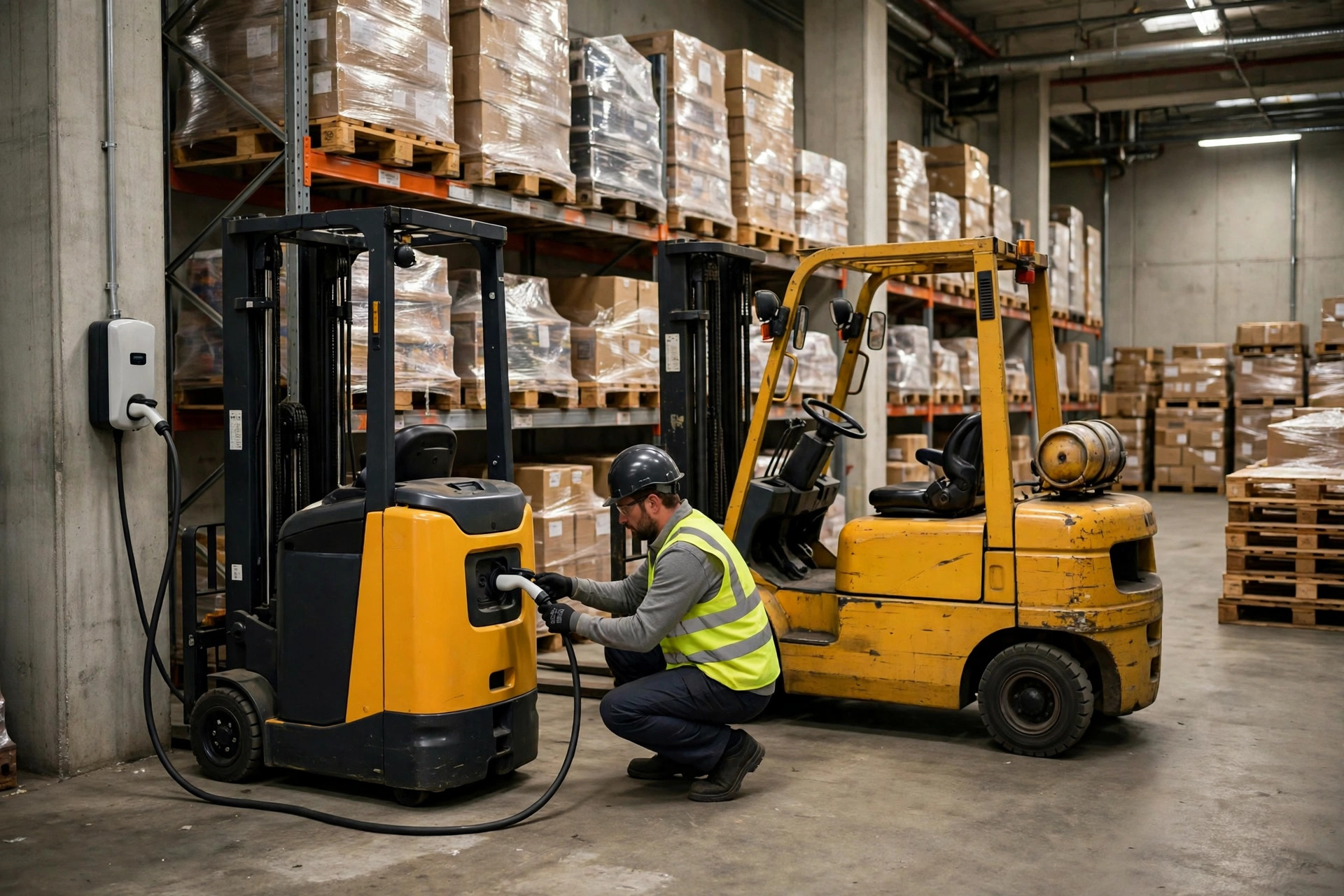
Let me tell you something. After years on the road, I have backed into more small warehouses than I can count, and I have seen this forklift argument play out in every one of them. A couple of years ago I delivered to a small warehouse outside Ningbo — barely 2,000 square meters — where the owner had just bought a shiny new electric forklift. He told me the salesman had shown him how much he would save on fuel. I kept quiet, but I was thinking: this place runs one shift a day, and that truck barely moves for more than a few hours. Does that math really work out?
Six months later I was back, and the owner had a different story. The battery did not hold a charge the way it used to, cold weather made it worse, and the quote for a replacement battery nearly knocked him over. The truck itself was fine. But for a single-shift warehouse like his, the fuel money he saved was not enough to cover the battery bill. That is the whole story in one sentence: for a small warehouse, electric vs diesel is not a question of which truck is better. It is a question of how many hours a year yours actually runs.
Start With Hours, Not Horsepower
A single-shift small warehouse works its forklift nothing like a big three-shift operation. In a big warehouse, the truck runs fourteen hours a day and burns through fuel fast, so the electric advantage shows up right away. In a small place, the pattern is different: unload a truck in the morning, ship a load in the afternoon, move a few pallets in between. Real working time comes to three or four hours a day. Over roughly 260 working days a year, that is barely over 1,000 hours.
That number is where the whole calculation starts. In the fall of 2024, a small auto-parts warehouse in Langfang asked me about replacing its truck. The old diesel unit was nearly ten years old and repair bills were creeping up, and a salesman was pushing electric with a promise of big annual fuel savings. We sat down and ran the honest numbers: at about 900 hours a year, diesel fuel came to a little over ten thousand yuan a year, while electricity for the same work ran only two or three thousand. But spread a battery replacement over five or six years and you add several thousand a year back, and the electric truck itself costs more up front. Over five years, the two options came out about even. The owner kept the diesel, gave it a proper overhaul, and got two more good years out of it. For his volume, that was the right call.
Now take the opposite case. A small e-commerce fulfillment warehouse in Yiwu, not much bigger in floor space, but running its forklift practically nonstop from morning to night — over 2,000 hours a year. At that volume, annual fuel runs to thirty or forty thousand yuan, and the electric truck pays back its battery and price premium quickly. For a warehouse like that, going electric is an easy decision.
Electric vs Diesel Forklift: The Five-Year Comparison
Laid out side by side, each type is expensive in its own way. Electric costs more up front and in batteries, and less in energy and routine maintenance. Diesel costs less up front, and more in fuel and repairs — especially once an old diesel starts leaking, smoking, and getting hard to start, when repair bills stop being predictable.
| Item | Electric forklift | Diesel forklift |
|---|---|---|
| Purchase price | Higher | Lower, good used market |
| Energy (single-shift volume) | A few thousand a year in electricity | Over ten thousand a year in fuel |
| Battery / major overhaul | One big battery bill every five or six years | Old trucks need repairs every year, no fixed number |
| Indoor work | Zero exhaust, quiet, no restrictions | Exhaust fumes limit indoor use |
| Outdoor heavy work | Struggles on slopes, heavy loads, rain | Strong, rugged, built for the yard |
| Refueling | Hours to recharge, must plan ahead | Five minutes at the pump and gone |
For a single-shift small warehouse, the dividing line looks roughly like this: under about 1,200 hours a year, especially with outdoor and heavy work, diesel usually wins — and if you already own a diesel that can be overhauled, overhaul it first. Over about 1,800 hours a year, or with mostly indoor work, electric pulls ahead clearly and switching is only a matter of time. Between 1,200 and 1,800 hours, it comes down to two questions: how much of the work is indoors, and how much are you willing to pay for not breathing exhaust and not fixing the truck every other month.
Here is the part most salesmen will not tell you, and it cuts against the usual pitch: for a single-shift warehouse, the biggest advantage of electric is not saving money, it is saving hassle — no fuel storage, no exhaust in the building, turn the key and go. And the biggest advantage of diesel is not cheapness, it is readiness: an extra shift pops up, a night shipment needs to go, five minutes at the pump and you are rolling, while an electric truck sits there waiting on a charge. Figure out which shortage hurts you more — money or readiness — and then pick the truck.
Three Practical Pieces of Advice
First, do not let anyone sell you on one year of fuel savings. Ask for the five-year total: purchase price, energy, battery or overhaul, and repairs, all added up. Compared over one year, electric always wins. Compared over five, a single-shift diesel often does not lose.
Second, count your own hours before you believe any estimate. Do not go by feel — "we stay pretty busy" means nothing. Check a month of work orders or fuel records and find out how many hours a day the truck really runs. Once you have that number, the dividing line above tells you where you stand.
Third, think indoor and outdoor separately. A purely indoor warehouse should almost always go electric; the exhaust question alone settles it. A warehouse that works the yard, climbs ramps, and hauls heavy loads outdoors will still get more out of diesel muscle. And if you can manage it, one of each is often the smartest setup: diesel for the heavy yard work, electric for indoors.
A truck is for working, not for showing off. Count your hours, run the five-year numbers, and the truck you buy will not be the one you regret.
By Shifu Zhao, Trucking Veteran (15 yrs)