Let me give you the conclusion first: warehouse carbon monoxide safety is rarely an equipment problem. It is a management problem. A propane forklift is not dangerous by itself. What gets people hurt is the combination nobody notices — dock doors shut tight for winter, trucks idling outside the dock, a detector mounted in the wrong place, and a crew that feels perfectly safe. CO has no color and no smell. By the time a driver feels dizzy, he has usually been breathing it for a while. This cuts two ways. One side is compliance, and OSHA fines are real. The other side is people. When someone goes to the hospital, the fine is the smallest problem you have. I have seen too many warehouses with clean aisles, good racking, and solid fire safety where nobody gave a thought to the one hazard you cannot see.
Carbon Monoxide and Propane Forklifts: The Winter Afternoon I Will Not Forget
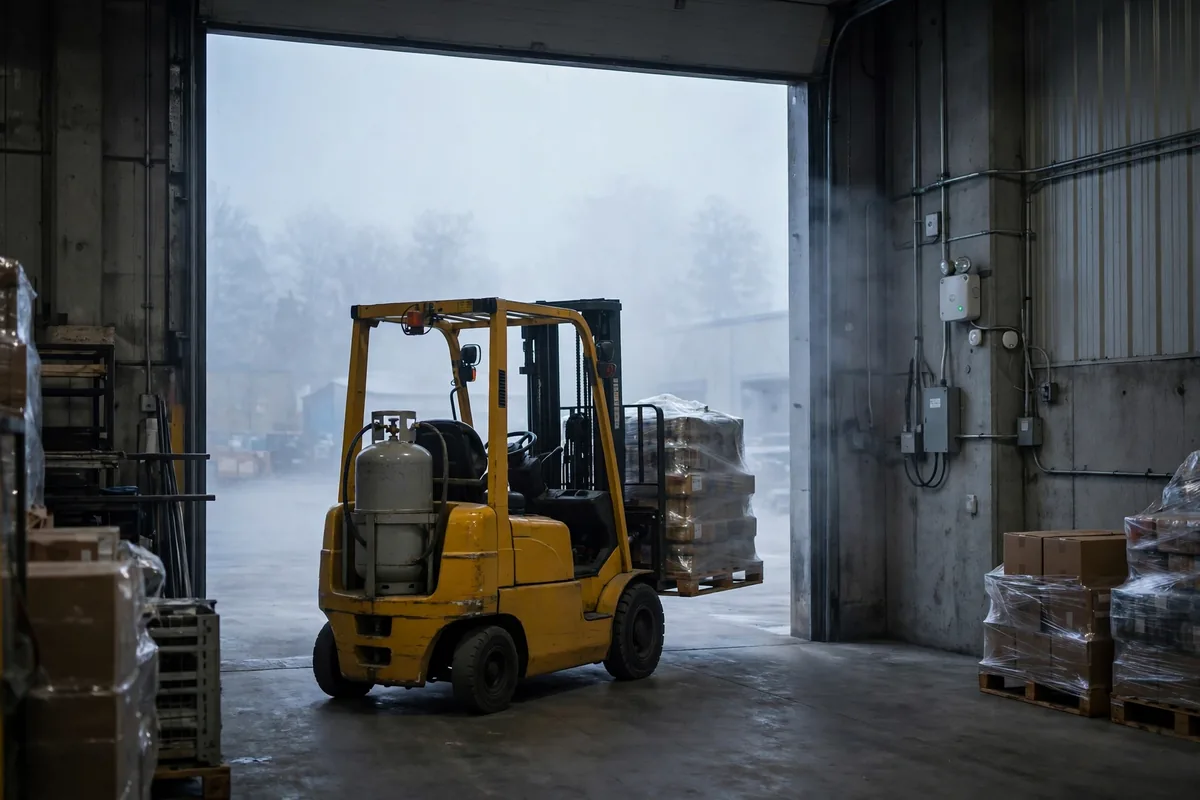
Years ago I was doing a process review at a food distribution warehouse in the Midwest, in the middle of a hard cold snap. It was a big building with high ceilings, and on a normal day, with the dock doors cycling, ventilation was fine. That week, temperatures dropped well below freezing, so the supervisor kept every dock door closed to hold the heat. Six or seven propane forklifts were running inside, and the drivers were joking that the engines doubled as heaters.
Mid-afternoon, a driver with eight years on the job stepped off his truck, grabbed the racking, and said he felt dizzy and sick. Everyone assumed low blood sugar. Then a second driver complained of a pounding headache, and the lead finally pulled everyone outside and called for help. At the hospital, blood tests confirmed carbon monoxide poisoning for both men. They were lucky. Oxygen and a night of observation were enough.
The review afterward found a chain of small failures. The building had no CO detectors at all. Two forklifts were badly out of tune and burning fuel poorly — their exhaust smelled noticeably heavier, and nobody had treated that as a warning sign. Two road trucks were idling outside the dock the whole time, and exhaust was seeping back in through worn dock seals. No single factor was fatal. Together, on a sealed-up winter afternoon, they were more than enough.
That day taught me the core lesson of warehouse carbon monoxide propane forklift safety: the most dangerous moment is the one that feels safest. Doors closed, building warm, freight moving — nobody thinks about what is building up in the air.
Why Big, Well-Ventilated Warehouses Still Get CO Events
Many managers assume a large, high-ceiling warehouse dilutes exhaust on its own, and that only small buildings need to worry. That is half true at best. A good share of the CO alarms and poisonings I have seen happened in big, airy buildings.
The math is simple. A big warehouse runs more trucks. One forklift emits a modest amount, but a dozen running at peak, in a building sealed for winter, is a different story. Tall, full racking also creates dead zones. A forklift idling deep in an aisle waiting for a pick can push local concentrations up fast, while the air in the middle of the building still tests fine. Clean air where you happen to stand proves nothing about the far end of aisle twelve.
Here is the other counterintuitive one: a detector mounted at the wrong height is the same as no detector. I once saw sensors mounted nearly twelve feet up the wall, placed there so forklifts would not hit them. CO mixes with air rather than sinking like propane or rising like hot exhaust. Mounted that high, the alarm sounds only after the people below have been breathing elevated levels for a long time. Detectors belong near the breathing zone, positioned per the manufacturer guidance and the actual airflow of the building. Always ask: are you measuring the air near the ceiling, or the air your people actually breathe?
A Practical Control Checklist, In Order
When I build a control plan for a client, I never start with buying gear. Sequence matters.
First, measure. Without detectors, every decision is a guess. Prioritize the inside of the dock, the cylinder exchange and storage area, break areas, and spots where trucks idle or drivers spend long stretches. One detector cannot cover an entire wall of docks. Units need audible and visual alarms, with alarm levels set around OSHA's permissible exposure limit for CO — an 8-hour time-weighted average in the 50 ppm range; always confirm exact limits and alarm tiers against current OSHA rules and the detector manufacturer's spec. And when the alarm sounds, the response has to be scripted: evacuate, ventilate, verify levels have dropped, then resume. An alarm everyone ignores is decoration.
Second, ventilate. Fans alone are not a plan. The building needs mechanical ventilation that works with the dock doors closed, bringing fresh air in and pushing exhaust out. If heat retention fights with ventilation, fix the doors and seals — fast-acting doors and good dock seals cut open time — instead of sealing the building and hoping. Idle control is the cheapest win of all: road trucks shut down at the dock, forklift drivers kill the engine when they step off for more than a few minutes. Enforced consistently, that one rule removes a large share of the source.
Third, maintain. A poorly tuned propane engine can emit several times more CO than a healthy one. Put exhaust checks into scheduled maintenance, and pull any truck that smells wrong or tests high until it is repaired. Store and exchange cylinders in a separately ventilated area and leak-check valves and hoses on schedule. Propane leaks and CO are different hazards, but they tend to live in the same loosely managed building.
Fourth, train. Drivers must know the early symptoms — dizziness, headache, nausea, unusual fatigue — and the first move: get to fresh air and report it, never push through. Supervisors need the alarm playbook cold, and everything gets documented. When OSHA asks questions, your training, inspection, and maintenance records are your defense.
Should You Switch to Electric? Run the Numbers First
After every CO scare, someone asks whether to just go all-electric. Again, two sides. Electric trucks eliminate exhaust at the source indoors, and maintenance is simpler. But the purchase price is typically higher, you will pay for charging areas and electrical work, cold storage cuts battery runtime, and multi-shift operations need a charging or battery-swap strategy. For a large fleet, the capital bill is serious money.
Decide by scenario, not by slogan. Indoor-heavy operations with long winters and multiple shifts gain the most from electrification. Mixed indoor-outdoor yards can keep propane, provided detection, ventilation, and idle rules are actually in place. In freezers, test real battery runtime yourself before signing anything. Small fleets with low hours should first nail down detection and maintenance, and let electrification wait its turn.
Electrification removes an emission source. It does not fix management. A warehouse that never calibrates a detector will find another way to get someone hurt, electric fleet or not.
My closing advice is simple. You cannot see this gas, so your management has to be visible: detector readings, signed maintenance records, and a written log of every alarm response. With those three in place, I can walk into a sealed winter warehouse and feel fine about it. Without them, ask yourself one question — would you let your own kid take a winter job in that building?
By Lao Mi, Supply Chain Veteran (20 yrs)