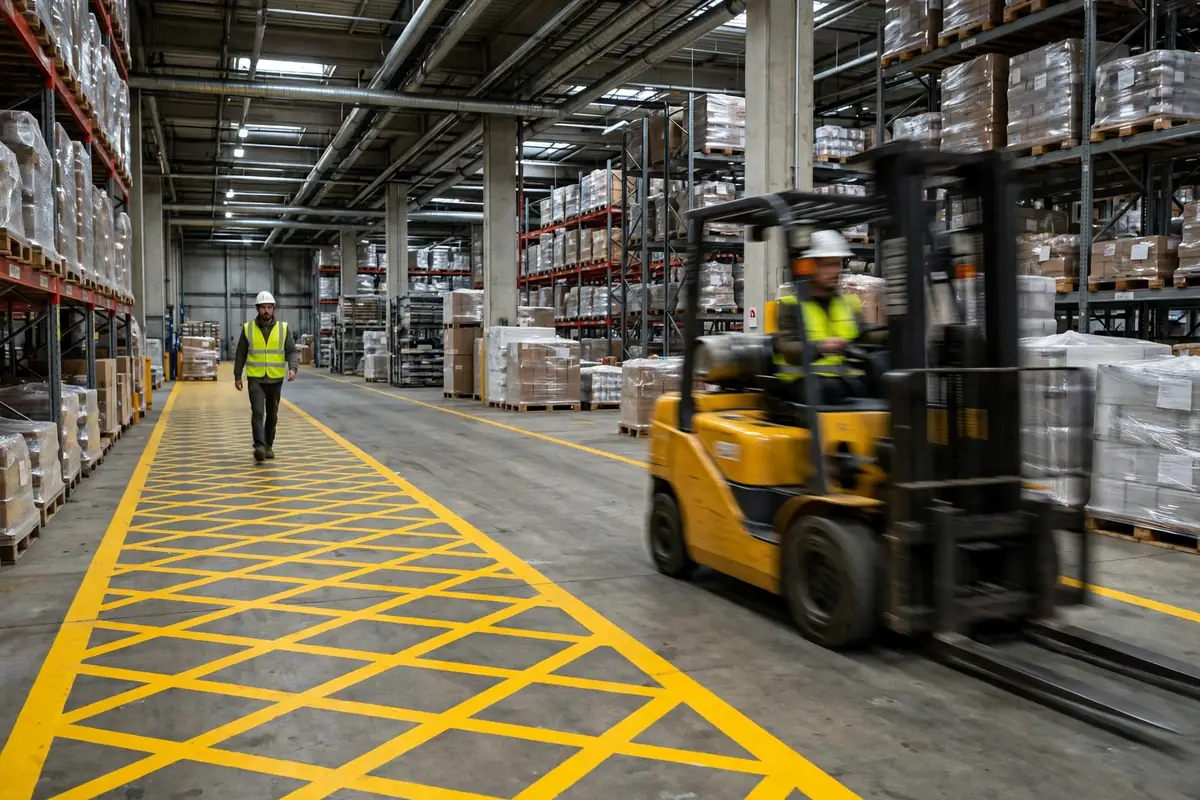
A warehouse pedestrian aisle floor marking job looks like the cheapest project in the building. Paint, tape, done. I believed that until March last year, in a Columbus, Ohio auto-parts warehouse, where I was tuning an AMR fleet. A forklift backed out of a rack aisle and its rear swung straight into a walkway whose yellow edge had worn down to a ghost. The picker pressed himself against the rack and got clear. No injury, just a manager who went pale and said the line had been painted two years earlier and scrubbed ever since. That is exactly how a sensor fails: the signal fades a little each week, nobody recalibrates it, and one day the system is running blind.
I build automation, so I read floor markings as a control system. No PLC, no camera, but it broadcasts instructions to drivers and walkers all day. When the broadcast fades, people improvise.
Start a warehouse pedestrian aisle floor marking plan with the route, not the paint
Most sites ask about paint versus tape first. That is backwards. Route first, material second.
Draw the route people actually walk, not the route the layout wishes they walked. In November 2024 I reviewed a consumer-goods warehouse in Indiana. Its walkway cut straight through packing because that was shortest on paper. Between 3 p.m. and 5 p.m., pallets staged by the stretch wrapper blocked it, and walkers stepped into the forklift lane. We watched two full shifts, counted walkers and crossings, then moved the walkway along the wall. It added roughly forty steps and cut crossing points from seven to two. A durable line on the wrong route protects nobody.
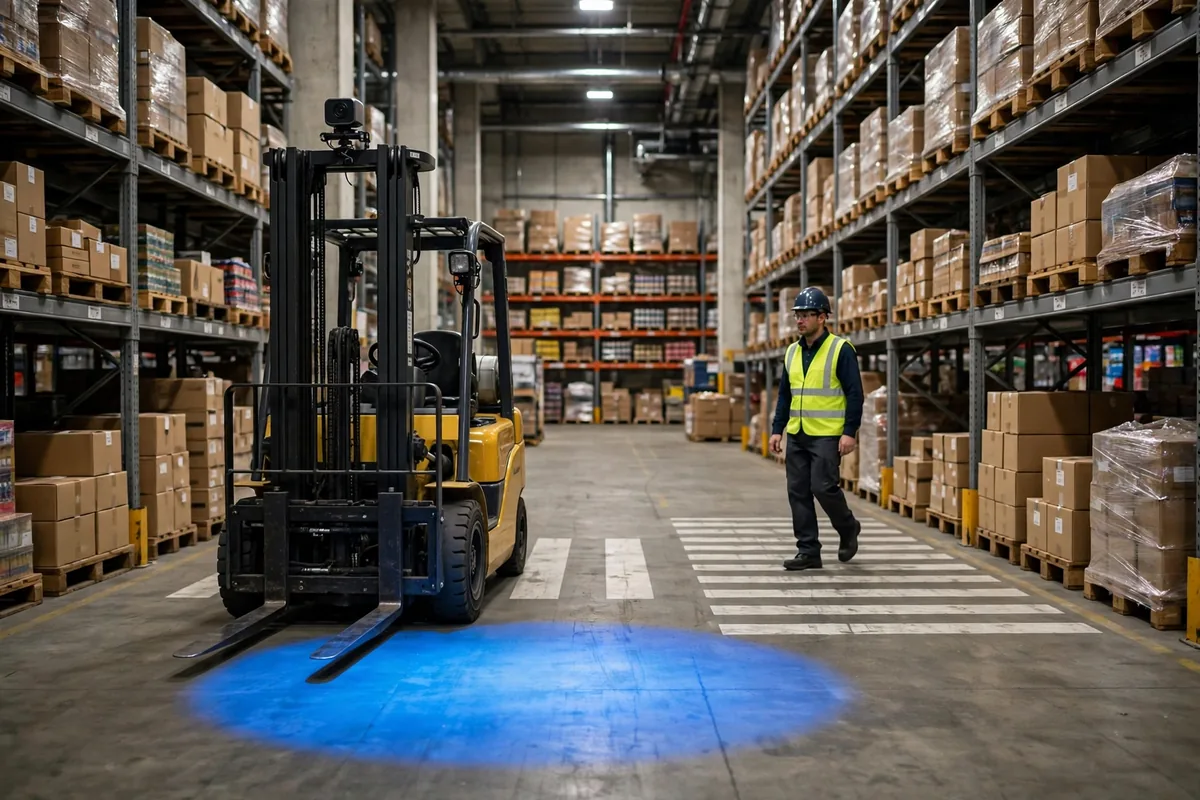
Three route rules hold up in the field. Keep walkways against walls or columns where you can, so a walker's position is predictable. Protect sight lines at every crossing; freight stacked at a rack end can hide a truck until it is too late. Connect the walkway to the places people must reach — doors, time clocks, break areas — or they will cut corners. Corner cutting is usually a design signal, not a discipline problem.
Here is the counter-intuitive part: wider is not automatically safer. A very wide walkway reads as spare floor. Drivers stage a pallet on it, park on it, and the lane dies by inches. A very narrow one forces two people passing each other to step outside it. Size it for your traffic and carts, check the current standard for any specific dimension, and trial it with tape for a week before committing.
Warehouse pedestrian aisle floor marking materials: paint, tape, or projected lines
Think of materials like tires. All are round; service life depends on the road. The table below is an example calculation with invented unit costs, shown only to demonstrate the method — get local quotes before budgeting.
| Option | Example assumption, 100 m | Main failure mode | Best fit |
|---|---|---|---|
| Basic floor paint | Lowest first cost, say 1 unit | Wears first where tires cross | Walker-only branch lanes |
| Heavy-duty coating | Several times paint, say 4 units | Needs shutdown and cure time | Fixed main walkways |
| Heavy-duty tape | Mid cost, say 2.5 units | Pallet drag lifts the edges | Pilot layouts, changing areas |
| Projected lines | Highest upfront, say 8 units | Blocked or washed out by glare | High-wear crossings |
Now run the example math. Paint at 1 unit, refreshed three times a year, costs 9 units over three years before you count labor for closing the lane. Tape at 2.5 units, replaced once a year, totals 7.5. A projector at 8 units plus minor power and one light-source service may land near either figure. The deciding variable is crossing count. Where tires cross a line hundreds of times a day, any coating is a consumable. Judge each option by rework frequency — how many times per year you must redo each meter.
A Tennessee site I visited mixed the system sensibly: durable coating on fixed mains, projection only at the worst crossing, tape on branch lanes that still moved. Projection is like a traffic light — tire wear cannot erase it, but a blocked projector or a glossy floor can wash the line out. Use it at points, not as a blanket answer.
Keep color semantics boring. Yellow, white, or green can each work; what fails is mixed meaning. If yellow means walkway on Monday and staging on Tuesday, drivers and walkers both start guessing. Inspectors read that as no system at all.
Separation needs more than a warehouse pedestrian aisle floor marking line
A line advises. A barrier enforces. In January 2025, at a Dallas-area e-commerce site in peak season, a textbook walkway emptied straight across a forklift main lane at the packing exit. The site changed no paint. It added a short guardrail that made walkers travel a few extra steps to a marked crossing with warning signs. Cut-throughs dropped immediately. It is the fuse in a circuit: do not rely on everyone behaving; make the wrong path physically awkward.
Practical measures, in order of spend: convex mirrors or warning lights at blind rack ends; a defined crossing treatment where walkways meet truck lanes, so drivers lift off the throttle by habit; guardrail or gated entry points at the few genuinely dangerous crossings; and, in AMR or AGV buildings, alignment between the robot map and the floor. I once debugged a map whose virtual keep-out zone sat half a meter off the painted lane. The robots braked hard beside the walkway all shift, and operators learned to ignore the braking. A safety signal people ignore is worse than none.
Do not overbuild the barriers either. Rail everywhere lengthens forklift travel, drivers under time pressure hunt for gaps, and soon the barrier line is full of unofficial openings. Protect the crossings with poor sight lines and high speed; let paint and habit carry the rest.
What inspectors actually check, and how to set the maintenance cycle
Watch one inspection and the pattern is clear. Nobody praises straight paint. They check whether lines are continuous where it matters, whether pallets and scrap live on the walkway, whether people actually use the route, whether crossings are blocked, and whether worn sections have any repair record behind them. They are auditing a running system, not a one-day paint job. For any specific requirement, check the current standard rather than trusting a screenshot from an old slide deck.
Set maintenance by wear, not by calendar alone. Monthly, walk the high-wear points — crossings and dock doors — and schedule repairs where the line is broken or polished away. Quarterly, walk the main walkways. Twice a year, check branch lanes. Photograph each repair with a date. In summer 2024 a Kentucky manager answered a question about a faded line by producing three months of dated inspection photos and work orders; the conversation moved on in minutes. Another site, same faded line and no records, spent forty minutes on it. The paint was identical. The evidence was not.
Coordinate floor scrubbing, too. Scrubber brushes and detergent eat tape edges and old paint. Tell the cleaning crew which markings are fresh, and keep machines off new tape until it has settled. Small coordination, real money.
The expensive way to do warehouse pedestrian aisle floor marking is the panic repaint before a visit: lane closed in a rush, traffic released before the coating settles, line gone again in a month, and no habit changed. Route it right, grade the material by tire crossings, guard the bad crossings, and keep dated proof you are maintaining it. Whether the money was well spent comes down to one number: three months from now, how many people in your building are still walking outside the lines.
By Da Liu, Automation Engineer