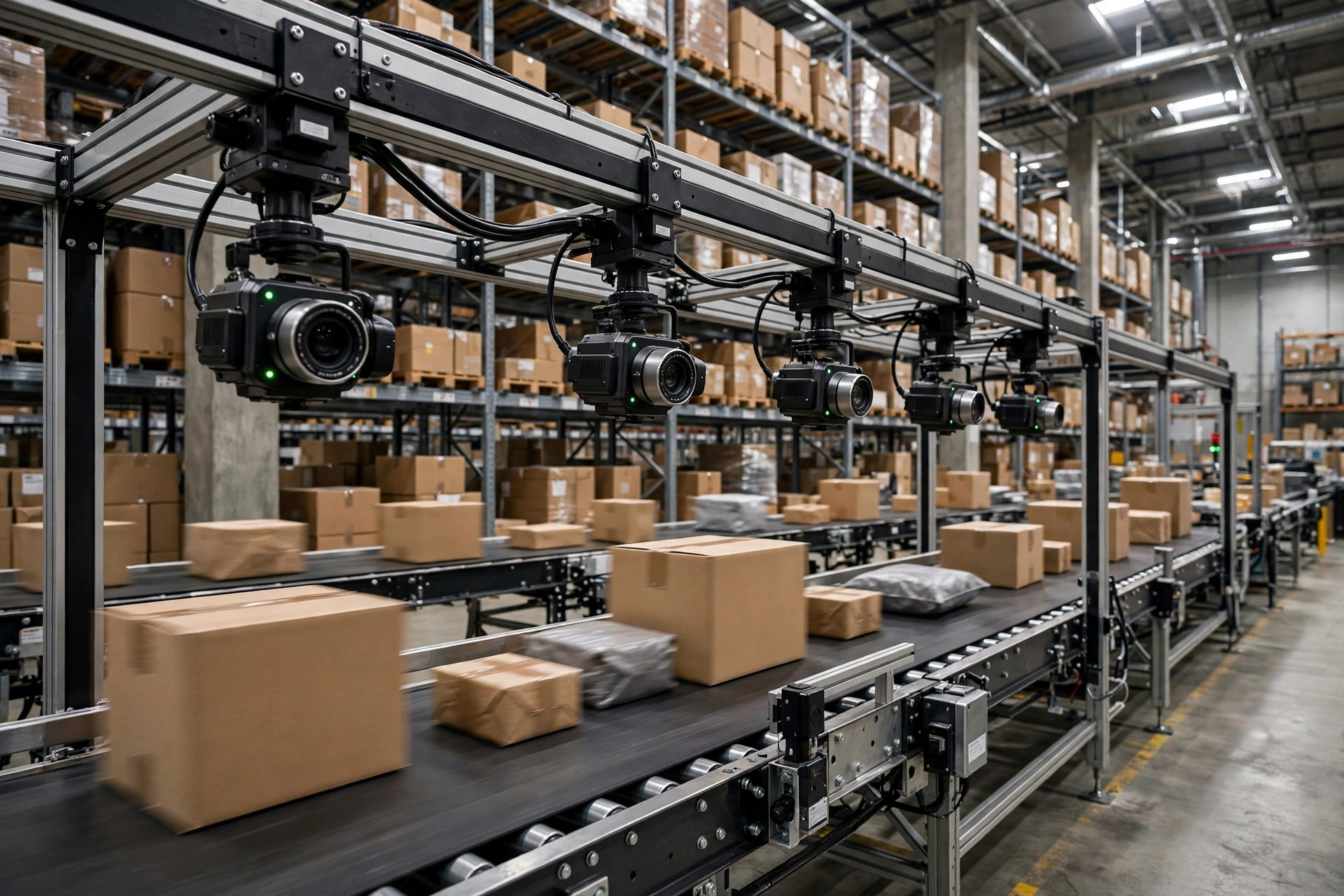
There has been a subtle but consequential shift in how AI vendors sell to warehouses since 2025. They no longer lead with model accuracy. Instead, the opening line is almost always the same: "Give us three months of historical data and we will run a free proof of concept." That sentence is exactly what a warehouse AI data agreement exists to govern. Across the dozen or so warehouse AI pilots I have followed over the past year, nearly every pilot agreement contained the same clause: the vendor reserves the right to use customer data to "improve products and services." In legal language, that means your WMS records, order history, and inventory data can train the next generation of the model — including the generation eventually sold to your competitor. Almost no operator seriously asked, before signing, what that data was worth.
The numbers: a risk that is systematically underestimated
Start with the public figures. According to IBM's Cost of a Data Breach Report 2025, the average breach costs $4.44 million, with a mean lifecycle of 241 days. That figure covers breaches in the traditional sense — data stolen by outside attackers. The AI vendor scenario is structurally different: the data is not stolen, it is handed over under a signed agreement.
The third-party dimension makes it worse for supply chains. Verizon's 2025 Data Breach Investigations Report found that roughly 30% of breaches involved a third party. In the traditional IT outsourcing era, third-party risk mostly meant a service provider's security hole. In the AI era, the risk moves upstream into the contract itself — the boundary of data use is no longer set by the firewall but by the few pages you signed. A firewall stops hackers; it does not stop an authorized use you agreed to.
There is also a live legal precedent every warehouse operator should be watching. In December 2023, The New York Times sued OpenAI and Microsoft over unauthorized use of copyrighted journalism to train large models. The case is still in the courts, but it has already established a principle relevant far beyond media: training-data rights must be settled in advance, in writing, because litigating them afterward costs far more than drafting the clause beforehand.
Why warehouse data is worth more than you think
In late 2024, while researching a 3PL in Ontario, California, I saw this dynamic up close. The warehouse served 40-plus e-commerce brands at roughly 12,000 orders a day and was piloting an AI replenishment forecast. The vendor requested twelve months of order detail, SKU masters, and pick-time records. The IT lead hesitated for three days before exporting — because the file contained three things, each of which could save a competitor a year of trial and error.
The first is a three-dimensional portrait of the customer base. Order data reveals not just who ships, but each brand's volume curve, SKU mix, seasonality, and return rate — a ready-made market map for any rival 3PL eyeing the same categories.
The second is the true cost structure. Pick rates, audit error rates, slot utilization, overtime distributions: combined, they let anyone with operational experience reverse-engineer the warehouse's real operating cost. When a vendor serves several 3PLs in one region, that cost intelligence becomes the vendor's asset, and your pricing floor is on the table.
The third is the evidence chain of fulfillment capability. On-time ship rates, exception ratios, peak-season elasticity determine your leverage in every renewal negotiation. Once they circulate, the customer negotiates with full knowledge of your capacity and cost. You start behind.
None of the three, in isolation, qualifies as a trade secret. Combined, they are complete competitive intelligence — and that is the defining characteristic of warehouse data: its value lies in the combination, not the single data point. AI models are precisely the tool best at extracting patterns from combinations. You are not handing over spreadsheets; you are handing over a machine that can be asked, endlessly, "how does this warehouse make money?"
The hidden cost of skipping the agreement
The decision logic becomes straightforward once the math is explicit. A lawyer's review and drafting of a data agreement is typically a one-time cost in the low thousands of dollars. A single breach averages $4.44 million, per IBM. And the subtler loss — "our data trained a model that now serves our competitor" — is unquantifiable, because you can never prove a rival's model was trained on your data. An unprovable loss is, in court, a nonexistent loss. That is why the liability clause must be written before anything goes wrong.
Here is the counterintuitive finding I would put in front of every operator currently negotiating an AI pilot: the cheapest AI pilot usually carries the highest data cost. Vendors trade "free validation" and "low-cost pilots" for the broadest possible data-use rights. When you think you are buying a tool, the transaction structure says you are selling an asset — except the pricing power sits entirely on the other side. Free is the most expensive price, and AI procurement has given that old saying its first precise financial meaning.
Five clauses to lock down in your AI data agreement
A serious warehouse AI data agreement needs at least these five clauses. Each missing clause maps to a specific exposure that has already materialized somewhere in the industry.
| # | Clause | What to lock down | Cost of leaving it out |
|---|---|---|---|
| 1 | Purpose limitation | Data may be used solely to deliver the contracted service; delete or precisely define vague phrases like "product improvement" or "service optimization" | The vendor can legally use your data for any "improvement" scenario it imagines |
| 2 | Training restrictions and de-identification | Explicit ban on using your data to train general foundation models; any model-optimization use requires de-identification, aggregation, and your written consent | Your operating data becomes training corpus for the vendor's models, and your competitors share the upside of the iteration |
| 3 | Deletion and return | Within 30 days of termination or your written request, the vendor must delete all original data and derivative copies and provide written certification; you may demand return of the original data at any time | Three years after the engagement ends, your data is still sitting on someone else's servers |
| 4 | Audit rights | You may audit the vendor's data-handling records at least once a year, or require an independent third-party compliance audit report | After handover, the data's journey is a black box |
| 5 | Liability for breach | Define the liquidated-damages formula or a minimum compensation amount, plus governing law and jurisdiction | Breach leaves you suing for actual damages that are nearly impossible to evidence |
Beyond the five clauses, put three questions to the vendor — the answers are themselves a test of its data-governance maturity. Where is the data stored, and is there cross-border transfer? What isolates customer data from public data in the training pipeline? Any customer-data security incidents in the past two years, and how were they resolved? A vendor that cannot answer these is not worth your data, however impressive the demo.
Where this is heading: the data agreement becomes standard equipment
Zoom out and the trajectory is clear. The late-2023 New York Times suit put "training-data rights" on the global agenda. The EU AI Act took effect in August 2024, with data-governance obligations for high-risk AI systems applying from August 2026. Multiple industry associations have begun publishing AI data-use guidelines for enterprise buyers. Within two to three years, the data agreement will likely move from today's optional add-on to a mandatory RFP item — the same path security questionnaires took a decade ago, from bonus points to table stakes.
Deeper down, the trend follows the AI business model's own logic: as algorithms commoditize, differentiation shifts to who holds more and better vertical-industry data. Warehouse operating data is among the most coveted "high-quality vertical corpora" — real, continuous, closed-loop with feedback. Once operators internalize that, the negotiating posture flips: from "give us a good price" to "my data is an asset you need, and asset transfers require consideration and boundaries."
So the next time a vendor says, "Give us three months of data and we will run a free validation," ask one question first: how will you handle those three months of data — how long will you keep it, and what will you use it for? The answer determines how the data agreement should be written. And how well it is written may determine whether, three years from now, your competitor's model was trained on your data. There is no standard answer. But the only moment to ask is before you sign.
By Dr. Chen, Supply Chain Researcher