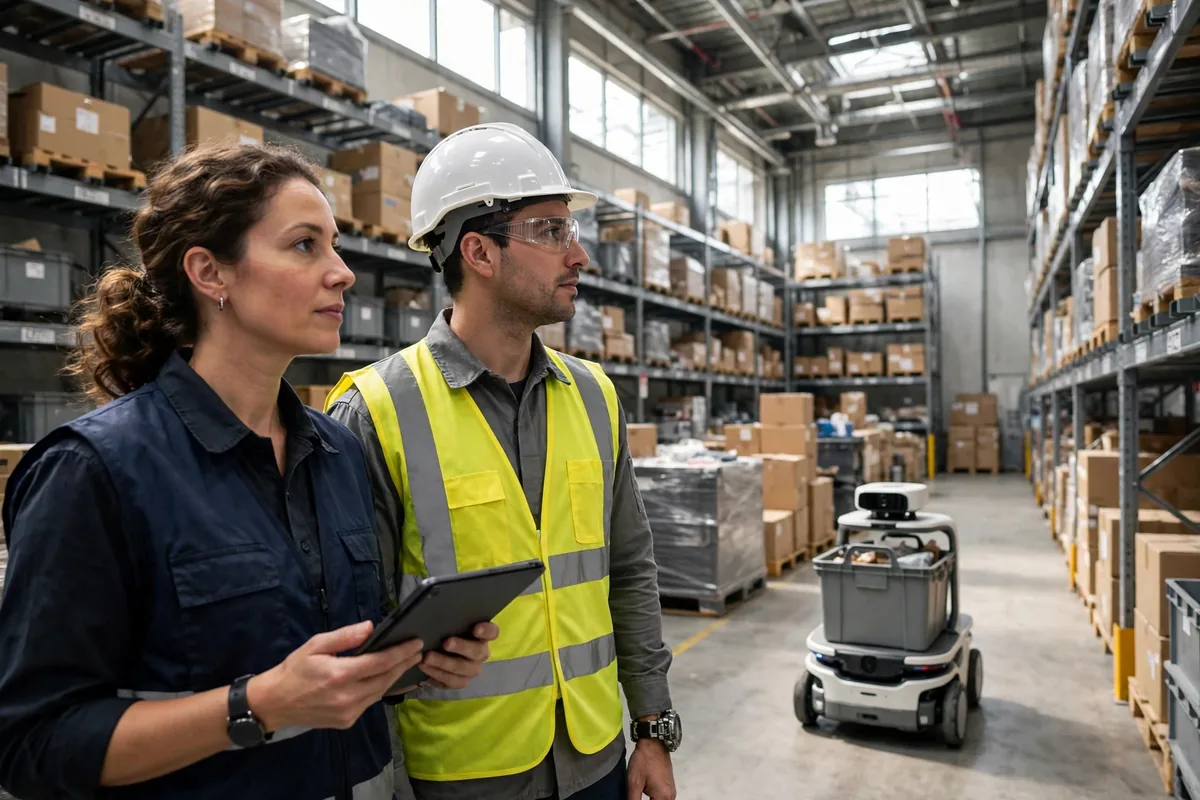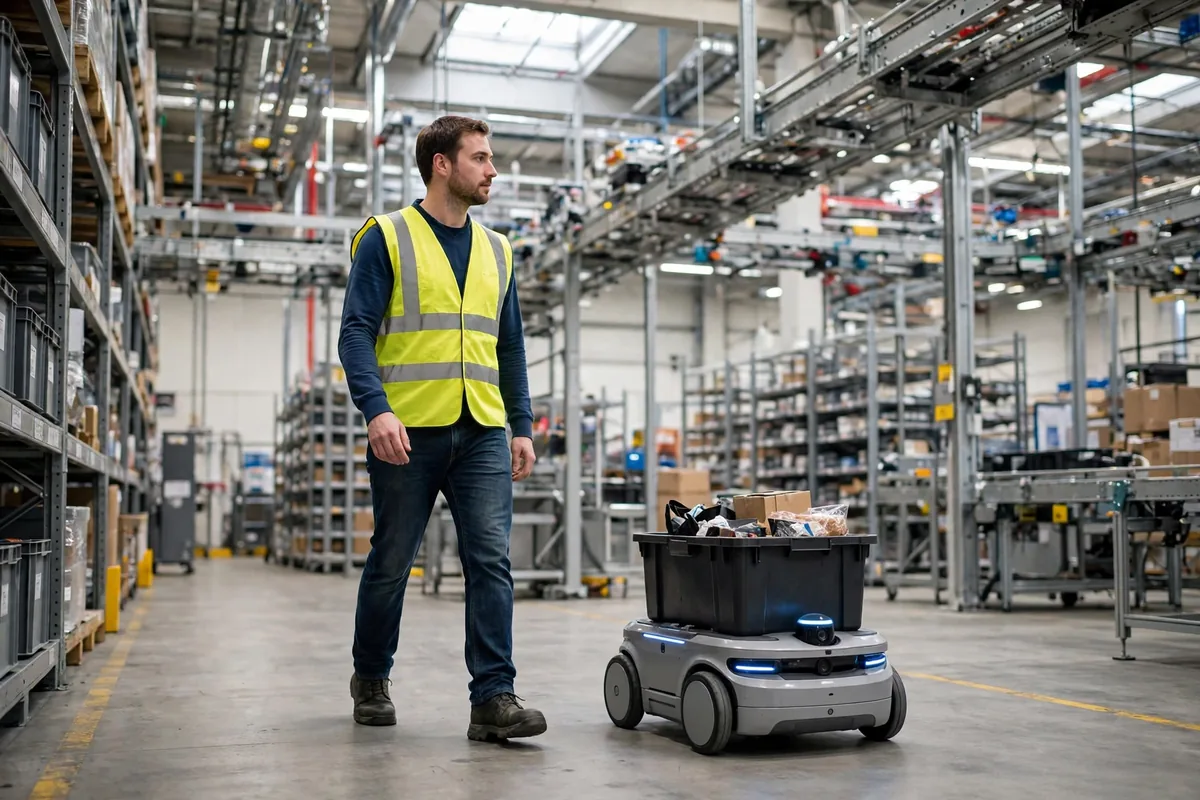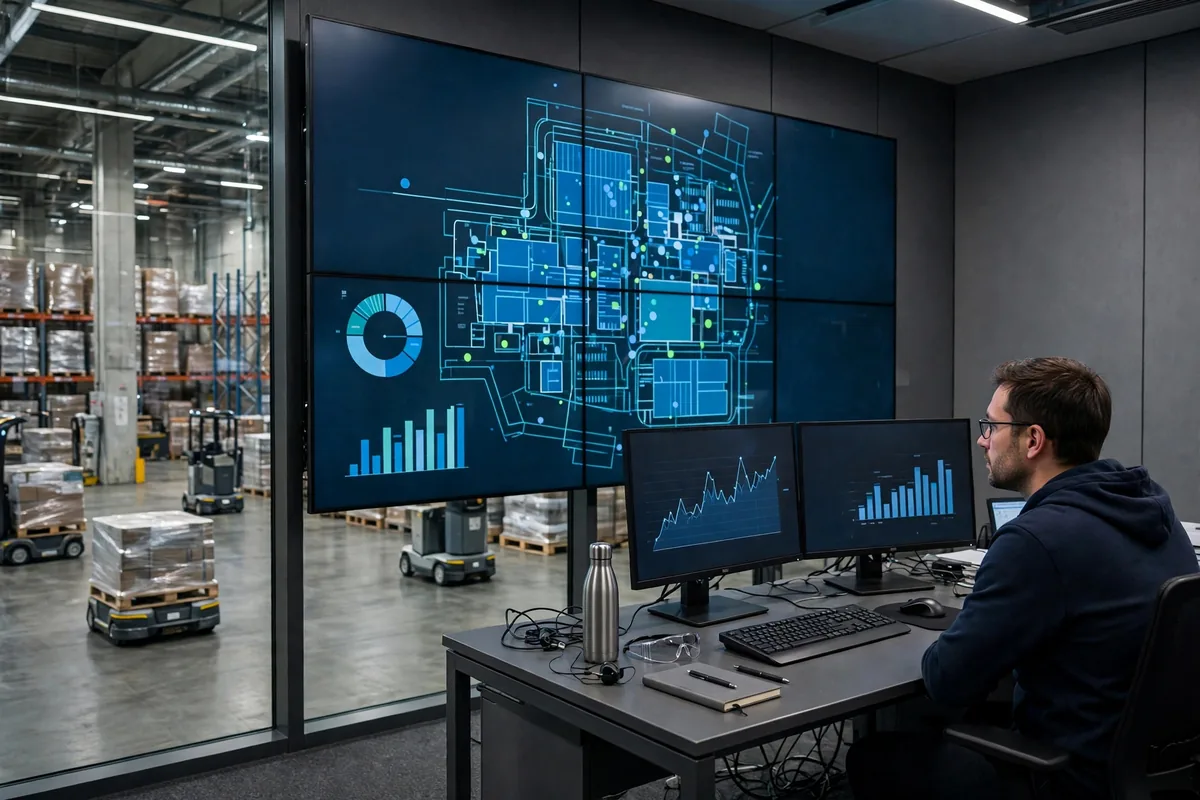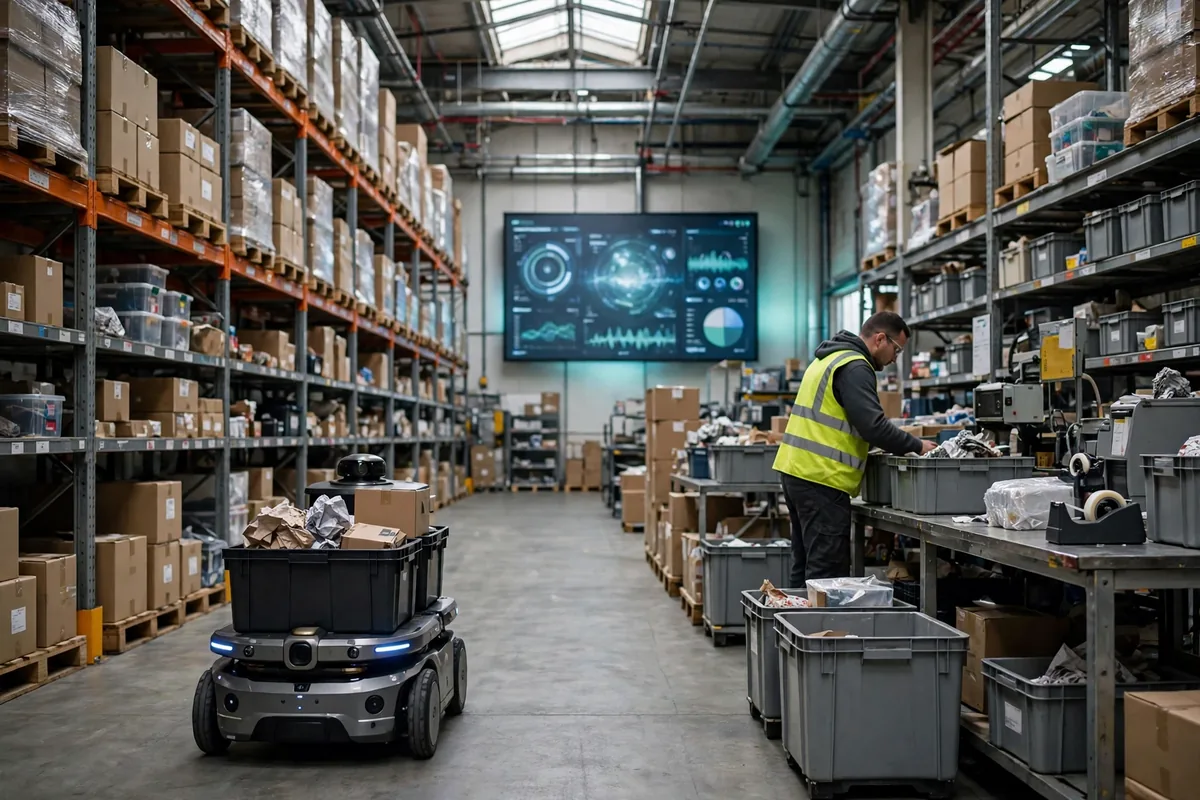
Last fall I watched a demo in an integrator's showroom: an AMR tracing a figure eight across an empty floor, a robotic arm placing a mug into a carton for the camera, and a screen flashing 99.9% accuracy. The salesperson said payback in three months. That same week, at a client's warehouse, a newly installed vision-checking system was flagging over 200 orders a day by mistake, and the site had hired two extra checkers just to handle the false alarms. Same "warehouse AI," two completely different realities.
This is the warehouse ai hype vs reality gap, and it matters more than any product brochure. The hype is real. So is the cold math. Figure out which side yours is on before you talk about selection.
Where the Warehouse AI Hype Comes From
Start with the market numbers, because they are genuinely impressive. Mordor Intelligence puts the global warehouse automation market at about $34.17 billion in 2026, heading toward roughly $65.7 billion by 2031. Big numbers, busy trade shows. But the same data set carries a second story: about 80% of warehouses worldwide still run no automation at all, only around 25% have implemented any form at all, and just about 10% use advanced automation. Interact Analysis projects that by 2030, only 13% of warehouses will have deployed even a single fulfillment AMR.
Market size measures what gets sold; adoption measures what actually runs on a warehouse floor.
The hype has a second source: the headline cases are spectacular. Amazon operates more than 750,000 robots globally, and its vision-guided arm Sparrow can handle roughly 65% of the products in its catalog. Locus Robotics runs more than 13,000 bots across 350-plus sites and has picked over 2 billion units. Every one of those figures is real and verifiable. They also share one precondition: extremely high order density, stable SKU profiles, and an IT team that can absorb integration in-house. Copying Amazon's answer into a mid-size warehouse doing 3,000 orders a day is like dropping a Formula 1 engine into a delivery van. The specs look great. The chassis falls apart first.
The Cold Math of Warehouse AI
In equipment selection I have used one dividing line for a decade: calculate the takt time first, then talk about intelligence. AI is no exception.
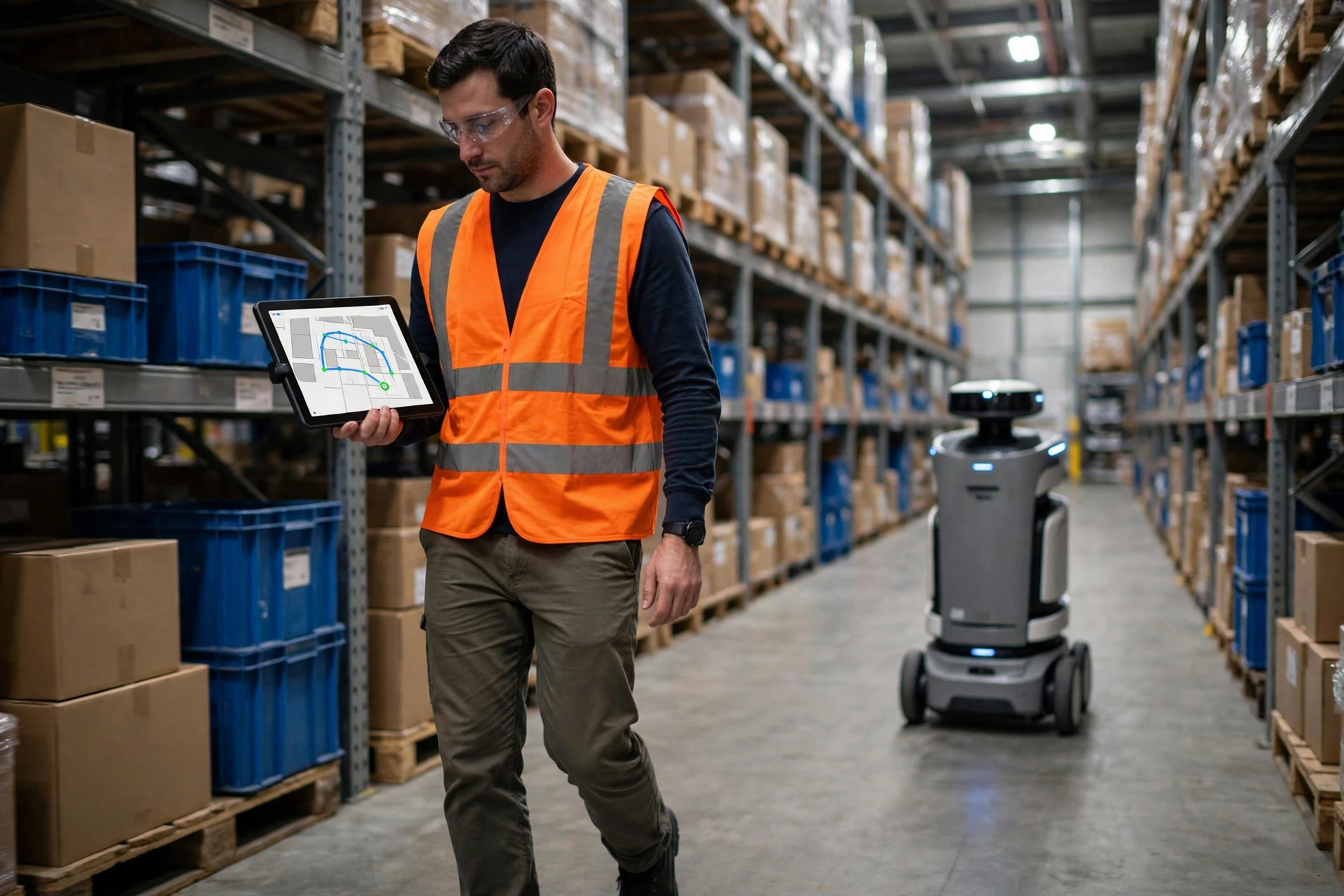
Take the picking numbers, which are easy to verify. Manual picking runs roughly 60 to 100 units per hour. In a goods-to-person AMR setup, a picker can reach 300 to 600-plus units per hour. The gap is enormous, but it only holds under one condition: the picker stops walking. That single condition is the warehouse ai hype vs reality divide in one number. What AMRs really eliminate is not the picking motion but the kilometers a picker walks between racks every day. If your pickers already stand at fixed stations and goods already arrive by conveyor, the walking time an AMR saves is close to zero, and the payback model collapses on the spot.
Then the payback window. Industry data puts AMR payback under 24 months in standard deployments, with ROI above 250% in live deployments. High-volume e-commerce fulfillment centers can see payback as short as 8 to 14 months. Read the qualifiers: "standard deployments," "high-volume." I worked through two illustrative scenarios built on those public benchmarks. A beauty-products warehouse doing 8,000 orders a day put in 40 AMRs and genuinely cut picking labor by nearly a third in the first peak season. A small auto-parts warehouse doing 1,500 orders a day with fewer than 2,000 SKUs ran the same math and landed on payback beyond four years, because volume could not keep the fleet busy; half the robots sat in the charging area. These are hypothetical worked examples, but the conclusion is real: payback is not about how advanced the equipment is. It is about whether your order density can feed it.
This is the dividing-line table I use with clients when they ask about AI selection. Three lines separate real demand from fake demand:
| Scenario | Key metric | Sign of real demand | Sign of fake demand |
|---|---|---|---|
| Goods-to-person AMR | Daily orders, share of picking time spent walking | 5,000+ orders a day, walking over half of picking hours | Under 2,000 orders a day, pickers already stationary |
| Vision check / quality inspection | Mis-ship rate, cost of checking labor | Mis-ships happen every month, SKUs look confusingly similar | Mis-ships are rare, SKUs all look alike anyway |
| AI forecasting / replenishment | Stockout rate, dead-stock share | Stockouts and overstock exist at the same time, manual replenishment cannot keep up | Under 500 SKUs, an experienced planner already gets it right |
| Voice picking / smart scheduling | Wave and channel complexity | Multiple waves and channels collide every day | One wave a day, a printed schedule on the wall is enough |
Behind the table sits a counterintuitive judgment: the biggest value of warehouse AI is usually not replacing people. It is eliminating wasted walking and wasted waiting. Labor runs 50% to 70% of total warehousing budgets, but the bulk of that money is not spent on the picking motion. It is spent on people walking between racks and standing around waiting. Buyers who purchase AI to cut headcount usually end up disappointed. Buyers who purchase it to give people's time back to work that actually creates value are the ones who find positive returns.
Three fake demands, dismantled one by one
Fake demand number one: full vision recognition for a small warehouse. Fewer than 1,000 SKUs, barcodes applied properly, and vision adds nothing except a good demo. Barcode scanning beats vision on accuracy and cost at small scale, and it costs a fraction to maintain. The technology works; the demand does not exist.
Fake demand number two: buy the AI first, fix the data later. Forecasting, smart replenishment, dynamic slotting all rest on accurate inventory data. In a warehouse where location accuracy sits below 98%, a forecasting model is a building on sand: the prettier the output, the further wrong it lands. I have seen a site with double-digit cycle-count variance sign a forecasting contract before fixing its counts. The order is never negotiable: get data accuracy up first, then spend on intelligence.
Fake demand number three: treating a pilot as a deployment. A two-week pilot, the easiest SKUs, the most experienced staff — of course the numbers look good. The real dividing line is peak season: double the volume, half the staff temporary, new SKUs arriving daily. Is the system still stable? Before signing, ask the vendor one question: at your worst customer site, what was uptime during peak? If they cannot answer, or only offer demo data, do not sign yet. MTBF and uptime are the two numbers integrators least like to discuss in detail, and exactly the two that decide the experience after go-live.
Then there is the bill nobody puts on the slide: maintenance. AMR batteries, tires, lidar, floor-flatness requirements — all recurring costs. Cracked floors, crooked pallets, Wi-Fi dead zones all turn "intelligent" into "needs manual intervention." Add three years of maintenance and downtime losses to the calculation and many ROI cases shrink by half.
Four things to do before you deploy
First, measure the walking. Give pickers a pedometer for a week, or pull pick-path data from the WMS, and calculate what share of picking hours goes to walking and waiting. Under 30%, the AMR math rarely works.
Second, measure data accuracy. Physically count 200 locations. If inventory accuracy is below 98%, fix counting and process first and hold the AI budget.
Third, set a pilot exit standard in writing before the pilot starts: which metrics mean we keep investing, and which mean we stop. Without an exit standard, every pilot becomes "one more month" and then a sunk cost.
Fourth, ask to see the worst site, not the best one. Ask the vendor to take you to its ugliest customer installation, with peak-season data, fault logs, and maintenance bills on the table. A vendor willing to show you that has some confidence. One that only offers slides and a showroom — treat that 99.9% as if you never heard it.
Warehouse AI is neither a scam nor a cure-all. It is a machine that needs volume to feed it, a system that needs clean data, and equipment that needs someone to maintain it for years. The hype belongs to the trade show. The cold math belongs to your warehouse. Keep the two apart — that is the whole warehouse ai hype vs reality lesson — and the money gets spent properly.
Is this money well spent? Look at one number: after go-live, how many labor minutes per picked order did you actually save? Every other number can be dressed up. That one cannot.
By Da Liu, Automation Engineer