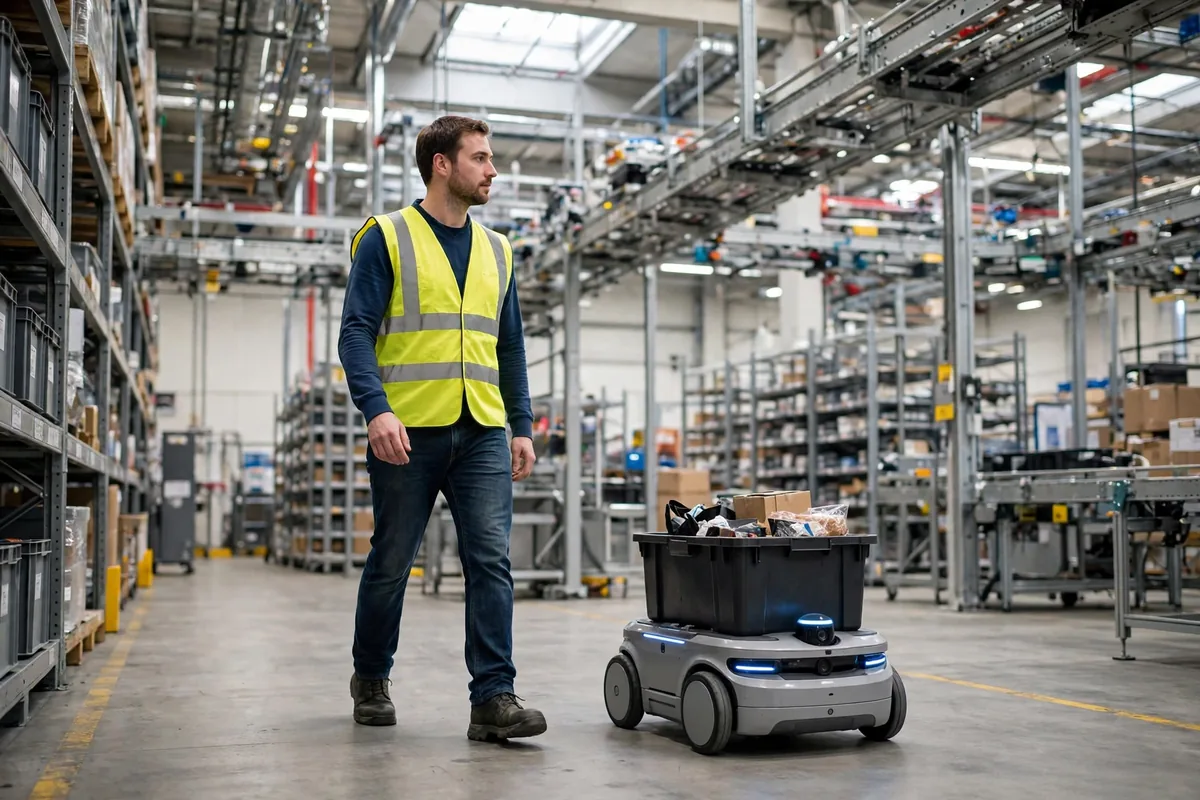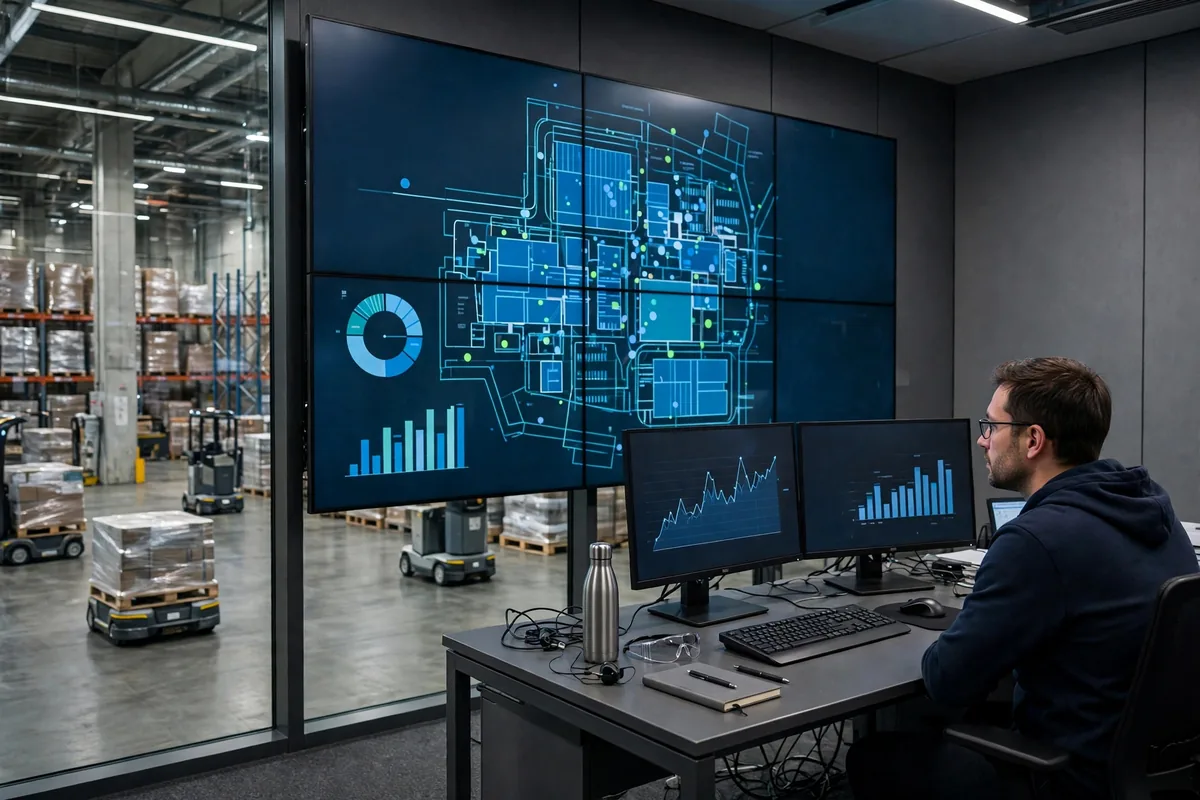
Generative AI entered the warehouse through the side door. In 2025, its first steady job inside most facilities was not running a sortation line or steering a robot; it was answering questions. A picker asks where a SKU sits, a supervisor asks what is short on the night shift, and a system replies in plain language. The scene looks modest, and that modesty is the point. Whether the technology earns a larger role will be decided less by what the models can say than by what organizations are willing to let them do.
The chatbot comes first: where generative AI in the warehouse earns its keep
According to a November 2025 survey from the MIT Intelligent Logistics Systems Lab, covering more than 2,000 professionals across 21 countries, 92.1% of organizations were implementing or planning to implement AI in the near term, and 87% expected to increase AI budgets over the following two to three years. Respondents ranked generative AI the most valuable method, at 70.3%, ahead of predictive machine learning at 58.4%. The same study put the typical payback period at two to three years. Warehouses, in other words, are testing whether a specific tool repays its cost inside a normal budget cycle.
The chatbot became the first deployment because its failure costs stay low. A wrong answer about a location can be checked against the WMS in seconds, and the error stops there. A wrong decision about replenishment quantities or wave sequencing, by contrast, travels through orders, carriers, and customers before anyone notices. McKinsey's reporting on supply chains records the same asymmetry from the other side: the technology can cut documentation lead time by up to 60% and reduce logistics coordinators' workload by 10% to 20%. The gains cluster where a human can still inspect the output before it matters.
Amazon offers a useful reference point for sequencing. In July 2025, the company introduced a generative model, DeepFleet, to coordinate robot movement across its fulfillment network, with a stated goal of improving robot fleet travel time by 10%. By April 2026, Amazon reported more than one million robots operating in its fulfillment centers. The sequence carries the lesson: the model arrived first in coordination and scheduling, work dense with information and forgiving of small errors, while physical movement stayed under deterministic control.
A second illustration comes from everyday warehouse life, presented here as a hypothetical scenario with illustrative figures. Consider a third-party logistics warehouse in eastern China that connected such an assistant to its WMS in March 2026. Before the rollout, routine queries about stock, locations, and order status consumed roughly three hours of each supervisor's day. Afterward, about 70% of routine queries were answered directly, returning around two hours a day to each supervisor. The numbers are hypothetical, but the test they imply is real: a chatbot should be judged not by how many questions it answers, but by how much high-cost human attention it returns to judgment work.
From answering questions to making decisions: the autonomy trade-off
The move from chatbot to autonomous decision-maker changes the warehouse's chain of accountability more than it changes its technology stack. Gartner predicted in May 2025 that by 2030, 50% of cross-functional supply chain management solutions will use intelligent agents to autonomously execute decisions. That forecast describes what vendors will be able to sell, not how much decision authority managers will actually hand over.
McKinsey's 2025 State of AI survey, based on 1,993 respondents across 105 countries, captures the gap between adoption and maturity. Some 88% of organizations said they now use AI regularly in at least one business function, up from 78% a year earlier. Within that group, 62% were experimenting with AI agents and 23% were already scaling them in at least one function. Yet only 1% believed their AI adoption had reached maturity. The same research found that 80% had encountered risky agent behavior, including improper data exposure and unauthorized system access. Adoption rises steeply while maturity stays nearly flat, and that divergence points to the real bottleneck: autonomous decisions are limited less by model capability than by whether the organization has built the supervision to match.
The counterintuitive finding is this: the warehouse tasks where autonomy is technically easiest are not necessarily the ones where it pays best. McKinsey documented a last-mile operator with a fleet of more than 10,000 vehicles that deployed virtual dispatcher agents and achieved $30 million to $35 million in savings on an investment of about $2 million. Those agents assisted dispatchers with driver troubleshooting and roadside support rather than replacing dispatcher judgment. The return came from automating frequent, low-risk decisions and keeping rare, high-stakes calls with people. Projects that began by asking a model to set replenishment quantities and safety stock autonomously have often stumbled at the first demand shock, because a model trained on history keeps ordering to history while promotions, stockouts, and weather refuse to follow it.
The workable path runs through three permission tiers. In the first, the model only advises, presenting a recommendation with its reasoning while a person decides. In the second, the model drafts an adjustment and a person approves it before it takes effect. In the third, the model executes directly within explicit limits on value, quantity, and time, escalating automatically when a case falls outside them. Moving between tiers should be a joint decision by operations, finance, and risk functions, not a setting changed by a technical team alone. The pace of autonomous decisions will track that accountability arrangement more closely than model size.
Counting the return: what generative AI in the warehouse actually pays back
Any honest ROI discussion starts with the warehouse cost structure. Industry benchmarks commonly place labor at 50% to 70% of total warehouse operating cost, a range cited across industry reports including figures attributed to MHI and Deloitte. That range is the starting point for every calculation that follows: a technology that cannot change how labor time is allocated will struggle to show a return, however impressive its demonstrations. The table below breaks the return logic down by stage. All figures are illustrative examples, shown to expose how the economics differ by stage rather than to promise a result.
| Stage | Typical investment (illustrative example) | Main source of return (illustrative example) | Payback (illustrative example) |
|---|---|---|---|
| Question-answering assistant | WMS and knowledge-base integration | Query time falls; exceptions answered faster | 12–18 months |
| Advisory agent | Adds data governance and permission design | Wave, replenishment, and scheduling advice adopted | 18–30 months |
| Bounded autonomous execution | Adds auditing, rollback, and risk controls | Frequent low-risk decisions automated | 24–36 months |
A rough calculation makes the constraint concrete, using hypothetical figures throughout. Take a mid-sized warehouse processing 8,000 orders a day, with annual operating cost of $5.6 million, of which labor is 60%, or about $3.4 million. If a question-answering assistant frees roughly 5% of supervisor and customer-service labor time, the annual saving is about $170,000. Set against a one-time investment near $210,000 and annual running costs near $40,000, the static payback lands near 18 months. The constraint it reveals matters more than the arithmetic: the chatbot stage is capped by how much expensive human time it can release, not by how many questions it answers. Where query work already sits with low-cost roles, the same system can take twice as long to repay.
The MIT survey's typical payback of two to three years sits near the middle tier of this table. The payback period for the technology in the warehouse is set by three operating variables — labor's share of cost, query density, and exception frequency — rather than by any vendor's marketing claim. Measuring those three variables before procurement will tell a buyer more than comparing model specifications.
What to watch between 2027 and 2030
Three variables will shape what happens next, and they are moving at different speeds. The first is data governance. Much warehouse knowledge still lives in senior staff experience, while procedures lag behind practice and exception handling goes unrecorded. A model's ceiling depends heavily on whether that tacit knowledge can be turned into retrievable, verifiable assets. The second is audit and accountability: each step toward autonomy needs logging, review, and rollback, without which even an advanced model stays confined to answering questions. The third is the labor market: when hiring is hard and turnover is high, the premium a warehouse will pay for automation rises across the board.
Because these variables move at different speeds, the years to 2030 are more likely to produce divergence than a smooth upward curve. Some warehouses will carry the technology from chatbot to bounded autonomous execution; others will stay at the question-answering stage for years. The distance between them will reflect who repaired data, accountability, and audit capacity earliest. Whether the technology becomes standard equipment in the warehouse should be settled by 2030. The shape of that answer may be more divided than today's forecasts suggest, and the division itself is the development worth watching.
By Dr. Chen, Supply Chain Researcher