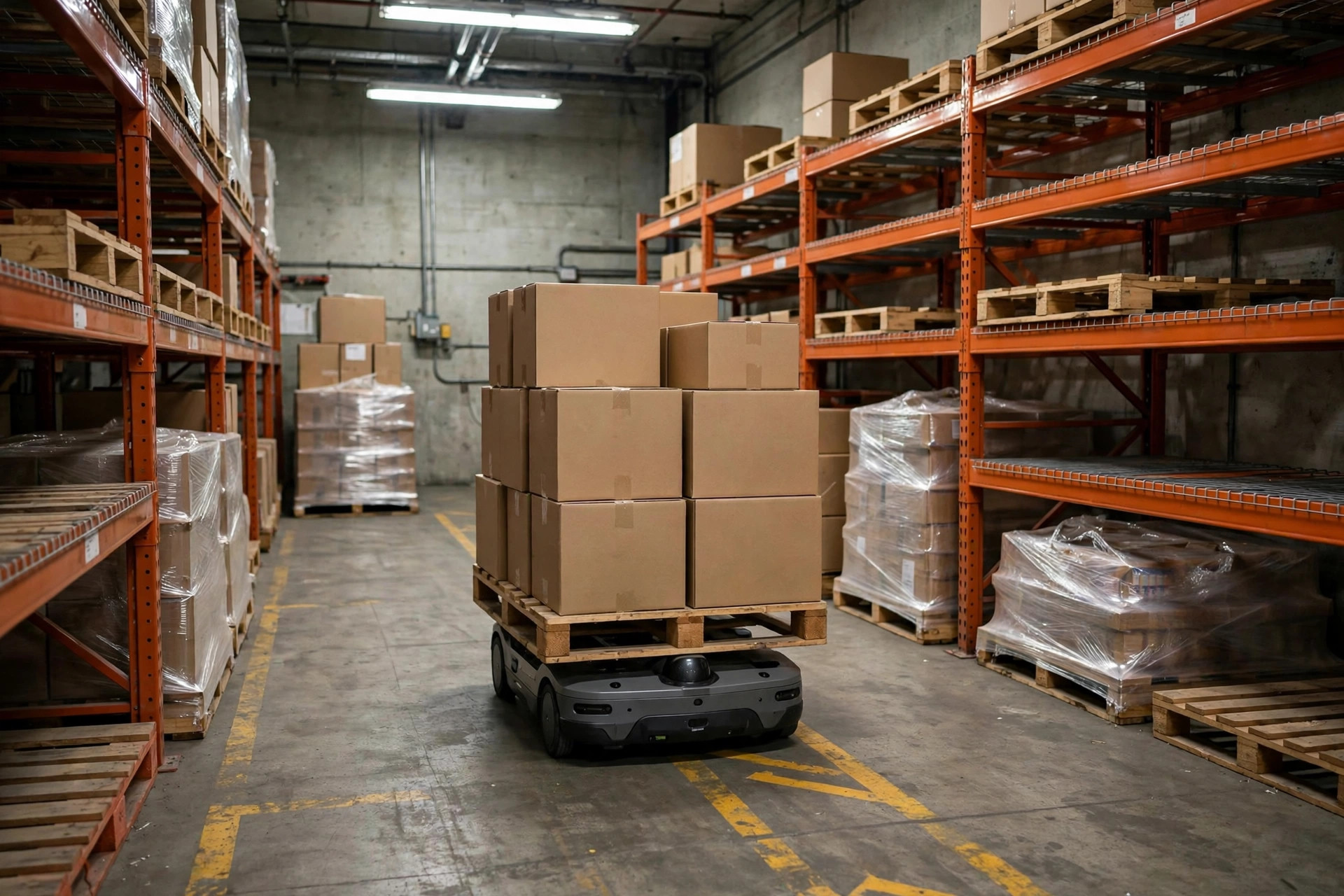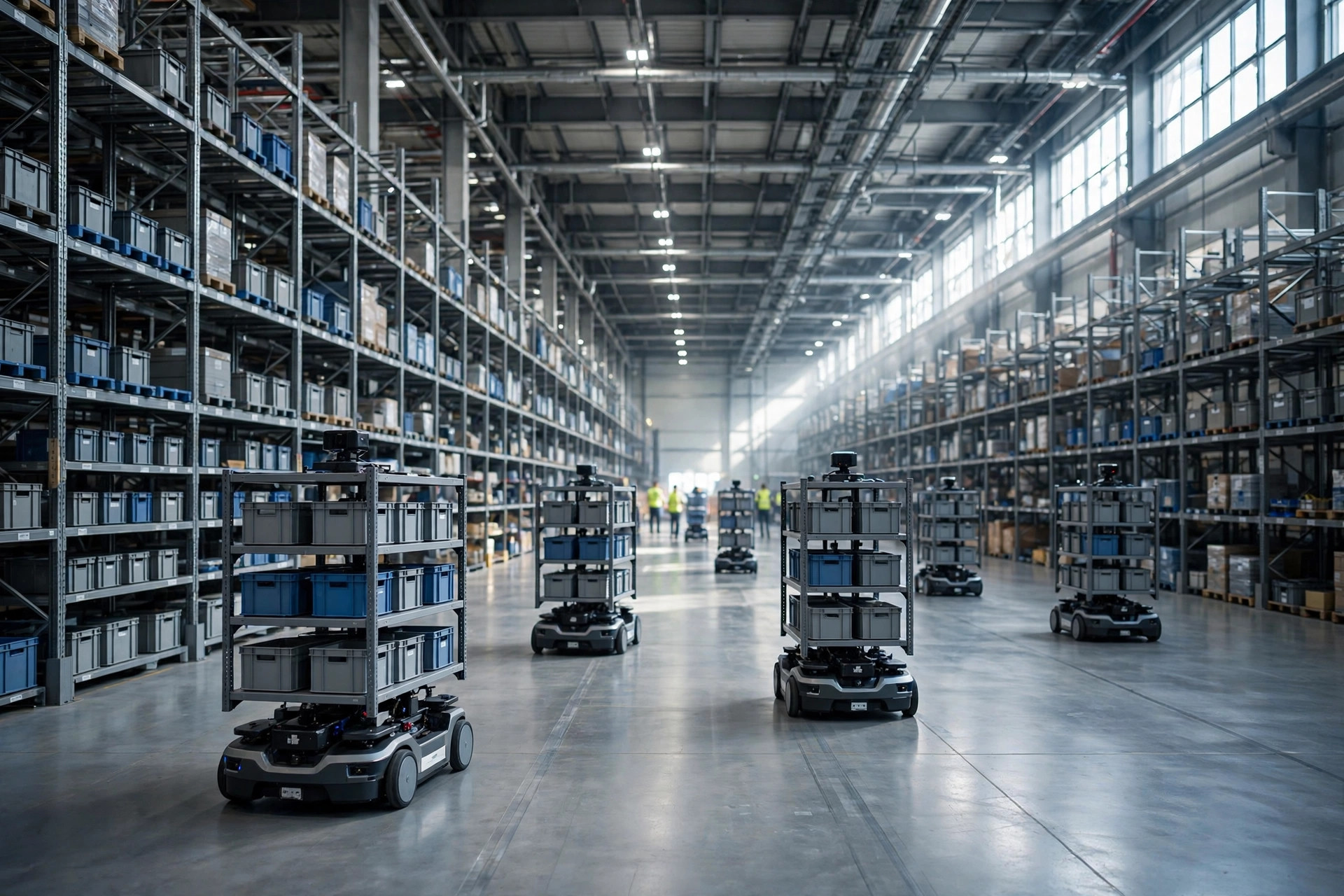
The best way to read the warehouse AI hype cycle is not an analyst report but a set of public events from the summer of 2024. On June 27, GXO Logistics signed a multi-year agreement with Agility Robotics to deploy the humanoid robot Digit at a SPANX facility — called by both companies the industry's first formal commercial deployment of humanoid robots, structured as robots-as-a-service. Months earlier, Figure AI had raised $675 million at a $2.6 billion valuation, backed by Microsoft, NVIDIA, and Jeff Bezos. Meanwhile, almost unnoticed, Locus Robotics' AMR fleet had quietly crossed billions of cumulative picks. Same "AI plus warehouse" story: one side under the spotlight, the other already making the economics work. That contrast is what this curve is really about.
The Phenomenon: Seven Technologies, Seven Positions
Start with the public record. In October 2023, Amazon began testing Digit at its robotics R&D facility south of Seattle, starting with tote recycling — hauling away emptied totes. Two months later, GXO began testing Digit at its SPANX facility in Georgia, moving merchandise-filled totes off AMRs and onto a conveyor. The June 2024 agreement turned the pilot into a "commercial deployment," but disclosed no deployment numbers.
The funding market tells a very different story. Per PitchBook, Figure AI raised $675 million at a $2.6 billion valuation in February 2024; eighteen months later, its Series C valued the company at $39 billion — roughly a 15x increase. Across the robotics sector, Q2 2025 deal value hit $8.8 billion across 221 deals, up 170.5% quarter over quarter. Money is voting — and it is voting for "looks like a person."
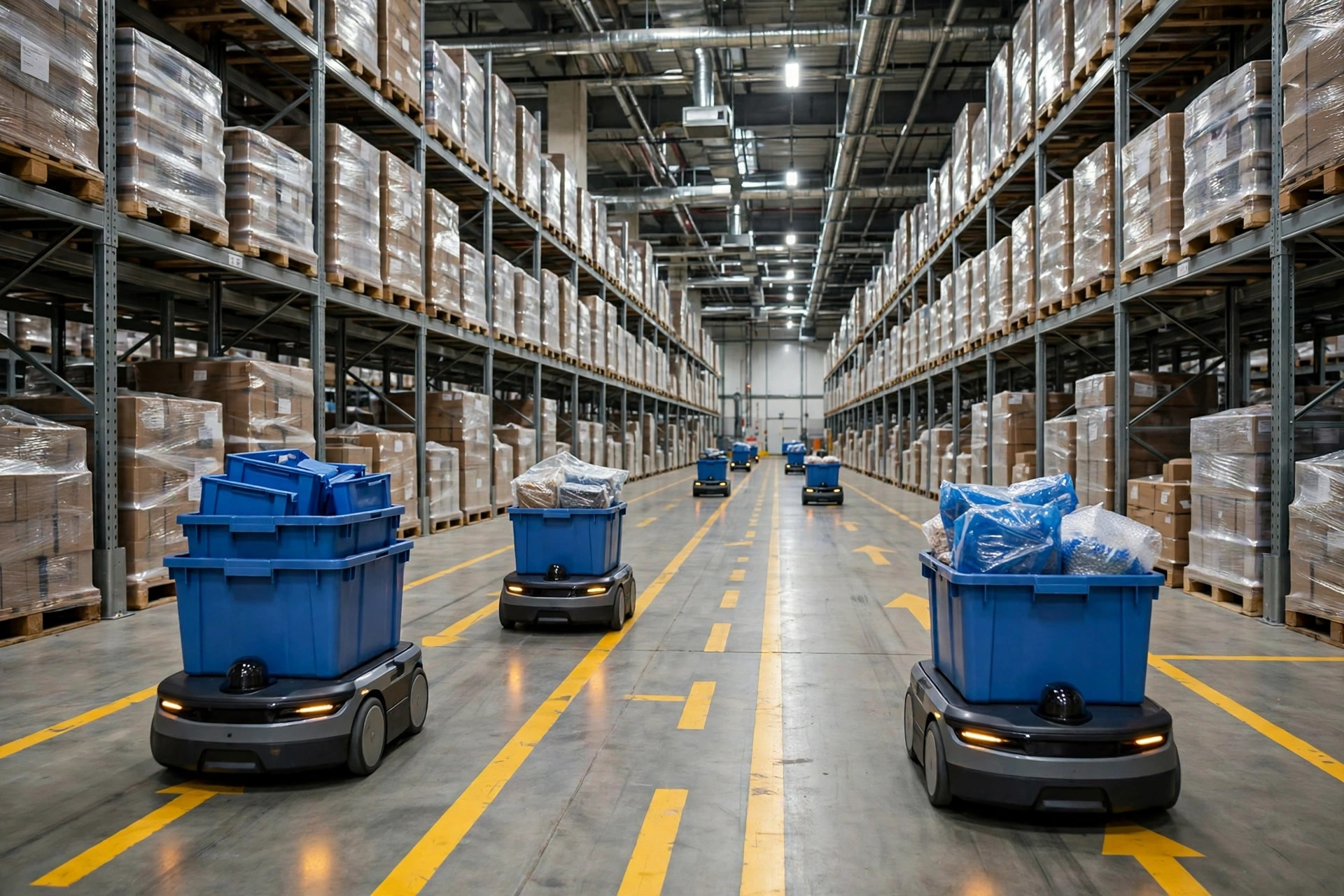
The AMR world is far quieter. Locus Robotics' October 2026 disclosure: 22,000+ robots, 8.5 billion+ picks, 150+ customers across 360+ sites in 20+ countries — and Interact Analysis's #1 AMR provider in the Americas by revenue, second year running. No launch events, no hundred-billion valuations — just work orders.
Vision inspection took a third path: in November 2022, Amazon unveiled the Sparrow robotic arm, which the company said could identify roughly 65% of the products it sells — picking individual items of varying shapes out of totes. Not glamorous, but it was the first time vision AI entered the core each-pick workflow.
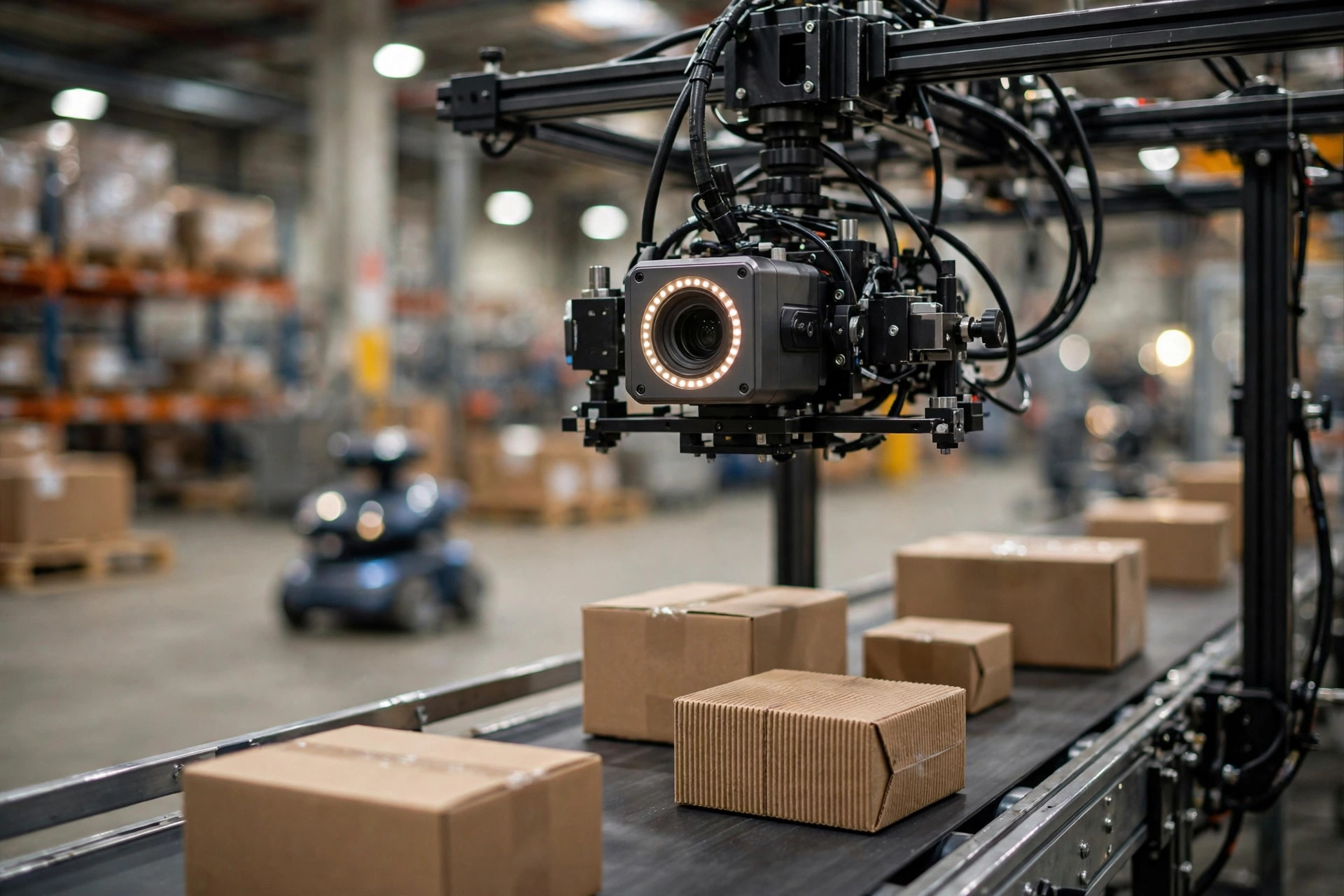
Digital twins sit in the "everyone has heard of it, few are paying for it" zone. According to NVIDIA's published case material, Amazon Robotics is building AI-enabled digital twins of its warehouses with Omniverse Enterprise and Isaac Sim — in an Amazon Devices manufacturing scenario, Isaac Sim generated over 50,000 synthetic images per new device, lifting one marker-detection success rate from 88.6% to 98%. The technology is real, but outside a handful of giants, paying customers for full warehouse-scale twins remain scarce.
Voice picking has faded from the "AI conversation" entirely — which is precisely what makes it worth discussing. Vocollect pioneered industrial voice recognition in 1987; today voice-directed workflows are standard WMS peripherals. Sometimes a technology stops being talked about because the problem is solved.
Seven Coordinates on the Warehouse AI Hype Cycle: Stage and Evidence
| Technology | Position on the curve | Evidence | | Vision inspection (sort / QC) | Slope of enlightenment | Sparrow (Nov 2022) identifies ~65% of sellable products; vision has moved from "recognition" into concrete work orders: QC, exception interception | | Voice picking | Plateau of productivity | Vocollect pioneered industrial voice in 1987; voice is now a standard WMS peripheral — low discussion volume is itself the signal | | AMRs (collaborative picking) | Slope of enlightenment | Locus Oct 2026 disclosure: 22,000+ robots, 8.5B+ picks, 360+ sites; Interact Analysis #1 in the Americas by revenue, second year running | | AI demand forecasting | Slope of enlightenment (diverging) | The constraint isn't algorithms but clean historical sales and inventory data; data quality puts the same technology at different stages in different companies | | Warehouse digital twins | Late peak of inflated expectations, sliding toward the trough | Real deployments exist at giants like Amazon, but paying customers for full-scale twins remain few; most use stays in simulation validation | | Humanoid robots | Peak of inflated expectations | Figure's ~15x valuation jump in eighteen months; GXO's June 2024 deal was the first commercial deployment, yet disclosed no scale | | Generative AI (docs / knowledge base / support) | Peak of inflated expectations | Model capability became broadly usable after 2023; verifiable ROI cases in warehousing have not yet reached consensus |
Why the Curve Looks This Way: Three Lines of Attribution
The first line is whether the economics close. An underappreciated reason AMRs are climbing is the business model: RaaS converted one-time capex into monthly or per-pick opex — the pay-per-use logic behind Locus's 8.5 billion picks, which smaller warehouses can afford. Humanoids, by contrast, currently have only "pilot budgets" — no "operating budgets." GXO's multi-year agreement is itself structured as RaaS — even the largest buyers won't purchase the hardware outright; the vendor keeps the risk. When the only way to buy a technology is "let's try it," it cannot be on the slope of enlightenment.
The second line is whether the problem is closed. Voice picking and visual QC answer closed, repetitive, measurable questions: bounded instruction sets, quantifiable accuracy, calculable ROI. "General-purpose manipulation" is an open problem, and the real cost of a humanoid is not the hardware but the word "general": covering the 5% of long-tail tasks demands close to a 100% complexity premium — bipedal balance, dexterous hands, semantic understanding, each an engineering abyss of its own. The technologies that climb fastest are always the ones that shrink the problem domain enough.
The third line is deployment density driving the data flywheel. Locus's 360+ sites generate real work orders daily and the algorithms iterate on real picks; the humanoid industry's combined real work-order data is likely a rounding error next to that. No work-order data, no model iteration, no slope.
Two counter-intuitive judgments follow. First: technologies sliding into the trough may be the best buying opportunity. In the peak you buy the narrative; in the trough you buy the discount and the engineering — vendors cut prices and delivery gets more reliable. This curve's real use for buyers was never predicting winners; it is pricing at the negotiating table. Second: the most "AI-looking" warehouse technology is furthest from payback, while the least glamorous one (voice picking) has the most certain ROI — because it answers a question with a known answer. A warehouse AI technology should be judged not by how new its models are, but by how closed its question is.
Reading the Next Three Years Off the Hype Cycle: Timeline-Attached Judgments
Humanoids: in the peak of inflated expectations through 2024–2026, with the trough of disillusionment likely in 2027–2028. The basis is the validation cycle — pilot to scaled validation typically takes two to three full years of real work-order data, while today's "commercial deployments" remain at the agreement stage with no disclosed scale. Reaching the slope of enlightenment around 2030 depends on three to five replicable scaled deployments; until then, any "mass production next year" claim deserves a discount.
Vision inspection and AMRs: already on the slope of enlightenment; the next two to three years are the scale-replication window, and competition shifts from "can it work" to "at what cost." The buyer's job here is negotiating price, service SLAs, and multi-site replication — not picking the technology path.
Digital twins: sliding into the trough, which is not necessarily bad. If simulation costs keep falling, twins could re-climb around 2027 on a new narrative — "simulation trains robots": the 88.6%-to-98% improvement already suggests the value lies not in visualization but in data generation.
Voice picking: stable on the plateau of productivity; growth comes from replacing the installed base, not new scenarios. The right attitude is "use it well," not "chase the new."
AI demand forecasting: diverging. Companies with solid data foundations already run it as routine; those with poor data quality are stuck at "bought the software, nobody uses it." The same technology sits at different positions on the curve in different companies — the most overlooked point of the whole curve: position is not a property of the technology, but of the technology multiplied by the organization's data foundation.
The hype cycle was never a crystal ball. Its real use for buyers is a coordinate system: when, at what price, and for which class of problem. Whether humanoids hit the trough in 2028 or digital twins climb back on robot-training simulation — those answers aren't on the curve; they're in the next three years of work-order data. The more interesting question may be the next one: when the hottest technology falls into the trough and gets cheapest, which cards should your warehouse still be holding?
By Dr. Chen, Supply Chain Researcher