Here's my verdict up front: when AI moves into your warehouse, the biggest risk is never "is it accurate enough." It's "who owns the decision when something goes wrong." The human-machine line belongs in your SOP — not for efficiency, but so that on the day things blow up, you know exactly whose name is on it.
I've seen too many warehouses celebrate on AI go-live day, then three months later one incident turns the whole building into a blame game: IT says the model is fine, operations says "I just clicked what the system told me," the vendor says "we only provide recommendations." The blame lands on nobody, the AI gets switched off, and the money is gone. Here's the thing — AI can absolutely help you make decisions, but the act of signing off on one? That will never be AI's job.
Two pits I've watched people fall into: nobody signed off, and the wrong one did
Fall of 2024, a 3PL warehouse outside Ontario, California, had just turned on AI replenishment recommendations. For two straight weeks the system flagged one SKU for a key account: order 400 cases, safety stock won't survive peak season. The supervisor glanced at it, decided "this SKU never moves anyway," and ignored it — didn't even click "reject" in the system, just pretended he never saw it. Three days before peak, they stocked out. The account's fill rate dropped into the low 80s, and chargebacks ran into the tens of thousands.
The post-mortem was something to watch. IT said the alert went out. Operations said they assumed the system would auto-order. The vendor said "we only make recommendations." A 400-case recommendation sat in the system for two weeks, and not one person felt it was their call. That's the part people miss: the most dangerous thing about AI isn't that it makes mistakes — it's that when it errs, or when its advice gets ignored, nobody in the building feels responsible.
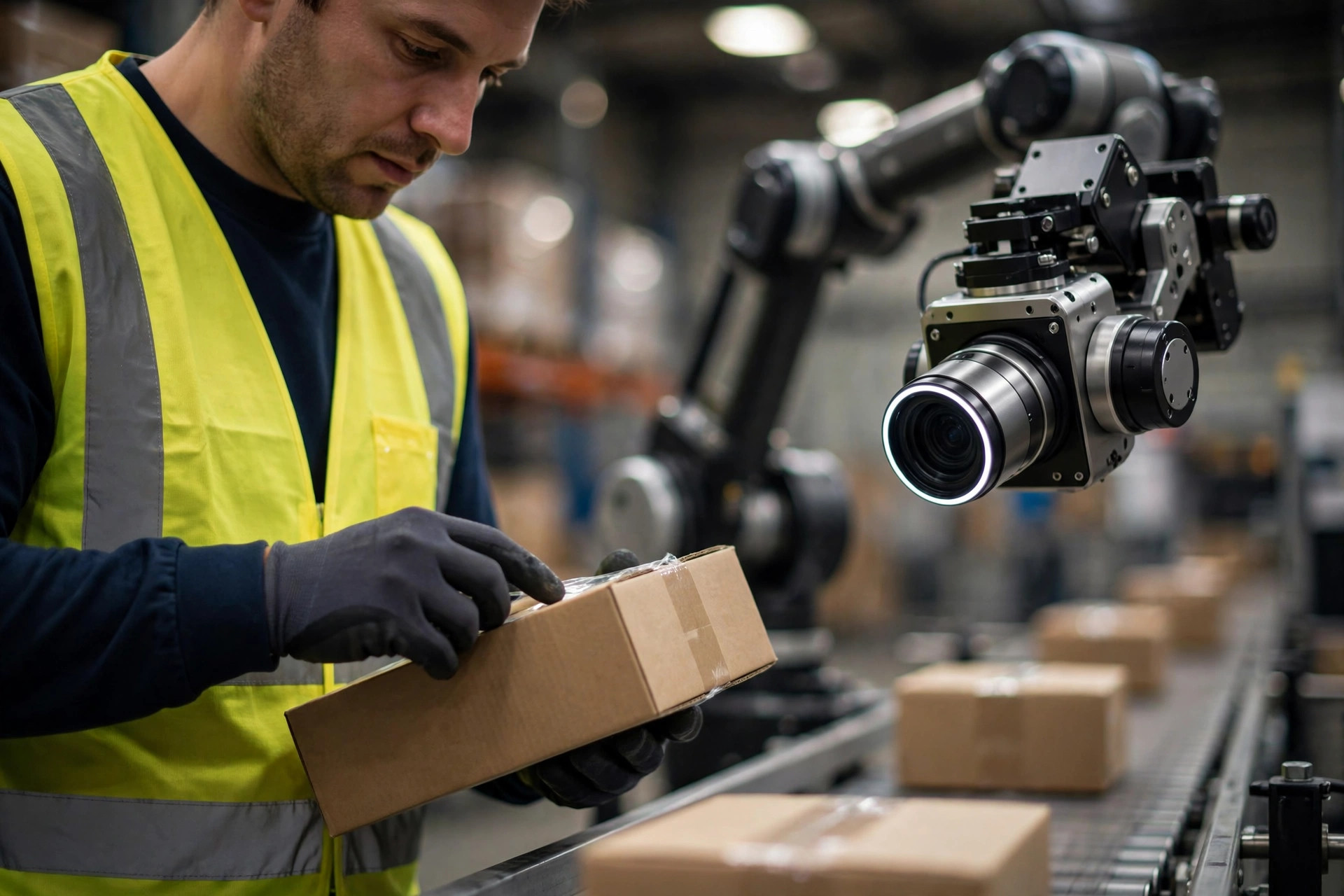
The opposite pit happened in early 2025 at a home-goods e-commerce warehouse that had deployed AI vision inspection. Cameras scanned outbound cartons; dents and damage got auto-rejected. One batch of custom-packaged goods had minor carton scuffing — within the customer's tolerance — and the AI condemned 200-plus cases as "damaged, return." Luckily the recheck operator, an old hand, trusted his gut, pulled the batch for a manual look, and saved it. Had it gone back, freight plus repacking would have cost close to ten grand.
One pit: the person who should have decided, didn't. The other: AI decided something it had no business deciding. Same root cause both times — nobody wrote down the human-machine division of labor.
One table: the human-machine decision matrix
Don't overcomplicate it. Cut by risk level — three tiers is enough:
| Risk level | Division of labor | Who has the final say | Examples |
|---|---|---|---|
| Low risk, reversible | AI decides | System executes directly; humans spot-check | Slotting recommendations, auto-converting replenishment under $5,000 into purchase orders |
| Medium risk, partially reversible | AI recommends, human approves | System must show its recommendation and its reasoning; a human clicks approve; everything logged | Fraudulent-order holds, vision-inspection rejects, wave releases |
| High risk, irreversible | Human decides | AI provides data only — no conclusions | Key-account claim rulings, safety line stops, labor scheduling and layoffs |
This cuts both ways: if you won't let go in low-risk scenarios, you bought the AI for nothing — having a human click "approve" all day is slower than no AI at all. But hand high-risk calls to the machine and one incident will cost you dearly. And here's what I keep seeing: warehouses do it backwards. They won't release the low-risk stuff, and they can't be bothered to guard the high-risk stuff.
Three hard SOP rules, plus one review mechanism
A matrix on a slide isn't enough. It has to be nailed into the SOP as non-negotiable rules. The version I give clients has exactly three:
Rule one: AI gives "recommendation plus reasoning," never "conclusion plus execution." Unless a scenario is on the low-risk whitelist, AI output is always a recommendation — and it must carry its reasoning: which data points, what logic. A recommendation with no reasoning gets no approval, period. This is your guardrail against AI hallucinating confidence.
Rule two: every AI recommendation gets a named approver. The system logs it automatically: who, what time, approved or rejected, on what basis. When something goes wrong, you pull the log and find the name in five minutes. It sounds harsh, but it actually protects your frontline people — with a record, blame can't fly around randomly.
Rule three: humans may override, but an override needs a one-sentence reason; three consecutive overrides of the same recommendation type trigger a review. Either the model needs tuning or the process needs changing. An override with no reason turns your AI into decoration; consecutive overrides with no review is just saving up trouble.
The review mechanism is simple: once a month, hold a "human-machine disagreement review." Pull the list of every case this month where AI's recommendation and the human's decision diverged, and score who was right more often. If AI wins, give it more authority next month. If the humans win, tune the model — or shut off AI for that scenario entirely. Let the data talk, not egos.
Here's the counterintuitive truth at the center of all this: deploying AI is not a contest of model accuracy. It's a contest of whether your organization dares to write down, in plain language, who is responsible. A 95%-accurate model that nobody dares to sign off on is worth zero. An 80%-accurate model with a clear division of labor and a working review loop gets sharper every month.
So before AI enters your warehouse, draw the "who calls the shots" chart for your building. If you can't draw it, the more accurate your AI gets, the more dangerous it becomes. Trust me — I've seen too many.
By Lao Mi, Supply Chain Veteran (20 yrs)