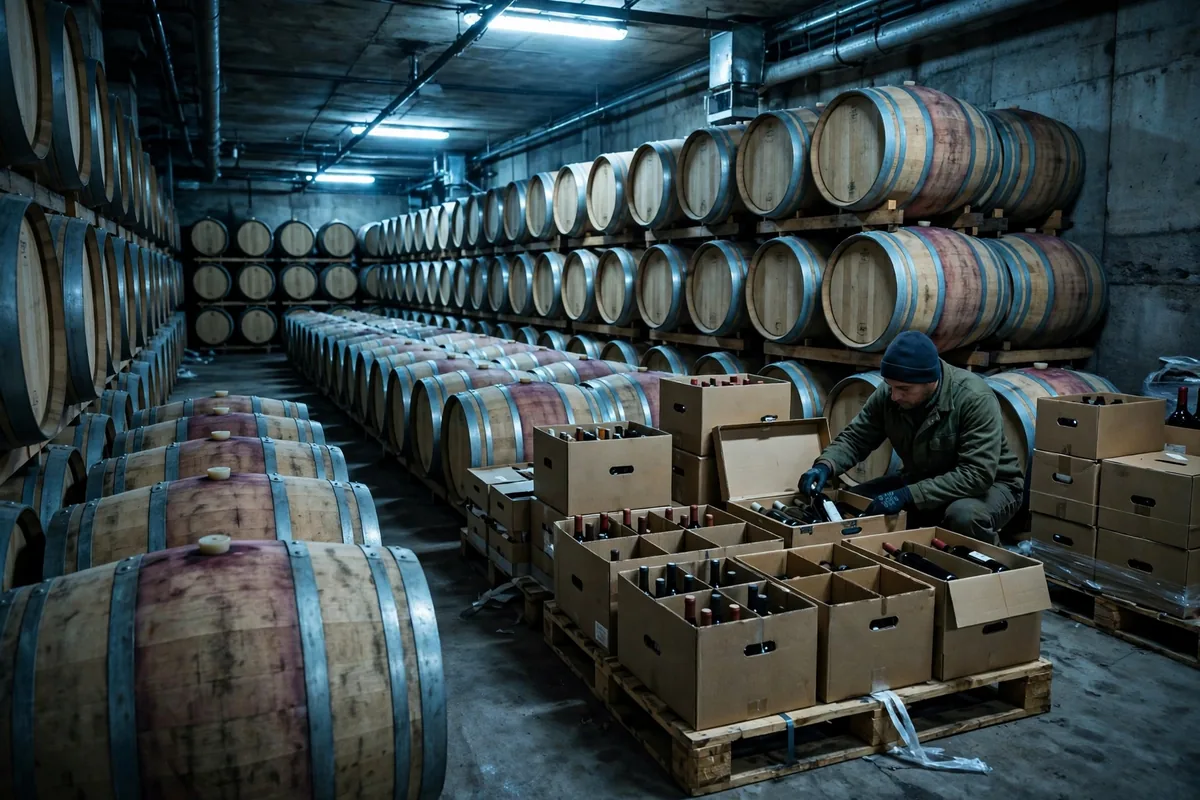
Here is the conclusion up front: Uruguay wine export warehouse storage comes down to three rules. Keep the temperature steady, not low. Get the paperwork right early, not fixed later. Leave slack in the vessel schedule, don't gamble on it. A small winery shipping a few dozen containers a year can deliver every bottle intact to Brazil or the United States if it follows those three rules. Miss one, and the prettiest temperature-controlled cellar in Canelones is just decoration.
Uruguay does not make much wine. In 2023 the country produced about 102,964 tonnes of wine from 9,023 hectares of vineyards, the fourth-largest volume in South America. The star grape is Tannat, and Brazil is the biggest export destination. Small volume means one thing: you have no room for error like the big shippers do. One bad container is a quarter of profit gone. So this article skips the theory and sticks to details I have personally checked on projects.
Uruguay wine export warehouse storage starts with the temperature bill
I have seen this exact failure three times, and every time it killed the wine the same way: the cellar temperature looked fine on the dashboard, and the wine still spoiled.
In September 2023, a mid-sized winery in Canelones was shipping one container of Tannat to São Paulo, 2,400 bottles (illustrative example). The cellar dashboard showed 14°C all day, no alarms. The night before loading I went to the site with a handheld thermometer and measured the top, middle, and bottom shelves: 19°C at the top, 14°C in the middle, 11°C at the bottom. The sensor was mounted at the return-air vent, so it measured return air, not the wine. Summer heat had baked the roof all day and the warm air sat at the top of the racks. Those 800 bottles had effectively spent three weeks at 19°C.
The ideal storage temperature for red wine is around 13°C, and anything in the 7–18°C range works, provided it stays constant. The enemy is not 18°C. The enemy is 11°C today and 19°C tomorrow. Every swing makes the wine expand and contract, the cork loosens and tightens, and air creeps in a little at a time. Humidity works the same way: 60–70% is the sweet spot. Too dry and the cork shrinks; too damp and the labels grow mold.
What happened to that container? The top 800 bottles were diverted to the local market, and the middle and bottom layers shipped as planned. The winery did not lose freight money. It lost the export price premium on 800 bottles of premium wine (illustrative example). Since then, item one on my loading checklist has never changed: put the sensor in the middle of the pallets, not at the return-air vent, and measure all three shelf levels by hand 24 hours before loading, with the readings written down.
The road to Montevideo: where Uruguay wine export warehouse storage fails most often
The second checkpoint is the road. Canelones is only about 40 kilometers from the Port of Montevideo, under an hour by truck, and most people assume that leg needs no attention. That assumption is exactly the second trap: short hauls get ignored.
In March 2024 I followed a container of white wine that went to the port in a standard box truck. Loaded at 7 a.m., arrived at 9 a.m. Daytime temperatures in Montevideo in March can reach 28°C, the truck had no temperature control, and the wine sat in a hot box for two hours, arriving at 24°C. A reefer container needs 4–6 hours plugged in to pull the temperature back down (illustrative example), so the shipment took a heat shock before it even boarded the vessel. White wine is more fragile than red. Once the aroma is gone, it does not come back.
The right approach treats the journey as three legs, each with its own rule. Winery to port: use a refrigerated truck even for 40 kilometers; if no reefer is available, load before 6 a.m. and avoid the midday heat. At the port: Montevideo handled about 1.11 million TEU in 2024, and temperature-controlled slots at the port warehouse need booking two weeks ahead in peak season. Fix the vessel first and book the slot later, and you have booked nothing. On the ocean leg: keep the reefer plugged in for the whole voyage, confirm at booking that the carrier provides downloadable temperature logs, and have the set temperature written on the bill of lading. The first thing to do on arrival is download the temperature curve, not start customs clearance.
I have run the numbers on three shipping options for one container of 2,400 bottles (illustrative example):
| Option | Temperature cover | Extra cost per container (illustrative example) | Best for |
|---|---|---|---|
| Cellar direct, reefer truck + reefer container | Steady 13°C end to end | About $1,200 | Premium bottled wine |
| Port cold store transfer | Steady at the port, road leg depends on the truck | About $700 | Regular exports |
| Standard warehouse + reefer container | Only the ocean leg is controlled | About $300 | Bulk wine, low-price volume |
Here is the counterintuitive part: the money spent on temperature control has to match the value of the wine. Bulk wine makes up close to half of Uruguay's wine export volume, and the cheapest option is completely fine for it. Only premium bottled Tannat earns full end-to-end control. Put a bulk shipment on the premium setup and you have fitted racing tires to a tractor: money spent, and the wine price will never pay it back.
The paperwork bill: one wrong letter and the container does not move
The third trap is not in the warehouse at all. It is in the paperwork. The winery, the forwarder, the carrier, and customs each hold a document, and if one letter disagrees, the container sits at the port. In May 2024 I watched it happen: the packing list said 13.5% alcohol, the customs declaration said 13%, the customs system locked the filing, and the container sat in the yard for four extra days while reefer plug-in charges kept climbing (illustrative example). The vessel nearly sailed without it.
That is why paperwork checks sit above temperature checks on my list. Before sealing the container, verify six items against the customs declaration, character by character: product name, vintage, alcohol content, bottle count, case count, and net and gross weight. Find the error after sealing and the cost of reopening and restuffing exceeds the freight on the whole container.
The night-before-loading checklist has twelve items. Skip one and do not seal the container:
- Measure temperature at three shelf levels by hand and write it down
- Confirm humidity at 60–70%
- Pre-cool the reefer to 13°C and run it empty for two hours
- Put the temperature logger inside and confirm the battery
- Check the six packing-list items against the customs declaration, character by character
- Labels facing out, shipping marks legible
- Pallets not stacked too high, ventilation gaps left open
- Photograph the seal number
- Confirm plug-in and temperature setting with the carrier
- Insurance covering the full temperature-controlled leg
- Reconfirm the consignee's contact details at destination
- Write the emergency contact on the outside of the case and on the documents
One last piece of advice: Uruguay wine export is not a volume game. It is a game of every bottle arriving tasting the way it did when it left the winery. Get the warehouse math right and a small winery can sell its wine anywhere in the world.
By Lin Xiao, WMS Implementation Consultant