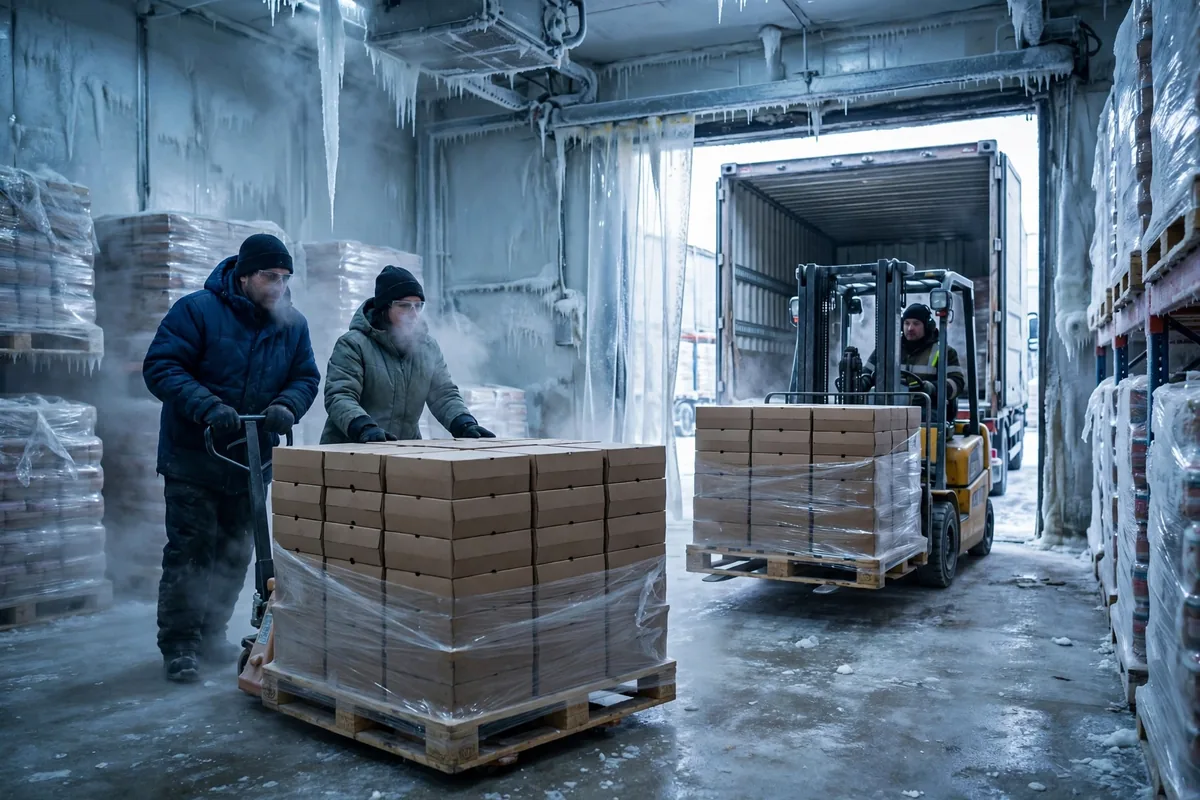
Here is the verdict up front: in the uruguay beef export warehouse cold chain, you are never really betting on the beef. The beef is superb — grass-fed, traceable, hormone-free by law. You are betting on temperature. Uruguay exported 496,322 tonnes carcass weight equivalent of beef in 2024, worth USD 2,097 million, into 46 markets. But put one container of chilled beef on a ship, let the temperature drift two degrees, and what arrives at the other end is not beef. It is a claim form. Put bluntly, the people who make money on this lane are the ones who treat temperature as sacred.
Uruguay Beef Export Warehouse Cold Chain: How Long the Chain Really Is
I have seen too many people start by asking about the ocean freight rate, as if the cold chain were one sea leg. It is not. The chain starts on a ranch in the Pampas: cattle leave the farm, travel to the slaughterhouse, get processed and vacuum-packed, go into cold storage, get trucked to the port of Montevideo, get stuffed into a reefer, sail for weeks, clear customs, and enter the buyer's cold store. Break any one link and everything before it was wasted effort.
The real strength of the uruguay beef export warehouse cold chain sits at the source. Since 2006 Uruguay has run mandatory individual cattle traceability nationwide. Every calf gets an electronic ear tag at birth, and the national livestock information system records every movement, ownership change, and veterinary treatment. Growth-promoting hormones are banned by law. What that means in practice is that a carton of beef landing in China or the United States can be traced back to a specific farm. That is not window dressing. It is the passport that gets Uruguayan beef into the European Union, the United States, and Japan — the markets that ask the hardest questions. In 2024 Uruguay shipped 36,845 tonnes of chilled and frozen beef to the EU. Small volume, high price, and it only gets in on the strength of that traceability and inspection system.
You also need to read the market structure honestly. In 2024 China was still Uruguay's biggest beef buyer at 190,844 tonnes carcass weight equivalent, 39% of total exports — but down 31.7% on 2023. The USMCA bloc — the United States, Canada, and Mexico — came second at 169,489 tonnes. There are two sides to this. The good side is that Uruguay is no longer betting everything on one buyer, and shipments to the United States are growing. The bad side is that when Chinese demand sneezes, the whole Uruguayan industry catches a cold. In the first eleven months of 2025, exports reached 486,893 tonnes with revenue of USD 2,442.78 million at an average of USD 5,017 per tonne — volume and price recovering together. But anyone running cold chain on this lane should understand the consequence: the more diversified the markets, the more fragmented the temperature and paperwork standards. China wants frozen, the United States wants chilled, the EU wants traceability files. One cold store ends up serving three sets of rules.
Chilled Versus Frozen: Two Chains, Two Sets of Books
This is the fork in the road where most people get hurt, because they treat the two chains as one.
Chilled beef is the premium route. Vacuum-packed chilled cuts held between 0 and minus 1.4 degrees Celsius keep for 10 to 12 weeks, and they sell on freshness and eating quality into high-end retail and foodservice. But the product is fragile. Beef muscle starts to freeze between minus 1.5 and minus 1.8 degrees, and if chilled beef falls below minus 1.4 degrees, slow-growing ice crystals rupture muscle cells. Thaw it and the purge runs, the color goes dull, and the microbiological risk climbs. In other words, the chilled reefer's safe window is barely a degree or two wide. There is almost no margin for error.
Frozen beef is the volume route. Standard frozen meat ships and stores at minus 18 degrees Celsius or below, where microbial activity effectively stops, and it holds for months. Careful exporters set the point at minus 25 degrees to buy a buffer against door openings, defrost cycles, and transshipment swings. The frozen math is simpler and the risk is lower, but the price per tonne is lower too, so the game becomes scale and turnover.
I watched the lesson land once at Montevideo. A container of chilled beef sat at the terminal for two days, and the shoreside set point got changed from minus 1.4 to minus 14 degrees — somebody treated a chilled box like a frozen one. At destination the cartons came out dark and weeping purge, and the buyer rejected the whole container. The cargo value, the freight, the inspection fees, the penalty — all gone. The reefer was not broken. What was broken was somebody's understanding of temperature. A reefer maintains temperature. It does not judge whether the temperature is right.
Three Places the Uruguay Beef Export Warehouse Cold Chain Breaks
The first is before stuffing. A reefer is not a refrigerator. It can only hold the temperature cargo arrives at; it cannot pull heat out of warm product. Beef must reach its target temperature in the plant's cold store before loading — frozen meat frozen through to minus 18 or below, chilled meat steady between 0 and minus 1.4 degrees. If the core temperature is wrong at the dock, no one can save it at sea. Probing core temperature pallet by pallet before stuffing is the cheapest insurance on this lane, and it is also the step most often skipped.
The second is transshipment and waiting. Every transfer from cold store to truck, from truck to terminal, from terminal to vessel, is a break risk. Half an hour with the reefer unplugged in the sun and the internal temperature starts climbing. My rule is simple: every handover point must produce logger data, and a container with a gap in its temperature record gets inspected before release at destination — not after the buyer complains.
The third is paperwork and grading. The EU, the United States, and China each run different inspection and traceability requirements, so one lot gets split by grade, by container, by file. An EU audit in 2026 found traceability weaknesses at some independent Uruguayan cold stores — EU-eligible and non-eligible beef not properly segregated. The cold chain budget has to include a paperwork line: veterinary certificates, traceability records, grading labels. Miss one document and the beef sits at the port, perfectly cold and perfectly unsellable.
Running the Numbers
Here is the costing framework I use with exporters. The figures are an illustrative example — check actual quotes and the latest official policy before using them:
| Leg | Chilled route (illustrative example) | Frozen route (illustrative example) |
|---|---|---|
| Slaughter, cutting, vacuum packing | about USD 180 per tonne | about USD 150 per tonne |
| Plant cold storage | about USD 60 per tonne | about USD 40 per tonne |
| Port reefer handling and loading | about USD 900 per container | about USD 800 per container |
| Ocean freight to main markets | about USD 3,500 per container | about USD 3,200 per container |
| Inspection, traceability, documents | about USD 500 per lot | about USD 500 per lot |
| Breakage reserve for downgrade | 3% of cargo value | 1% of cargo value |
Look at the last row, because that is where the money actually sits. The direct cost of the chilled route is only about 20% higher than frozen. The real gap is the reserve. One broken chilled container gets downgraded to frozen prices or written off entirely — a loss of 30% of cargo value or more. One broken frozen container can usually be saved. Here is the counterintuitive part: the most expensive item in the cold chain budget is never electricity or freight. It is the downgrade loss after a break. Anyone who budgets only for freight will eventually pay tuition for a break.
So chilled or frozen? My answer is to follow the market, not your sentiment. If you hold steady premium foodservice and retail orders and someone is watching temperature end to end, go chilled — the margin is real. If orders are lumpy, transshipments are many, and terminal dwell is long, stay frozen, learn to run an unbroken chain first, and upgrade later. In the uruguay beef export warehouse cold chain, the contest is never about whose cattle are better. It is about whose chain never breaks.
One question to take with you: when did you last read the full temperature log of your last container, segment by segment?
By Lao Mi, Supply Chain Veteran (20 yrs)