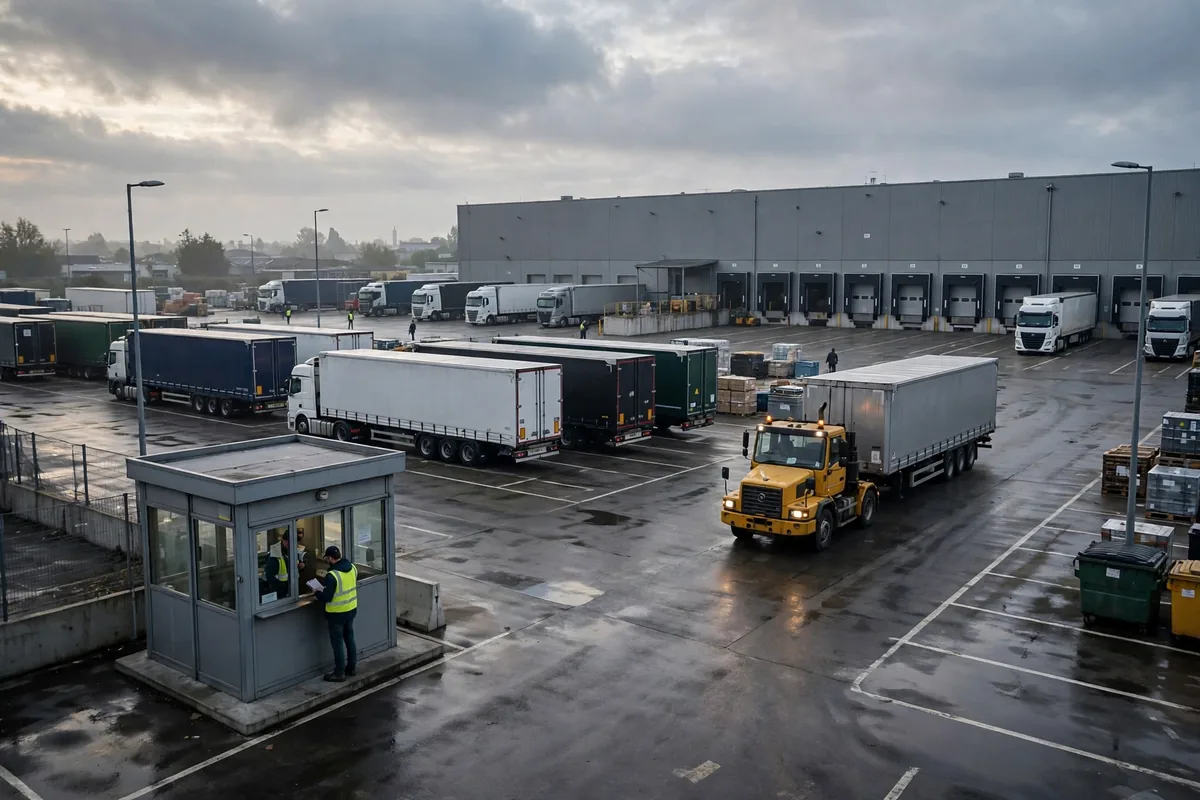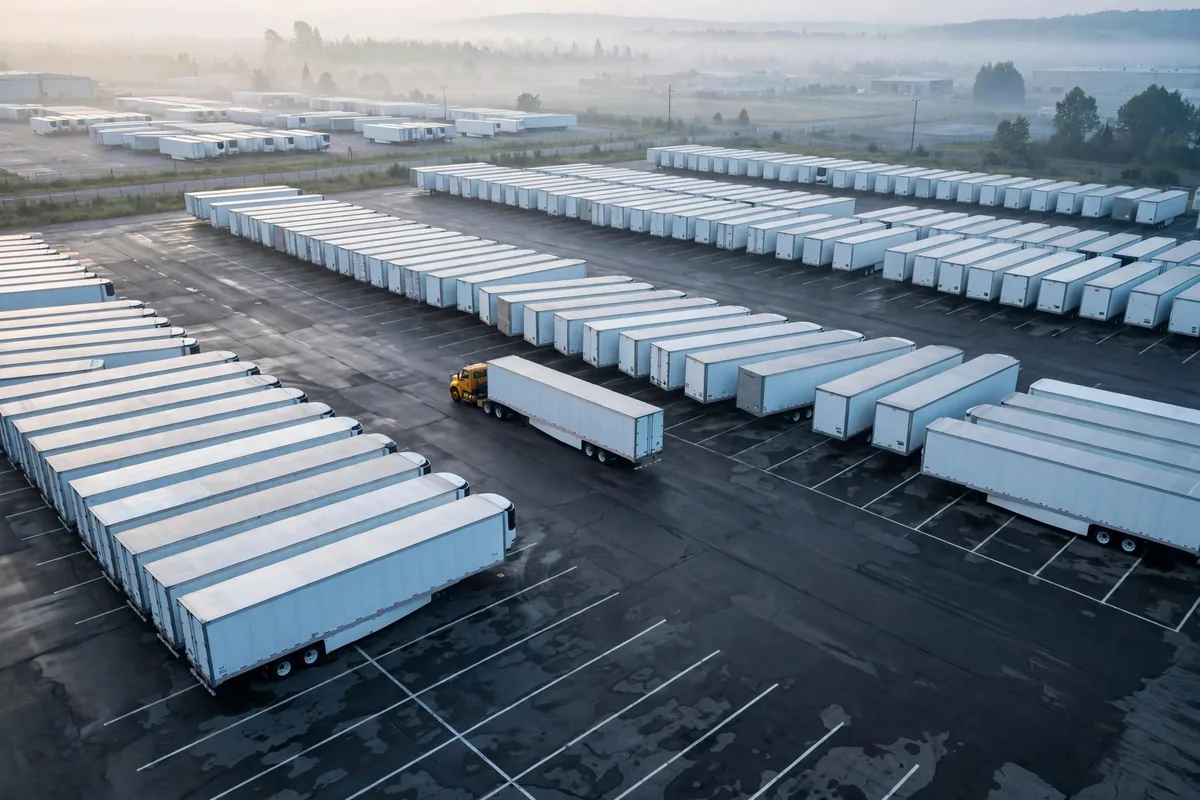
Last fall I walked into a 3PL yard near Fontana to look at an automation project. Two hundred trailers sat in the yard. The warehouse manager's first words to me were: the books say 198, we counted 187 on the ground, and nobody knows where the other 11 went. A trailer yard inventory count sounds like counting, but it is the hardest number in the whole yard to get right. Freight in a slot stays put. A trailer is an asset with legs of its own. The gate opens, it drives out, and where it parks when it comes back depends on the driver's mood.
Where the Trailer Yard Inventory Count Breaks Down
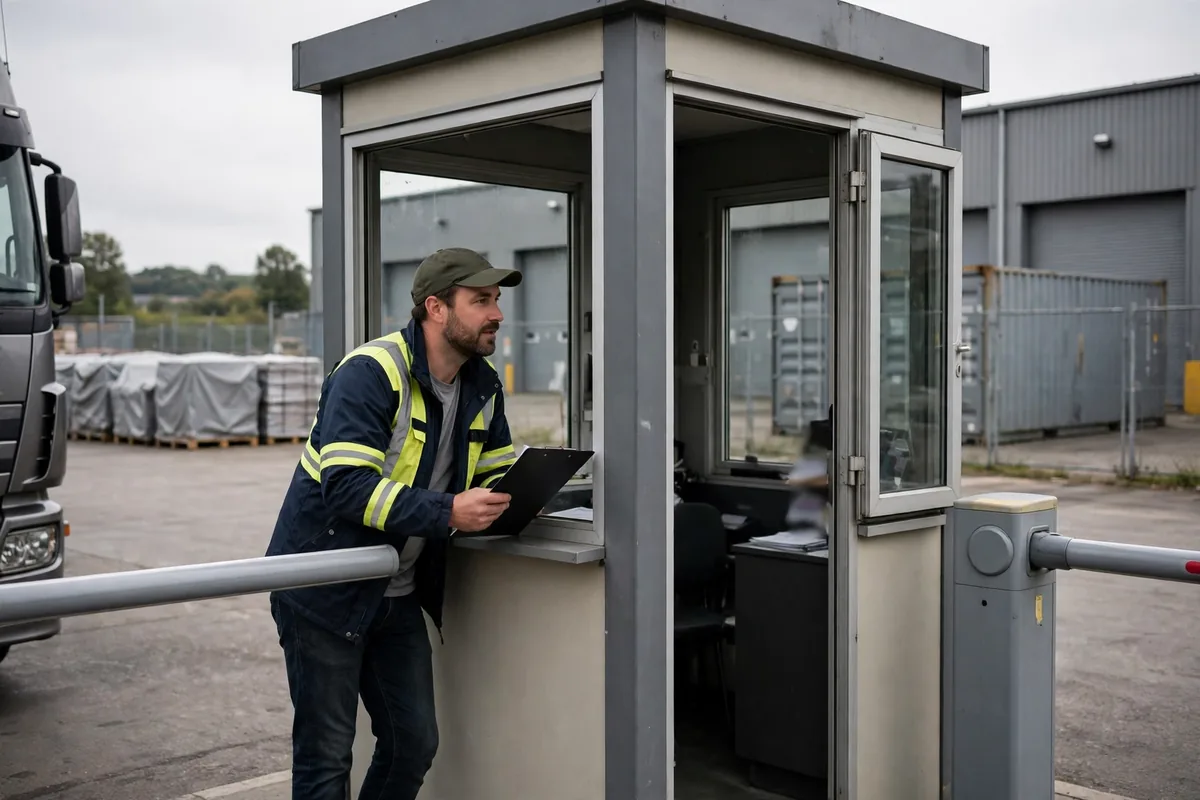
Start with the mechanics. Counting trailers is not hard because counting is hard. It breaks in three places at once. One, trailers move in and out without ever touching the WMS, so the warehouse system cannot see them at all. The record lives in two places that never agree: the gate guard's handwritten log and the dispatcher's spreadsheet. Two, parking spots have no real identity. A warehouse slot has a code. A yard spot is often just open asphalt and a painted line, and a driver parks wherever there is room. The system says Row B, spot 12, and the ground shows three trailers squeezed into that area. Three, status matters more than location. Whether a trailer is present is only the first question. Is it empty or loaded, does the seal number match, can it roll right now? That is what dispatch actually needs.
We eventually found the 11 missing trailers. Three had been pulled by a carrier for a pickup three days earlier and nobody logged the move. Two were parked in the shared lot of the yard next door because it was convenient. Four were duplicate records in the system, one physical trailer with two numbers. The last two had seal numbers that did not match and sat in a pending-check state. That is the truth about a trailer yard inventory count: the gap is rarely a stolen trailer. It is almost always a messy record. Think of it like counting cars in a parking lot, except the cars come and go dozens of times a day, the spaces have no numbers, and the people counting work in three different shifts.
How long does it take two people to walk a yard of 200 trailers? At that site it took most of a day, more than four hours, one person calling numbers and the other writing them down. Treat that figure as a scene estimate, not an industry benchmark, but the order of magnitude holds. Worse, the count expires the moment it is done. A dozen trailers moved in or out that same afternoon, and by the next morning the books were wrong again. Count more often and the count goes stale faster. That is the loop the manual method can never escape.
The Manual Method Works Until It Hits Its Ceiling
Whiteboard plus radio plus spreadsheet, and I am not mocking that setup at all. Under about 60 trailers it is the best answer there is. I know a small yard in Ontario with 58 trailers where the manager walks the yard himself every Monday morning, counts everything in 20 minutes, and checks seals and tires while he is at it. His accuracy beats plenty of yards running real systems. Few trailers, familiar faces, a yard you can see end to end, and the manual method costs almost nothing. Buying software there would be burning money.
The ceiling shows up when three signals light up together. Past roughly 80 trailers, human memory starts dropping parking spots. Across two or more shifts, handover losses compound every single day. With more than five carriers, outside drivers do not know your local rules and park wherever they like. One signal lit is manageable. Two means it is time to think seriously about changing methods. All three lit and you are still on a whiteboard, losing a trailer is a matter of time, not luck.
Put the two approaches side by side and the picture gets clear. Figures below are scene estimates:
| Dimension | Manual method (whiteboard + spreadsheet) | YMS (gate + spot scanning) | | Time per full count | Two people, most of a day | One person, about 40 minutes of spot checks | | Record accuracy | Good on count day, drifts the next day | Updated live with every move | | Finding one specific trailer | 20 minutes or more on average | Walk straight to the spot number | | Cost to start | Almost zero | Gate hardware, scanners, system integration |
The point of that table is that the manual method does not lose on effort. It loses on structure. No amount of diligence can keep up with a process that has no live data underneath it.
A YMS Counts Trailer Yard Status, Not Trailers
A lot of people think a YMS just puts a GPS dot on each trailer. That misses the point. Strip away the marketing and a trailer yard inventory count YMS rollout does one thing: it turns every trailer into a record with a state. The gate scans the plate on entry, the spot code is scanned on parking, and the driver taps the new status on a phone. Counting stops being something people do and becomes something the system does every day. People only spot-check.
The same yard after going live tells the story. A full count went from more than four hours to about 40 minutes of spot checks, and finding a specific trailer dropped from over 20 minutes to under five. Those are that yard's own scene figures, and your yard will differ, but the direction is the same: time goes into checking exceptions instead of walking and counting. Here is the counterintuitive part. After a YMS goes in, formal counts happen less often, because the system counts every day. The count changes from a periodic deep clean into daily spot checks plus a monthly reconciliation.
I will be straight about the maintenance traps too. Spot scan plates fail in two ways: the painted lines get redrawn and nobody updates the plate positions, or rain and grime make the plates unreadable. Gate cameras struggle with backlight, and recognition drops in the late afternoon sun. The biggest trap is drivers skipping the scan entirely, parking the trailer and walking off, which breaks the status chain. None of these are problems with the software. They are all execution problems. In the first month after go-live, managing execution matters ten times more than managing the system.
The One Number That Decides Whether It Is Worth It
The decision framework is a single number: how many hours a year do you pay for looking for trailers? Worked example, labelled as an assumption: a yard searches for a trailer three times a day, 25 minutes per search, over 300 working days. That is 375 hours a year. Convert those hours into labor plus idle equipment cost, compare it with the annual cost of a light YMS, and you have your answer. More trailers, more shifts, more searches, and the number climbs fast.
You can also price the cost of a trailer you cannot find. Dispatch rents a replacement for the day, the driver waits, and the bill runs into hundreds of dollars, with exact figures subject to local rates. More expensive is the schedule that falls apart: one loaded trailer goes missing and the whole outbound line waits on it. Add those numbers up and the answer is usually clearer than people expect.
My advice is two steps. Do not rush to buy software. Spend two weeks nailing down three things: paint clear numbers on every spot, keep a single entry point for the move log, and write status handover into the shift handover sheet. If the numbers still do not reconcile after two weeks, then talk about a YMS, and by then you will know exactly which features you need. You buy a system to solve a problem, not to rearrange your operation around it.
Whether the money is worth it comes down to one number: how many hours a year you pay for looking for trailers.
By Da Liu, Automation Engineer