Here is the conclusion first: Thessaloniki Greece port warehouse logistics is the most underrated route in a China seller's playbook for the Balkans. Everyone stares at Piraeus, as if Greece had only one port. But if your cargo is headed inland — North Macedonia, Serbia, Bulgaria, Romania — the Port of Thessaloniki is closer, its rail lines run straight to Sofia and Nis, and the distribution math after the port works out better than hauling everything up from Piraeus.
There are two sides to this. On the ocean leg, Thessaloniki is genuinely small and cannot take the biggest ships. On the inland leg, its location is the advantage. I have seen too many people compare ocean freight only, save a few dozen dollars per container, and then give it all back on hundreds of extra kilometers of inland trucking. Choosing a port is not about where the ship docks. It is about where the cargo ends up.
What the Port of Thessaloniki actually is, in numbers
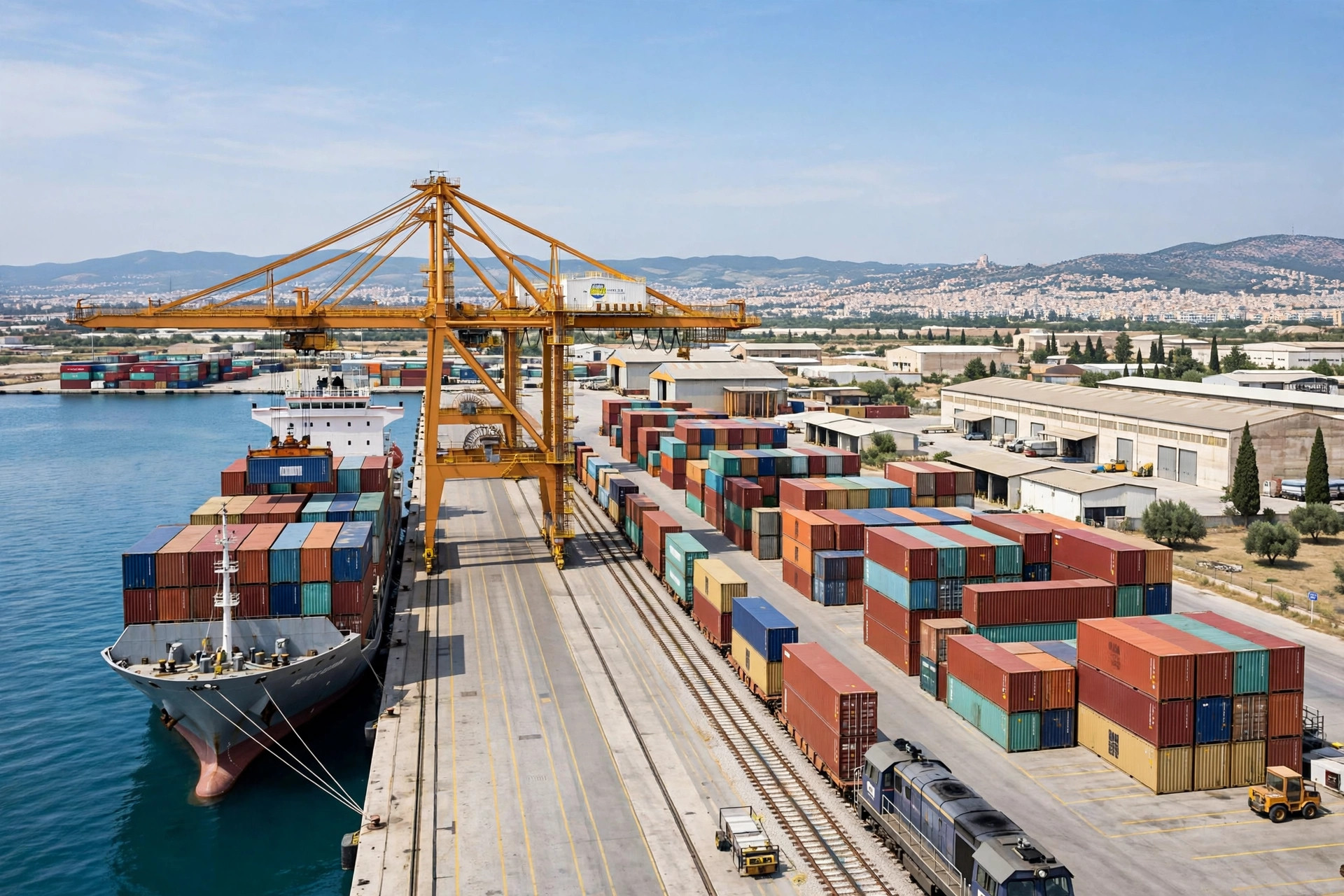
Thessaloniki is Greece's second-largest port and its largest export port, billed as the main sea gateway to the Balkans and Southeast Europe. The container terminal sits on the western side of Pier 6: 550 meters long, 340 meters wide, covering 254,000 square meters, with a draft of up to 12 meters. It is a free zone, which helps on customs and tax handling, and the terminal connects directly to the national rail network.
On volume, the port handled 617,000 TEU of containers in 2025, up 9.1% from 566,000 TEU in 2024 — a record high — alongside 2.8 million tonnes of conventional cargo. In 2023, total cargo was 16.78 million tonnes with 520,048 TEU. Modest next to Piraeus, but the growth rate says more shippers are routing this way.
The expansion is the part worth watching. On November 19, 2025, the port authority signed a contract with the METKA–TEKAL consortium to expand Pier 6: a 195.6-million-euro project over 40 months, adding 513 meters of length and 306.5 meters of width, with the navigation channel dredged deeper. When it is done, annual container capacity jumps from 650,000 TEU to 1.5 million TEU, and the port will receive ultra-large container vessels of up to 24,000 TEU. The bottleneck that makes this a "small port" today disappears in a few years — and the people who position themselves now collect that upside.
Three ways inland once the cargo lands
Once cargo lands at Thessaloniki, there are three main ways into the Balkan interior, ranked by how often they make sense.
First is rail intermodal, and this is the port's real strength. The port authority has run a direct rail link to its dry port in Sofia, Bulgaria, since November 2020, and a direct link to Nis, Serbia, since August 2022. On April 7, 2026, it signed a memorandum with Hellenic Train and Bulgarian State Railways to build a rail freight corridor centered on the port. And in October 2026, funding was approved for a new 2.2-kilometer double-track rail connection straight into Pier 6, at a public cost of 60.99 million euros. Rail here is an asset that gets more valuable every year.
A second scenario shows how it works. A shipment bound for Bulgaria and Romania lands at Thessaloniki, rides the rail straight to the Sofia dry port, and gets deconsolidated and sorted there — part stays in a Bulgarian warehouse, part continues north to Romania. The dry port sits close to the consumer market, so clearance and distribution happen at one point instead of hauling a full container into downtown Sofia and breaking it down twice. For a seller distributing across two countries, that "port to dry port, then split" structure beats renting a warehouse in each country. One caution: negotiate the dry port's storage and handling fees into the quote up front, before the cargo arrives.
Second is trucking. The port connects to the Trans-European road network — north through North Macedonia into Serbia, east into Bulgaria. Trucks win on flexibility: consolidated loads, break-bulk, rush orders. Balkan inland border crossings occasionally queue, so leave buffer time in peak season.
Third is warehousing and distribution inside the port itself. The conventional cargo terminal has 14 quays with 4,200 meters of quay wall, suited to bulk and break-bulk cargo. Goods can be sorted, repacked, and relabeled in port-area warehouses, then dispatched in batches against inland orders. For a seller distributing across several Balkan countries, that beats dragging a whole container to one country and re-splitting it there.
One more scenario makes the trade-off concrete. Suppose a shipment has to split between Skopje and Sofia. Through Thessaloniki, it goes by rail to the Sofia dry port while a truck covers Skopje — both legs can move the same day or the next. Through Piraeus, the cargo first travels north across the whole of Greece, adding most of a day on the road and an extra trucking leg. A forwarder's quote may not spell that out, but the difference in when the warehouse receives the goods is real.
How to cost Thessaloniki Greece port warehouse logistics
Do not cost Thessaloniki Greece port warehouse logistics on ocean freight alone. Here is the framework, in the order that matters:
| Cost item | How to look at it | What stands out on the Thessaloniki route |
|---|---|---|
| Ocean freight | Per container | Smaller vessels, fewer sailings — not always the cheapest per box |
| Port charges | Lift, storage, documentation | Small port, short queues — negotiate the free storage period |
| Inland transport | Rail or truck to the inland warehouse | Closer to the Balkan interior, usually a shorter inland leg |
| Warehousing and distribution | Port-area or inland warehouse | Free zone allows sorting and labeling before splitting |
| Time cost | Total door-to-door days | Days saved inland matter most in peak season |
And an illustrative comparison of the three routes into the Balkans — the figures are indicative scenarios, and actual freight should always follow the carrier's latest quote:
| Route | Ocean leg | Inland leg | Best for |
|---|---|---|---|
| Via Thessaloniki | Fewer sailings | Rail direct to Sofia and Nis | Multi-country Balkan distribution |
| Via Piraeus | More sailings, bigger ships | Long haul north across Greece | Greece-local or single-point volume |
| Via Koper | Steady Central Europe sailings | Overland into the western Balkans | Slovenia and Croatia direction |
Here is the counterintuitive judgment: bigger port does not mean better port. A big port has more ships and more boxes, but also longer queues at the gate, congested yards, and inland trucking capacity fought over by everyone. Thessaloniki handles just over 600,000 TEU today — small ships, small volumes — and that means faster pickup and more flexible coordination. For a small or mid-sized seller, that "small port, fast turnaround" often beats "big port, wait in line." Of course, once the Pier 6 expansion is complete and capacity doubles to 1.5 million TEU, this window narrows. The opportunity is now, between today and completion.
Two traps: paperwork and peak-season sailings
The first trap is documentation. Greece is an EU member, so cargo entering Thessaloniki goes through EU customs — a free zone is not a paperwork exemption. Certificates of origin, product compliance documents, tariff classification: one missing item can cost days in the port area. My advice is to send the full document set to the destination-port agent for pre-check before the vessel sails. Better to spend an extra day before departure than three extra days sitting in the port.
The second trap is peak-season sailings and capacity. Thessaloniki has fewer container sailings than the big ports to begin with, and in peak season space tightens and schedules shift. If you sell into the Balkans, book at least two weeks ahead in peak season and keep one sailing of buffer. Also note that construction on the Pier 6 expansion will change the working areas inside the port over time — check the port authority's latest notices on its official website before shipping, and do not plan off last year's experience.
Put plainly, the Thessaloniki route is a bet not on today but on the Balkan interior's tomorrow. The port is expanding, the rail network is linking up, and throughput grew 9% in a single year. When volumes are still small, start moving cargo through it — get the agent, the customs clearance, and the inland warehouse chain working. When the volume grows, you will not just be a day or two faster than the competition. You will have a whole chain that is already broken in. What do you think?
By Lao Mi, Supply Chain Veteran (20 yrs)