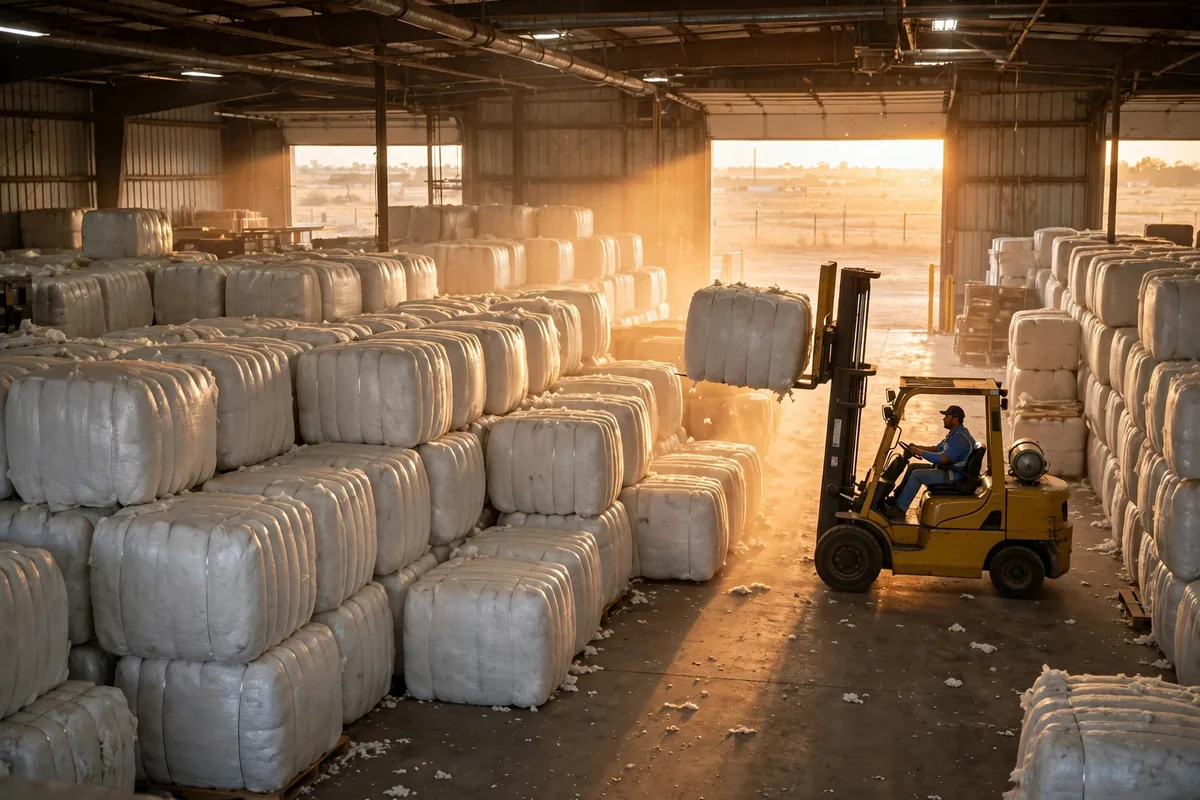
Let me tell you about a Texas cotton export warehouse storage run I made last fall, hauling cotton bales from Lubbock down to Houston. Lubbock to Houston is about 520 miles on the road, a good eight hours behind the wheel, through Abilene and Dallas, nothing but flat plains and cotton fields the whole way. When I pulled into the gin yard, the bales were stacked like little hills, white cotton pressed tight, each one wrapped in plastic, forklifts running back and forth and dust hanging in the air. And standing there I thought the same thing I always think: cotton looks tough, but it is a fussy cargo, and if you get the Texas cotton export warehouse storage math wrong, it does not matter how smooth the drive was, you will still get burned at the port.
Texas cotton export warehouse storage starts in the field, so that is where the numbers start. Texas grows more cotton than any other state. In 2024 the United States ginned about 14.1 million bales, and Texas alone ginned about 4.2 million of them, close to 30 percent of the national crop; in 2025 Texas production rose further to about 5.27 million bales, nearly 40 percent of the country, three times the runner-up, Georgia. The U.S. Department of Agriculture says exports account for more than 85 percent of all demand for American cotton, with domestic mills taking only a small slice, and exports for the 2024/25 season were projected at about 11.3 million bales, a nine-year low, with Vietnam, Pakistan, and China the main buyers. Put plainly, most of the cotton grown in Texas is headed overseas, and warehousing and trucking are the last two gates it has to pass before it gets there.
Moisture and fire: what Texas cotton warehouse storage has to beat
After all these years on the road, I have hauled plenty of loads, and cotton bales are the most interesting of the lot. A statistical bale weighs 480 pounds, about 218 kilos, and a physical bale usually runs around 500 pounds, measuring about 1.4 metres long, 0.53 wide, and 0.69 high, pressed so tight a forklift can pick it up without it shifting. To an outsider it looks indestructible, something you can leave anywhere. Anyone who has actually handled it knows a bale fears two things: water and fire.
Water first. Cotton drinks water. A bale that gets rained on gains weight and loses grade. The plastic wrap looks waterproof, but leave bales in an open yard in a real downpour and the rain works its way in through the seams, and the inside goes musty while the outside still looks fine. By the time the spinning mill opens the bale and the mouldy lint shows, the whole lot gets downgraded and the buyer docks the price, no argument. I once saw a yard that tried to save money by stacking bales two high in the open with nothing but a thin tarp over the top. One autumn storm later, the whole top layer had to be re-wrapped, and the re-wrapping plus the grade loss cost far more than a roof would have. So the first thing to check when a bale goes into a warehouse is whether the roof leaks and whether the floor sweats. Bales go on pallets, never straight on concrete, with a gap from the wall and the vents kept clear. Then fire. Cotton is flammable, and lint and dust catch from a single spark, which is why gins and cotton warehouses have always been strict about fire prevention. No smoking in the warehouse, that is the floor, not the ceiling. Forklifts and lights have to be rated for the space, dust gets swept every day, and bales must never block the fire lanes or the sprinklers. It sounds like common sense, and every year somebody learns it the hard way. The money you spend on fire prevention looks wasted, extinguishers and inspections and dusting, year after year, nothing to show for it. But that is how this business works: when nothing happens, the fire money looks thrown away, and when something happens once, the whole warehouse goes with it. After all these years on the road, I have one rule: with cotton, slow is fast, and steady is profitable.
Texas cotton export warehouse storage: the math on one container
Bales usually leave the gin for a nearby cotton warehouse, where they wait until there is enough for a full container, then head for the port. Cotton from around Lubbock mostly goes by truck to the Port of Houston, about 520 miles, a day's drive, in time for the next day's sailing. Some of it goes to a consolidation warehouse around Dallas first, one more handling step, and what that buys is a faster fill for the container. I know this road well. The Port of Houston handled about 4.14 million TEU in 2024, up 8 percent, making it the largest container port on the Gulf of Mexico and number one in the country for foreign waterborne tonnage, so a cotton shipment leaving from there has plenty of sailings to choose from, and that peace of mind counts for something.
Here is the math on one container, as an illustrative scenario, not a quotation. Actual rates should be checked against the latest official policies.
| Item | Illustrative scenario | What to watch |
|---|---|---|
| Bales per container | 90 bales assumed | At 480 pounds per bale, about 43,200 pounds, or 19.6 tonnes |
| Gin to warehouse | Short haul, half a day | In peak season, expect to wait half a day just to load at the gin |
| Warehouse storage | Charged by the week, first in, first out | Bales do not mind waiting, but waiting on a sailing is what hurts |
| Warehouse to Houston | About 520 miles, 8-plus hours | Leave a buffer for the sailing; getting into Houston is slow at the best of times |
| Port charges | Settled per container | Demurrage is the killer; a changed sailing adds cost by the day |
The line most people miss is the last one: demurrage. The sailing changes, the paperwork is late, customs pulls the box for inspection, and the container sits at the port one more day, and the charges stack up day by day. The cotton in the box is not worth that much, and a few days of delay can eat the whole margin. So anyone who runs this lane regularly learns that the cotton ledger is not just warehouse rent and freight. You have to price in time. A warehouse close to the port charges more rent, but it saves the time waiting on sailings and the risk of a changed sailing. A warehouse far from the port is cheaper on rent, and what you save goes straight into fuel and time on the road. A cheap warehouse is not always cheap, and an expensive one is not always expensive. It comes down to whether your cargo can afford to wait.
Consolidation is its own skill. Cotton exports often move as consolidated loads, several small shippers' bales sharing one container to save on freight, but a shared container has to wait until it is full. While it waits, the bales sit in the warehouse and the rent keeps running; and if you do not wait, your own volume will not fill a box and the freight does not spread. There is no standard answer. My experience is this: steady volume and a fixed sailing, run your own full container; scattered volume and no rush, find a reliable consolidator, but do not leave cargo sitting in a warehouse for two weeks just to save a little freight. The cotton can wait. Your cash cannot.
One more step before the cargo sails, and it cannot be rushed: the marks and the grade certificates on every bale have to match, bale number, weight, grade, origin, every single item. Customs and the buyer go by that paperwork, and if the documents do not match the cargo, the container will not clear at the destination port. I have seen a shipment sit three extra days at the destination because one bale's grade certificate was pasted on the wrong bale, and the port storage cost more than the bale itself. Paperwork is slow work done carefully: check it once more before you leave, and you save three trips at the port.
After all these years, I stick to one old saying: a careful driver sails ten thousand years. In the cotton business, you do not fear the long road or the hard work. You fear being in a hurry. Keep the bales dry, keep them away from fire, get the math right, and make the sailing, and the rest is up to the sea.
By Shifu Zhao, Trucking Veteran (15 yrs)